4th Grade Math Problems: Topics, Solved Examples & Practice
I explain everything 4th graders learn in math, from multi-digit multiplication, long division, fractions, decimals, and geometry, step-by-step and mapped to the US Common Core State Standards.

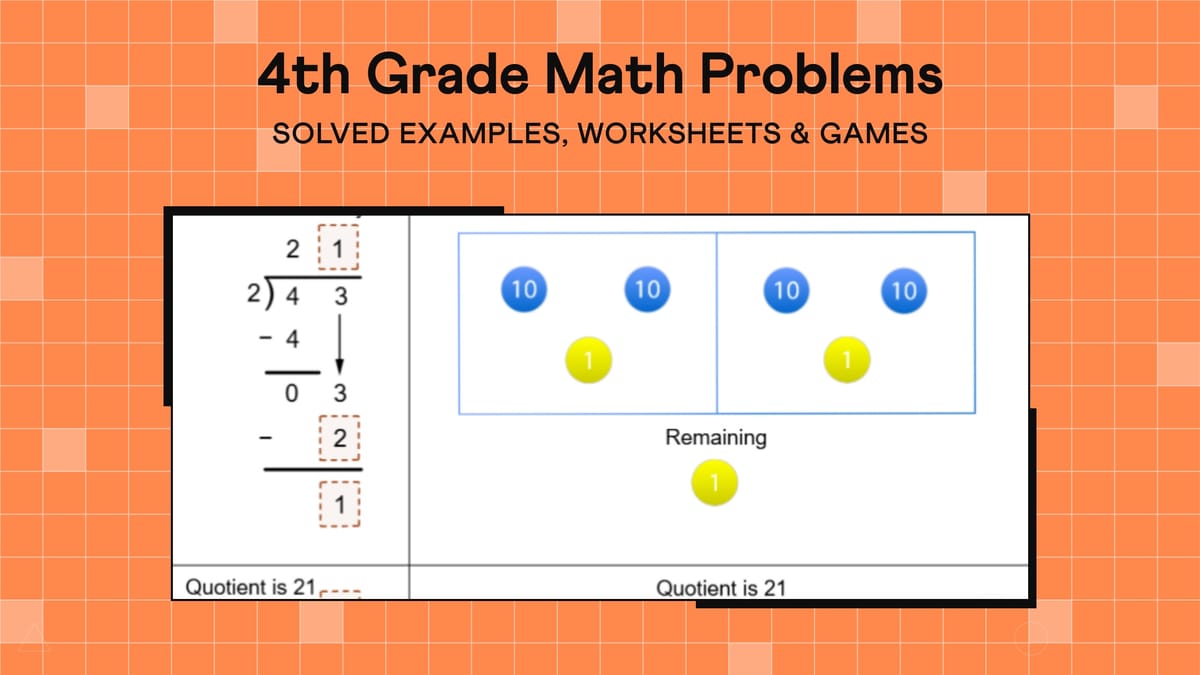
The way math is taught makes all the difference. When children can see a concept through visuals, explore it through guided simulations, and practice smart mental strategies instead of memorizing steps, they begin to understand, not just answer.
As someone who has spent time researching how kids learn math, my goal here is to share simple ways to solve math problems. The problems, solved examples, and curriculum structure you'll find here are based on content designed and taught by certified Cuemath tutors. They work with Grade 4 students every day and customize their teaching to each child's learning gaps and goals.
What Do 4th Graders Learn in Math?
According to the US Common Core State Standards for Mathematics, 4th grade math curriculum is divided into 5 core domains. 4th grade is the year of transition. Students move from foundational arithmetic toward multi-step reasoning, abstract fraction concepts, and geometry.
🎯 Grade 4 Focus Areas: The CCSS defined 3 core areas for 4th grade — (1) developing understanding and fluency with multi-digit multiplication and division, (2) developing understanding of fraction equivalence, and (3) understanding geometric figures and their properties.
Multi-Digit Multiplication
Students multiply a whole number of up to four digits by a one-digit whole number, and multiply two two-digit numbers, using strategies based on place value and the properties of operations.
The most common strategies are the standard algorithm, the partial products method, and the area model.
Solved Problems on Multi-Digit Multiplication
Problem 1: Calculate: 347 × 6
40 × 6 = 240
300 × 6 = 1,800
+ 240
+ 42
_______
2,082
Problem 2: Calculate: 53 × 47 using the area model.
50 × 7 = 350
3 × 40 = 120
3 × 7 = 21
┌────────┬────────┐
50 │ 2,000 │ 350 │
├────────┼────────┤
3 │ 120 │ 21 │
└────────┴────────┘
Problem 3: A school cafeteria serves lunch to 248 students every day. How many students are served lunch over 5 school days?
40 × 5 = 200
8 × 5 = 40
Long Division
Students find whole-number quotients and remainders with up to four-digit dividends and one-digit divisors, using strategies based on place value, the properties of operations, and the relationship between multiplication and division.
A good formula for the long division steps is DMSB: Divide → Multiply → Subtract → Bring down.
Solved Problems on Long Division
Problem 4: Calculate: 846 ÷ 3
─────
3 │ 8 4 6
6
──
2 4
2 4
──
6
6
──
0 ← no remainder
Problem 5: Calculate: 1,357 ÷ 4 (find the quotient and remainder)
Problem 6: A teacher has 97 pencils. She wants to give 8 pencils to each student. How many students can receive 8 pencils, and how many pencils will be left over?
Fractions
In 4th grade curriculum, fractions are a major focus area. Students learn to explain fraction equivalence using visual fraction models and number lines, compare fractions with different numerators and denominators, and add and subtract fractions with like denominators. The US Common Core also introduces the concept of multiplying a fraction by a whole number
Solved Problems on Fractions
Problem 7: Show that 2/4 and 3/6 are equivalent fractions.
Problem 8: Add: 3/8 + 2/8
Problem 9: Compare 3/4 and 5/6. Which is larger?
5/6 = (5×2)/(6×2) = 10/12
Decimals
4th-grade students learn to read, write, and compare decimals to hundredths, and relate decimals to equivalent fractions (e.g., 0.7 = 7/10).
This is a bridge standard: it connects fraction fluency from earlier in 4th grade to the decimal operations introduced in 5th grade.
Solved Problems on Decimals
Problem 10: Write 0.47 as a fraction and explain what each digit means.
Problem 11: Order these decimals from least to greatest: 0.6, 0.06, 0.62, 0.59
0.06 = 0.06
0.62 = 0.62
0.59 = 0.59
Geometry & Angles
Grade 4 geometry focuses on classifying shapes by their properties and measuring angles. Students learn that an angle is a fraction of the full 360° rotation of a circle, and that right angles measure exactly 90°. They use protractors to measure to the nearest degree and classify triangles by angle type (acute, right, obtuse) and by side length (equilateral, isosceles, scalene).
Solved Problems on Geometry & Angles
Problem 12: An angle measures 135°. Is it acute, right, or obtuse? Explain your reasoning.
Problem 13: The three angles of a triangle measure 45°, 90°, and x°. Find x. What type of triangle is this?
Measurement & Data
Students solve problems involving the measurement and conversion of measurements from a larger unit to a smaller unit. For example, converting feet to inches, pounds to ounces, or liters to milliliters. They also find the area and perimeter of rectangles and composite figures.
Solved Problems on Measurement & Data
Problem 14: A hallway is 7 yards long. How many feet long is the hallway?
Problem 15: A rectangular garden is 12 meters long and 9 meters wide. What is the perimeter of the garden? What is the area?
Multi-Step Word Problems
Students solve problems using all four operations, and must decide which operations to use and in what order.
Problem 16: A bookstore sold 124 fiction books and 89 non-fiction books on Monday. On Tuesday, it sold 3 times as many books as on Monday. How many books were sold in total over the two days?
Problem 17: Mia earns $8 per hour babysitting. She worked 6 hours last weekend and wants to save enough to buy a jacket that costs $75. How much more money does she need to save after last weekend?
Best Online Math Tutoring Platforms for 4th Graders in the USA
There is no shortage of websites where a 4th grader can find solved math problems (including this blog). But parents who've seen their child practice for weeks without making real progress usually identify the same root cause: the child is copying steps, not building understanding.
That is not something a worksheet or a video can fully provide. It requires a skilled human tutor.
In the past, I have reviewed the best math tutoring platforms in detail. You can have a look:
 Nikita Joshi
My Verdict
The right math tutoring platforms depend on what your child actually needs.
- If your child needs extra practice alongside school, Khan Academy and IXL are genuinely good free-to-low-cost tools.
- They are decent, standards-aligned, and good enough for motivated students.
- If your child is behind, struggling with specific concepts, or attending school without really understanding the math, Khan Academy or IXL will not work.
- Your child needs a human tutor who can watch how your child thinks. For that, the combination of live 1:1 tutoring, a structured curriculum, and a pedagogy built around student reasoning is needed.
- This makes Cuemath the best math tutoring platform among those reviewed here, particularly for Grade 4, where conceptual foundations (fractions, division, multi-step reasoning) become the basis for everything that follows in middle school.
Cuemath's 4th-grade math curriculum is designed as per the US Common Core State Standards covered in this article. Below are sample 4th-grade math worksheets. These are the actual materials students encounter in sessions, not worksheets generated to fill time.
- Download Multi-Digit Multiplication Worksheet
- Download Fraction Equivalence Worksheet
- Download Long Division Worksheet
- Download Geometry & Angles Worksheet
Try a Free 1:1 Cuemath Class for Grade 4
See how your child learns with visuals, simulations, and mental-math strategies in a 1:1 session with a Cuemath tutor.
Get My Free Trial Class200K+ Students • 4.9+ Trustpilot Rating • 80+ Countries
Frequently Asked Questions (FAQs)
What math topics do 4th graders learn according to Common Core?
According to the Common Core State Standards for 4th grade, students learn across five domains: Operations & Algebraic Thinking, Number & Operations in Base Ten, Number & Operations (Fractions), Measurement & Data, and Geometry. The three focus areas are multi-digit multiplication and division, fraction equivalence and operations, and geometric measurement and classification.
How is 4th grade math different from 3rd grade math?
Third grade focuses on multiplication and division facts within 100 and introducing fractions as parts of a whole. Fourth grade extends this significantly: students multiply multi-digit numbers (up to 4-digit × 1-digit), perform formal long division with remainders, develop fraction equivalence and comparison with unlike denominators, and learn decimal notation to hundredths. Geometric reasoning also becomes more formal, with angle measurement and shape classification by properties.
What are good 4th grade math problems for practice at home?
Good at-home practice should span all five CCSS domains. For multiplication, practice 3-digit × 1-digit and 2-digit × 2-digit problems. For division, work on long division with 3–4 digit dividends and single-digit divisors, including problems with remainders. For fractions, compare fractions with unlike denominators and practice adding and subtracting fractions with the same denominator. For decimals, practice reading, writing, and comparing tenths and hundredths. For word problems, use multi-step problems that require two or more operations.
How do you explain long division to a 4th grader?
Use the DMSB formula: Divide, Multiply, Subtract, Bring down. Understand each step of the problem properly: "How many times does [divisor] fit into [portion of dividend]?. Multiply that number by the divisor. Subtract. Bring down the next digit."
Division is just asking what number times [divisor] equals [dividend]. Remainders are explained as what's left over after sharing equally.
What are prime and composite numbers, and are they in 4th grade?
Yes, identifying prime and composite numbers is a part of 4th grade math curriculum. A prime number has exactly two factors: 1 and itself (e.g., 2, 3, 5, 7, 11, 13). A composite number has more than two factors (e.g., 6 has factors 1, 2, 3, 6). 1 is neither prime nor composite. Students also learn to find all factor pairs for numbers from 1 to 100.