Cuemath vs IXL: Which is Better for US Students in 2026?
In this comparison, we review Cuemath and IXL side by side, covering teaching format, pricing, curriculum alignment, and what US parents actually say about both platforms.

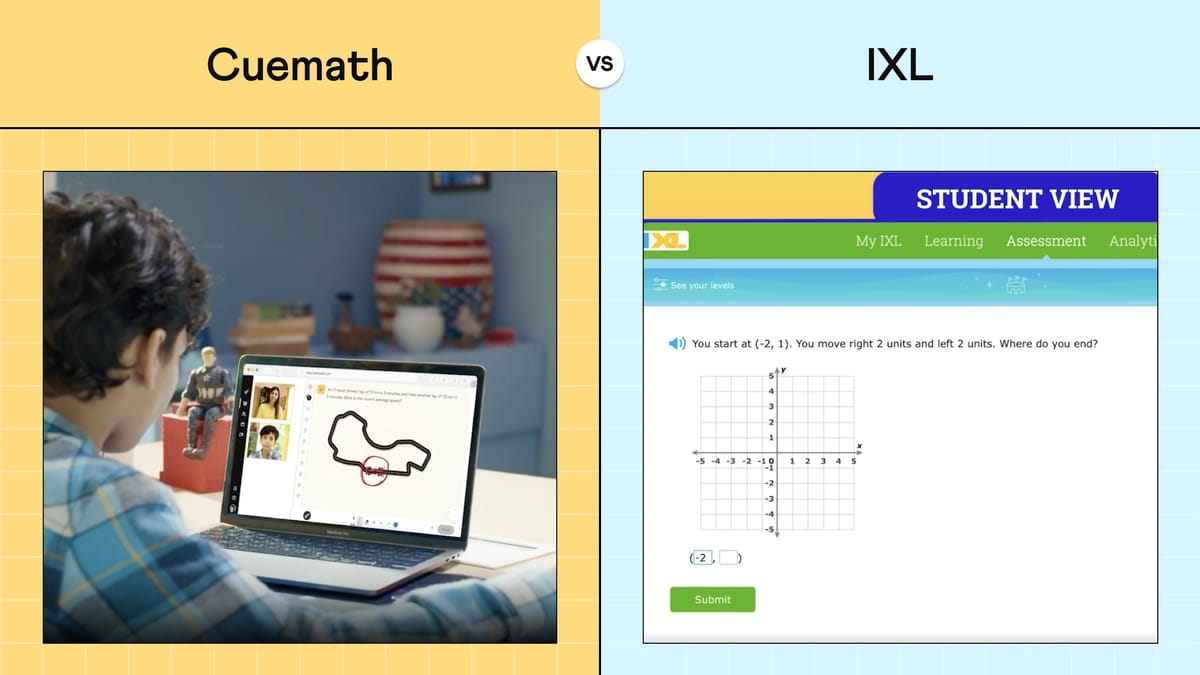
Cuemath teaches math. IXL assesses math skills. That single difference shapes everything else about how these two programs work, what they cost, how kids experience them, and what kind of results parents can expect.
Cuemath is a live 1:1 tutoring program. A tutor explains concepts and builds a customized learning plan. IXL is a self-paced practice platform. It gives your child thousands of problems to solve, tracks which ones they get right, and adapts the difficulty.
In this blog, we review both honestly, covering teaching format, curriculum alignment, pricing, engagement, and what US parents actually say. We break it down grade by grade so you can decide which one your child actually needs.concluding
Quick Answer: Cuemath or IXL, Which is Better?
| Best For | Winner |
|---|---|
| Best 1:1 Math Tutoring with a Dedicated Expert Tutor | Cuemath |
| Best Adaptive Self-Paced Practice for K–12 | IXL |
| Best for Building Math Concepts from Scratch | Cuemath |
| Best for Tracking Specific CCSS Skill Gaps | IXL |
| Best Value Supplemental Practice Tool | IXL |
| Best for Students with Math Anxiety | Cuemath |
| Best for High School and SAT Math Prep | Cuemath |
How Did We Review Cuemath and IXL?
Besides the official website data, we reviewed the following:
- Trustpilot reviews and individual reviews: We understand that in some cases, there are false negative reviews, so those were not taken into making a firm judgement. We weighted parent-reported experience more heavily when concluding.
- Reviews and opinions of parents or students who have tried either platform and shared their thoughts on parent community forums.
- Official product pages for both platforms.
Cuemath Review
When parents evaluate a math program, they're not looking for a feature list; they're asking specific questions about their child. We've structured this review around the five questions parents ask most.
| Cuemath — At a Glance | |
|---|---|
| Grades | K–12 |
| Curriculum | US Common Core (CCSS) |
| Format | Live 1:1 online |
| Cost | Starting at $200/month |
| Free Trial | 1 full class + MathFit Evaluation (no credit card) |
| Commitment | Monthly or annual |
| Trustpilot | 4.9/5 (9K+ reviews) |
Does Cuemath assign the same tutor every class?
Yes. Cuemath uses what educators call the "looping" model: your child is matched with one expert math tutor who has expertise in what they need and matches their personality. The match is intentional.
If the match isn't right, parents can request a change with no friction. Most don't need to.
What Cuemath Parents Say About Their Child's Tutor
Source: TrustpilotAnand 🇺🇸 United States
★★★★★
"Ms. Asmita Kukreja helped my child with the transition to US curriculum standards — patient and supportive throughout."
View on Trustpilot →Anjali Verma 🇺🇸 United States
★★★★★
"My son initially struggled a lot with math. Teacher Kanika's patient, clear explanations transformed him from math-averse to enjoying the subject."
View on Trustpilot →Susan 🇺🇸 United States
★★★★★
"Well-structured and engaging — Ms. Zaineb's clear explanations and encouragement made all the difference."
View on Trustpilot →Is Cuemath's curriculum aligned with what my child learns in school?
Yes. Cuemath's curriculum is aligned to the US Common Core State Standards (CCSS) across all K–12 grades. Cuemath's curriculum also includes interactive simulations, real-world practice questions, and downloadable PDFs, all mapped to four skill dimensions: Fluency, Understanding, Application, and Reasoning. Tutors can mirror what a student is covering in school that week, or work ahead for families who want acceleration.
How does Cuemath personalize learning for each student?
Every student starts with a free MathFit Evaluation, a pre-assessment that identifies whether the student has conceptual gaps or needs more skill-building across dimensions. From there, the tutor builds a personalized learning plan adjusted to the student's pace, gaps, and goals. The LEAP platform adjusts difficulty in real time within sessions. The Talk-o-Meter tracks how much the student is actively participating, not just watching.
For families on an accelerated path, Cuemath has a documented competition track. Students have reached AIME qualifier, 99th percentile on the NJSLA, AMC 8 success, and IMO Gold through personalized advanced learning plans.
Achievements of Cuemath Students
From SAT scores to Math Olympiads, what consistent 1:1 tutoring builds.
With Cuemath's 1:1 tutoring, Bryan built logic and confidence — now he has aced high-school algebra and ranked #9 nationally in Math Kangaroo.
Cuemath strengthened Aadi's step-by-step thinking — turning raw talent into 99th percentile AMC success and consistent top scores.
Cuemath strengthened her mental math and stepwise logic. Nivriti improved calculation speed, concepts, and accuracy under Olympiad pressure.
Cuemath turned math anxiety into mastery — helping Harshitha excel in AP Calculus, skip college Calc I, and enter a top U.S. business school.
With Cuemath's logic-first tutoring and consistent practice, Midyan achieved a 1520 SAT and 790/800 in Math on his first attempt.
Cuemath's guided practice and US-aligned curriculum shaped Vanya's reasoning, leading her to ace AP Calculus BC and score a 1530 in SAT.
How does Cuemath keep kids engaged?
Sessions are live, 1:1, and 55–60 minutes. Tutors are selected from the top 1% of applicants and trained in child psychology, not just math. They use the "cue, don't tell" approach: ask the right questions so students discover answers themselves. Brain teasers, visual puzzles, and gamified platform tools are built into every session structure.
Whether a child thrives depends heavily on the tutor match. Parents report a wide range of experiences, and the right fit matters.
How does Cuemath measure student progress?
Parents get two layers of visibility. After each session, the tutor leaves notes on what was covered and how the student performed. Monthly, students in Grades 3–8 receive a MathFit Score on a 3–10 scale across Fluency, Understanding, Application, and Reasoning. Parents can track this score over time and see whether the arc is moving in the right direction.
Cuemath's limitation: Cuemath is a premium program; sessions are 55–60 minutes, twice a week, starting at $200/month. Students who need minimal support or just want occasional drill practice may find it more than they need. It works best when a family is investing in their child's math foundation with a long-term view.
Best for: Students who need a tutor to build genuine understanding, not just more practice problems. Grades K–12.
Not for: Students whose families need a low-cost, flexible supplement for occasional practice reinforcement.
IXL Review
We applied the same parent-first lens to IXL: the same five questions, answered directly, so you can compare apples to apples.
| IXL — At a Glance | |
|---|---|
| Grades | K–12 |
| Curriculum | US Common Core (CCSS) |
| Format | Self-paced adaptive (no live instruction) |
| Cost | Starting at ~$9.95/month (math only) |
| Free Trial | Limited free access |
| Commitment | Monthly; cancel anytime |
| Trustpilot | 1.2/5 (less reviews; mostly school-assigned students) |
Does IXL assign the same tutor every class?
No. IXL has no tutors. It is a fully automated, self-paced practice platform. There is no live instruction, no human teacher, and no scheduled sessions. Your child logs in, selects a skill, and practices. That is the model, by design, and it is a valid model for what IXL is built to do.
Is IXL's curriculum aligned with what my child learns in school?
Yes, and this is IXL's clearest strength. IXL has one of the most granular Common Core-aligned skill trees of any math platform. It covers 4,500+ math skills across K–12 and maps directly to what US students are learning grade by grade. Teachers use IXL specifically because of this alignment; many schools provide access at no cost to families. If your child's school uses IXL, they may already have free access.
How does IXL personalize learning for each student?
IXL adapts difficulty within each skill as a student answers questions. Correct answers make the questions harder; incorrect answers bring them down. This is adaptive practice, not adaptive instruction. The platform adjusts what it asks, but it does not explain why a student got something wrong or introduce a concept from scratch.
IXL's SmartScore system tracks mastery of each skill on a 0–100 scale. The concern parents and students flag consistently: a single wrong answer can drop the SmartScore significantly, even after a long streak of correct answers. For students who are already cautious about math, this mechanic adds pressure.
How does IXL keep kids engaged?
IXL's engagement depends heavily on context. Parents who use it voluntarily at home report that younger children enjoy the awards system and visual feedback, particularly when treated as a short daily warm-up. The friction happens when IXL is assigned as mandatory homework with a score attached; in that context, the SmartScore's penalty mechanic changes the emotional experience completely.
One parent wrote: "My son does 15 minutes of IXL each morning before school. He likes the short streaks. It's a good warm-up." The product is the same in both cases; the context is what differs.
How does IXL measure student progress?
IXL gives parents a detailed dashboard: which skills have been practiced, which are at mastery, how much time was spent, and where gaps exist across the CCSS skill tree. For parents who want to know exactly which standard their child hasn't mastered yet, this reporting is excellent, arguably the strongest of any affordable platform in its price range.
IXL's limitation: IXL is a practice and assessment tool, not a teaching tool. It identifies gaps and provides repetition; it does not fill those gaps with explanation or instruction. Students who encounter a concept they don't understand will be marked wrong repeatedly, with no clear path to understanding why. Parents frequently report needing to pair IXL with another resource for concept explanation.
Best for: Families who want an affordable, self-paced supplement for structured practice and skill-gap tracking. Students whose schools already use IXL. Students who are on track and need more practice volume.
Not for: Students who struggle with math anxiety or need encouragement to stay engaged. Students are learning a concept for the first time. Students who need a teacher to explain their understanding, not just test it.
Where Hard Work Turns Into Real Results
Give your child the same structured guidance that helped thousands of students succeed. Try a FREE live Cuemath class today.
200,000+ students · 4.9+ Trustpilot Rating · 80+ countries
Cuemath vs IXL: Which is Better for Elementary School?
Cuemath is the stronger primary program for elementary students. At this stage, foundational concept-building matters most, and that requires a tutor who can see where a child is confused and redirect in real time.
- Cuemath: 1:1, 55–60 minutes, tutor trained in child psychology. Builds number sense, fractions, and early algebra foundations through guided discovery. Tutors catch the moment a child stops understanding.
- IXL: Solid supplemental practice tool. Works well for 10–15 minutes of morning drill on skills already taught in school. Awards and visual feedback are engaging for younger children at home, on their terms.
- If budget is the deciding factor, IXL alone is better than nothing, but it works best as a supplement to, not a replacement for, guided instruction at this age.
Cuemath vs IXL: Which Program is Better for Middle School?
It depends on what the student needs. Middle school is where math anxiety peaks and where foundational gaps from elementary school surface as failure in pre-algebra and algebra.
- Cuemath: Best for students who are behind, anxious, or need conceptual clarity on abstract topics: ratios, expressions, integers, geometry. The tutor relationship builds trust that reduces math avoidance over time.
- IXL: Best for students who are on track and need more practice volume. The CCSS skill tree is thorough at this level, and IXL is genuinely useful for STAAR, NJSLA, and state test prep through targeted skill practice.
- Choose Cuemath if: Your child needs someone to explain, not just test.
- Choose IXL if: Your child understands the concepts and needs structured supplemental repetition.
Cuemath vs IXL: Which Program is Better for High School?
Cuemath has the stronger case at the high school level. IXL covers Algebra 1, Geometry, and Algebra 2 well, but its coverage weakens above that. Precalculus, AP Calculus, and SAT Math preparation are not IXL's core strengths.
- Cuemath: Full K–12 curriculum including Precalculus, AP Calculus, and SAT/ACT Math prep. The 6-month and 12-month plans for Grades 8–12 include a free SAT Prep Suite valued at $499. The same tutor is maintained throughout high school, a meaningful advantage when the math becomes genuinely hard.
- IXL: Strong for Algebra 1 and Geometry skill practice. Useful for state test review of foundational skills. Coverage thins out significantly above Algebra 2.
- If the goal is AP, SAT, or advanced math, Cuemath is the clearer choice.
- If the goal is reinforcing Algebra 1 or Geometry basics, IXL is an effective, affordable supplement.
Cuemath vs IXL: Complete Comparison
| Feature | Cuemath | IXL |
|---|---|---|
| Teaching format | Live 1:1 with dedicated tutor | Self-paced adaptive practice (no live instruction) |
| Grade levels | K–12 | K–12 |
| Curriculum | US Common Core (CCSS) | US Common Core (CCSS) |
| Concept teaching | Yes; tutor explains and guides | Minimal; brief explanations on wrong answers |
| Human teacher | Yes | No |
| Scheduling | Twice a week, 55–60 min sessions | Anytime, no schedule required |
| Progress tracking | Tutor notes + monthly MathFit Score | Detailed skill dashboard + SmartScore |
| SAT/test prep | Yes; included in high school plans | Limited (Algebra/Geometry review only) |
| Free trial | 1 full live class + MathFit Evaluation | Limited free access |
| Starting cost | $200/month | ~$9.95/month |
| Trustpilot | 4.9/5 | 1.2/5 |
| Best for | Students who need teaching + guidance | Students who need practice + skill tracking |
Where Hard Work Turns Into Real Results
Give your child the same structured guidance that helped thousands of students succeed. Try a FREE live Cuemath class today.
200,000+ students · 4.9+ Trustpilot Rating · 80+ countries
Frequently Asked Questions
Is Cuemath better than IXL?
Cuemath and IXL serve different purposes, so "better" depends on what your child needs. Cuemath is a live 1:1 tutoring program, better for concept-building, personalized instruction, and students who need a teacher to explain. IXL is a self-paced practice platform, better for supplemental drill, gap-tracking, and affordable independent practice. For primary math instruction, Cuemath is the stronger choice. For a low-cost supplement, IXL is effective.
What is the main difference between Cuemath and IXL?
The main difference between Cuemath and IXL is the format. Cuemath is live 1:1 tutoring with a tutor in every session. IXL is a self-paced digital platform with no live instruction. Cuemath teaches new concepts; IXL tests and drills concepts already learned. They are fundamentally different tools built for different purposes.
How much does Cuemath cost compared to IXL?
Cuemath starts at $200/month for the monthly plan for Grades K–7, or $256/month for Grades 8–12. IXL starts at approximately $9.95/month for math-only access, or $19.95/month for all subjects. The price difference reflects the format: Cuemath includes 8 live 1:1 sessions per month with a dedicated expert tutor; IXL is unlimited self-paced digital practice with no human instruction.
Does IXL have a free trial?
IXL offers limited free access, allowing students to try a set number of practice questions before a paid subscription is required. Cuemath offers one full live 1:1 class plus a MathFit Evaluation at no cost, no credit card required.
Is IXL good for math?
IXL is a useful math practice tool, particularly for reinforcing skills already taught in school. Its strength is the granular Common Core skill coverage and detailed parent reporting. Its limitation is that IXL does not teach; it tests. Students who are stuck on a concept will not get an explanation from IXL; they will be marked wrong and asked to try again. For drill practice and skill-gap identification, IXL is effective. For learning new concepts, a teaching program like Cuemath is needed.
Does IXL teach math or just test it?
IXL primarily tests and drills math skills rather than teaching them. When a student gets a question wrong, IXL provides a brief explanation, but this is minimal compared to what a live tutor provides. IXL is best understood as a practice and assessment platform, not a teaching platform. Families who use IXL most effectively tend to pair it with live instruction.
What grade levels do Cuemath and IXL cover?
Both Cuemath and IXL cover Kindergarten through Grade 12. Cuemath's curriculum is aligned to US Common Core State Standards across all K–12 grades, including advanced high school topics. IXL covers 4,500+ skills across K–12, also CCSS-aligned, with strongest coverage through Algebra 2. At the high school level, Cuemath's live tutoring extends through AP Calculus and SAT prep, areas where IXL's coverage is limited.
Is IXL good for students with math anxiety?
IXL's SmartScore system, where a single wrong answer can drop the score significantly even after many correct ones, is frequently cited by parents and educators as increasing math anxiety rather than reducing it. For students already anxious about math, the punitive scoring mechanic can make practice feel high-stakes. Cuemath's approach, where tutors trained in child psychology guide students through mistakes as learning moments, is better suited for students who need confidence alongside content.
Can I use both Cuemath and IXL together?
Yes, Cuemath and IXL can be used together effectively. Cuemath provides the teaching and conceptual foundation during twice-weekly live sessions. IXL can be used for 10–15 minutes of daily practice between sessions to reinforce specific skills. Parents who use both tend to report stronger outcomes than either alone, but the primary investment should go toward the live instruction.
Which is better for SAT math prep, Cuemath or IXL?
Cuemath is the stronger choice for SAT math preparation. The 6-month and 12-month plans for Grades 8–12 include a free SAT Prep Suite valued at $499. Cuemath tutors can target sessions specifically at SAT Math content areas, and the same tutor who knows your child's weak areas works on them strategically across the full prep period. IXL supports Algebra and Geometry review, which are SAT-relevant, but does not offer a structured SAT prep path.
How does Cuemath track student progress?
Cuemath tracks student progress in two layers. After each session, the tutor provides notes on what was covered and how the student performed. Monthly, students in Grades 3–8 receive a MathFit Score on a 3–10 scale across four dimensions: Fluency, Understanding, Application, and Reasoning. Parents can track this score over time and see the arc of measurable improvement.
How does IXL track student progress?
IXL tracks student progress through the SmartScore system, which measures mastery of each skill on a 0–100 scale. Parents can access a dashboard showing which skills have been practiced, which are at mastery level, how much time was spent, and where gaps exist across the CCSS skill tree. This reporting is detailed and specific, and it is one of IXL's genuine strengths for parents who want visibility into exactly where their child stands.
Sources
- IXL — Official Math Program
- Cuemath Trustpilot Reviews — 4.9/5 from 9,667+ reviews
- IXL Trustpilot Reviews — 1.2/5 from 349 reviews
- US Common Core State Standards for Mathematics