SAT 1350 in Grade 10: The Math Foundation Nikita Madineni Built Before Test Day
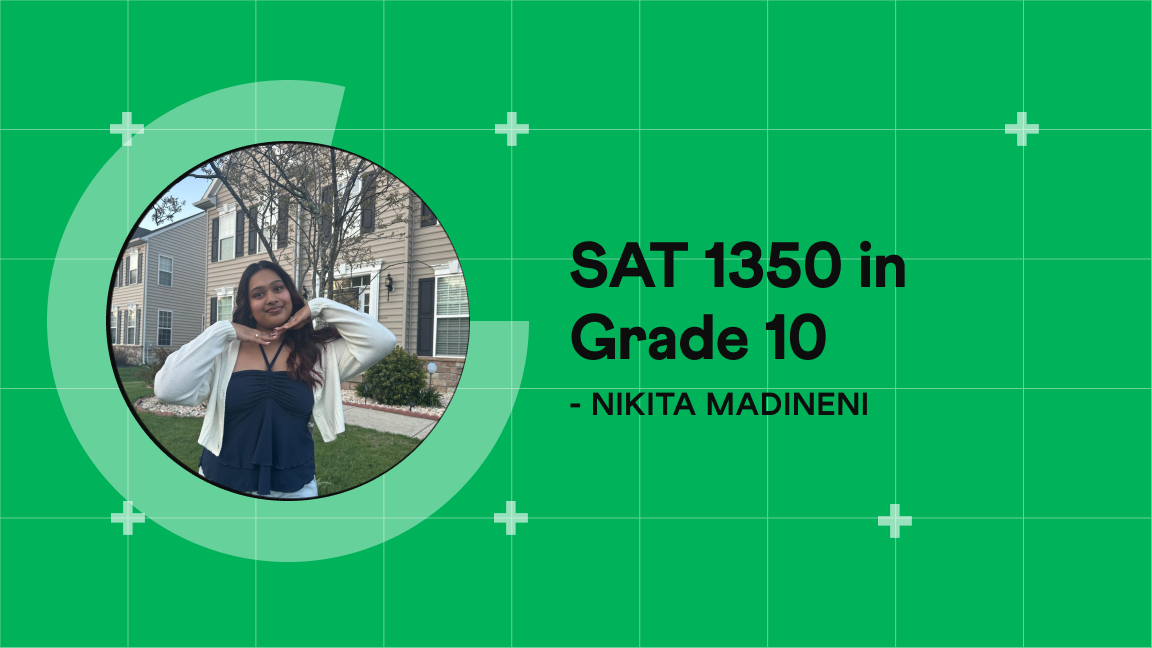
Nikita Madineni was in Grade 7 when she joined Cuemath. By Grade 10, she scored 1350 on the SAT in her first sitting. Most students take it two years later.
Sitting the SAT in Grade 10 is not the norm. Most students take it in junior or senior year, when college applications are closer and the pressure is more immediate. Choosing to sit for it as a sophomore requires something that cannot be assembled in a prep course: a mathematical foundation that holds up under real test conditions.
Nikita Madineni, a Grade 10 student in the United States, scored 1350 out of 1600 on the SAT in December, in her first sitting. She had been working with her Cuemath tutor, Sadhana Sahini, for three years before test day arrived.
This is the story of how that readiness was built.
Meet Nikita Madineni
- Grade: 10
- Country: USA
- Tutor: Sadhana Sahini
- With Cuemath Since: 3 years
- SAT Score: 1350 / 1600
What the SAT Actually Measures
The SAT is a standardized college admissions test administered by College Board. It is scored on a scale of 400 to 1600, with two sections: Reading and Writing (200 to 800) and Math (200 to 800). The Math section covers algebra, advanced math, problem-solving and data analysis, and geometry and trigonometry. A score of 1350 places a student at approximately the 90th percentile nationally, meaning she performed better than roughly nine in ten students who sat the same test. The SAT is accepted by virtually every four-year college in the United States, and strong scores in Grade 10 or 11 give students the opportunity to retake and improve before college applications are due.
How Did Nikita Build SAT-Ready Math Skills Before 10th Grade?
Nikita joined Cuemath at the start of Grade 7, three years before her December SAT date. That timing matters. The SAT does not reward what a student has memorised. It rewards how a student thinks when the problem is unfamiliar. That kind of readiness cannot be rushed. It is built, layer by layer, over years.
Tutor Sadhana Sahini began working with Nikita when the mathematical content was still foundational. At that stage, the work was about building the kind of deep understanding that makes harder material easier when it arrives — not speeding through topics, but making sure each one was genuinely secure before moving on. What Sadhana recognized in those early sessions was not just a student who worked hard, though Nikita was exactly that: diligent, focused, and willing to stay with a problem. What she recognized was a student who would respond to being pushed.
Does Starting SAT Prep Early Actually Make a Difference?
By the time Sadhana shifted the focus to SAT-specific preparation, Nikita already had the mathematical groundwork in place. That is the difference between a student who studies for the SAT and a student who is ready to study for it. The former spends most of their prep rebuilding skills that should have come earlier. The latter spends it sharpening what is already there.
Nikita's December test confirmed what three years of consistent work had been building toward. A 1350. First sitting. Tenth grade.
"She has been my student for three years. She is obedient, friendly, and hardworking. I trained her for the SAT and she achieved a good score."
~ Sadhana Sahini, CUEMATH TUTOR
"We are so proud of Nikitha for achieving a score of 1350 on the SAT! Her hard work from studying and help from her Cuemath teacher really paid off. This is a big achievement and a great step towards her college applications."
~ Nikita's Parent
Does This Sound Like Your Child?
Your child might be on a similar path if they:
- Are in middle school or early high school and want to build ahead of SAT season, not scramble before it
- Have a genuine work ethic but need structured, consistent guidance to turn that effort into measurable results
- Are beginning to encounter the more complex math of high school and want the kind of mathematical reasoning that standardized tests actually reward
- Have college applications on the horizon and want test scores that reflect what they are actually capable of
- Are ready to work with a tutor who knows how to take a capable student and make them genuinely competitive
Frequently Asked Questions
Can a 10th grader take the SAT?
Yes. College Board allows students of any grade level to register for the SAT. While most students sit for it in 11th or 12th grade, taking it earlier gives students additional time to retake if needed and signals initiative to admissions offices.
Is 1350 a good SAT score for a 10th grader?
A 1350 is approximately in the 90th percentile nationally for all test-takers. For a 10th grader sitting the exam a year or more ahead of the typical schedule, it is a genuinely strong result and competitive at many selective colleges.
When should my child start preparing for the SAT math section?
Earlier than most families realize. SAT Math tests reasoning and application across a range of mathematical concepts, not just the most recent chapter covered in class. Students who begin building mathematical understanding in middle school arrive at formal SAT prep with a stronger foundation and tend to score higher with less last-minute stress.
How does Cuemath support SAT math preparation?
Cuemath's approach emphasizes conceptual clarity and problem-solving rather than rote practice. Students who work with Cuemath consistently over several years often find that SAT-specific preparation becomes a refinement of thinking skills they have already built, rather than a crash course in content they are seeing for the first time.
Is Your Child Building Their SAT Foundation Early Enough?
Nikita started in Grade 7. By December of 10th grade, the math was already deeply familiar. The right time to build that foundation is now.
Try a FREE live Cuemath class today.
Book a Free ClassFor students in Grades K to 12 worldwide.
What Nikita's Score Tells Us About How She Thinks
The child who freezes on an unfamiliar problem is not less capable. She just has not yet learned to trust her own thinking. That is what three years of the right kind of work produces. Not a student who has seen every problem type. A student who stays calm when she has not.
Nikita took the SAT two years before most of her peers will. The 1350 was not the goal she had been chasing. It was the evidence of what the work had already made her. A student who is ready that early is not lucky. She has been built. That is MathFit.