AP Precalculus Score 5: How Grade 11 Student Saanvi Shivkumar Got There
Saanvi Shivkumar's first AP Precalculus test did not go well. Stepping back felt like the sensible choice. She stayed, and earned a score of 5, the highest possible on the AP exam.
When a capable student encounters something genuinely difficult for the first time and the first attempt does not go well, what happens next shapes far more than a single test. It shapes how they think about their own ability.
In Grade 11, Saanvi Shivkumar was offered a place in AP Precalculus, a college-level mathematics course that asks for a style of thinking most high school curricula do not prepare students for. Her first test was disappointing. Confidence dipped. For a moment, stepping back felt like the sensible choice.
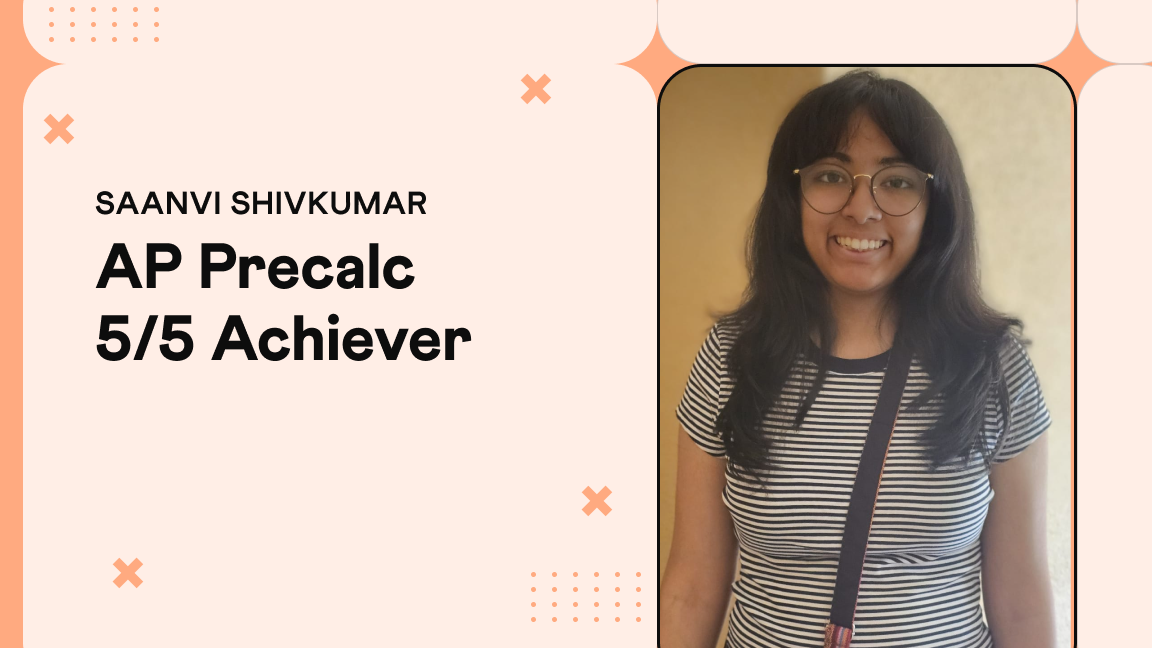
She did not step back. With her tutor Chinmaye P and her parents alongside her, Saanvi adapted, pushed through, and earned a score of 5 on the AP Precalculus exam, the highest possible.
This is the story of Saanvi Shivkumar.
Meet Saanvi Shivkumar
- Grade: 11
- Country: USA
- Tutor: Chinmaye P
- With Cuemath Since: 2020 (5 years and counting)
- AP Precalculus Score: 5 out of 5 (Top Score)
What AP Precalculus Actually Tests
AP Precalculus is a College Board course equivalent to a college-level precalculus or algebra with trigonometry class. Taken by students in Grades 9 through 12, it covers four main areas: polynomial and rational functions, exponential and logarithmic functions, trigonometric and polar functions, and functions involving parameters, vectors, and matrices. What makes it genuinely demanding is not only the content but the reasoning it requires. Students must translate mathematical information fluidly between algebraic, graphical, and numerical representations and justify their thinking precisely, going well beyond the procedural steps that most high school tests reward. The exam is scored on a scale of 1 to 5. A score of 5, the highest, indicates college-equivalent mastery and the capacity for sophisticated mathematical reasoning. Many colleges grant advanced placement credit to students who score a 4 or 5.
Does AP Precalculus Require a Different Kind of Thinking?
Saanvi came to AP Precalculus as an engaged, capable learner. Her tutor Chinmaye P describes her as someone who "excels in school, embraces challenges with enthusiasm, and grows through active collaboration and reflection on mistakes." She is the kind of student who asks questions freely and takes genuine pleasure in working through problems.
But AP Precalculus is designed to push even capable students. The course asks students to move fluidly across multiple mathematical representations, translating between algebraic, graphical, and numerical forms, and to reason about functions in ways that feel unfamiliar at first. This is a meaningfully different skill set from what most high school assessments reward, and encountering it for the first time can be disorienting, regardless of how strong a student is.
Saanvi's first test reflected that disorientation. The result was disappointing enough to shake her confidence and, briefly, make her question whether this course was the right fit.
That doubt is entirely understandable. It is also, looking back, exactly where the real learning began.
What Helped Saanvi Push Through After a Poor First Test?
Chinmaye and Saanvi's parents encouraged her to continue, not with empty reassurance but with the kind of honest support that acknowledges difficulty without treating it as a verdict. The message was clear: struggling at the start of something genuinely hard is not evidence that you cannot do it.
What followed was a gradual shift. Saanvi began to understand what the AP-style questions were actually asking of her. She learned to slow down, to think carefully about what a problem was testing before deciding how to approach it. The content itself, polynomial and rational functions, exponential and logarithmic functions, trigonometric and polar relationships, was demanding but manageable once she understood the reasoning it required.
Chinmaye's role throughout was to treat every moment of confusion as a starting point rather than a setback. Saanvi's willingness to ask questions freely, something her mother Gayathri specifically noted, became one of her greatest advantages in the classroom. Each question she worked through made the next unfamiliar problem slightly less unfamiliar.
By the time the AP exam arrived, Saanvi was not simply more prepared on the content. She was a more adaptable, more confident mathematical thinker.
She scored a 5.
"Saanvi was offered a place in the AP Precalculus course, a challenge that initially overwhelmed her. After a disappointing first test, she lost confidence and thought about stepping back. However, with guidance from me and her parents, she found the strength to keep going. As she adapted to the new style of questions, her skills grew, and she eventually earned the top score of 5. Her journey is a testament to the power of perseverance and support."
~ Chinmaye P, CUEMATH TUTOR
"I would like to share my feedback as a parent regarding my daughter’s learning experience with Cuemath. Overall, we have had a very positive experience with the program and with her tutor. The tutor has been patient, encouraging, and clear in explaining concepts. I appreciate the structured approach and the focus on building logical thinking and problem-solving skills rather than rote learning. My daughter feels comfortable asking questions, which has helped build her confidence in math. Outside of academics, my daughter enjoys drawing, reading, dance and music. Incorporating real-life examples or interactive discussions that connect math to everyday situations keeps her engaged and motivated. Thank you for the continued support and effort in helping her grow academically. We look forward to her continued learning journey with Cuemath. Warm regards, Gayathri"
~ Gayathri (Trustpilot Review)
Does This Sound Like Your Child?
Your child may be ready for this kind of growth if they:
- are enrolled in or considering an AP or advanced math course and feel uncertain whether they can keep up
- had a shaky start and are weighing whether to push through or step back
- are strong in school but find that advanced coursework asks for a different style of thinking
- learn best when they feel safe asking questions without judgement
- have interests beyond academics and benefit from a tutor who connects math to what genuinely engages them
Frequently Asked Questions
What is a score of 5 on the AP Precalculus exam?
The AP exam is scored on a scale of 1 to 5. A score of 5 is the highest possible and indicates college-equivalent mastery of precalculus. Many colleges grant advanced placement or course credit to students who score a 4 or 5, though policies vary by institution.
What does AP Precalculus cover?
AP Precalculus covers polynomial and rational functions, exponential and logarithmic functions, trigonometric and polar functions, and functions involving parameters, vectors, and matrices. The course is equivalent to a college precalculus or algebra with trigonometry class. Students must work across multiple representations and reason about functions precisely, a different skill set from what standard high school assessments typically reward.
What should my child do after a disappointing first test in an AP course?
A poor first result in an AP course is common and does not predict the final outcome. The AP exam style asks for reasoning across multiple representations, which differs from most high school tests, and many students need time to adapt. Targeted 1:1 support to identify the gaps and build the right habits tends to make the biggest difference.
When should a student take AP Precalculus?
AP Precalculus is typically taken by students in Grades 9 through 12, depending on their school's sequence. The College Board recommends completing introductory algebra and geometry first. It is strong preparation for AP Calculus and for college-level mathematics and science.
How does Cuemath support students in AP courses?
Cuemath's 1:1 tutoring means every session is built around one student's specific pace, gaps, and understanding. For AP students, this means targeted work on the exact concepts causing difficulty alongside consistent attention to the reasoning habits that AP exams reward. Students who feel comfortable asking questions close gaps faster and arrive at the exam in a much stronger position.
Could Your Child Earn a 5 on Their AP Exam?
Saanvi started with a disappointing first test and nearly stepped away. What changed was the right support at the right time. Your child can build that same confidence and capability, one session at a time.
Try a FREE live Cuemath class today.
Book a Free ClassFor students in Grades K to 12 worldwide.
What This Story Is Really About
Saanvi did not earn a score of 5 because AP Precalculus came naturally to her. She earned it because she stayed in the work after a disappointing start, asked every question that confusion prompted, and learned to think across the representations the exam demanded rather than simply executing procedures. That shift, from capable student to genuinely adaptable mathematical thinker, is what it means to be MathFit. The score was the evidence. The thinking behind it was the point.