Math Kangaroo Grade 3 Top Score: How Tavasya Ranked 3rd in Tennessee and 16th in the USA
A Grade 3 student in Tennessee entered Math Kangaroo and scored 79 out of 96. State Rank 3. National Rank 16. This is how Tavasya got there.
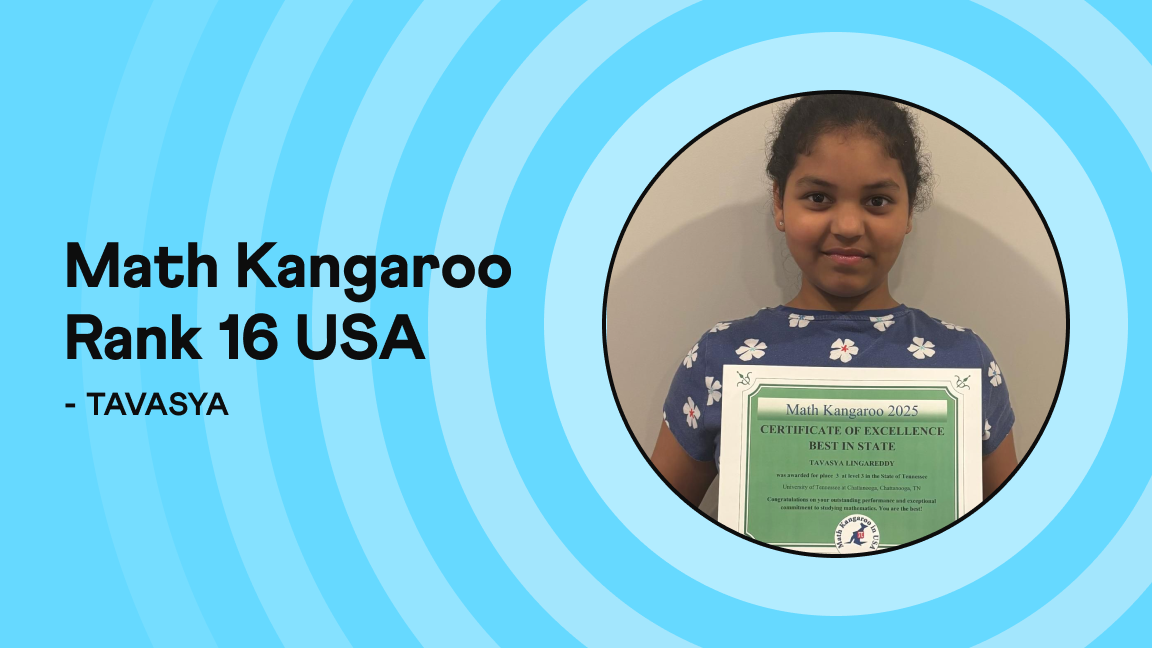
The moment a young child walks into a math competition and realizes that every problem requires genuine thinking rather than a memorized procedure, something shifts. That moment, handled well, shapes how a student sees herself as a learner for years.
In Grade 3, Tavasya entered the Math Kangaroo competition in Tennessee and came away with a score of 79 out of 96, a State Rank of 3 in Tennessee, and a National Rank of 16 across the United States. Among more than 53,000 students who participated nationally, she placed in the top tier before she had finished third grade.
This is the story of Tavasya.
Meet Tavasya
- Grade: 4
- Country: USA
- Tutor: Poonam Poonia
- With Cuemath Since: 2021 (5 years)
- Math Kangaroo 2025: 79/96 | State Rank 3 (Tennessee) | National Rank 16 (USA) in Grade 3
What Math Kangaroo Actually Tests
Math Kangaroo is an international mathematics competition held annually in March for students in Grades 1 through 12. In the United States, more than 53,000 students competed in 2025 across all 50 states through over 1,000 centers. Globally, the competition reaches over 6 million students from 80 countries. Students compete within their grade band: Grade 3 and Grade 4 students are grouped together at the same difficulty level. The exam has 24 multiple-choice problems divided into three difficulty tiers worth 3, 4, and 5 points respectively, giving a maximum score of 96. What makes Math Kangaroo genuinely demanding is not the content but the reasoning it requires. Problems test logical thinking, pattern recognition, and spatial reasoning rather than curriculum mastery. Most students encounter this style of problem for the first time at Math Kangaroo, which is part of what makes a top state or national rank so meaningful.
Does Math Kangaroo Ask for Something Different from School Math?
Tavasya came to Cuemath as a naturally curious learner. Her tutor Poonam Poonia describes her as a student whose curiosity, discipline, and strong problem-solving skills set her apart, someone who leans into difficulty rather than looking for shortcuts.
Math Kangaroo competition is not a test of curriculum recall. The question is rarely which formula to apply. The question is how to think about the problem at all. For a Grade 3 student, this is often the first time mathematics feels genuinely open-ended, and how a child responds to that newness matters.
Tavasya responded with focus and consistency. Her score of 79 out of 96 reflects not just accuracy but the ability to work through genuinely challenging problems at a level that most third graders have not yet encountered.
What Gave Tavasya the Edge in a Field of 53,000 Students?
Poonam's approach was built on what works for young competition learners: consistent practice with unfamiliar problem types, patience with the process of reasoning through problems that have no obvious first step, and a session environment where asking questions freely is the expectation rather than the exception.
What Tavasya's parent noticed was confidence. Not the kind that comes from being told you are good at something, but the kind that builds when a student figures out something genuinely hard and knows she did it herself. That shift, from capable classroom learner to independent mathematical thinker, is quiet but visible. Tavasya carried it into the competition.
She ranked 3rd in Tennessee and 16th in the United States.
"Tavasya is a brilliant and hardworking student whose dedication has paid off with an impressive rank in Math Kangaroo. Her curiosity, discipline, and strong problem-solving skills make her stand out. She is an inspiration to her peers and a source of great pride for me as her teacher."
~ Poonam Poonia, CUEMATH TUTOR
"I wanted to sincerely thank you for your dedication and support in helping my daughter achieve 3rd rank in the math competition. Your guidance and encouragement made a big difference in her confidence and performance. We truly appreciate the time and effort you invest in with Tavasya Thank you once again for being such a wonderful teacher!"
~ Tavasya's Parent
Does This Sound Like Your Child?
Your child might be on a similar path if they:
- show genuine curiosity about numbers and patterns beyond what is covered in class
- enjoy puzzles and problems that require thinking rather than just calculation
- are in elementary school and ready for a first introduction to competition mathematics
- learn best when challenged at the right level with space to figure things out independently
- get excited about achieving a concrete goal and having their progress recognized
Frequently Asked Questions
What is Math Kangaroo and who can participate?
Math Kangaroo is an international math competition open to students in Grades 1 through 12, held annually in March. In the United States, over 53,000 students participated in 2025 across all 50 states through more than 1,000 centers. Globally, the competition reaches over 6 million students across 80 countries. Students compete within their grade band, so Grade 3 students compete alongside Grade 4 students at the same difficulty level.
What does a score of 79 out of 96 mean on Math Kangaroo?
The Math Kangaroo exam at the Grade 3-4 level consists of 24 multiple-choice problems in three difficulty tiers worth 3, 4, and 5 points respectively, giving a maximum possible score of 96. A score of 79 places a student well above the national median and reflects strong performance across all three difficulty levels. State and national rankings are calculated separately based on scores within each grade band.
How is Math Kangaroo different from school math?
Math Kangaroo problems are not drawn from the school curriculum. They test logical reasoning, pattern recognition, and spatial thinking rather than memorized procedures. For most students, this is their first encounter with problems that reward careful thinking over speed and recall. That shift is what makes top scores difficult to achieve and also what makes the preparation valuable well beyond the competition itself.
What is the best way to prepare a Grade 3 student for Math Kangaroo?
Consistent practice with competition-style problems, starting well before the exam, is the most effective preparation. Young students benefit most from a learning environment that builds comfort with unfamiliar problem types and rewards asking questions rather than rushing to an answer. One-on-one support helps because it allows the difficulty and pace to be matched precisely to the student, building the patience and instincts that Math Kangaroo rewards.
How does Cuemath help young students prepare for competitions like Math Kangaroo?
Cuemath's 1:1 tutoring model means every session is built around one student's pace, strengths, and gaps. For young students preparing for competition math, this means working through the reasoning problems that Math Kangaroo rewards in a setting where they feel safe asking every question. Building that curiosity and confidence in elementary school creates a foundation that carries forward into every math challenge that follows. Cuemath supports students from Grade K through Grade 12 across the USA and globally.
Could Your Child Excel at Competition Math in Elementary School?
Tavasya ranked 3rd in Tennessee and 16th nationally in Grade 3. Competition-level thinking starts earlier than most parents expect, and the habits built now carry forward into every math challenge ahead.
Try a FREE live Cuemath class today.
Book a Free ClassFor students in Grades K to 12 worldwide.
What This Story Is Really About
Tavasya did not rank 16th in the United States because the problems were easy for her. She ranked there because she had built the habits that competition math demands: the discipline to stay with a problem that does not immediately make sense, the curiosity to keep asking why, and the confidence to work through difficulty rather than around it. A student who builds those habits in Grade 3 carries them into every mathematics classroom that follows. That is what it means to be MathFit. The rank was the recognition. The thinking was the foundation.