
How Structured Math Learning Helped a Grade 5 Student Achieve the 92nd Percentile in CogAT Math
A US Grade 5 student scored in the 92nd percentile in CogAT Math through structured learning that strengthened reasoning, confidence, and MathFit skills.
Many parents wonder how to recognize and support advanced mathematical ability early. This is especially true when a child shows strong reasoning skills but still needs the right structure to translate potential into measurable outcomes.
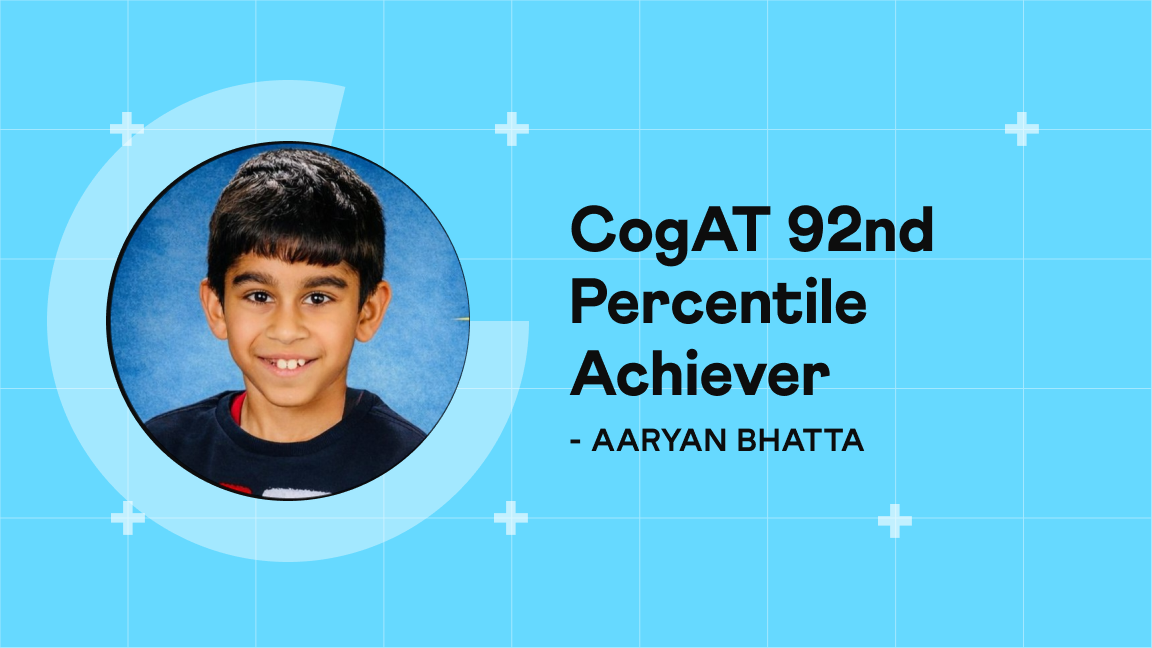
This student success story highlights how Aaryan Bhatta, a US-based learner, developed deeper logical reasoning, problem-solving confidence, and stronger mathematical thinking. This led to a 92nd percentile score in Mathematics on the CogAT (Cognitive Abilities Test) and placement into a Highly Capable Center program, learning a grade ahead.
Can structured math learning help students become MathFit™ early?
Yes. When math learning prioritizes reasoning, conceptual clarity, and problem-solving rather than rote procedures, students develop the core abilities that define MathFit.
Instead of simply moving faster through topics, children build:
- Stronger reasoning and pattern recognition
- Deeper conceptual understanding
- Confidence with unfamiliar problems
- A mindset that embraces challenge
Aaryan’s journey is a strong example of how consistent, guided learning can nurture both mathematical proficiency and mathematical mindset.
Student Snapshot
- Name: Aaryan Bhatta
- Country: United States
- Current Grade: Grade 5
- Learning Level: Working a grade ahead
- Assessment: CogAT (Cognitive Abilities Test)
- Math Achievement: 92nd percentile
- Program Placement: Highly Capable Center, Forest View Elementary
- Tutor: Geeta Pachisia
Before: Strong Ability That Needed the Right Structure
From an early age, Aaryan showed curiosity for numbers and strong logical instincts. However, like many high-potential students, the challenge was not about effort or motivation.
It was about ensuring his learning environment:
- Stretched his reasoning rather than repeating familiar exercises
- Built conceptual understanding instead of procedural memory
- Encouraged thinking through complex problems
- Developed confidence with challenge
At the elementary level, many capable students:
- Complete assignments quickly but lack depth of engagement
- Show reasoning ability but limited exposure to non-routine problems
- Develop fluency without fully strengthening understanding
- Rarely experience productive struggle
Aaryan needed a learning approach that would deepen thinking, strengthen fundamentals, and cultivate long-term mathematical confidence.
The Learning Approach That Made the Difference
Under the guidance of his tutor, Geeta Pachisia, Aaryan’s sessions focused on building deep mathematical thinking rather than accelerating mechanically through topics.
Lessons emphasized:
- Logical reasoning and multi-step problem solving
- Understanding the why behind methods
- Explaining strategies and justifying answers
- Gradual progression aligned with ability
- Comfort with challenging, unfamiliar questions
Instead of simply solving problems, Aaryan was encouraged to think, analyse, and articulate his reasoning.
This approach helped him:
- Develop stronger conceptual clarity
- Build flexibility in problem-solving
- Approach new problems with confidence
- See challenge as part of learning
Over time, he began working comfortably at an advanced level while still younger, building the type of reasoning abilities assessed by tests like the CogAT.
After: 92nd Percentile in CogAT Math and Advanced Placement
The impact of this structured, reasoning-focused learning became evident when Aaryan appeared for the CogAT assessment on February 24, 2025, while he was still in Grade 3.
Key Outcomes
- Scored in the 92nd percentile in CogAT Mathematics
- Selected for the Highly Capable Center program
- Advanced to learning math at a Grade 5 level
Beyond test scores, the transformation was visible in how he approached mathematics:
- Greater confidence with non-routine problems
- Stronger logical reasoning
- Improved problem-solving independence
- Comfort with complex challenges
What This Story Reveals About Being MathFit
Aaryan’s journey highlights an important insight.
High performance in assessments like the CogAT is rarely driven by memorization or speed alone. It emerges from students who develop:
- Fluency
- Understanding
- Application
- Reasoning
These abilities grow when students engage in consistent practice, explore concepts deeply, solve real-world problems, and tackle non-routine challenges that stretch their thinking.
Equally important is mindset.
Students become MathFit when learning nurtures curiosity, builds confidence with challenge, normalizes mistakes, and connects mathematics to real-life contexts.
In other words, MathFit develops when proficiency and mindset evolve together.
Insight from His Tutor
“It has been a privilege to teach Aaryan for the past five years and witness his academic journey. Now confidently excelling at a Grade 5 level, his progress reflects not just his intelligence, but also his curiosity, discipline, and love for learning. With focused guidance and consistent effort, he continues to achieve outstanding results.”
~ GEETA PACHISIA, TUTOR
Parent’s Perspective
“Aaryan achieved the 92nd percentile in Mathematics on the High Capability state-level assessment. This success reflects his strong understanding of logic and problem-solving skills, developed through effective strategies and continued support. We sincerely thank the Cuemath team and Miss Geeta Pachisia.”
Is This Right for Your Child?
This journey may resonate with you if your child:
- Finishes math quickly but needs deeper challenges
- Shows strong logical thinking
- Struggles with unfamiliar problems despite strong basics
- Needs confidence with complex questions
- May be ready for advanced programs or assessments
Take the Next Step
If you are exploring how to strengthen your child’s mathematical thinking:
Check Your Child’s Math Readiness
Book a Free ClassEarly clarity helps ensure children are not just ahead in topics, but ahead in thinking.
Frequently Asked Questions
What is the CogAT test used for?
The CogAT measures reasoning abilities in areas such as mathematics, verbal reasoning, and non-verbal reasoning. Schools often use it to identify students for gifted or highly capable programs.
At what age can math potential be identified?
Foundational reasoning and problem-solving skills can often be observed in elementary school when students are exposed to concept-focused learning.
How can parents prepare children for CogAT Math?
Preparation should focus on reasoning, pattern recognition, logical thinking, and problem-solving rather than memorization. Children perform better when they develop conceptual understanding and confidence with unfamiliar questions.