Grade 6 Math Bowl and Science Bowl Winner: How One Student Won Both
A Grade 6 student in the US took first place in both his regional Math Bowl and Science Bowl in the same April 2026 week. His tutor and parent describe the years of weekly puzzle practice that built the kind of reasoning two academic competitions rewarded.
By Grade 5, Madhavi Perepa had Shri working a year ahead of his school's math curriculum. She added logic puzzles, reasoning challenges, problems his classmates would not see for another year. By Grade 6, that compounding showed up in a way no one could miss.
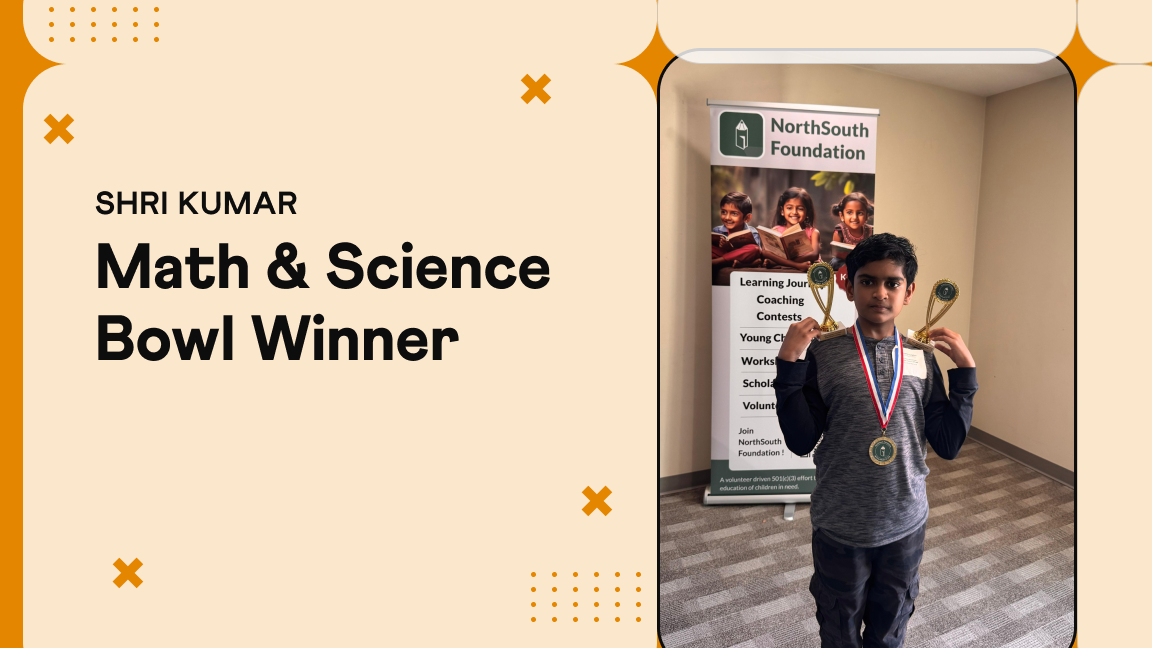
Shri Kumar, a Grade 6 student in the US, took first place in both his regional Math Bowl and Science Bowl in the same April 2026 competition week. The dual win came after years of weekly online math tutoring with Cuemath, where every puzzle, problem, and logic challenge was work worth finishing.
Meet Shri Kumar
- Grade: 6
- Country: USA
- Tutor: Madhavi Perepa
- With Cuemath Since: Elementary school
- Achievement: First place in both regional Math Bowl and Science Bowl, April 2026
What Does It Take for a Grade 6 Student to Win a Regional Math Bowl?
Regional math bowl competitions for 6th graders are not school exams. They are quiz-bowl-style contests where students answer mental math, logic, and reasoning questions under time pressure, often against teams from neighboring districts. Unlike classroom math, math bowls reward speed of recognition over completeness of working. The questions are not the kind you can drill for in the week before. They reward students who have been doing math reasoning consistently over years, students who have built the speed and confidence to think on their feet.
For most middle school students, this is the gap. They have classroom math but not competition math. They can solve a textbook problem at their own pace but freeze when the clock is running. The shift does not come from cramming. It comes from a steady habit of doing harder problems than school is asking, every week, for years.
"I give all the credit to the Student and the Cuemath. Shri is outstanding because of his hard work and discipline. He is self disciplined and self motivated. He never misses even a puzzle. He does each and every problem of the Cuemath curriculum. Not only the curriculum but he also aces in logical thinking by doing puzzles. He completely understands the logic behind every puzzle and moreover he enjoys what he is doing."
~ Madhavi Perepa, CUEMATH TUTOR
How Does Long-Term One-on-One Math Tutoring Build a Competition Mathematician?
Madhavi's sessions did something Shri's school could not. They ran ahead of the school curriculum and added logic puzzles, reasoning challenges, and the kind of multi-step problems that reward thinking, not memorization. The point was not just to get math right. It was to get used to the discomfort of a problem that did not solve itself in the first try.
Madhavi's note about Shri makes the rhythm visible. He never missed a puzzle. He did every problem in the Cuemath curriculum, then the logic challenges Madhavi sent on top. By Grade 6, that habit had accumulated. Shri did not just know more math than his classmates. He thought differently, faster, with the kind of confidence that wins regional competitions.
"Cuemath has been a game-changer for my kids, and I couldn't be more grateful! The exceptional teaching skills of Mrs. Kayalal Pachayappa and Mrs. Madhavi Perepa have not only helped my children excel academically but have also instilled in them a love for learning. My son Shri's first-place win in the regional math bowl is a testament to their dedication and expertise. Thank you, Cuemath!"
~ Shri's Parent (Trustpilot Review)
What Shri's Dual Math and Science Bowl Win Says About Years of Consistent Practice
On a Sunday in April 2026, Shri took first place in his region's Math Bowl. Two days later, he took first place in the Science Bowl. Both competitions drew 6th graders from across multiple districts. Winning one regional academic competition is the headline. Winning two, in different subjects, in the same week, is rarer.
The transfer is what makes it interesting. Math Bowl and Science Bowl both reward reasoning under time pressure, applied to different content. Shri won both because his thinking was generalized, not narrowly trained. The years of puzzle-driven practice with Madhavi had built something that worked across subjects.
None of this is the start of his story. It is the visible part of a story Shri's parents had been watching for years. A 6th grader who never skipped a puzzle. A tutor who kept raising the bar. A weekly Cuemath rhythm that made hard problems feel ordinary. That is what being MathFit looks like for a Grade 6 student. A child whose math identity was built one puzzle at a time, until winning a regional bowl was simply the natural overflow. The years of work that won Shri the bowl were not the months before the competitions. They were the years long before, and that runway shortens with each grade a child waits.
Does This Sound Like Your Child?
Your child might be on a similar path if they:
- Are heading into middle school and you want them ready for academic competitions, not just classroom math
- Like math but have not yet been pushed beyond what school is asking of them, and you want to know what they could do with more
- Have shown signs of strong logical thinking and you want a tutor who builds on it, not just teaches the school curriculum
- Are in 5th or 6th grade, the window when consistent practice still has time to compound before middle school stakes peak
Build the Math Reasoning That Wins Regional Competitions
The earliest you start, the further it goes. Years of consistent one-on-one math tutoring is what turns a curious 6th grader into a regional Math Bowl champion, and the foundation is built grade by grade, not week by week.
Start with a Free Cuemath Evaluation Today.
Book a Free EvaluationFor students in Grades K to 12 worldwide.
Frequently Asked Questions
What is a math bowl competition for Grade 6 students?
A math bowl is a quiz-bowl-style team math competition for middle school students, often run at the regional or district level. Students answer mental math, logic, and reasoning questions under time pressure, sometimes against opposing teams. Math bowls reward speed and confidence built from consistent practice over years, not last-minute test prep.
How can I help my 6th grader prepare for regional math competitions?
The strongest preparation is a steady habit of doing math reasoning problems that go beyond the school curriculum, ideally with a one-on-one tutor who can introduce competition-style problems progressively. Most students who win regional academic competitions in middle school have been doing this work weekly, for years, before the actual competition. Cramming in the weeks before rarely produces a podium finish.
Does long-term one-on-one math tutoring help with academic competitions like Math Bowl and Science Bowl?
Yes. Both Math Bowl and Science Bowl reward fast reasoning, multi-step thinking, and the ability to stay calm under time pressure. These habits are built slowly through weekly one-on-one math tutoring that introduces puzzles, logic challenges, and harder problems than school provides. Over years, this work creates the cognitive readiness that competitions reward.
Does Cuemath help students prepare for math competitions?
Yes. Cuemath is one-on-one online math tutoring for students in Grades K to 12, and tutors regularly add competition-style logic puzzles, reasoning problems, and multi-step challenges to weekly sessions. For students whose parents want to take them beyond school math, the tutor introduces competition-track problems progressively, building the speed and reasoning that Math Bowl, MATHCOUNTS, AMC 8, and similar competitions reward.
How is Cuemath different from school math tutoring?
Cuemath is one-on-one, online, and built around active reasoning rather than answer-checking. School tutoring usually focuses on completing homework or repeating what was taught in class. Cuemath tutors run ahead of the school curriculum, add logic puzzles and problem-solving challenges that school does not cover, and use a method where the student does most of the thinking and talking. Over years, this builds reasoning that transfers across subjects.