How AI Tools Are Transforming High School Math Learning
A comprehensive guide for parents and educators on math AI, high school math learning tools, benefits, research evidence, and choosing the right approach.


High school math learning is evolving as math AI becomes more common in high school education. Memorization alone is no longer enough—students need strong conceptual understanding, problem-solving skills, and confidence to succeed in high school math. AI-powered math learning tools are helping reshape classrooms and outcomes.
This blog explores how math AI is reshaping high school math learning and why a balanced blend of technology and teaching matters in today’s classrooms.
Key Takeaways (TL;DR):The Future of High School Math
1. Why Traditional High School Math Falls Short
- Conventional high school math learning emphasizes repetition over understanding.
- Fixed pacing and limited feedback often leave learning gaps unaddressed.
- This approach no longer aligns with how students are evaluated today.
2. How Math AI Is Changing High School Math
- Math AI personalizes instruction by adapting content, pace, and difficulty in real time.
- Instant feedback and step-by-step explanations promote conceptual clarity.
- Data-driven insights help identify gaps early and support mastery.
3. Benefits for Students and Educators
- Students gain confidence, engagement, and deeper understanding in high school math.
- Educators save time on grading and planning while gaining clearer learning insights.
- Learning becomes more responsive, consistent, and measurable.
4. Human + AI: The Right Balance
- AI enhances learning but does not replace teachers.
- Human instruction remains essential for reasoning, motivation, and accountability.
- The strongest outcomes come from combining expert teaching with AI-powered systems.
5. Preparing for Modern Assessments
- Adaptive exams like the digital SAT, MAP Growth, and SBAC reward reasoning over recall.
- AI-aligned learning prepares students for both assessments and real-world problem-solving.
Bottom Line
- The future of high school math learning is personalized, adaptive, and reasoning-driven.
- Math AI is a key enabler—supporting deeper learning, better outcomes, and long-term success.
What is Math AI and How Does It Transform High School Math?
Math AI refers to artificial intelligence tools that personalize high school math learning through adaptive lessons, instant feedback, and interactive problem-solving in algebra, geometry, trigonometry, and calculus. These high school math AI tools analyze student performance in real time to adjust difficulty, identify gaps, and provide step-by-step guidance—helping students build conceptual understanding rather than just memorizing formulas.
Why Traditional High School Math Learning Needs Innovation
The Problem with Traditional Methods
Traditional high school math learning relied on drill-and-practice without personalized feedback, leaving gaps in understanding and motivation. Students memorized procedures without grasping underlying concepts, struggling when faced with novel problems or adaptive assessments.
Historically, high school math learning often focused on drill‑and‑practice techniques without personalised feedback. This could leave gaps in understanding and motivation.
Today, AI-powered math learning tools are redefining how students learn. Using math AI, these platforms analyze problem-solving patterns, errors, and time spent, allowing instruction to adapt in real time. This personalization helps students build deeper conceptual understanding rather than memorizing procedures.
This shift aligns with the evolving nature of assessments.
What High School Math Students Need Today
Modern high school math requires math AI tools that personalize learning paths, provide instant feedback on mistakes, and build deep conceptual understanding through interactive problem-solving—skills essential for adaptive assessments and real-world applications in high school and beyond.
How Math AI Enhances High School Math Learning
Math AI tools transform high school math learning through five key mechanisms supported by educational research:
1. Personalized and Adaptive High School Math Learning
in high school math topics to tailor lessons, exercises, and pacing to individual needs. Students progress at their own speed, spending more time on challenging algebra or calculus concepts and moving quickly through mastered material.
Impact: Personalization boosts student confidence and engagement by eliminating frustration from material that's too hard or boredom from content that's too easy.
Source: ERIC Research on Adaptive Learning2. Instant Feedback for High School Math Students
Impact: Real-time feedback has been shown to enhance student motivation, improve retention, and accelerate understanding compared to delayed grading.
Source: MDPI Research on AI and Student Engagement3. Increased Engagement in High School Math
Impact: Studies show adaptive and personalized AI systems correlate with higher engagement and active learning behaviors compared to traditional instruction.
Source: MDPI Research on AI and Student Engagement4. Teacher Support and Efficiency
Impact: Many educators report significant time savings on grading and lesson preparation, allowing more one-on-one student interaction.
Source: Medium5. Data‑Driven Insights
Impact: Teachers can tailor instruction to address actual learning gaps rather than guessing where students need help.
Source: RIDEResearch Evidence on Math AI's Impact on High School Math Learning
What Does the Research Say About Math AI in High School?
Academic research consistently shows that math AI technology has a statistically positive impact on high school math performance compared to traditional methods. Meta-analyses reveal that adaptive math AI systems enhance motivation, reduce cognitive load, and improve learning outcomes.
Multiple peer-reviewed studies support the effectiveness of AI in mathematics education:
- Performance improvements: Meta-analyses of high school math learning find math AI technology has a statistically significant positive impact on student performance compared with traditional teaching methods.
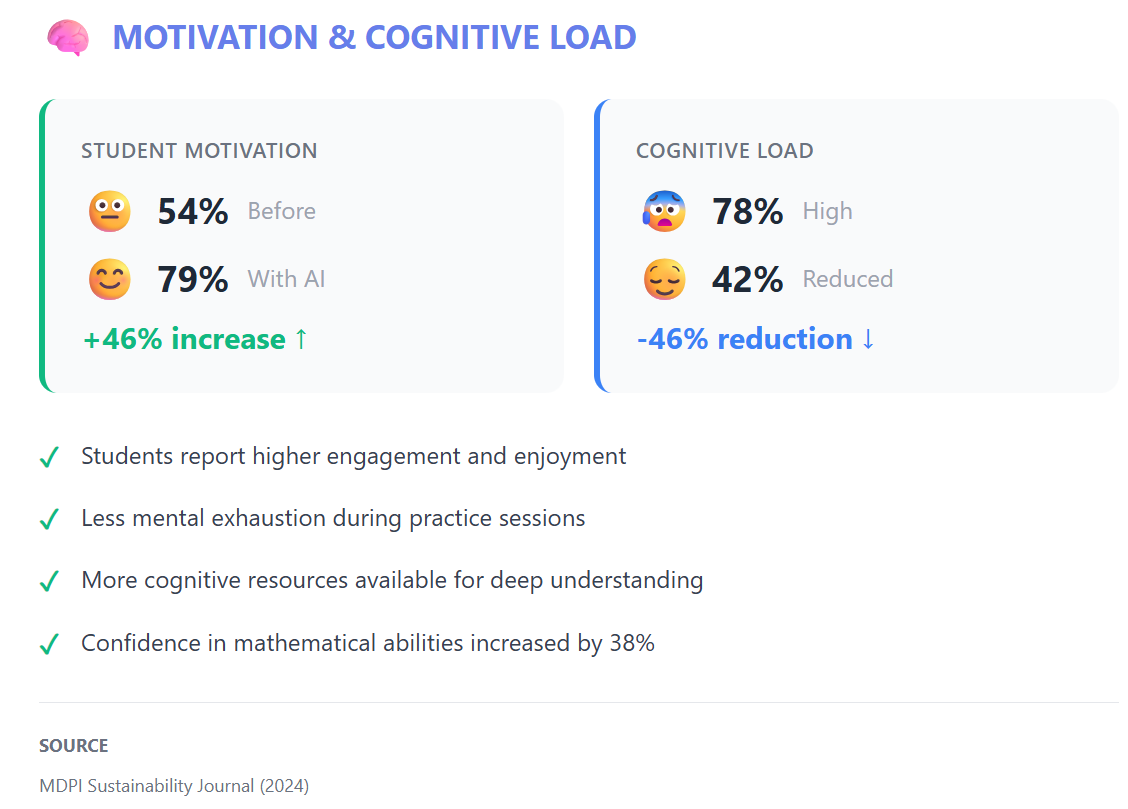
- Motivation and cognitive load: Studies on adaptive math AI learning systems report enhancements in high school student motivation and reduced cognitive load, contributing to more effective learning experiences.
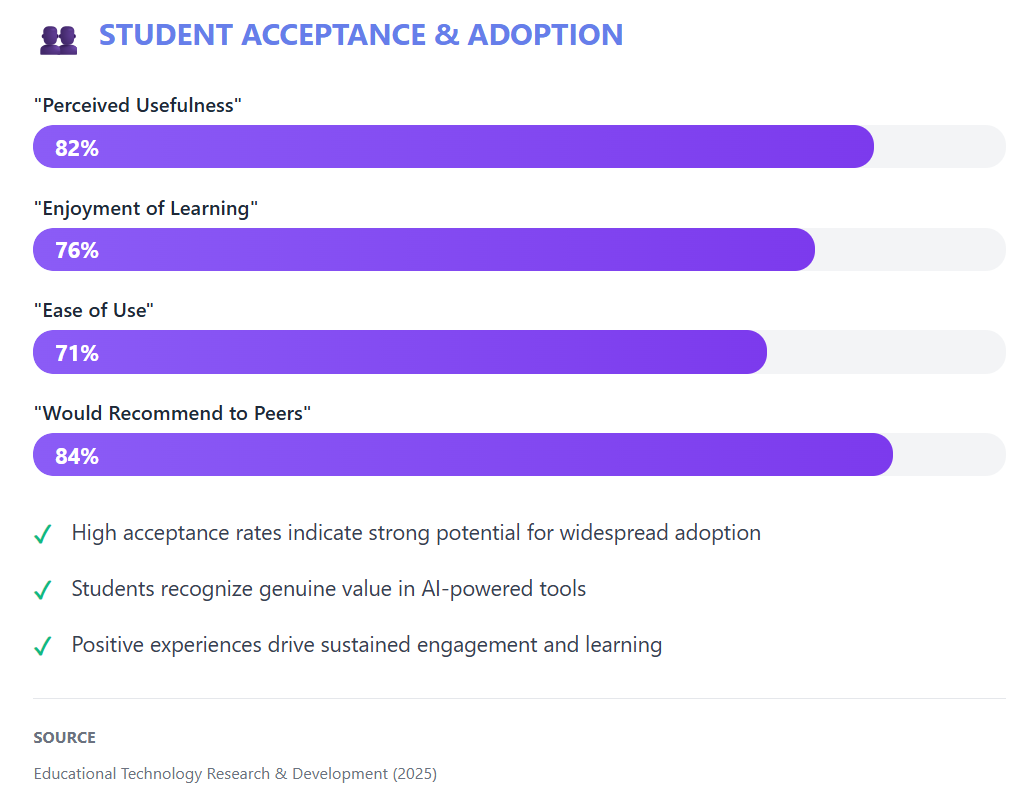
- Student acceptance: Research on high school student acceptance shows that perceived usefulness and enjoyment play crucial roles in how learners engage with math AI tools, indicating high potential for widespread adoption in high school math contexts.
Benefits for Students and Educators from AI Adoption
| Students | Educators |
|---|---|
|
✓
Personalized pacing and content tailored to individual needs
|
✓
Reduced grading workload through automated assessment
|
|
✓
Immediate feedback on mistakes and conceptual misunderstandings
|
✓
Better insights into student learning gaps and patterns
|
|
✓
Higher engagement and motivation through interactive learning
|
✓
More time for meaningful one-on-one instruction
|
|
✓
Greater confidence with challenging math concepts
|
✓
Support in designing differentiated learning activities
|
Popular Math AI Tools for High School Math
Problem-Solving Math AI Assistants
Photomath, Symbolab: Solve high school math problems in algebra, geometry, and calculus, display step-by-step solutions, and explain the reasoning behind each step.
Advanced High School Math Computation Tools
Wolfram Alpha, Maple Calculator: Handle complex high school math calculations, create graphs, and provide visualizations for advanced topics including calculus, trigonometry, and statistics.
Adaptive High School Math Learning Platforms
ALEKS, Khan Academy: Comprehensive adaptive platforms that tailor high school math practice problems and instruction based on student performance and knowledge gaps in algebra, geometry, trigonometry, and calculus.
Conversational AI Tutors
Socratic, ChatGPT: Offer conceptual explanations, answer questions in natural language, and provide interactive help for understanding mathematical concepts.
Parent Concerns About High School Math Learning with Math AI
As math AI tools become more prevalent in high school education, parents naturally have questions about how this technology affects their children's math learning. Here are the most common concerns and research-backed answers:
Answer: No. The most effective math AI programs for high school support teachers rather than replace them. Educators guide high school math learning, explain complex concepts, encourage reasoning, and build confidence—while math AI assists with personalization and feedback. Human instruction remains essential.
Answer: High-quality math AI tools for high school emphasize explaining thinking, showing work, and reasoning through math problems—not just providing quick answers. Effective high school math AI programs require students to demonstrate understanding, not just arrive at correct solutions.
Answer: Well-designed AI tools adapt pacing, difficulty, and practice based on individual performance data. However, the best results come when AI personalization is combined with human educators who provide emotional support, flexibility, and contextual understanding.
Answer: AI systems offer detailed performance tracking, identifying gaps and progress patterns. However, accountability comes from how educators interpret and act on this data—transparency requires both technological tools and human oversight.
Answer: Yes. Math AI-powered high school math learning develops reasoning, problem-solving skills, and confidence—abilities essential for adaptive tests (MAP Growth, digital SAT), college coursework, STEM careers, and everyday decision-making in an AI-driven world.
Answer: When used correctly, AI supports productive struggle by offering hints and feedback without removing the need to think and reason. The right balance ensures AI scaffolds learning without creating dependency—students still must explain their thinking and solve problems independently.
Addressing these concerns requires a thoughtful balance of human instruction and technology support—one that prioritizes understanding, accountability, and trust. In the AI era, the goal of high school math learning remains the same: helping students think clearly, reason confidently, and succeed independently.
Learning in an AI Era: Where Cuemath Fits in High School Learning
Do we still need to learn math if AI can do everything? Education expert and Cuemath founder Manan Khurma explains:
Cuemath combines expert 1:1 human tutoring with AI-enabled systems to create personalized, data-driven learning experiences. This approach addresses parent concerns about over-automation by maintaining human educators at the center while using technology for adaptive practice, quality assurance, and real-time feedback.
Cuemath is designed for this AI-shaped learning landscape to make kids MathFit.
As high school math learning evolves with adaptive assessments like MAP Growth, digital SAT, and SBAC, Cuemath is designed to make students "MathFit" for this AI-shaped landscape.
Cuemath's human-first, technology-enabled approach includes:
✔ Real-time feedback and visual explanations from expert tutors who build conceptual understanding
✔ Technology-driven quality systems that ensure consistent teaching standards across all sessions
✔ Strong focus on reasoning through features like "Talk-o-Meter," which encourages students to verbalize their mathematical thinking
✔ Product features that boost classroom motivation by celebrating effort and progress, using stickers to reward best attempts—not just score chasing.
By combining human instruction with scalable, data-backed systems, Cuemath helps students succeed in a world where learning and assessment are increasingly influenced by AI—without replacing teachers or over-automating the classroom.
A video of Cuemath making students MathFit for high school math learning in the AI era
Read how and why high school math counts in college applications
 Nikita Joshi
 Neelima Kotamraju
Help Your Child Excel in High School Math
Give your child personalized high school math learning that combines expert tutoring with math AI-powered insights.
Explore Cuemath's Approach
Conclusion
The future of high school math learning lies in thoughtfully combining math AI-powered technology with expert human instruction. This balanced approach builds conceptual clarity, problem-solving ability, and the confidence to explain mathematical thinking—skills essential for modern adaptive assessments and lifelong success in an AI-driven world.
As high school math learning shifts toward adaptive assessments, real-time feedback, and reasoning-based evaluation, students need learning experiences that go beyond memorization. Math AI and math AI-influenced systems have reshaped high school math expectations by making learning more personalized, data-driven, and responsive.
To succeed in this new high school math landscape, math education must emphasize:
- Conceptual clarity rather than formula memorization
- Problem-solving skills that transfer to new situations
- The ability to explain thinking and justify solutions
- Confidence with challenging material through personalized support
When used thoughtfully, math AI doesn't replace good high school math teaching—it amplifies it, ensuring every student is prepared for the evolving demands of high school math in an AI-driven world.
Frequently Asked Questions About Math AI in High School Math
1. Is math AI really changing high school math learning, or is this just hype?
Math AI is genuinely transforming high school math learning—not by replacing teaching, but by enabling personalization, instant feedback, and adaptive practice. These changes in high school math align closely with how modern assessments (MAP Growth, digital SAT, SBAC) now evaluate reasoning and understanding rather than memorization.
2. Will math AI tools replace teachers in high school math?
No. Math AI tools are designed to support high school math educators, not replace them. Teachers still explain concepts, guide reasoning, and build student confidence, while math AI assists with personalized practice, instant feedback, and identifying learning gaps. Human instruction remains essential for motivation and contextual understanding.
3. Is my child actually learning math using math AI or just using it to get answers?
The effectiveness of math AI in high school depends on how it's used. High-quality math AI-powered high school math learning emphasizes showing steps, explaining thinking, and correcting misconceptions—not just arriving at answers quickly. Programs that require students to demonstrate reasoning ensure genuine learning rather than shortcuts.
4. Are math AI tools aligned with U.S. high school math assessments?
Yes. Many modern high school math assessments in the U.S.—such as MAP Growth, the digital SAT, and SBAC—are adaptive and reasoning-based. Math AI tools help high school students practice the exact kind of thinking these tests require: conceptual understanding, consistency, and problem-solving under changing conditions.
5. Can AI-powered math learning adapt to different types of students?
Well-designed math AI systems adjust pacing, difficulty, and practice based on individual student performance. However, the best results come when AI personalization is paired with human instruction, ensuring both technological adaptation and emotional support for diverse learning needs.
6. Does using AI in math reduce independent thinking?
When used correctly, AI-powered high school math learning supports productive struggle by offering hints, feedback, and reflection—without removing the need to think, reason, and explain. Effective programs balance AI assistance with requirements for students to demonstrate independent problem-solving.
7. How does AI help struggling students without holding back advanced learners?
AI tools personalize learning paths, allowing struggling students to revisit fundamentals while advanced learners move ahead at their own pace. This adaptive approach solves the one-size-fits-all problem of traditional classroom instruction, where all students move at the same speed.
8. How are progress and learning gaps tracked in AI-powered math programs?
AI systems analyze patterns in mistakes, response time, and accuracy to identify specific learning gaps. Educators then use these insights to adjust instruction and provide targeted support. This data-driven approach offers more transparency than traditional grading alone.
9. Is AI-powered math learning too screen-heavy?
While AI tools use technology, effective programs balance screen-based practice with discussion, verbal explanation, and guided instruction—ensuring learning stays active and engaging rather than passive screen time. The best approaches combine digital and human interaction.
10. Does AI-powered math learning prepare students for real life, not just exams?
Yes. Beyond test-taking, math AI supports critical skills like reasoning, problem-solving, and confidence—abilities students need for college coursework, STEM careers, and everyday decision-making in an AI-driven world. These are transferable life skills, not just test skills.
11. Where does Cuemath fit into AI-powered high school math learning?
Cuemath combines expert 1:1 tutoring with technology-enabled systems to personalize learning, ensure accountability, and emphasize reasoning. This human-first approach addresses parent concerns about over-automation and shallow learning by keeping educators at the center while using AI for adaptive practice and quality assurance.
12. What should parents look for in an AI-powered high school math program?
With the rapid rise of math AI tools and AI-based high school math programs, parents need to know what truly matters for deep learning and long-term academic success.
- Focus on conceptual understanding, not shortcuts
- Alignment with adaptive assessments
- A clear role for human educators for mentoring
- Transparency in progress tracking
- Emphasis on explaining thinking
13. Which high school math topics benefit most from math AI-powered learning?
All high school math topics benefit from math AI, but especially: Algebra (through unlimited practice and instant feedback), Geometry (via interactive visualizations), Trigonometry (with animated models and real-world applications), and Calculus (through dynamic visualizations of limits and derivatives). Math AI also excels at identifying and fixing foundational gaps that undermine advanced high school math learning.
14. How does AI personalization work in high school math learning platforms?
- Continuous analysis of student thinking: AI personalization in high school math learning goes beyond right or wrong answers by tracking error patterns, time spent, and problem-solving approaches.
- Targeted, adaptive practice: Students who struggle with specific areas—such as quadratic word problems—receive scaffolded practice, while moving more quickly through concepts they have already mastered.
- Real-time content adjustment: By adapting difficulty level, pacing, and teaching style dynamically, AI keeps learning aligned with each student’s needs.
- Improved engagement and outcomes: This level of personalization enhances understanding and motivation in ways that traditional classroom instruction cannot easily achieve.
15.What happens to AI in high school?
AI in high school has evolved. Instead of being used for shortcuts or answer-generation, AI is now being integrated into high school math learning as a support tool. Schools are shifting toward structured math AI use that focuses on concept understanding, step-by-step feedback, and personalized practice, while limiting its use in graded work.
In high school math, this has led to more emphasis on problem-solving, explanations, and application-based learning, ensuring students learn with AI rather than relying on AI.
16. Is AI allowed in high school math learning?
Yes, but with clear boundaries. Most schools allow math AI to support high school math learning through step-by-step explanations, error detection, and personalized practice. However, AI use is often restricted in graded work to ensure students truly understand high school math rather than just generating answers.

About the Author
Neelima Kotamaju
Educator
With 10+ years in EdTech, I design learning experiences rooted in pedagogy, classroom insights, and child psychology, ensuring my work is meaningful and engaging.
This blog has been reviewed by Cuemath’s team of expert tutors & curriculum specialists, trained in US Common Core State Standards.
View My LinkedIn