
How High School Math Strengthens Your College Applications (Even Humanities)
High school math isn’t just for STEM majors. From psychology to journalism to law, math matters more than ever. In this blog, I examine the impact of high school math courses on college admissions, future majors, and long-term career prospects.


It's no secret that high school math is the gateway for STEM majors. But its real value doesn't stop there. I'm seeing that math skills are becoming the key differentiator in all fields, from social science to the humanities.
I've read a lot of stories — A PhD in Psychology student on Reddit wishes that they had "taken the time to learn calculus earlier".
❓It raises a valid question: Why should a course like calculus be a priority for a future psychologist or literary scholar? It feels a bit counterintuitive.
Here’s the answer: Top universities are looking for versatile, analytical, and most importantly, curious thinkers who are prepared for the challenges of the modern competitive world.
My ultimate takeaway from all the student college applications stories I have read is simple: Math keeps doors open to new majors, to grad school, and to career paths you can't even imagine yet.
Key Takeaways
- Math is a Smart Choice: For non-STEM and arts majors, advanced math isn't just a requirement. It's a smart way to show colleges you are a versatile and curious thinker.
- Your Field Runs on Data: Fields like psychology, journalism, and law all require data literacy and statistical understanding.
- Aim Above the Minimum: If top colleges recommend 3 years of math, they expect 4. Meeting the minimum makes you eligible; exceeding it makes you competitive.
- Course Choices Matter: Taking a challenging class like Calculus or Statistics demonstrates that you possess the resilience and discipline necessary for college.
- Don't Quit in Your Final Year: If you drop math during your senior year, colleges may think you're giving up instead of finishing strong.
- Tell Your Story: Use your essays and activities list to show how your math skills make you a better historian, writer, or psychologist. Connect the dots for them.
Spoiler Alert: Even Humanities and Social Sciences Rely on Data!
That old idea that you're either a math person or a humanities person is, from what I've seen, completely outdated.
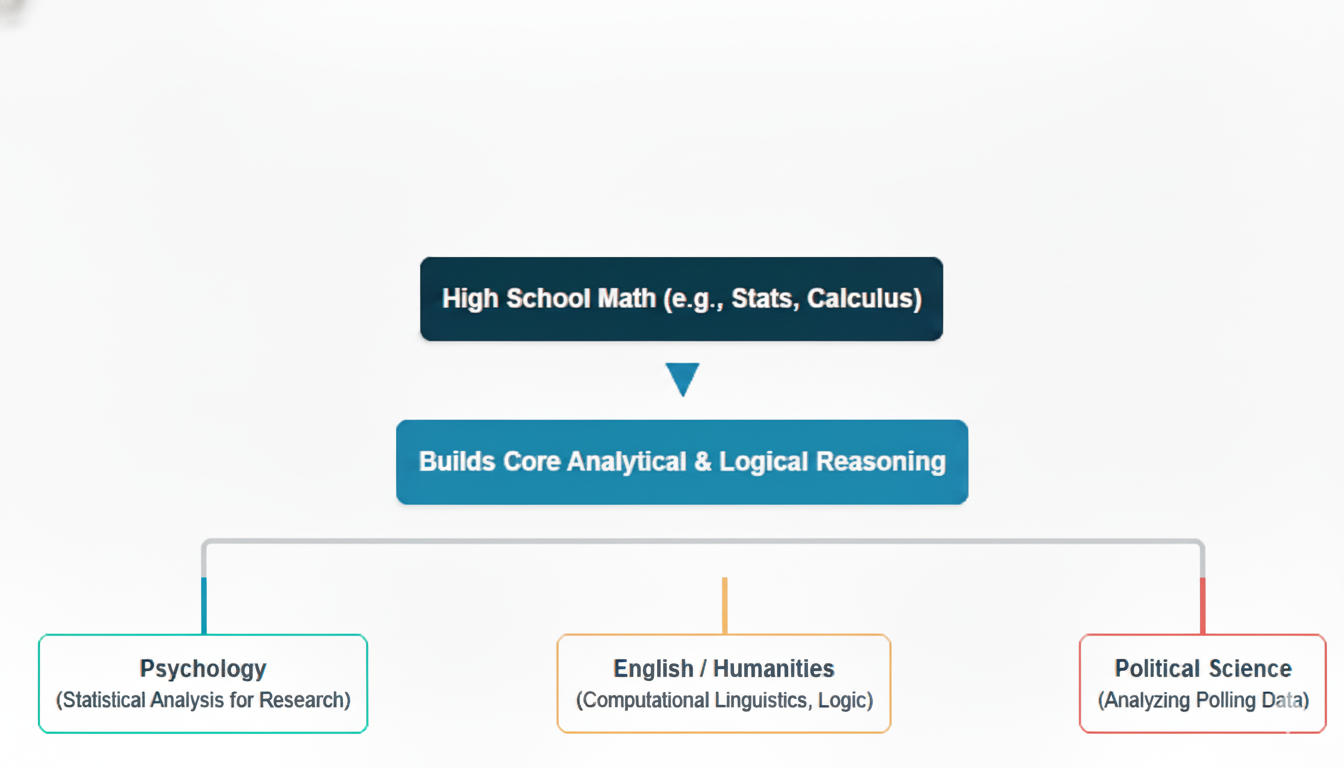
In today's world, data is reframing every single field. A future leader in any industry, whether it's psychology, journalism, or law, needs to be bilingual.
In context:
- 📕 Psychology: To be a good psychologist, you need a deep understanding of statistics to design experiments, collect data, and analyze your findings.
- 📰 Journalism: Nowadays, journalists rely on data analysis to uncover stories, investigate claims, and hold institutions accountable.
- ⚖️ Law: Lawyers depend heavily on quantitative data. For example, statistical analysis can be used to assess the impact of a particular law or policy.
Question: Does Math = More Earnings?
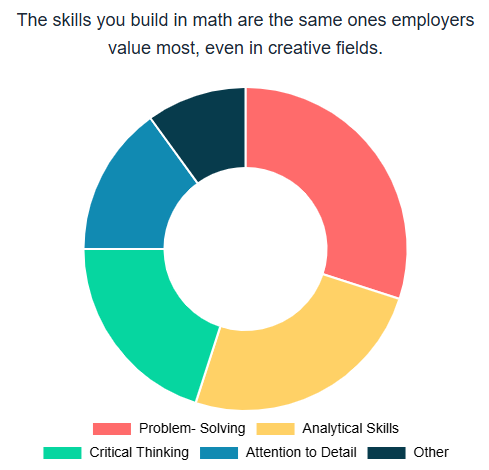
Answer: Studies have shown that math skills are a better predictor of your potential net worth/income than reading scores. People with STEM-related knowledge, even in non-STEM jobs, earn significantly more than their peers.
Decoding University Expectations: Minimums vs. Competitive Reality
This is one of the first things I researched, and the gap is huge.
There's a massive difference between the minimum requirement (just to get your application read) and the competitive reality (to get your application seriously considered).
I looked up the policies at several major universities:
- The University of California requires 3 years of math, but strongly recommends a fourth.
- The University of Texas at Austin requires 3 credits but strongly recommends four.
- Big public flagships like the University of Arizona and the University of Minnesota list four years of math as either a requirement or a firm expectation.
(Sources: UC, UT Austin, Arizona, Minnesota Admission Brochure)
Students who take math in each year of high school are far more successful in college. — National Association for College Admission Counseling (NACAC)
At Harvard, Yale, Stanford, and their peers, the standards for academic rigor are sky-high.
An analysis of the 11 most selective colleges in the US found that while 100% recommend 4 years of English, a whopping 90% also recommend 4 years of math.
| Institution | Recommended Years of Math |
|---|---|
| Harvard University | 4 |
| Yale University | 4 |
| Princeton University | 4 |
| Brown University | 4 |
| Dartmouth College | 4 |
| Columbia University | 4 |
| University of Pennsylvania | 4 |
| Cornell University | 3 |
| University of Chicago | 4 |
| MIT | 4 |
| Stanford University | 4 |
Why Your Course Choices Are More Important Than Your GPA?
Admission officers are aware that GPAs can be misleading. An 'A' in an advanced, college-prep math class is valued far more than an 'A' in a less demanding elective.
It signals to them that you're willing to seek out challenges, you're determined, and you have the mental capability for college-level education.
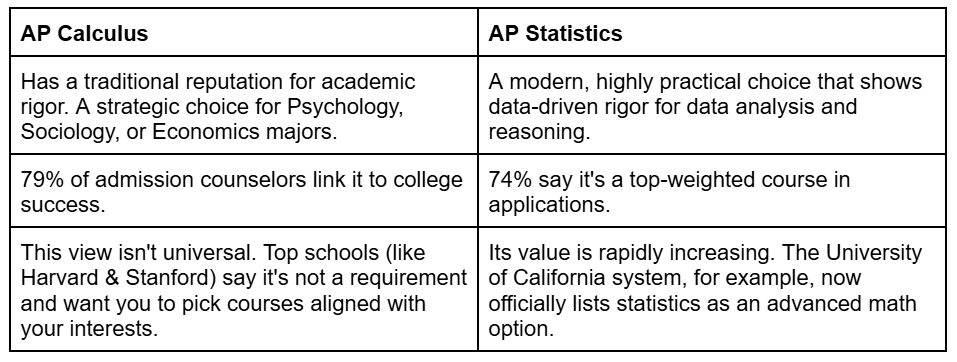
Calculus, Statistics, and Your Strategic Advantage
So, what advanced math should you take? This is a key strategic decision.
How to Convey You are MathFit™ in Your College Applications?
From what I've gathered, admissions officers aren't just looking for a grade; they're looking for this way of thinking.
Here's my advice: Instead of treating math as a separate requirement, you should strategically integrate what Cuemath calls a 'MathFit™ mindset' (the one who thinks mathematically and applies logical thinking in any kind of challenge) into your application narrative to showcase your intellectual versatility.
- In Your College Essays: Write about the intersection of your interests. Talk about how learning statistical significance in AP Stats gave you a new framework for judging historical sources.
- In Your Activities List: Did you analyze data for a science fair? Did you do an independent research project for a history class that used demographic data? Highlight them. This provides concrete proof that you can apply these skills in the real world.
Where Hard Work Turns Into Real Results
Give your child the same structured guidance that helped thousands of students succeed. Try a FREE live Cuemath class today.
Book a Free ClassFor Students in Grades K to 12 Worldwide
Frequently Asked Questions (FAQs)
Ques: How many years of math do I need for college?
Ans: Most colleges require a minimum of 3 years of math. However, popular universities, like the University of California and the University of Texas at Austin, strongly recommend a fourth year. Other public flagship universities, such as the University of Arizona and the University of Minnesota, list four years of math as a requirement.
Ques: Will taking 4 years of math look better than 3 on my application?
Ans: The majority of the top universities in the US recommend 4 years of math. The rest of the colleges require a minimum 3 years of math. However, meeting the minimum makes you eligible; exceeding it gives you a competitive advantage.
Ques: Do I still need to take advanced math if I'm not a STEM major?
Ans: Yes, taking advanced math is a smart choice, even for non-STEM majors to show colleges they are versatile and curious thinkers. For example, fields like psychology, journalism, and law all require data literacy and statistical understanding.
Ques: How can a humanities student mention math in a college essay?
Ans: A humanities student can write about the intersection of their interests. For example, mentioning how learning statistical significance in AP Statistics gave you a new framework for judging historical sources or discussing how the math proofs helped you build stronger arguments in your literary analysis essays.

About the Author
Nikita Joshi
Math Educator | Writer @ Cuemath
Math educator & writer by day, storyteller by night.
View My LinkedIn
Read more

20 Best Online Math Classes for US Students by Grade, Learning Goal, and Budget (2026)
Not all programs are built the same. We reviewed 20 online math classes in the US and matched each one to a grade level, learning goal, and budget so you know exactly where to start.
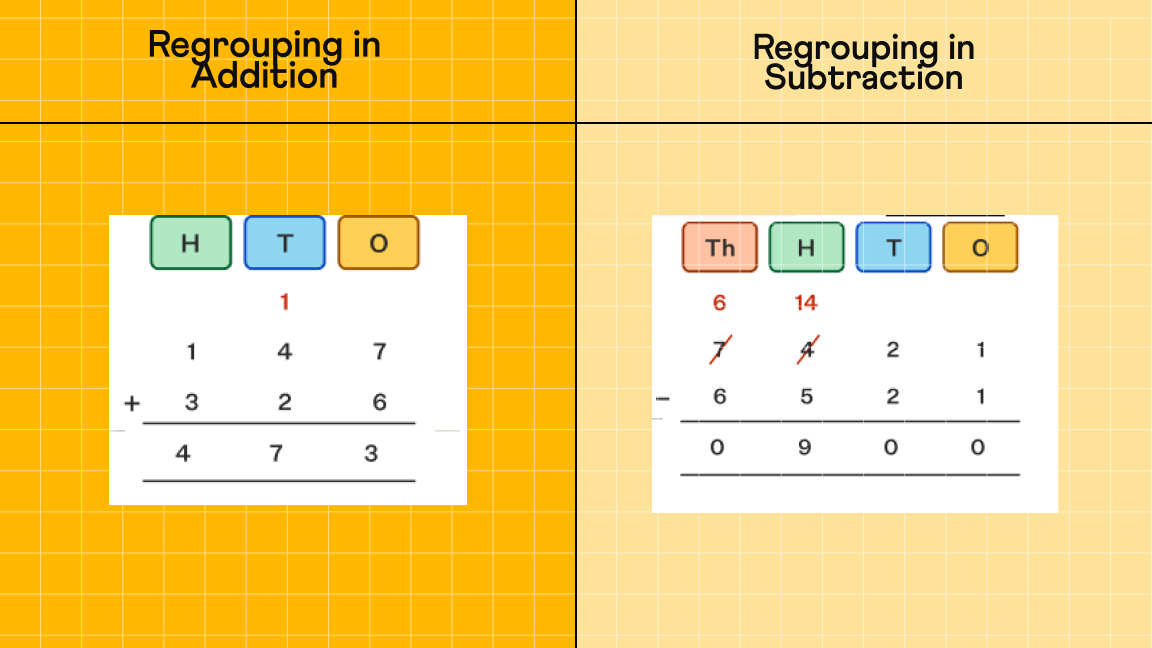
What Is Regrouping in Math? A Complete Guide
Is regrouping in math the same as "borrowing" and "carrying"? Let's find out. This guide breaks down regrouping in addition and subtraction with simple examples, and shows how to help your child practice it at home.

SAT 1350 in Grade 10: The Math Foundation Nikita Madineni Built Before Test Day
Nikita Madineni was in Grade 7 when she joined Cuemath. By Grade 10, she scored 1350 on the SAT in her first sitting. Most students take it two years later.
Math Kangaroo Grade 3 Top Score: How Tavasya Ranked 3rd in Tennessee and 16th in the USA
A Grade 3 student in Tennessee entered Math Kangaroo and scored 79 out of 96. State Rank 3. National Rank 16. This is how Tavasya got there.