9 Signs Your Child Needs a Tutor
Homework that drags on, tests that trigger panic, or fading curiosity—these are signs your child may benefit from targeted math support.


You ask your teenager how math class is going. "Fine," they say, eyes glued to their phone.
But here's what "fine" sometimes hides: A student who once solved problems confidently now second-guesses every answer or freezes during tests. A teen who has lost that spark of curiosity they had when math was just counting blocks and measuring ingredients.
Struggle isn’t always bad, but how do we know when it’s a sign that they need more support?
Drawing on my experience in education and research-backed insights, I’ve identified a few signs that often whisper (and sometimes shout) that it's time to consider a math tutor.
Key Takeaways (TL; DR) :
Your teen might need math support if you notice 3+ of these signs:
1. Homework takes forever - 30-minute assignments stretch to 2-3 hours due to foundational gaps
2. Consistent test anxiety - Understands at home but freezes during tests; anxiety-performance cycle
3. Effort doesn't match results - Studying hard but grades still declining; working harder, not smarter
4. Stopped asking questions - Silence in class signals being too lost, embarrassed, or giving up
5. Every lesson feels new - No connections between concepts; re-learning instead of building
6. Can't explain "why" - Memorizes formulas but can't explain underlying concepts or reasoning
7. "I'm not a math person" - Fixed mindset creates self-fulfilling prophecy of failure
8. Avoids math everywhere - No longer enjoys puzzles, games, or anything math-related
9. Teacher recommends support - Professional observation that individualized help is needed
⚠️ Why waiting is risky: Math gaps compound over time. Students develop coping mechanisms (pattern-matching, formula memorization, strategic guessing) that work temporarily but create long-term barriers for college, careers, and standardized tests.
How Cuemath can help: Online math classes like Cuemath offer 1:1 personalized math sessions with live guidance, interactive problems, and step-by-step support, helping teens close gaps, enjoy learning again, and prepare for high school challenges — and beyond.
- Sign 1: Math Homework Takes Too Long
- Sign 2: Test Anxiety Has Become a Consistent Pattern
- Understanding Math Test Anxiety
- Sign 3: Declining Grades Despite Increased Effort
- Sign 4: Your Teen Has Stopped Asking Questions
- Sign 5: Every New Lesson Feels Like Day One
- Sign 6: Cannot Explain the “Why” Behind Concepts
- Sign 7: Fixed Mindset About Math Ability
- Sign 8: Avoiding Math Outside Schoolwork
- Sign 9: Teacher Recommends Additional Support
- When Should I Consider a Math Tutor for My Child?
- What Happens When Parents Wait Too Long
- Conclusion
- Frequently Asked Questions (FAQs)
Sign 1: Math Homework Takes Too Long
The Homework Time Warning Sign
Math homework or even assignments that should take 30-45 minutes stretch into two or three hours. Your teen erases repeatedly, restarts multiple times, procrastinates, and eventually either rushes through in frustration or gives up entirely.
Why This Happens
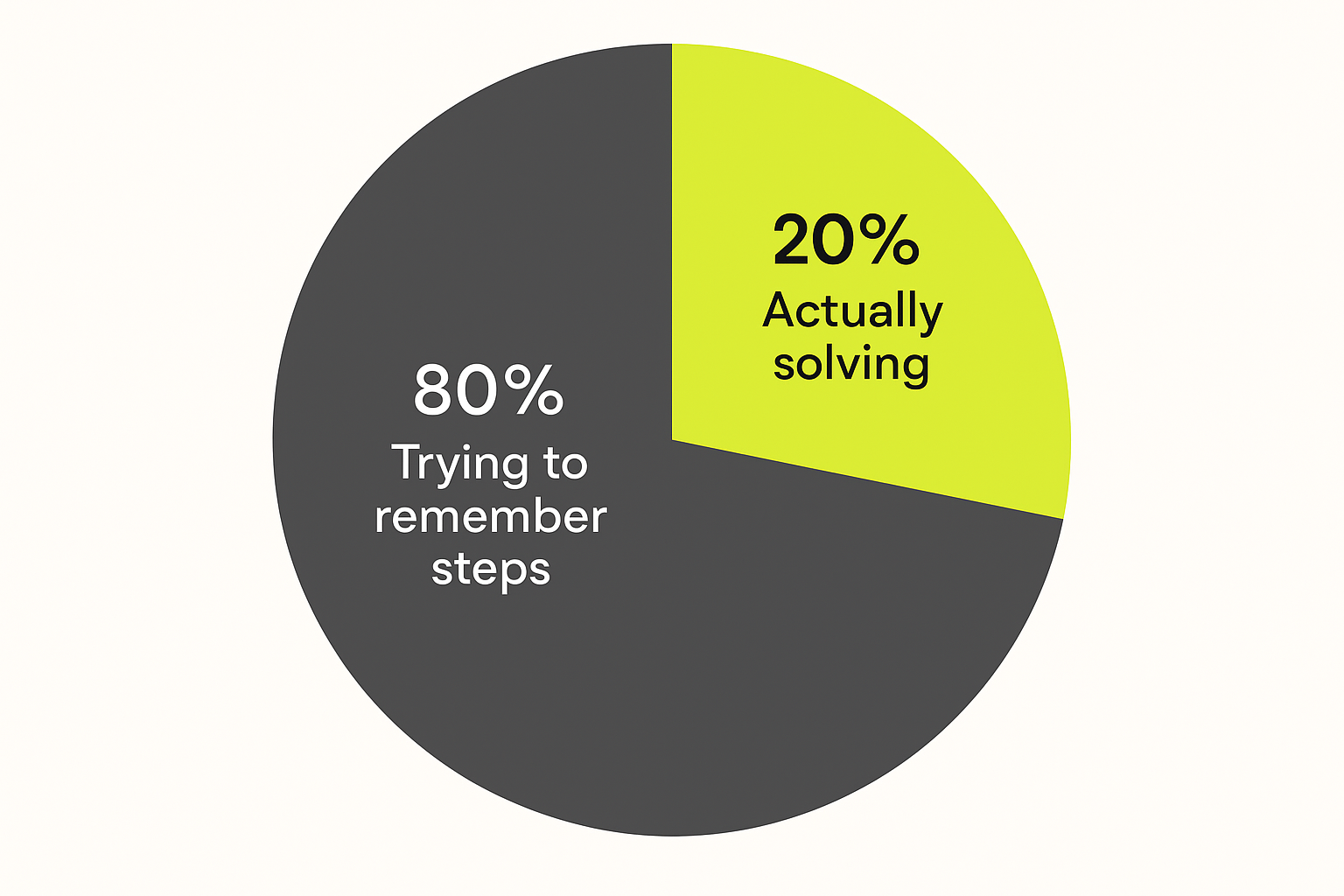
This isn't about laziness or poor time management—it's about cognitive overload from foundational gaps. When core concepts are shaky, every new problem becomes disproportionately difficult. Your teen might be spending 80% of their mental energy trying to recall the required concepts, leaving only 20% for actually solving the problem.
Patterns to Notice
- Stuck at problem initiation: Can't get past the first step
- Repetitive questions: For instance, during homework, your teen keeps asking, “Do I add or multiply here?” even though you just explained it two problems ago. It’s not forgetfulness—it’s a sign they’re following steps without truly understanding why those steps work.
- Topic-specific struggles: Quick with some topics, extremely slow with others
- Increasing avoidance behaviors: Procrastination, distraction-seeking
Sign 2: Test Anxiety Has Become a Consistent Pattern
Understanding Math Test Anxiety
Some pre-test nervousness is normal. However, pay attention when your teen demonstrates solid understanding at home yet consistently underperforms during math tests.
The Anxiety-Performance Cycle
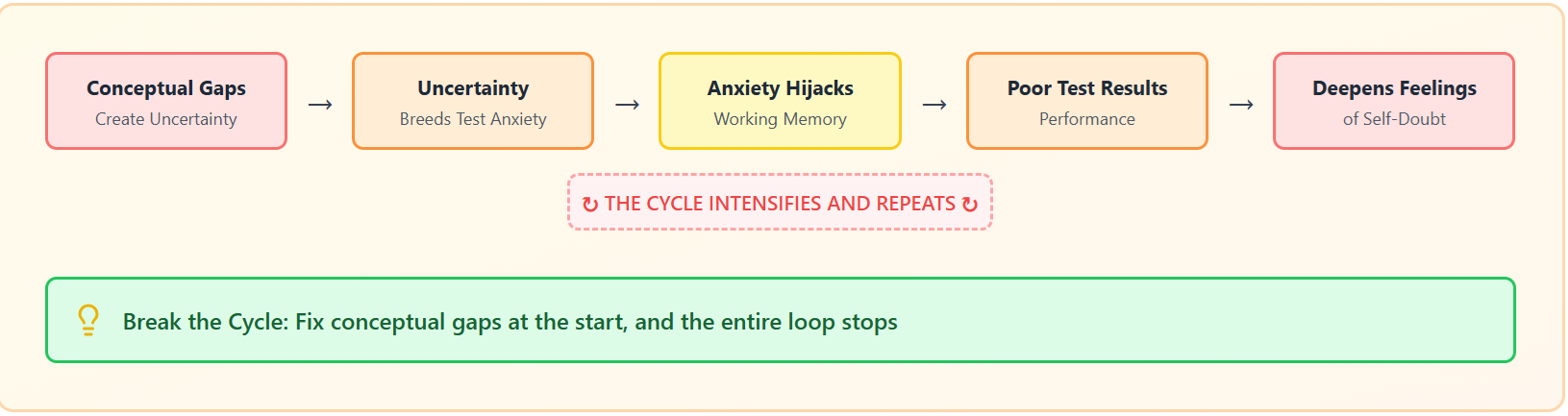
The cycle works like this:
- Conceptual gaps create uncertainty
- Uncertainty breeds test anxiety
- Anxiety hijacks working memory during tests
- Poor test performance deepens feelings of uncertainty
- The cycle intensifies
Key insight: Test anxiety often stems from shaky confidence, which originates from gaps in mathematical understanding.
Sign 3: Declining Grades Despite Visibly Increased Effort
The Effort-Results Disconnect
Your teen is clearly trying! You observe them studying, completing practice problems, and watching tutorial videos. Yet grades continue declining.
Why Effort Alone Isn't Enough
This is perhaps the most frustrating signal for parents because the effort is genuine. The problem? Effort without an effective strategy is like running on a treadmill—lots of energy expended, but no forward movement.
Common Ineffective Study Patterns
Your teen might be:
- Passive re-reading: A student might read through their algebra notes several times and think, “Yes, I know how to solve quadratic equations.” But when given a fresh problem, they freeze.
- Decontextualized practice: Doing problems without understanding the underlying concepts.
- Diffuse studying: Spending hours without targeting specific gaps.
- Ineffective retrieval: Not testing themselves on material from memory.
What This Signals
If studying harder isn't producing results, your teen needs to study differently.
Professional math tutoring provides personalized, targeted instruction addressing specific conceptual gaps rather than generic "more practice."
Sign 4: Your Teen Has Stopped Asking Questions in Math Class
No Questions — A Red Flag
Remember when your child's hand shot up frequently? “Why does that work?”, “Can you show me another way?” Now, the teacher says, she notices silence.
What Silence Really Means
When teens stop asking questions in math class, it rarely indicates sudden comprehensive understanding. More often, it signals one of three problems:
- Too lost to formulate questions: Gaps are so large that they don't know what to ask.
- Social embarrassment: Fear of revealing confusion in front of peers.
- Learned helplessness: Given up on understanding, just trying to survive.
Diagnostic Conversation
Try asking: "What's one thing from math class this week that confused you or seemed interesting?"
If they consistently say "nothing" while grades are declining, that's a warning sign. Confusion they cannot articulate often indicates gaps deeper than they realize.
Sign 5: Every New Lesson Feels Like Day One
Mathematics is fundamentally cumulative. Today's lesson should connect to last week's, which connects to last month's, which builds on last year's foundations.
For some teens, every new chapter feels like learning a completely foreign language. There's no connecting thread, no "aha" moments where concepts click into a coherent system.
Examples of Broken Connections
If your teen is re-learning rather than building, for example, if calculus seems to have no connection to algebra, they’re likely missing the conceptual bridges that link concepts together.
Diagnostic Conversation
Ask your teen: "Can you find a connection between what you're learning now and something you learned last month or last year?"
Sign 6: Your Teen Cannot Explain the “Why” Behind Mathematical Concepts
The Conceptual Understanding Test
Here's a diagnostic conversation you can have today: Ask your teen to explain a concept they recently learned, not just show you the steps, but explain why those steps work.
For example, if they're learning about quadratic equations, ask: "Why do we set the equation equal to zero?" Or with geometry: "Can you explain why the Pythagorean theorem only works for right triangles?
What This Reveals
If your teen can use formulas but can’t explain why, they’re memorizing steps, not understanding concepts.
Research insight: Studies in cognitive science show that conceptual understanding, not just fluency with steps, predicts long-term math success and retention. (Source: Research Paper)
Sign 7: Your Teen Has Adopted a Fixed Mindset About Math Ability
The "I'm Not a Math Person" Belief System
Listen carefully to how your teen talks about themselves and mathematics:
"I'm just not good at this."
"Math isn't my thing."
"I don't have a math brain."
"Some people are math people, I'm not one of them."
Why This Matters
These statements sound like harmless self-assessment, but they represent a fixed mindset, the belief that mathematical ability is innate and unchangeable.
The Self-Fulfilling Prophecy Effect
Research by Carol Dweck and colleagues demonstrates that a fixed mindset becomes self-fulfilling:
- Students believe ability is fixed
- They interpret struggles as proof of inadequacy
- They reduce meaningful effort
- They do the minimum to survive rather than engage with curiosity
- Limited engagement confirms initial belief
The Growth Mindset Truth
Here's what teens need to understand: Mathematical thinking is built, not born. Neural pathways strengthen with deliberate practice and proper guidance. (Source: Research Paper)
The phrase "I'm not a math person" really means "I haven't had the right support and instruction to build these skills yet."
Sign 8: Avoiding Math Outside of Schoolwork
The Behaviour Pattern
Your teen used to enjoy puzzle apps, strategy games, logic problems, or building projects. Now they actively avoid anything involving mathematical thinking.
Why does this develop?
This behavior is psychologically protective. The teens steer clear of situations where they might fail or feel incompetent. However, this also means:
- Lost opportunities to see math's practical applications.
- Reduced exposure to mathematical reasoning in natural contexts.
- Reinforcement of "math is punishment" rather than "math is problem-solving".
What Healthy Math Engagement Looks Like
Math should feel like:
- Problem-solving and pattern-finding
- Logical thinking and creative reasoning
- A tool for understanding the world
Diagnostic Scenario
Consider this: Would your teen willingly help a younger sibling with math homework? Or would they find excuses to avoid it?
At the kitchen table, your younger one asks, “How do you find 25% of 80?” Your teen glances over, hesitates, then says, “I’m not sure—ask Mom.” It’s a small moment, but it quietly reveals how comfortable (or uncomfortable) they really feel with math when the pressure is off.
Sign 9: Teacher Recommends Additional Support
The Professional Observation Signal
Sometimes the clearest indicator comes from the person who observes your teen's mathematical thinking five days per week: their math teacher.
Understanding Teacher Recommendations
When teachers recommend tutoring or additional math support,
-A judgment on your teen's intelligence.
-A criticism of your parenting.
-An indication of a learning disability (necessarily)
Common Parent Hesitations
- Hope that your teen will "catch up independently"
- Concern that tutoring stigmatizes them
- Worry about cost or time commitment
- Uncertainty about finding quality tutoring
- Belief that struggling "builds character"
When Should I Consider a Math Tutor for My Child?
If you recognized your teen in three or more of these signals, it's worth exploring support options.
But here's what matters most: Not just any tutoring, but the right kind.
Look for approaches that:
- Focus on conceptual understanding, not just procedural steps.
- Encourage your teen to explain their thinking (retrieval strengthens learning).
- Connect new concepts to previously learned material.
- Build genuine confidence through mastery, not just quick fixes before tests.
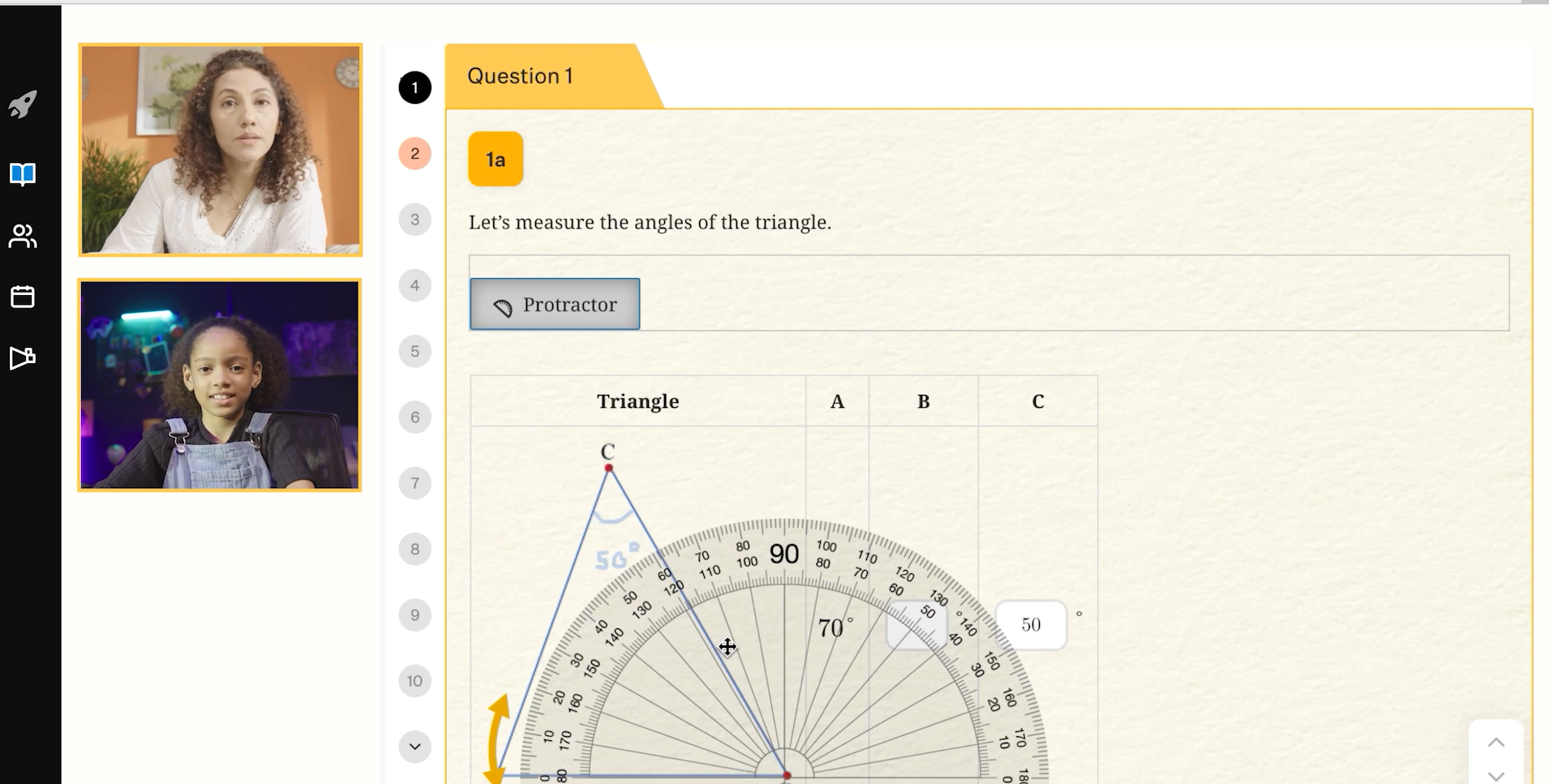
- Consider specialized math programs: Programs like Cuemath offer structured approaches designed specifically for building mathematical understanding:
When your teen can close their book and explain mathematical concepts in their own words—when they can teach it to someone else—that's when you know true understanding has taken root.
What Happens When Parents Wait Too Long to Get Math Tutoring
Small gaps widen quickly. By senior year in high school, foundational issues make algebra, geometry, or SAT math far harder. Students start memorizing formulas without understanding, and their math confidence drops further.
Early support isn’t about grades; it’s about making learning lighter.
Conclusion
If your teen were struggling to read, would you wait and hope it resolved itself?
Mathematical literacy is just as vital — it’s the foundation for logical thinking, confident problem-solving, and success in a data-driven world.
As an educator, I’ve seen how the right math tutoring can completely change a student’s relationship with learning. With consistent guidance and conceptual clarity, students don’t just improve their grades — they rediscover confidence and curiosity.
Take a moment to reflect: What signs of struggle have you noticed in your teen, even if you’ve brushed them aside? Imagine how things could improve with structured, expert support from a trusted program like Cuemath.
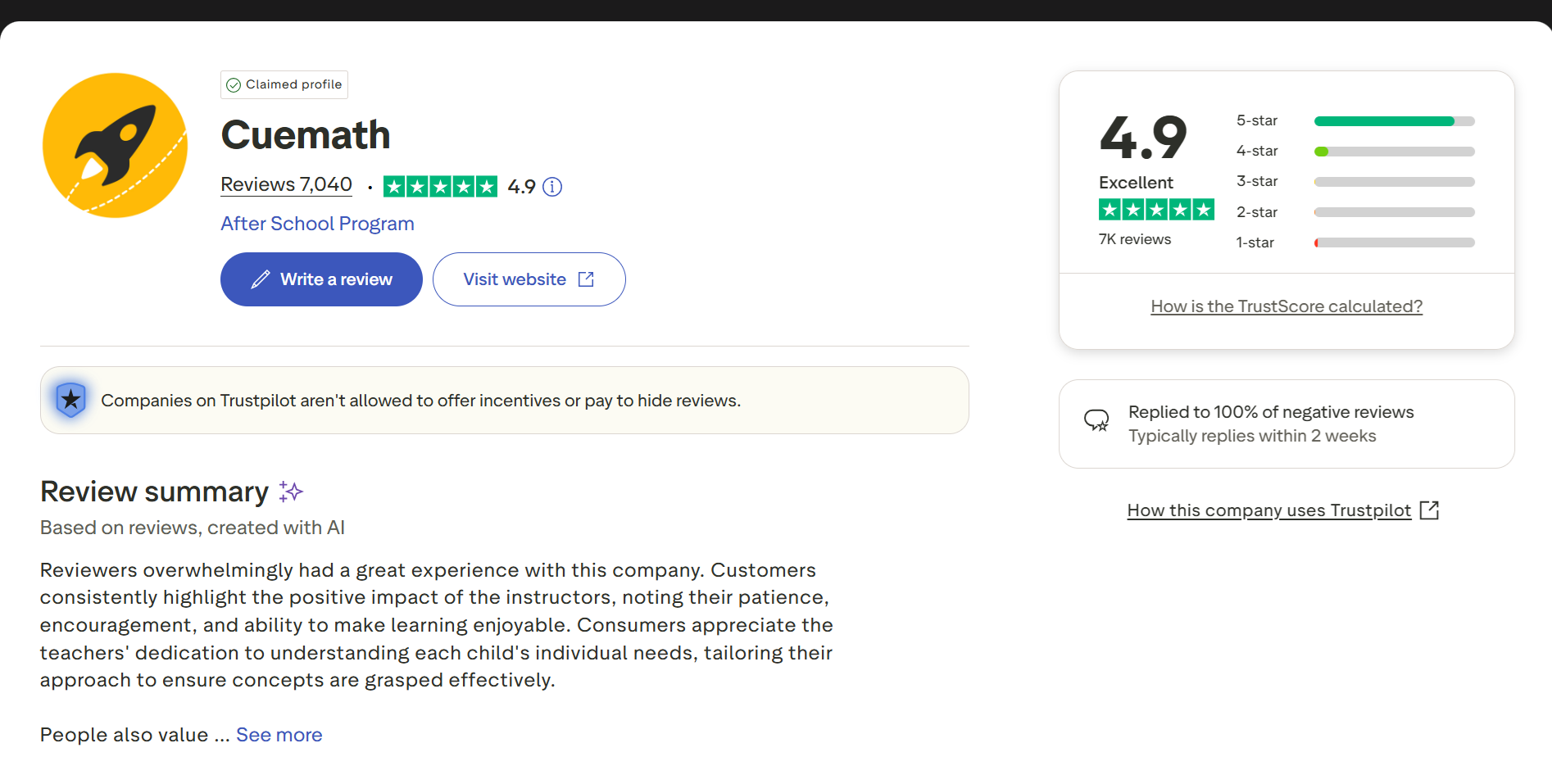
Cuemath offers personalized live 1:1 online math classes for students from Kindergarten through Grade 12, designed to build understanding, confidence, and problem-solving skills step by step. Check out the reviews on Trustpilot, and see why so many parents rely on Cuemath to help their children succeed.
Sometimes, the smallest step — a single tutoring session — can become the turning point in your teen’s academic journey.
Worried your teen might be struggling silently?
A short conversation with a qualified math tutor can make all the difference.
Book a free Cuemath trial class and see how 1: 1 personalized math support works.
Frequently Asked Questions (FAQs)
Q1: How soon will my teen see results from math tutoring?
Most teens show improved confidence and faster problem-solving within 3–4 weeks when sessions focus on conceptual understanding rather than rote drills.
Q2: My teen says they don’t need a math tutor—what should I do?
Instead of phrasing it as a 'tutor,' position it as 'math help' or 'guided sessions' to make math feel easier, not harder. A short Cuemath-style diagnostic session often helps teens see the value themselves.
Q3: Is online math tutoring as effective as in-person tutoring?
Yes—research shows personalized, interactive online programs (like Cuemath) can match or outperform traditional tutoring in engagement and progress.
Q4: Can math tutoring really help with test anxiety?
Absolutely. Consistent, low-pressure practice rebuilds confidence and breaks the anxiety loop many teens develop around math exams.

About the Author
Neelima Kotamaju
Educator
With 10+ years in EdTech, I design learning experiences rooted in pedagogy, classroom insights, and child psychology, ensuring my work is meaningful and engaging.
View My LinkedIn