
Math Facts Practice: The Math-Fit Foundation for Mental Math & Fluency
Build strong math facts through meaningful, strategy-based practice that develops number sense and confidence. Discover how the MathFit approach helps children move beyond memorization to true arithmetic fluency.

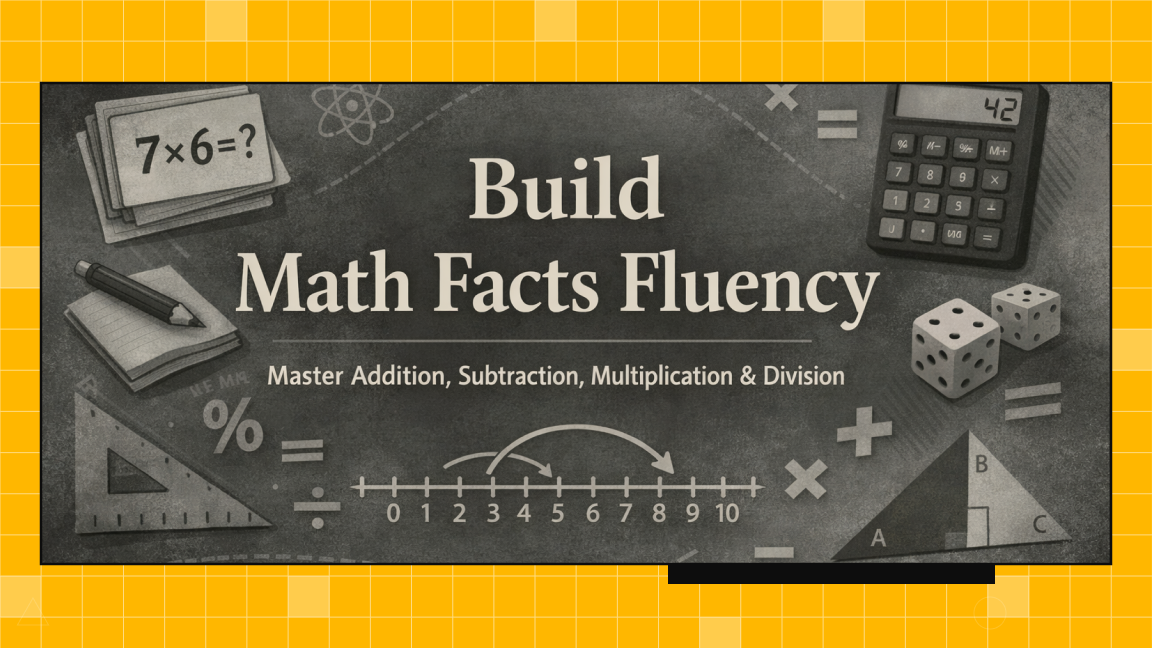
“I’m just not a math person.”
You’ve heard it. Maybe you’ve even said it. But math ability isn’t something you’re born with; it’s something you build, starting with the basics.
Those basics are math facts—addition, subtraction, multiplication, and division. When most of us think of math facts, we picture endless flashcards and timed drills. But there's so much more to mastering basic arithmetic than simple memorization.
It’s about understanding patterns, building number sense, and developing fluency. Think of math facts as the foundation of a house. When the foundation is strong, everything else in math becomes easier.
In this blog, we’ll explore what math facts really are, why they matter, and how the MathFit approach of Cuemath helps students build true confidence in math facts—not just quick recall.
Let’s dive in.
Key Takeaways — TL;DR Math Facts Practice
What Are Math Facts?
Basic addition, subtraction, multiplication, and division facts that students recall and apply fluently — not through memorization alone, but by understanding number patterns and relationships.
Why Are Math Facts Important in an AI-Driven World?
Strong math facts free up mental space for reasoning and problem-solving. In an AI-driven world, students who are MathFit don’t just get answers—they understand why and solve strategically.
What Is the MathFit Approach for Math Facts & Mental Math Fluency?
Cuemath's MathFit approach builds both mindset and skills — using visual models, smart strategies, and growth thinking so students understand math facts, apply them flexibly, and build lasting confidence.
Table of Contents
- What Are Math Facts?
- Why Math Facts Matter
- Strategies That Build Real Math Facts Fluency & Mental Math Skills
- Making Math Facts Stick: Practical Tips
- The MathFit Approach to Math Facts: Building Both Mindset and Skills
- Your Path Forward to Math Facts Fluency
- Frequently Asked Questions about Math Facts
What Are Math Facts?
Math facts are the basic operations in arithmetic that become second nature with practice: addition, subtraction, multiplication, and division. These are the building blocks that every student needs to confidently tackle more complex mathematical concepts. When a student instantly knows that 7 + 8 = 15 or 6 × 7 = 42, they can focus their mental energy on problem-solving rather than basic calculations.
Why Math Facts Matter
Students who develop strong fluency in math facts are better equipped to handle complex problem-solving. When basic facts become automatic, working memory is freed up for higher-level thinking.
This isn't just about speed—it's about building mathematical confidence.
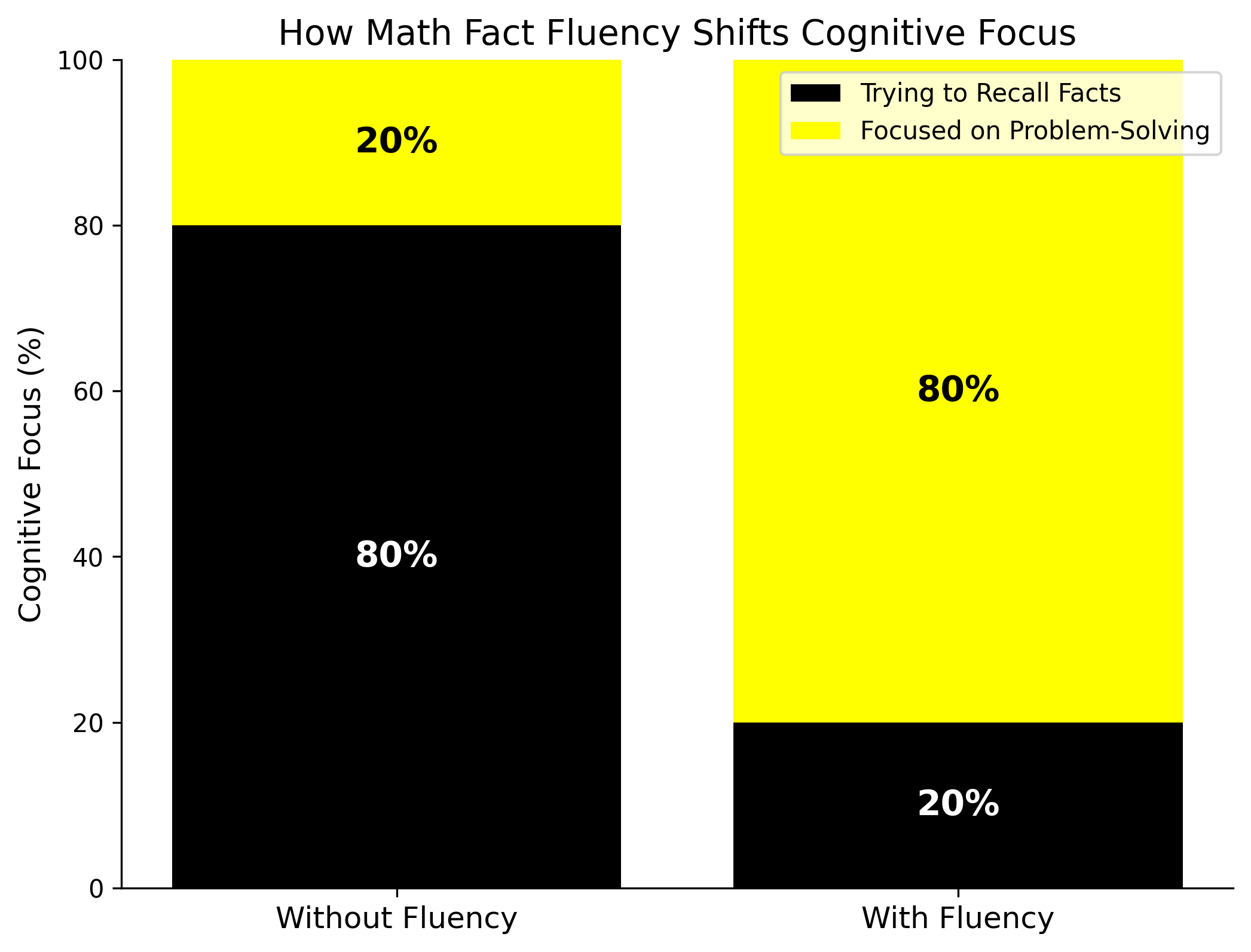
Consider this: a student struggling to recall 9 × 8 while solving a word problem will lose track of the bigger picture. But a student who knows their facts fluently can focus on understanding the problem and how to approach it strategically.
Strategies That Build Real Math Facts Fluency & Mental Math Skills
Traditional math facts programs often depend on rote memorization—using flashcards, repetitive drills, and constant repetition to reinforce answers. But memorizing math facts without understanding doesn’t build true fluency. Students don’t just need answers — they need to see how numbers connect.
Strong math facts fluency comes from understanding relationships between numbers.
Modern learning approaches bring math facts to life through visual models such as number lines, area models, and ten-frames. These tools help students see patterns instead of guessing or drilling.
Take this example:
To solve 48 + 27, think:
(40 + 20) + (8 + 7)
Add the tens.
Add the ones.
Then combine.
Now the answer isn’t random — it makes sense.
This is how math facts build number sense. Students begin to recognize that math facts are connected patterns. When children understand how numbers work together, math becomes logical, flexible, and faster — not stressful.
That’s the difference between memorizing math facts and mastering them.
Making Math Facts Stick: Practical Tips
1. Use Visual Tools to make Math Facts Stick
Visual models, simulations, hand-on activities help students understand why math works.
Example:
For 4 × 3, draw an array with 4 rows and 3 dots in each row. Students can count 12 and see multiplication as equal groups.
2. Connect Math Facts to Real Life
Math facts become meaningful when students use them in everyday situations.
Example:
At a store, if something costs $8 and you pay with $10, how much change should you get?
Thinking 10 − 8 = 2 makes subtraction purposeful.
Or while baking: doubling a recipe that needs 3 cups of flour → 3 + 3 = 6 cups.
3. Build on Known Math Facts
New facts can grow from familiar ones.
Example:
If a student knows 6 + 6 = 12, then
6 + 7 = 13 (just one more).
If they know 5 × 7 = 35, then
6 × 7 = 35 + 7 = 42.
4. Practice with Purpose for Arithematic Fluency
Practice should strengthen thinking, not just speed.
Example:
Instead of solving 20 random problems, ask:
“How many different ways can you make 15?”
(10 + 5, 12 + 3, 20 − 5, 3 × 5).
This builds flexibility and number sense.
5. Celebrate Progress
Confidence grows when effort is recognized.
Example:
If a child used to take 30 seconds to solve 86 × 8 and now takes 20 seconds—or explains their strategy clearly—that’s progress worth celebrating.
Praise strategies and persistence, not just correct answers.
Video explaining how fluency in fractions is built on division math facts
The MathFit Approach to Math Facts: Building Both Mindset and Skills
This is where Cuemath's innovative MathFit approach comes into play. Being MathFit means developing both the right mindset and the necessary skills—not just one or the other.
The MathFit Mindset
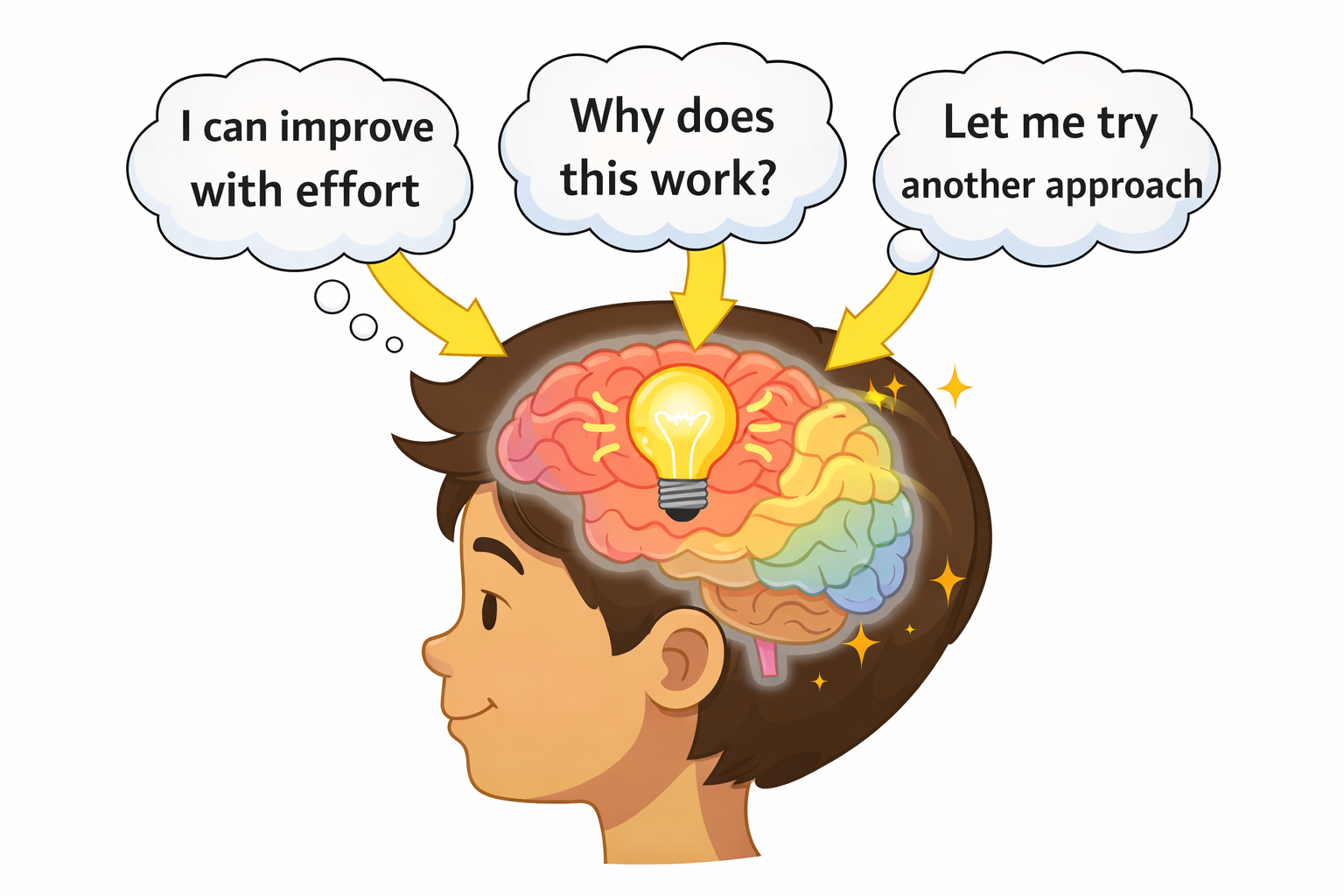
A MathFit mindset says, “I can improve with effort,” “Why does this work?” and “Let me try another approach.” This growth-oriented thinking transforms how students approach multiplication, addition, and other foundational math facts.
Instead of getting stuck or fearing mistakes, MathFit students pause and think strategically:
🟦 Multiplying by 10
Can I use place value?
6 × 10 → Just add a zero → 60
🟦Two-Digit Addition
Can I add tens first?
34 + 25 → (30 + 20) + (4 + 5) = 50 + 9 = 59
🟦 Two-Digit Subtraction
Can I count up instead of subtracting?
52 − 48 → 48 → 50 (+2) → 52 (+2) = 4
🟦 Area (Arrays)
Can I see it as rows and columns?
3 rows of 7 → 3 × 7 = 21
🟦 Fractions (elementary Level)
Can I picture equal parts?
If a shape has 8 equal parts and 4 are shaded → 4/8 = 1/2
🟦 Perimeter
Can I add all the sides carefully?
Rectangle with sides 6 and 4 → 6 + 4 + 6 + 4
It’s not about memorizing. It’s about choosing a smart strategy.
Mistakes become learning opportunities to strengthen number sense, not evidence that they’re “bad at math.” Over time, this mindset builds both confidence and true fluency in math facts.
MathFit Skills
MathFit students build strong fluency in math facts and mental math while developing deep conceptual understanding. They learn to explain their thinking clearly, reason step by step, break complex problems into manageable parts, and estimate and check their answers with confidence.
These aren’t just academic abilities — they’re lifelong problem-solving skills.
The MathFit approach shows that success in math isn’t about innate talent. It’s about mindset, persistence, practice, and the right guidance to build deep understanding.
At Cuemath, students learn math the MathFit way: first mastering math facts through visual and interactive tools, then applying those math facts to reasoning, word problems, and real-world situations.
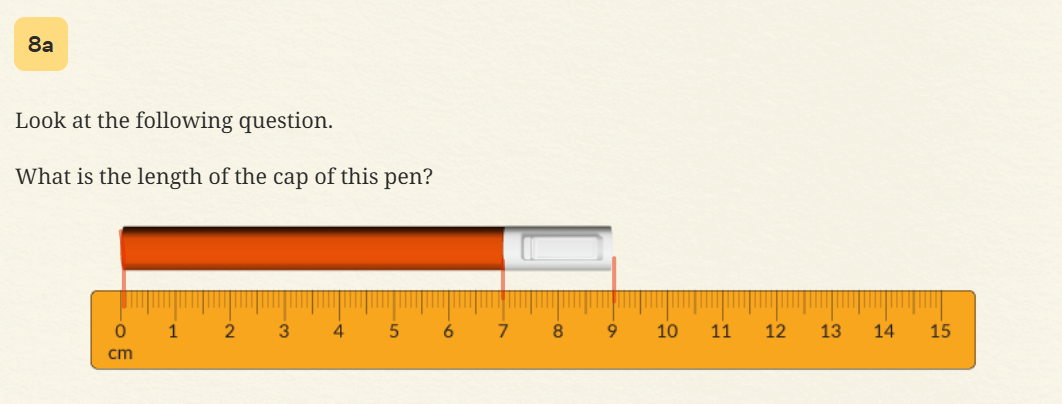
Try this question with a Grade 2 child:
Answer:
The length of the cap is 2 cm as it starts at 7 cm on the scale and ends at 9 cm.
Discover your child’s math strengths by grade.
Start the MathFit Evaluation today and get a tailored learning plan.
Your Path Forward to Math Facts Fluency
Mastering math facts is a journey — not about speed alone, but about understanding how numbers work together.
The goal isn’t to create human calculators. It’s to build confident thinkers who can solve unfamiliar problems with clarity. That’s what being MathFit — and achieving real math facts fluency — means.
In an AI-driven world, computation is automated. But clear thinking, pattern recognition, estimation, and reasoning? Those skills matter more than ever. Students who are MathFit don’t just get answers — they understand why those answers make sense. That ability to analyze, question, and solve strategically is what keeps math relevant in the age of AI.
Focus on understanding patterns. Use visual models. Practice consistently. Trust the power of effort and growth.
Every child can become MathFit—it just takes the right approach.
Remember: it's not about being naturally good at math—it's about building the right habits, mindset, and skills that make mathematical thinking second nature.
Ready to build lasting fluency in math facts?
Become MathFit—in every way.
 Pooja Purohit
Frequently Asked Questions about Math Facts
What are math facts?
Math facts are basic arithmetic operations—addition facts, subtraction facts, multiplication facts, and division facts—that students recall quickly and accurately, like 7 + 8 = 15 or 6 × 7 = 42.
At what age should children learn math facts?
Addition and subtraction facts typically start in grades 1-2, while multiplication and division facts come in grades 3-4. Math facts mastery develops gradually at each child's own pace. Programs such as Cuemath start the journey to math fact fluency through the MathFit approach to math from elementary school itself
Is memorization effective for math facts?
No. Research shows memorizing math facts without understanding doesn't build true fluency. Students need to see patterns and relationships in math facts, not just drill isolated operations.
How can I tell if my child struggles with math facts?
Watch for heavy finger counting, long pauses (7+ seconds) for basic math facts, or math anxiety. These signal a need for strategy-based practice of math facts. Try the MathFit evaluation from Cuemath for your child for better insights.
Are timed tests good for math facts learning?
While some speed practice helps math facts automaticity, excessive timed tests cause math anxiety. Focus on understanding math facts first, then build fluency through practice and games.
How much math facts practice is needed?
Short, daily math fact practice (10-15 minutes) beats marathon sessions. Students who practise math facts strategically can master about 10 new facts each week. Download gamified learning apps such as Cuemath and practice 15 minutes every day for Math Facts Fluency.
How can I make math facts practice fun?
Turn math facts practice into games—Math War for addition facts, dice for multiplication facts, scavenger hunts, or incorporate math facts into cooking and shopping.
How can I make math facts practice effective?
Effective math facts practice goes beyond memorization. Use short daily sessions, focus on number patterns and visual strategies, and connect math facts to real-life situations. Encourage multiple approaches and celebrate effort to build lasting fluency and confidence.
How does Cuemath differ from traditional math facts methods?
Cuemath's MathFit approach combines mindset with math facts skills. Instead of drilling math facts, it develops deep understanding, problem-solving strategies, and confidence through visual tools, interactive simulations, and expert 1-on-1 tutoring—leading to lasting fluency in math facts.
 Neelima Kotamraju

About the Author
Neelima Kotamraju
Math & Science Educator
Turning confusion into curiosity, and curiosity into confident learning.
View My LinkedIn
Read more
20 Math Facts That Will Change the Way You See Numbers
Explore 20 cool math facts that make learning numbers exciting! From mind-bending patterns to surprising number secrets, these facts go beyond memorisation and help build deeper mathematical thinking.
Best Online Math Programs in USA Recommended by Parents (2026)
In this blog, I review the top online math programs in the USA recommended by parents. Out of those, I find one that checks all requirements from elementary school to high school & beyond.
Best Online Math Tutors in the USA (2026): How to Choose the Right One?
Finding the best online math tutor in the USA isn’t as simple. Every platform claims to have expert tutors and proven results. But what does best really mean? Is it years of experience? Affordable pricing? Fun, game-based lessons? Or consistent academic improvement you can actually see?

Pranav’s Math Journey to UW-Madison Engineering
Starting his math journey in 2021, Pranav has secured admission to the University of Wisconsin–Madison for Computer Engineering. Know how.