
New Math vs Old Math: Differences, Grade-wise Examples for Parents
Is your child’s math homework looking different? You know how to get the right answer, but you have no idea how their teacher wants them to get there. Here's what actually changed, why it changed, and how to help your child understand new math better.

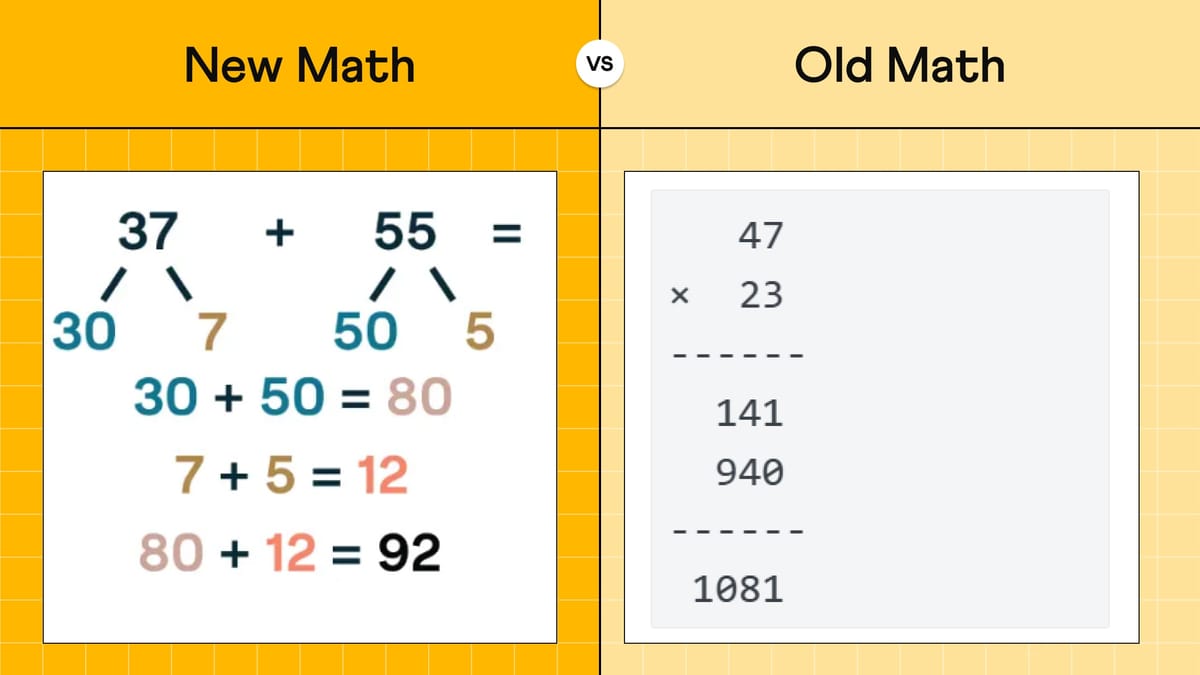
We all use new math every day. When you're at a store and calculate that 30% off $85 means roughly $25 off, by first finding 10% ($8.50) and then tripling it → that's decomposition. That's exactly the mental math strategy Common Core is teaching your child.
You just learned it on your own, informally, because the old way didn't teach it to you at all. Your child is getting it as a structured skill.
The Short Answer
Old math taught students what to do, i.e., memorize the steps, follow the formula, and get the answer.New math (also called Common Core math) teaches students why the logic and the formula work, understand the concept first, and then apply it to any problem.
Both methods get to the same answer. The path looks completely different.
For example, if you see your child draw number lines to subtract, split numbers into easy values to add, or use a box grid to multiply → that is new math.
What is Old Math? (What Most Parents Understand)
Old math is traditional math. Old math is the way most US parents learned from the 1960s through the early 2000s.
The defining feature of old math is rote memorization and standard algorithms. You memorized your multiplication tables. You memorized that to divide fractions, you flip and multiply. You didn't need to understand why flipping worked; you just knew that it did.
Old math seems easy and familiar. The problem that tutors identified over decades is this: students who learned the old math way often couldn't adapt when the problem looked slightly different.
It’s like they had the recipe but not the cooking skills.
What is New Math? (What Your Child is Learning Now)
New math refers to the Common Core State Standards for Mathematics, adopted by most US states between 2010 and 2013.
The core shift in new math is this: before students learn a procedure, they are taught to understand the concept behind it.
For example, instead of just learning to carry the 1 in addition, students learn why carrying works, because 10 ones become 1 ten, and that ten belongs in the tens column. Once a student truly understands that, they can apply it to decimals, fractions, and algebra without needing a new set of memorized rules for each.
Common Core math expects students to:
- Visualize problems (number lines, area models, base-10 blocks)
- Explain their reasoning, not just write an answer
- Apply concepts to real-world problems
- Solve problems in multiple ways, not just one standard method
Why Did Old Math Change to New Math?
This is the question I hear most from parents. The short answer is: American students were falling behind, and memorization wasn't enough anymore.
Students could pass procedural tests but struggled when problems required applying math in unfamiliar contexts. And surprisingly, this is the exact skill students need to get into their dream college, STEM courses, engineering, or data science.
Hence, the Common Core State Standards were officially released in 2010.
New Math vs. Old Math: Side-by-Side Examples by Grade
Let's look at exactly what your child's homework might look like, and the old math equivalent you probably remember.
New Math Addition (Grades 1–3)
Old Math: Stack the numbers. Add right to left. Carry when needed.
  47
+ 36
----
  83
New Math (Decomposition Method): Break numbers into tens and ones first.
- 47 → 40 + 7
- 36 → 30 + 6
- Add tens: 40 + 30 = 70
- Add ones: 7 + 6 = 13
- Combine: 70 + 13 = 83
Subtraction (Grades 2–4)
Old Math: Stack, borrow, subtract right to left.
  52
- 27
----
  25
New Math (Number Line / Jump Strategy): Start at 27, count up to 52.
- 27 → 30 (jump of 3)
- 30 → 50 (jump of 20)
- 50 → 52 (jump of 2)
- Total jumps: 3 + 20 + 2 = 25
New Math Multiplication (Grades 3–5)
Old Math: Memorize times tables. Use long multiplication.
   47
×  23
------
  141
  940
------
 1081
New Math (Area Model / Box Method): Break 47 into 40 + 7. Break 23 into 20 + 3. Draw a 2×2 grid:
| 40 | 7 | |
|---|---|---|
| 20 | 800 | 140 |
| 3 | 120 | 21 |
Add all four boxes: 800 + 140 + 120 + 21 = 1,081
Division (Grades 4–6)
Old Math: Long division algorithm. Steps memorized in sequence.
New Math (Partial Quotients): Use what you already know to chip away at the problem.
For 432 ÷ 16:
16 × 20 = 320
432 − 320 = 112

16 × 7 = 112
112 − 112 = 0
- 16 × 20 = 320 → subtract: 432 − 320 = 112
- 16 × 7 = 112 → subtract: 112 − 112 = 0
- Answer: 20 + 7 = 27
New Math Fractions (Grades 3–7)
Old Math: Learn the procedure. To divide fractions, flip and multiply. Trust it.
New Math: Show why dividing by ½ is the same as multiplying by 2 — using visual models like fraction bars or number lines before introducing any formula.
Decimal Multiplication (Grades 5–6)
This is one of the most common points of confusion for parents of 5th and 6th graders — and the method difference is stark.
Old Math: Line up the numbers, multiply as whole numbers, then count decimal places and insert the decimal point.
  1.2
× 3.4
------
   48
  360
------
  408  → place decimal = 4.08
New Math (Number Line / Area Model): Use a visual grid to show what 1.2 × 3.4 actually means — 1.2 groups of 3.4.
Break 1.2 into 1 + 0.2. Break 3.4 into 3 + 0.4. Draw a 2×2 grid:
| 3 | 0.4 | |
|---|---|---|
| 1 | 3.0 | 0.4 |
| 0.2 | 0.6 | 0.08 |
Add all four boxes: 3.0 + 0.4 + 0.6 + 0.08 = 4.08
Is New Math Better Than Old Math? What the Research Actually Says
I read a lot of surveys and research studies focusing on the impact of introducing new math. There is a mix of opinions around new math vs old math. Here are some insights:
In favor of new math/Common Core:
- A 2019 study published in Educational Researcher found that states that implemented Common Core math -> their students got higher math scores in 4th and 8th-grade on the National Assessment of Educational Progress (NAEP).
- Countries that use similar conceptual-first approaches (Singapore, Japan, Finland) consistently outperform the US on international assessments like PISA and TIMSS.
In favor of old math:
- A 2023 analysis found that some states that retained a stronger emphasis on standard algorithms showed comparable or better test score outcomes when teacher implementation of Common Core was inconsistent.
- Many parents and some educators argue that students still need to master standard algorithms for speed and efficiency, especially in higher-level math.
The Conclusion: New math, when taught well, helps students to think mathematically in daily life. The problem has never been the concept; it's been inconsistent teacher training and parent confusion, causing children to fall through the gap between classroom and home.
The Real Problem: Parents Are Not Trained in Common Core Math Ways
This is one of the typical situations in every household:
Your child comes home with a math worksheet. You teach them the way you learned (the old math way). It gives the right answer.
The next day, their teacher marked it wrong. Or worse, your child gets the right answer but can't explain their thinking on the test, because they followed the old math method, not the new math method.
A survey by the National Center for Families Learning (NCFL) found that more than 60% of parents with children in grades K–8 admit they have trouble helping with their children's math homework. When researchers asked why, the top answer wasn't "I don't have time." It was "I don't understand the subject matter" (cited by 46.5% of parents).
The problem is curriculum change, not parental effort.
This is exactly why many parents are turning to 1:1 tutoring with someone who understands both what Common Core actually requires and how to build the conceptual foundation that makes it click.
How Cuemath Bridges New Math and Old Math?
Cuemath's tutors aren't just any tutors. Only 1 in 100 applicants gets selected, each for a specific grade band (elementary, middle, or high school), and is experienced in the US Common Core standards.
That means when your child's 4th-grade school teacher assigns area model multiplication or their 6th-grade school teacher introduces integer operations on a number line, their Cuemath tutor already knows exactly what's being asked, and teaches as per the new math standards. There's no re-explaining between school and tutoring.
Every Cuemath class happens on the LEAP platform. It is a live, shared whiteboard where tutors and students work through problems together in real time.
Before a student practices a method, they understand why it works through interactive simulations, guided questions, and hands-on problem solving.
Students don't watch Cuemath tutors solve problems. They solve them. The tutor guides every step.
Students practice on the Cuemath MathGym App with logic puzzles and strategy games that reinforce the same conceptual thinking their tutor builds in class.
The Cuemath app turns practice into play without losing the math.
Cuemath's 1:1 sessions start at $20 per class, with a free math assessment tool called the MathFit Evaluation that identifies exactly where your child's gap is before the first paid class begins.
Try a Free 1:1 Cuemath Class
See how your child learns with visuals, simulations, and mental-math strategies in a 1:1 session with a Cuemath tutor.
Book a Free Class200K+ Students • 4.9+ Trustpilot Rating • 80+ Countries
New Math vs Old Math: What has Changed Grade-wise?
| Grade Range | Key New Math Concepts | How It Differs From Old Math | What to Watch For |
|---|---|---|---|
| K–2 | Number sense, ten-frames, counting strategies | Emphasis on understanding quantity before operations | Slow pace can feel boring, but it's intentional |
| 3–5 | Area model multiplication, partial quotients, fraction models | Visual methods replace memorized algorithms | Strong foundation here prevents algebra struggles later |
| 6–8 | Proportional reasoning, integer operations, early algebra | Variables introduced through real-world contexts | This is where gaps from Grades 3–5 most visibly appear |
| 9–12 | Algebraic thinking, functions, proofs, AP/SAT prep | Concepts traced back to elementary foundations | Students with weak number sense struggle most here |
Frequently Asked Questions (FAQs)
Is new math (Common Core) actually better than old math?
Yes, research supports that new math is better than old math. The conceptual-first approach helps retain math concepts forever and apply them to any problem.
My child knows the answer but doesn't know the new method. Is that okay?
Short-term, maybe. Long-term, no. If your child is assessed on their ability to explain and apply a method as Common Core assessments require, getting the right answer the old way won't always earn full credit. The visual and conceptual methods your child is learning now are the foundations for algebra, geometry, and calculus. Skipping them creates gaps that show up later.
Why does new math look so much harder for simple problems?
Because it's teaching a principle, not just solving this specific problem. Drawing a number line to subtract 12 from 20 looks unnecessarily complex. But the number line is teaching your child to understand distance between numbers — a concept that reappears in coordinate geometry, algebra, and physics. The harder method for the simple problem is training wheels for the harder problem coming in 4 years.
What if my child's state doesn't use Common Core?
Several states, including Texas (TEKS) and Virginia (SOL), use their own standards rather than Common Core. However, these state standards share most of the same philosophy as the Common Core math. The specific strategies (like the area model) appear across nearly all current US math curricula, not just Common Core states. The new vs old math distinction applies regardless of which state standards your school uses.
![5th Grade Math Problems with Answers [50+ Practice Questions]](/blog/content/images/size/w600/2026/02/5th-Grade-Math-Problems-Thumbnail.png)