
NJSLA Grade 3 Level 5 in Math and ELA: How Curiosity Became Performance
Tarun scored 817 in Math and 821 in ELA on the NJSLA in Grade 3 - both at Performance Level 5. He has been learning with Cuemath since 2024. This is what happens when a child's natural love for numbers meets the right guidance.
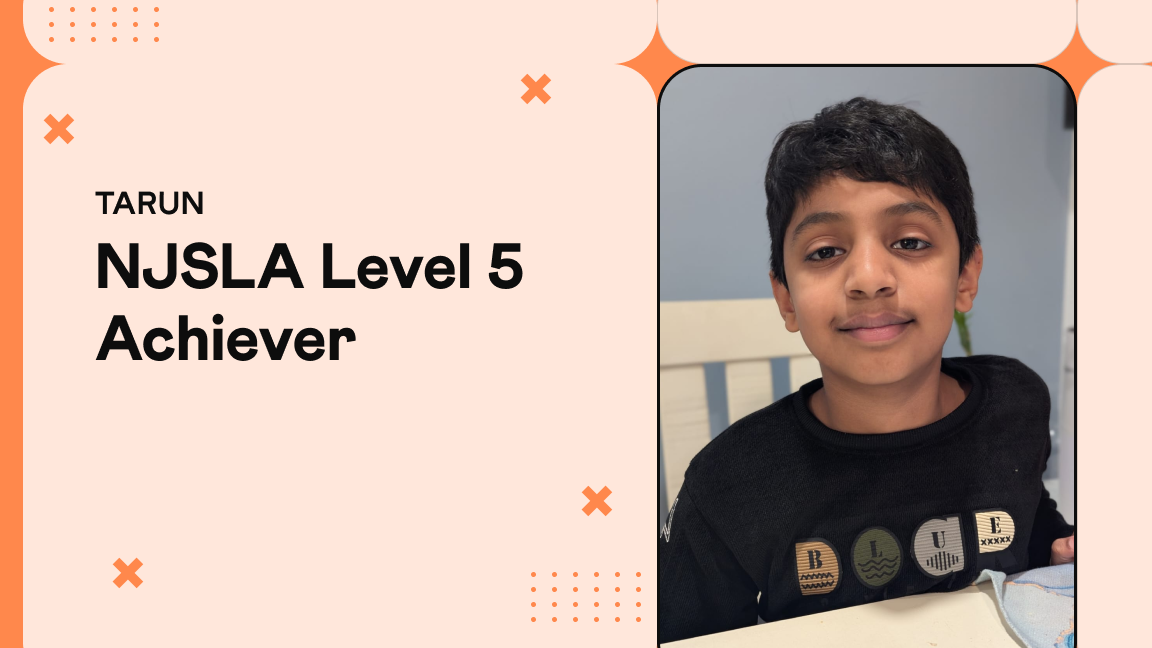
Most eight-year-olds have something they love. For some, it is dinosaurs. For others, it is space or football cards. Tarun collects the heights of famous buildings around the world.
Not pictures of them. The actual numbers. He looks up how tall they are, compares them, ranks them, and shares what he finds with his Cuemath teacher during class. It is the kind of curiosity that makes a parent think: there is something here. But Tarun was also a child who always wanted to compete. He regularly signed up for math competitions, eager to test himself against harder problems. The brightness was clear. What he needed was continuous, structured support to turn that raw enthusiasm into consistent, measurable performance. That is the distance where the right learning environment matters most.
In May 2025, Tarun sat the NJSLA as a Grade 3 student in New Jersey. He scored 817 in Math and 821 in ELA - both at Performance Level 5, the highest tier on the assessment. On a scale that tops out at 850, those scores place him at the very top of the state. He has been learning with his Cuemath tutor, Farhana Liyakat, for over a year.
This is the story of what happened in that year.
Meet Tarun
- Grade: 4 (Grade 3 when assessed)
- Country: United States (New Jersey)
- Tutor: Farhana Liyakat
- With Cuemath: Since 2024
- NJSLA Math Score: 817 / 850 - Performance Level 5
- NJSLA ELA Score: 821 / 850 - Performance Level 5
What a Level 5 on NJSLA Math Actually Means
The NJSLA (New Jersey Student Learning Assessment) is administered every spring to students in Grades 3 through high school. Scale scores range from 650 to 850. They are grouped into five performance levels, with Level 5 (790–850) representing students who have exceeded grade-level expectations.
For Grade 3 Math specifically, the assessment measures a student's ability to work with operations and algebraic thinking, understand place value and properties of number operations, work with fractions, solve measurement and data problems, and reason about geometric shapes. The questions at the upper end are not designed to check whether a child memorised a procedure. They are designed to test whether a child can figure something out when the path is not immediately obvious.
A child who scores a straight A on their report card can still land at Level 3 on the NJSLA. Classroom grades often reflect effort, completion, and participation. The NJSLA asks a harder question: can your child apply what they know in unfamiliar situations, independently, under timed conditions? Level 5 means yes – and not just adequately, but convincingly.
Tarun did not just reach Level 5 in Math. He reached it in ELA as well, scoring 821. Performing at the highest level across both subjects in Grade 3 signals something broader than strong math skills. It signals a student who reasons clearly, reads carefully, and communicates logically - the kind of thinking that holds up across every domain.
The Curiosity That Was Already There
Some children need to be convinced that math is interesting. Tarun was never one of them. His tutor, Farhana Liyakat, noticed it from the start. He is drawn to numbers in a way that goes beyond the classroom. When he works through his Cuemath worksheets, he spots patterns on his own - connections between numbers that were not part of the lesson. He collects real-world data (the heights of the world's tallest buildings) and brings those facts into his sessions, eager to share what he found. And he was always putting his hand up for math competitive exams - not because anyone pushed him, but because he wanted to.
This is the kind of curiosity that goes beyond just liking math. Tarun does not experience math as a school subject. He experiences it as a way of understanding the world. Buildings have heights. Heights are numbers. Numbers have relationships. That instinct to connect math to everything around him is exactly what the NJSLA rewards at the top performance level - and it is also what many schools, focused on procedural fluency, do not specifically nurture.
But curiosity and enthusiasm on their own do not produce a score of 817 out of 850. Plenty of children are interested in numbers. Plenty sign up for competitions. Fewer have the continuous, structured support needed to turn that eagerness into the kind of deep reasoning that holds up under the pressure of a state assessment. Something has to bridge the gap between loving numbers and performing with them at the highest level.
What Changed in One Year with Cuemath
The bridge, in Tarun's case, was his tutor.
Farhana did not try to contain Tarun's curiosity or redirect it toward a syllabus. She worked with it. When he brought in number facts about skyscrapers, she used that as a springboard into measurement, comparison, and data reasoning. When he spotted a pattern during a worksheet, she asked him to explain why it worked - not just that it existed. She gave him challenging problems and puzzles specifically designed to stretch his thinking beyond what came naturally.
This is what productive struggle looks like when a teacher gets the balance right - stretching a student beyond their comfort level, but not so far that they give up. Farhana keeps Tarun in that zone consistently. She makes sure Tarun does most of the thinking in their sessions. She cues rather than tells, probes rather than corrects, and gives him space to reason through problems before guiding him.
The result was not just stronger math skills. It was a shift in how Tarun approaches difficulty. Listen to how he describes his own learning:
“I like my Cuemath teacher. She is kind and considerate. I enjoy learning math with her because she explains math concepts in a simplified and clear way. She gives me challenging math problems and puzzles which makes me think and workout my brain so I can get smarter.”
— TARUN
That last line is worth pausing on. 'She gives me challenging math problems and puzzles which makes me think and workout my brain so I can get smarter.' An eight-year-old describing challenge as something that makes him smarter - not something that makes him frustrated - is the clearest sign of a growth mindset. He does not avoid difficulty. He leans into it because he understands it is how he improves. That belief system, built over a year of consistent guidance, is what separates a child who likes math from a child who performs at Level 5.
What His Tutor, Farhana Liyakat, Sees
“Tarun is a jovial kid, very interested in Math. He loves numbers and always finds some interesting patterns with numbers that come up while he does his sheets in class. He loves to collect data on the height of famous buildings of the world and also shares with me and gives me interesting facts that include numbers.”
~ FARHANA LIYAKAT, CUEMATH TUTOR
What stands out in Farhana's observation is not just what Tarun knows, but how he engages. He is not passively receiving lessons. He is actively bringing the world into his sessions. He spots patterns without being prompted. He collects data because he wants to, not because it was assigned. And he shares his findings - which means he is already practising the kind of mathematical communication (explaining, justifying, connecting) that deepens understanding far more than solving problems in isolation.
This is not a student who needed to be fixed. This is a bright student who was already eager to compete - but who needed continuous, structured support to turn that brightness into the kind of deep performance that shows up on state assessments and competition scoresheets alike.
What His Parents Say
“Tarun enjoys learning math with Ms. Farhana Liyakat. She is accommodative, patient and kind. I would recommend her!”
— SRINIVASAN, TARUN'S PARENT (TRUSTPILOT REVIEW)
Three words in that review carry more weight than they might seem: accommodative, patient, and kind. For a naturally curious child, the worst thing a tutor can do is rush them through a syllabus or penalise their tangents. Farhana did the opposite. She accommodated Tarun's pace, was patient with his explorations, and created a space where his love of numbers could grow alongside his mathematical rigour. That combination of warmth and challenge is what kept Tarun engaged - and what ultimately showed up in his scores.
Tarun's NJSLA Score Card
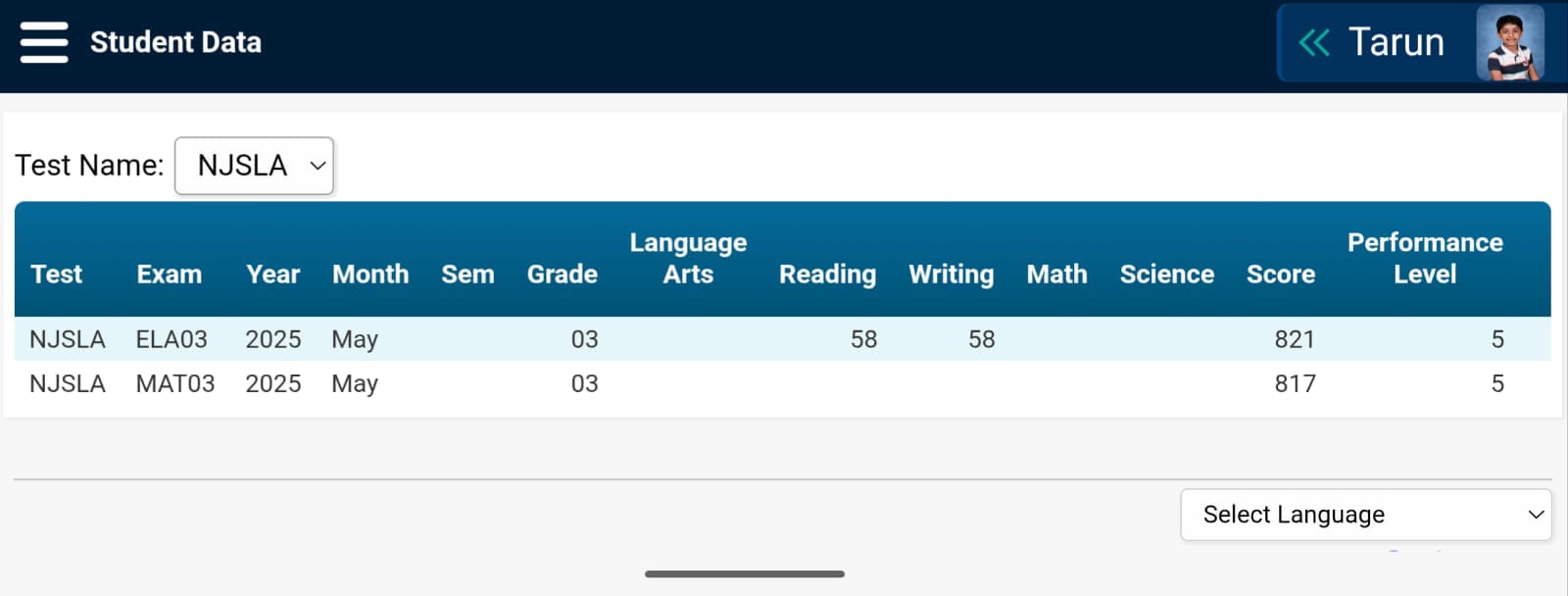
Tarun's NJSLA score report showing 817 in Math and 821 in ELA, both Performance Level 5, Grade 3, May 2025
Does This Sound Like Your Child?
This story may resonate if your child:
- Already loves numbers, patterns, or data - but you are not sure if that curiosity is being stretched at school
- Gets good grades but you wonder whether they are building the deeper reasoning that state assessments demand
- Is in early elementary school and you want to build the right foundation before assessments start carrying real weight
- Needs a tutor who works with their personality, not against it - especially if they are keen on math competitions and need consistent guidance to perform at their best
Children who reach Level 5 on the NJSLA in Grade 3 almost always had one thing in common: someone who knew how to turn their natural strengths into structured, transferable skills. For Tarun, that someone was Farhana.
Frequently Asked Questions
What is NJSLA and what grades does it cover?
The New Jersey Student Learning Assessment (NJSLA) is the state's standardized test for students in Grades 3 through high school. It measures proficiency in English Language Arts (ELA) and Mathematics. Scores are reported on a scale of 650 to 850 and grouped into five performance levels.
What score do you need for Level 5 on NJSLA?
Level 5 requires a score of 790 or above (out of 850). It represents students who have exceeded grade-level expectations. For Grade 3 Math, this means demonstrating strong reasoning, problem-solving, and application skills - not just procedural accuracy.
Can a child get straight A's and still not reach Level 5?
Yes. Classroom grades often reflect effort, participation, and homework completion. The NJSLA tests whether a student can apply their knowledge independently in unfamiliar, multi-step problems. A student can perform well in class but score at Level 3 or 4 on the NJSLA if their understanding has not moved beyond procedures to genuine reasoning.
How early should parents start preparing for NJSLA?
The most effective preparation is not test-specific. Students who reach Level 5 typically have a foundation of reasoning-focused learning built over years. Starting structured, concept-driven math in early elementary school gives children the depth of understanding that holds up when questions get genuinely challenging.
How does Cuemath help with NJSLA preparation?
Cuemath builds the reasoning, understanding, and application skills that the NJSLA specifically rewards at the highest performance levels. Rather than drilling test formats, Cuemath develops the underlying mathematical thinking - fluency, conceptual clarity, real-world application, and logical reasoning - that makes strong scores the natural result of how a student approaches any problem.
Where Curiosity Meets the Right Guidance
Tarun did not prepare for the NJSLA with past papers and cramming. He spent a year learning to think mathematically – with a tutor who understood how to channel his natural love of numbers into structured, transferable skills. That foundation showed up when it mattered.
If your child is in Grade 1, 2, or 3 right now, this is the window. The thinking habits that produce Level 5 performance take time to build. The best time to start is before the assessment feels urgent.
Try a FREE live Cuemath class today.
Book a Free ClassFor students in Grades K to 12 worldwide.
This is Tarun. He is MathFit.
He collects the heights of the world's tallest buildings, spots patterns his tutor did not assign, and describes challenging puzzles as a way to 'workout his brain so he can get smarter.' He scored Level 5 on both NJSLA Math and ELA in Grade 3 - not because someone drilled him for a test, but because someone helped him think. That is what MathFit looks like when it is built with curiosity, patience, and the right guidance.


![5th Grade Math Problems with Answers [50+ Practice Questions]](/blog/content/images/size/w600/2026/02/5th-Grade-Math-Problems-Thumbnail.png)