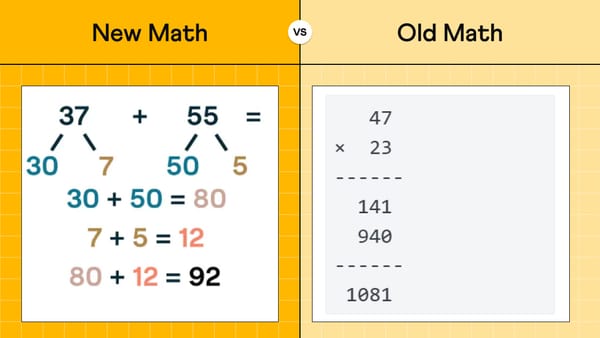
The Complete Math Curriculum Guide: What Students Learn From K–12
In this blog, I cover what a math curriculum is, how it progresses across grade levels, and the key concepts students learn from early number sense to advanced topics like algebra, geometry, and statistics.

Learning without a curriculum is like trying to assemble furniture without the instruction manual. You might get somewhere, but chances are you will miss steps, get confused, or build things in the wrong order.
Math works the same way. A clear math curriculum provides students with a structured path so that concepts build on one another. Students start with number sense and basic operations, then gradually move on to topics such as fractions, algebra, geometry, and statistics.
To understand how this progression is designed, I spoke with expert teachers at Cuemath who have spent decades building and refining structured learning programs. Their experience shows that the right curriculum can help students develop strong problem-solving and mathematical thinking skills.
In this blog, I explain what a math curriculum looks like across grade levels, what an online math curriculum is, and which programs students can use to learn math in a structured way.
What is a Math Curriculum?
Quick Answer
A math curriculum is a structured, sequential plan that outlines what mathematical concepts, skills, and reasoning strategies students should learn at each grade level — from number sense in kindergarten through calculus and statistics in high school.
A well-designed math curriculum does far more than list topics to cover. It defines the order in which concepts build on each other, the depth of understanding expected, and the methods teachers use to develop conceptual thinking.
In other words, a curriculum answers three key questions:
- What students should learn
- When should they learn it
- How deeply they should understand it
In the United States, most public school math curricula are aligned with the Common Core State Standards (CCSS) or state-specific standards derived from them. These standards describe what students should know and be able to do by the end of each grade.
Math Curriculum in the US: Common Core vs. State Standards
Here is something that genuinely confuses a lot of parents, and honestly, it is a fair confusion to have. You will often hear two things mentioned together: Common Core and your state's math standards. They sound like the same thing, but they are not, and the difference matters when choosing a curriculum for your child.
Common Core State Standards (CCSS) were launched in 2010 to create consistency in what students learn across the country. Here's how it's divided now:
Learn Math Aligned With Your School Curriculum
Cuemath tutors specialize in Common Core and state-specific math standards, helping students build strong foundations while staying aligned with what they learn in school.
Explore the Cuemath CurriculumPersonalized 1:1 math learning for Grades K-12
Key Stages of a Math Curriculum
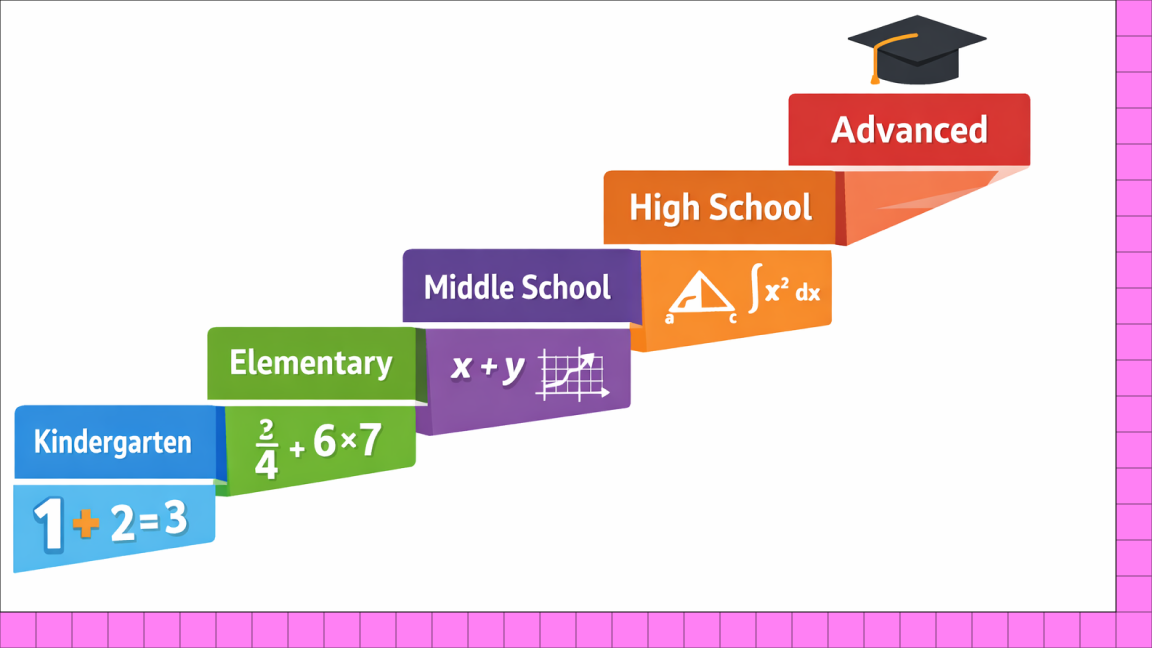
A typical math curriculum from kindergarten through 12th grade unfolds across five broad developmental stages. Each stage introduces new concepts that match students’ cognitive development and prepare them for the next level of mathematics.
As I reviewed research studies on math learning, one thing became clear. Students who build a strong conceptual foundation in the early grades are far more likely to succeed in higher-level math. Research also shows that gaps in topics like fractions and proportional reasoning are among the strongest predictors of difficulty in algebra and beyond.
Kindergarten Math Curriculum (Age 5–6)
The kindergarten math curriculum focuses on helping children understand numbers and quantities. At this stage, students begin to build number sense, meaning they understand what numbers represent and how they relate to one another.
Instead of memorizing rules, kindergarten math encourages students to explore numbers through counting, comparing, and recognizing patterns in everyday situations.
In kindergarten, students usually learn:
Elementary School Math Curriculum (Grades 1–5)
The elementary math curriculum builds on the number sense developed in kindergarten and gradually introduces more structured mathematical concepts. It covers four-operation fluency (addition, subtraction, multiplication, division), fractions, decimals, place value, geometry, measurement, and basic data analysis. By 5th grade, students are solving multi-step problems involving all four operations with whole numbers, fractions, and decimals.
Grades 1–2 Math Curriculum: Building the Foundation
1st and 2nd grade build on kindergarten number sense to develop fluent addition and subtraction, and introduce measurement and data.
Grades 3–5: Core Operations & Fractions
These years are the most critical window in elementary math. Students master multiplication and division and, crucially, develop a deep understanding of fractions.
Middle School Math Curriculum (Grades 6–8)
Middle school is when math becomes more abstract, and many students struggle for the first time. A strong middle school math curriculum bridges the gap between arithmetic and formal algebra, helping students develop the reasoning skills they will rely on in high school and beyond.
High School Math Curriculum (Grades 9–12)
The high school math curriculum follows a sequence: Algebra I → Geometry → Algebra II → Pre-Calculus → Calculus or Statistics. Advanced students may reach AP Calculus or college-level courses before graduation.
How to Choose the Right Math Curriculum
Many students struggle in math, not because they cannot learn it, but because gaps build up over time. A strong math curriculum focuses on closing those gaps while helping students develop the reasoning skills needed for higher-level math.
When evaluating a program, I usually look for a few key things:
- Concept-first learning, where students understand why math works, not just memorize formulas
- Alignment with school standards, such as the U.S. Common Core State Standards
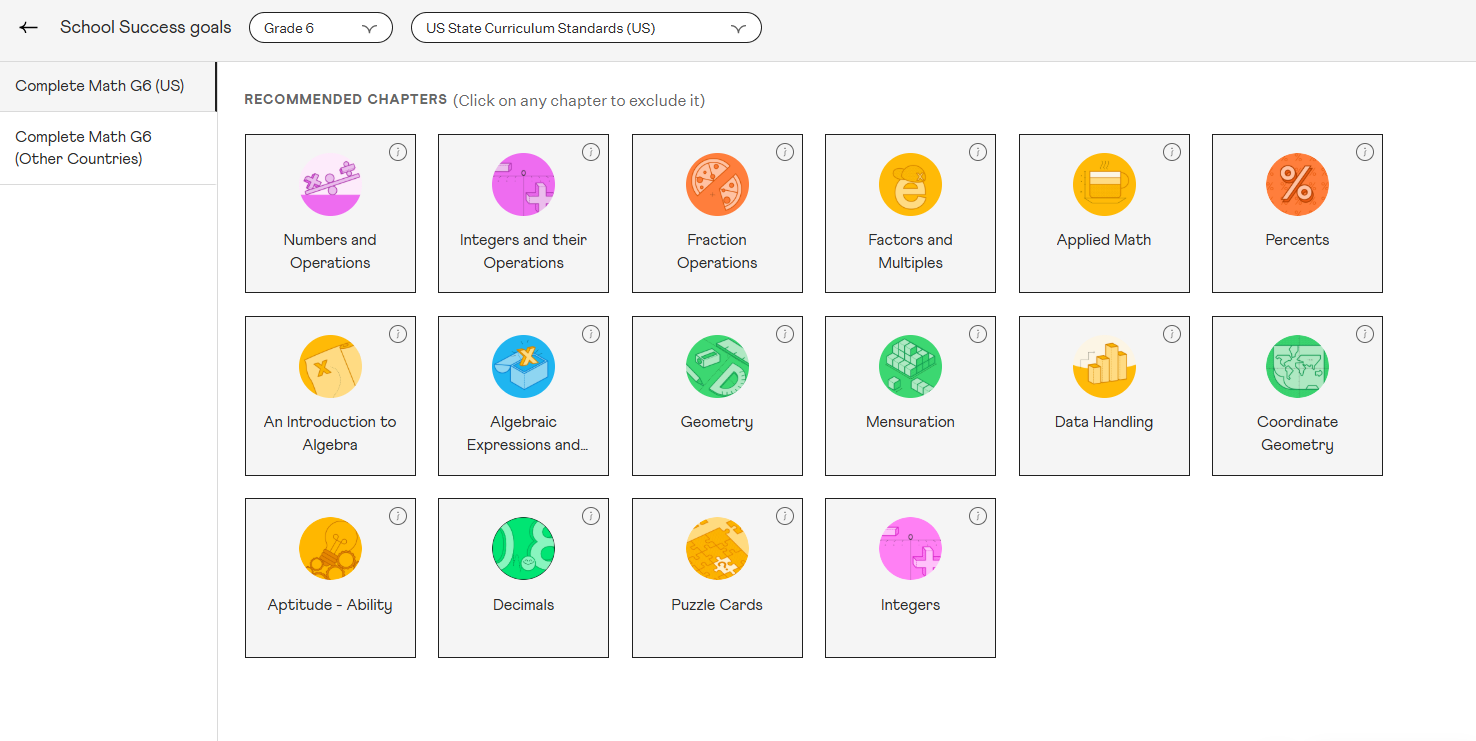
- Structured progression, where concepts build clearly from one grade to the next
- Personalized instruction that adapts to a student’s pace and learning gaps

- Regular practice and feedback to strengthen problem-solving ability
Programs that combine these elements tend to support long-term math learning much more effectively than those focused only on worksheets or test preparation.
Why Cuemath?
Cuemath's online math curriculum for Grades 1 to 8 is built to do more than help students keep up. It is designed to help them get ahead. By developing strong fundamentals, logical reasoning, and genuine confidence in math, Cuemath prepares students not just for their next test, but for every math course that follows.
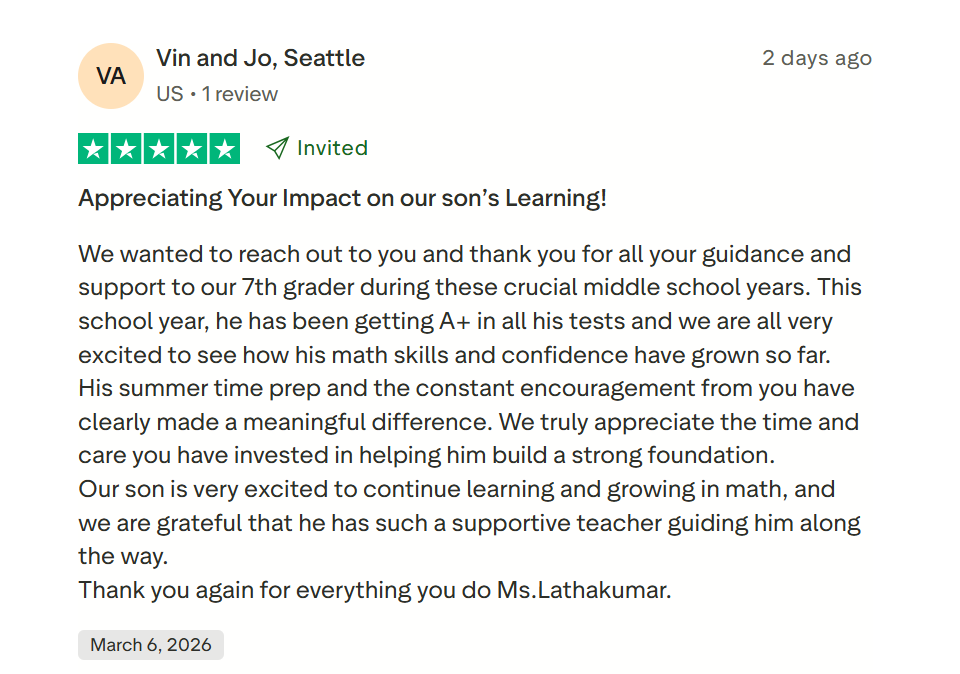
Key features of Cuemath’s Math Curriculum include:
- Personalized live 1:1 sessions: Every session is live, one-on-one, with a dedicated tutor. Not a group class. Not a pre-recorded video. A real tutor who knows where your child is and where they need to go next.
- Cuemath fully aligns its mathematics curriculum with the US Common Core Standards, the same standards used in most public schools across the country.
- Lessons that complement and adapt to a student’s school math curriculum.
- Students who need extra support can revisit foundational concepts and close learning gaps, while gifted or advanced students can move faster and accelerate beyond their grade level.
The Right Math Curriculum for Your Child
Cuemath’s structured math curriculum helps students build strong fundamentals, develop problem-solving skills, and stay aligned with their school learning. Start with a FREE live Cuemath class today.
Book a Free ClassPersonalized math learning for students in Grades K–12 worldwide
FAQs
Q: What is a math curriculum?
A math curriculum is a structured, sequential plan that outlines which mathematical concepts and skills students learn at each grade level, including topics, order, depth of understanding, and instructional materials.
Q: What do 6th graders learn in math?
Ratios, proportional relationships, fractions, decimals, percentages, negative numbers, algebraic expressions, area and surface area, and basic statistics.
Q: What do 7th graders learn in math?
Proportional reasoning, rational number operations, expressions and equations, geometry (circles, scale drawings), and probability and statistics.
Q: What's the difference between math standards and a math curriculum?
Standards define what students should know (the destination). A curriculum is the structured lessons and materials used to get there (the road map).


![5th Grade Math Problems with Answers [50+ Practice Questions]](/blog/content/images/size/w600/2026/02/5th-Grade-Math-Problems-Thumbnail.png)