What Do You Learn in 8th Grade Math?
I spoke with expert teachers at Cuemath and took a close look at what 8th grade math actually covers under the US Common Core standards.

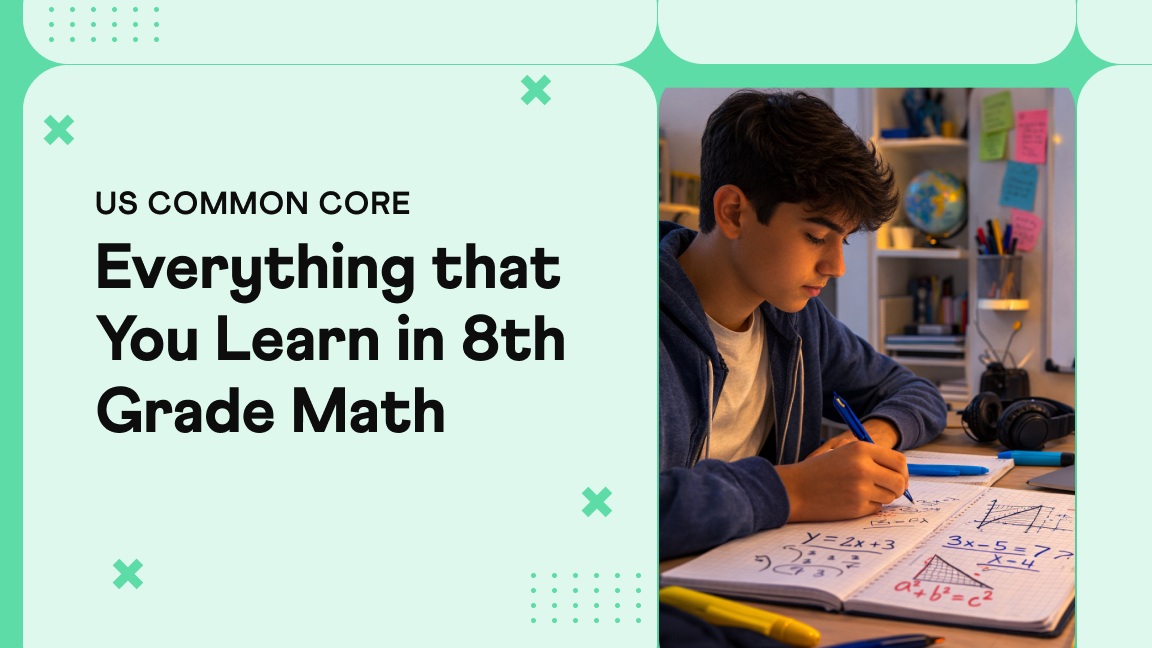
8th grade is one of the most crucial years in a student's academic journey. It serves as the bridge between middle school and high school and is often the point at which students either soar or start to struggle.
8th-grade math is where students begin learning the foundations of algebra. They work with linear equations, functions, exponents, and geometric concepts in greater depth. Problems become more multi-step, and students are expected to explain their reasoning clearly. Many students also move into advanced classes such as Algebra I, which can influence their high school math pathway and long-term college readiness.
So what do you learn in 8th-grade math?
In this guide, I have covered a complete breakdown of:
- The core topics taught under the US Common Core standards
- Real 8th-grade math problems with step-by-step solutions
- The key skills students are expected to master
- What an 8th-grade math test typically looks like
- How students can prepare and score well
Let's begin with what is actually covered in the 8th-grade math curriculum.
Common Core vs. State Standards: What’s the Difference?
Math standards in the United States are not identical across all states.
Most states follow the Common Core State Standards, which outline clear, grade-level expectations for what students should learn. However, some states use their own academic standards, which may vary slightly in pacing or emphasis.
That said, the core concepts taught in 8th-grade math remain largely consistent nationwide.
📘 Common Core (CCSS)
Adopted by 41+ states
- The Number System
- Expressions & Equations
- Linear Equations & Functions
- Systems of Linear Equations
- Geometry Transformations
- Pythagorean Theorem
- Statistics & Scatter Plots
- Exponents & Scientific Notation
🗺️ State Standards
Varies by state
- Texas (TEKS): Adds financial literacy
- Florida: Intro to statistics earlier
- Virginia: Stronger data analysis focus
- Some states offer Algebra I in 8th grade
- Pacing & depth varies by district
For the purpose of this guide, I have focused primarily on the 8th-grade math expectations outlined under the US Common Core standards, as they provide a widely recognized framework used by most schools across the country.
What Do You Learn in 8th Grade Math? (US Common Core)
Under the US Common Core State Standards, 8th-grade math is structured around five major domains. Each domain builds the foundation for Algebra I and higher-level mathematics.
The five domains are:
- The Number System
- Expressions and Equations
- Functions
- Geometry
- Statistics and Probability
Let’s take a closer look at what students are expected to master in each domain.
The Number System
In this topic, students expand their understanding of numbers beyond whole numbers and fractions. They explore a new category of numbers called irrational numbers and build skills around estimating, converting, and working with exponents.
They learn to:
- Understand the difference between rational and irrational numbers
- Estimate square roots and place them on a number line
- Convert repeating decimals to fractions
- Apply the properties of integer exponents
- Assuming √4 is irrational, when it equals exactly 2
- Rounding square roots too early and carrying the error forward
- Not recognising that 0.333... can be written as the exact fraction ⅓
📝 Practice Questions
Q1. Between which two whole numbers does √45 lie?
EasyQ2. Convert 0.727272... to a fraction.
MediumQ3. Simplify: (2³ × 2⁻⁵) ÷ 2⁻¹
HardExpressions and Equations
In this topic, students develop strong algebra foundations. They learn to work with exponents, understand linear relationships, and solve equations involving variables.
They learn to:
- Apply the laws of integer exponents
- Work with square roots and cube roots
- Understand slope as rate of change
- Solve multi-step linear equations
- Solve pairs of simultaneous linear equations
- Forgetting to apply exponent rules correctly
- Confusing slope with y-intercept
- Making sign errors while solving equations
📝 Practice Questions
Q1. Solve: 4x - 7 = 21
EasyQ2. Identify the slope of the equation y = 3x + 5.
MediumQ3. Solve the system: y = x + 2 and y = 2x - 1
HardFunctions
In this topic, students learn how two quantities are related. They begin formally studying functions and understanding how equations, tables, and graphs represent relationships between variables.
They learn to:
- Define and identify functions
- Understand function notation
- Represent functions using tables, graphs, and equations
- Interpret slope as rate of change
- Compare different linear functions
- Confusing a relation with a function
- Misinterpreting slope as the y-intercept
- Struggling to connect graphs to equations
📝 Practice Questions
Q1. Is the relation {(1,2), (2,4), (3,6)} a function?
EasyQ2. Identify the slope of y = -2x + 3.
MediumQ3. Compare y = 4x and y = 2x. Which function has a greater rate of change?
HardGeometry
In this topic, students explore transformations, similarity, the Pythagorean Theorem, and three-dimensional figures. They develop a deeper understanding of spatial reasoning and geometric relationships.
They learn to:
- Understand congruence and similarity using physical models, transparencies, or geometry software
- Perform and analyze rotations, reflections, translations, and dilations
- Understand and apply the Pythagorean Theorem
- Solve problems involving the volume of cylinders, cones, and spheres
- Confusing congruence with similarity
- Forgetting to square both legs in the Pythagorean Theorem
- Using incorrect formulas for volume
📝 Practice Questions
Q1. A right triangle has legs of 6 and 8 units. Find the length of the hypotenuse.
EasyQ2. Are two triangles with the same shape but different sizes congruent or similar?
MediumQ3. Find the volume of a cylinder with radius 3 units and height 5 units. (Use π = 3.14)
HardStatistics and Probability
In this topic, students learn how to analyze and interpret data. They examine patterns, relationships between variables, and draw meaningful conclusions from real-world information.
They learn to:
- Construct and interpret scatter plots
- Identify patterns of association in bivariate data
- Recognize positive and negative correlations
- Fit and interpret lines of best fit
- Analyze two-way tables and relative frequencies
- Assuming correlation implies causation
- Misreading scatter plot trends
- Incorrectly calculating relative frequency
📝 Practice Questions
Q1. A scatter plot shows that as study time increases, test scores increase. What type of association is this?
EasyQ2. If 20 out of 50 students prefer online learning, what is the relative frequency?
MediumQ3. What does a line of best fit represent in a scatter plot?
HardHow 8th Grade Math Prepares You for High School?
I spoke with expert teachers at Cuemath to better understand how 8th-grade math fits into the bigger academic picture. What becomes clear is that 8th-grade math essentially prepares students for high school coursework.
At this stage, the curriculum is designed to support one of three common pathways:
• Pre-Algebra
Some students use 8th grade to strengthen foundational algebra skills. The focus is on equations, proportional relationships, exponents, and problem-solving. This prepares them for Algebra I in 9th grade.
• Algebra I
Many students take Algebra I in 8th grade. This is typically considered an accelerated track and allows students to move into Geometry in high school.
• Geometry
In more advanced pathways, students complete Algebra I earlier and take Geometry in 8th grade. These students often continue into Algebra II as freshmen.
How Cuemath Makes 8th Grade Math Easy
Cuemath approaches 8th grade math by focusing on conceptual clarity and long-term academic progression. The program is designed to align with US school standards while making abstract concepts easier to understand.
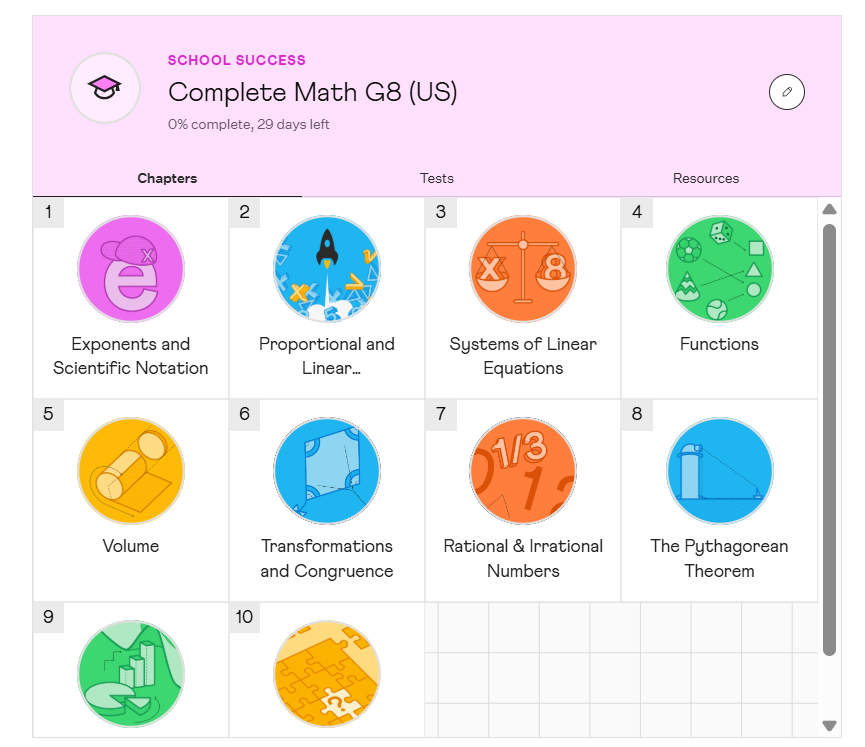
Key features include:
● Aligned with US Common Core and State Standards
The curriculum is built in accordance with school requirements, ensuring students remain academically aligned with their grade level.
● 1:1 Live Tutoring
Personalized instruction allows tutors to address individual learning gaps and adapt lessons based on each student’s pace and strengths.
1:1 Interactive class with the Cuemath Tutor
● Gamified Learning Platform
The platform enables tutors and students to solve 8th-grade math problems together in real time. Lessons include structured interaction, guided explanations, and collaborative problem-solving.
● Interactive Math Worksheets
The worksheets are structured and application-oriented. They include visual problems, simulations, and real-world scenarios that strengthen logical reasoning and problem-solving skills.
● Math Gym
Interactive games reinforce core concepts while keeping students engaged and motivated.
● Advanced Math Enrichment
Students can explore out-of-school topics such as number series, parity, and other enrichment concepts designed to prepare them for competitive examinations.
Now that the curriculum and guidance around 8th grade math have been outlined, it is important to understand what students can expect in an 8th grade math test.
Try a Free 1:1 Cuemath Class for Grade 8
See how your child builds confidence in 8th grade math with personalized instruction and a curriculum aligned with US school standards — all in a live 1:1 session with a Cuemath tutor.
Book a Free Trial Class200K+ Students • 4.9★ Rating • 80+ Countries