What to Expect in a Cuemath Trial Class?
Signing your child up for something new always comes with questions. What will it feel like? Will my child be comfortable? Will it actually help? We get it — so here's a complete walk-through of every part of the Cuemath trial session, so you know exactly what to expect before your child logs in.
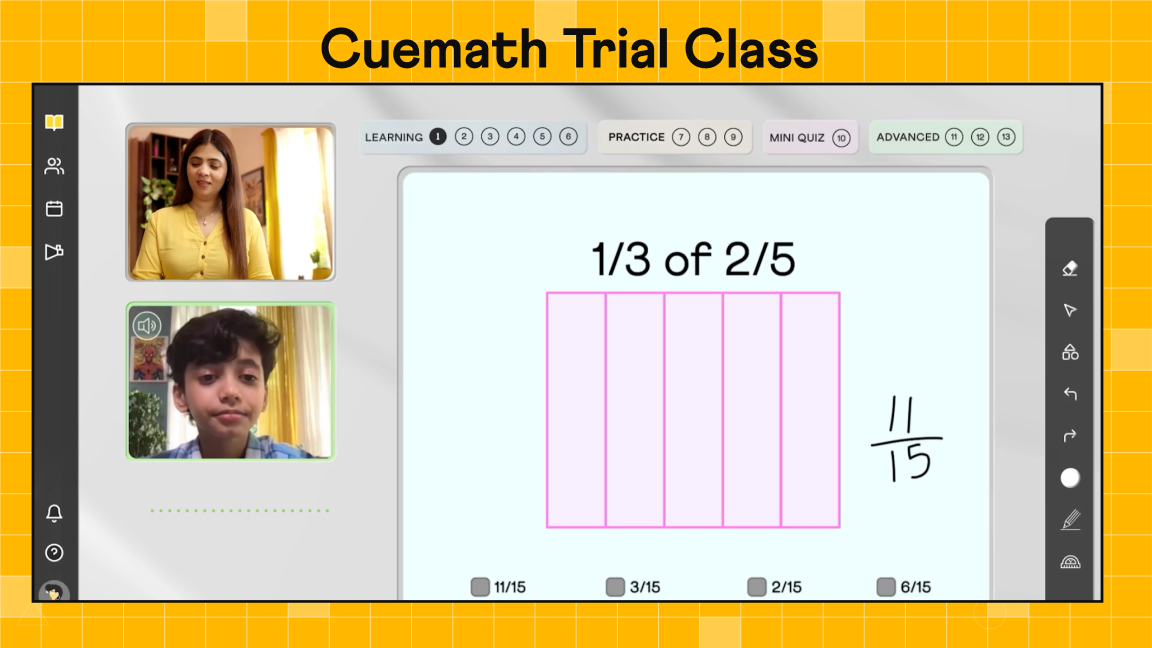
The trial isn't a test. It's an introduction — for us to understand your child, and for your child to experience how Cuemath teaches.
Signing your child up for something new always comes with questions. What will it feel like? Will my child be comfortable? Will it actually help? We get it — and that's exactly why we designed the trial the way we did.
Here's a complete walk-through of every part of the session, so you know exactly what to expect.
Table of Contents
How the trial is structured
The session is split into three parts — understanding your goals, a real learning experience for your child, and a clear picture of what comes next. Every minute is intentional.

The three-part structure your child's tutor follows in every trial
Part 1 · 10 minutes
Understanding your child — before any teaching begins
We don't start with a test. We start with a conversation. Before a single problem is introduced, your tutor takes a few minutes to understand where your child currently stands — and what you'd like to see change.
Where does your child stand in math right now?
You'll be asked to pick the description that best fits your child today. No judgment, no right answer — just an honest starting point so we can calibrate what happens next.

You choose — and we take your read seriously
What do you want your child to achieve?
Whether it's building stronger fundamentals, keeping up with school, preparing for a contest, or qualifying for a gifted program — every goal is valid. Your answers directly shape the plan we build for your child.

Most parents check more than one — that's completely fine
We align to your child's actual school curriculum
Your tutor pulls up your child's grade level, state curriculum, and a specific academic goal aligned to what they're learning in school right now. Nothing generic, nothing off-syllabus.

Built around your child's school — not a one-size-fits-all syllabus
Targeting an external test?
If your child is working toward MAP, CogAT, Math Kangaroo, or a state assessment, we note it here so it's factored into practice from day one. And if you're not sure yet — no pressure, you can always revisit this.

Test prep can be layered in at any point — it's never now-or-never
Interested in enrichment beyond the curriculum?
For children who want to explore beyond their grade level, we offer enrichment pathways in Cyber Math, Data Science, and Financial Literacy. Entirely optional — but worth knowing is there.

For kids who want to go further — not required, always available
Your child's profile, right in front of you
By the end of this section, your tutor has a complete, visible profile: level, goals, and learning plan. You can see it, question it, and ask for changes. There are no hidden assessments happening behind the scenes.

Fully transparent — everything the tutor sees, you see too
Why we start this wayWhen we understand what a child needs before we start teaching, the learning lands differently. Children feel the difference — and so do parents, by the end of the session.
Part 2 · 30 minutes
A real learning experience — not a performance
This is the heart of the trial. Your child works through a set of problems with their tutor, and it doesn't look or feel like a school lesson. Cuemath uses visual puzzles, curriculum-aligned problems, and open-ended challenges to help children reason through math — not just recall answers.
It starts with a game
We often open with a visual or logic challenge — something low-pressure and a little surprising. It gives us an early read on how your child thinks, without putting them on the spot.

The warm-up reveals how your child approaches problems — not just whether they get them right
Then comes real curriculum work
Your child moves into problems at their grade level — the kind they'd see in school. But here, they're not just finding an answer. The tutor asks them to explain their reasoning, and guides them at their own pace.

Real school content, taught with reasoning built in
Some problems are designed to stretch
This one asks a child to mentally remove a row and column from an array of hearts, then write a multiplication sentence for what remains. It's harder than it looks — and when a child works through it, something genuinely clicks.

Problems that build mathematical thinking, not just test recall
Puzzles that make kids curious
The matchstick puzzle is a favourite. It's spatial, open-ended, and has no single correct approach — which is exactly why children who are nervous about getting things wrong often surprise themselves. No one gets stuck. The tutor is there to guide, not to grade.

Spatial reasoning challenges — often the moment kids forget they're being evaluated
Part 3 · 15 minutes
You leave with a clear picture and a concrete plan
After the learning session, your tutor shares a performance summary specific to your child — not a template. You'll see which topics were covered, where your child needed support, and where they showed improvement even within the session itself.

Honest, topic-level feedback — not a vague "needs improvement"
Three things that come next
The session closes with a practical plan: regular personalised sessions aligned to your child's curriculum, daily practice on the Cuemath app, and a parent-tutor conference to review progress and adjust the approach as your child grows.

A support system — not just tutoring sessions
What parents tell usBy the end of the trial, the decision to continue almost makes itself. You've seen how we teach, heard what the tutor observed, and have a written plan in hand. That's a lot of signal for 55 minutes.
The Bottom Line
The free trial isn't a sales call. It's 55 minutes of real, personalised teaching — followed by a written plan that's yours to keep, whether you continue or not. You'll leave knowing exactly where your child stands in math and what it would take to move them forward.
If you've been on the fence about whether Cuemath is the right fit, the trial is the clearest way to find out. No pressure. No guessing. Just a real session, with a real tutor, built around your child.
Feel the Cuemath difference
55 minutes of real learning, plus a personalized plan to take home. No catch.
Book a Free Trial Class →Frequently asked questions
Nothing at all. The trial is designed to meet your child exactly where they are. Just show up — your tutor will take it from there.
That's one of the most common things we hear — and it's exactly the kind of child Cuemath is built for. The session starts with puzzles, not problems, and the tutor's job is to make your child feel capable, not tested. Most nervous children are visibly more relaxed by the midpoint of the session.
Cuemath sessions are conducted online on the Cuemath Leap Platform — a 100% safe, ad-free, interactive learning environment. The classes are 1-on-1 with a trained expert tutor. All you need is a device and a stable internet connection. The tutor handles everything else — including the interactive problems and the performance report.
Cuemath tutors are trained specifically in the Cuemath method — which focuses on building reasoning alongside calculation, not just drilling formulas. They're also trained to build a child's confidence over time, not just their scores.
No obligation at all. The trial is completely free, and the decision to continue is entirely yours. You'll receive the learning plan and performance report regardless — they're yours to keep. If you'd like to continue, your tutor will walk you through the available plans.
Yes — and we encourage it for the goals section at the start. For the learning session itself, some children focus better when parents step back, but that's entirely your call. Your tutor will share their observations with you right after.
Absolutely. The trial is calibrated to your child's level — so for children who are excelling, the problems will reflect that. We'll also explore enrichment pathways and contest prep options that could genuinely stretch them.
Usually within 24–48 hours. Once you sign up, you'll be matched with a tutor and offered a slot that works for your schedule. Evenings and weekends are available.