
What Is Regrouping in Math? A Complete Guide
Is regrouping in math the same as "borrowing" and "carrying"? Let's find out. This guide breaks down regrouping in addition and subtraction with simple examples, and shows how to help your child practice it at home.

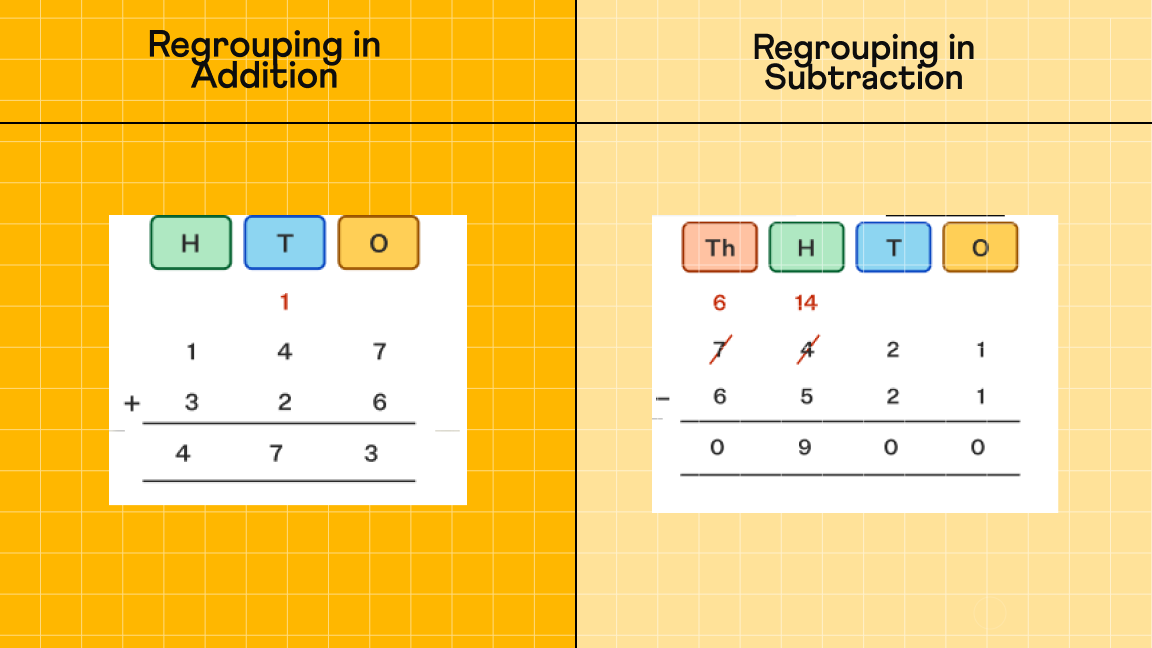
If your Grade 2 or Grade 3 child has come home with a worksheet on regrouping and you've thought, "Wait, isn't that just borrowing?", you're not alone. According to the National Center for Families Learning, 60% of parents with children in grades K–8 say they have trouble helping with homework. For math specifically, the challenge is usually not the concept itself. It's that the language has changed.
So what is regrouping in math, exactly? Regrouping in math is the process of exchanging values between place value columns — ones, tens, hundreds — to make addition and subtraction work correctly. It's the same skill you may know as "carrying" or "borrowing." The concept hasn't changed. Only the name has.
This guide explains exactly what regrouping means, how it works in both addition and subtraction, why schools use this term instead of "borrowing," and how to support your child at home — whether they're in Grade 2, Grade 3, or beyond.
💡 Quick Answer
TL;DR: What Is Regrouping in Math and How Does It Work?
- Regrouping in math is rearranging numbers across place values — ones, tens, hundreds — to make addition and subtraction work.
- Carrying” (in addition) and “borrowing” (in subtraction) are the same steps — regrouping is just more accurate.
- In addition, regroup when the sum is 10+.
In subtraction, regroup when the number you're taking away from is smaller than the number you want to subtract. - Visual tools help first — Base-10 blocks, drawings, and visual simulations make the concept clear.
- Regrouping across zeros requires two steps — you can't take from a 0, so go one column further left first, then regroup back.
- Regrouping concept in Grade 2–3 builds foundation for multiplication and division.
Table of Contents
- Regrouping at a Glance
- What Is Regrouping in Math?
- Why Schools Say "Regrouping" Instead of "Borrowing"
- Why Regrouping Needs to Be Visual First
- Regrouping in Addition: Step-by-Step
- Regrouping in Subtraction: Step-by-Step
- Regrouping Across Zeros in Subtraction
- Regrouping Math: Grade 2
- Regrouping Math: Grade 3
- How to Help Your Child Practice at Home
- Practice Problems
- Conclusion
- Frequently Asked Questions
Regrouping at a Glance
Before diving in, here's a quick reference table that covers the key differences between regrouping in addition and subtraction.
| Addition | Subtraction | |
|---|---|---|
| Old term | Carrying | Borrowing |
| When to regroup | Digits in a column sum to 10 or more | Digit you're taking away from is smaller than the number you want to subtract |
| What happens | Move 1 ten to the next place (column left) | Take 1 ten from the next place (column left) |
| Don't forget | Add the carried digit to the next place | Reduce the tens digit by 1 after regrouping |
| First taught | Grade 2 | Grade 2 |
What Is Regrouping in Math?
- Regrouping in math involves shifting value between place values, such as ones, tens, and hundreds to help perform operations such as addition and subtractions correctly.
- This is the same skill previously called "carrying" and "borrowing."
Regrouping in math means exchanging values between place values, just like swapping 10 pennies for 1 dime.
💡 Think of it like exchanging a $10 bill for ten $1 bills. You haven't gained or lost anything. You've reorganized the same money. That's regrouping.
It works the same for all place values:
This exchange is the entire engine behind multi-digit addition and subtraction. Every time a child "carries the 1" or "borrows from the tens," they are regrouping, whether or not they use that word.
When is regrouping NOT needed?
Not every problem requires regrouping. It's only needed when the numbers in a column exceed the limits of that place (column). For example:
- 47 + 21: ones place gives 7 + 1 = 8. No regrouping needed.
- 47 + 38: ones place gives 7 + 8 = 15. Regrouping needed: write the 5, carry the 1.
- 52 − 21: ones place gives 2 − 1 = 1. No regrouping needed.
- 52 − 37: ones place gives 2 − 7. Can't do it: regrouping needed.
Helping your child check each 'place ' (column) before calculating is one of the most effective habits you can build at home.
Why Schools Say "Regrouping" Instead of "Borrowing"
- Schools replaced “borrowing” with “regrouping” because “borrowing” suggests something is returned, which isn’t the case.
- The term “regrouping” connects directly to place value, making the concept clearer and more intuitive over time.
- Similarly, “carrying” in addition is now described as regrouping for the same reason.
When you "borrow" something, you return it. But if you take a ten from the tens place to help the ones column, that ten doesn't go back. So the word "borrowing" was never technically accurate; it left many students confused about what was actually happening.
"Regrouping" is precise: you are regrouping the same total value into different denominations. The $10-bill-for-ten-$1s analogy works perfectly here. Nothing is borrowed. Nothing is returned. The value is simply reorganized.
The shift to this language is part of a broader movement in U.S. "new math" education toward conceptual understanding. Instead of memorizing steps ("cross out the 5, put a 4, add a 1"), children are encouraged to understand why those steps work. That understanding becomes the foundation for fractions, algebra, and everything beyond.
Related Blog: New Math vs Old Math: What Changed and Why It Matters for Your Child
Why Regrouping in Math Needs to Be Visual First
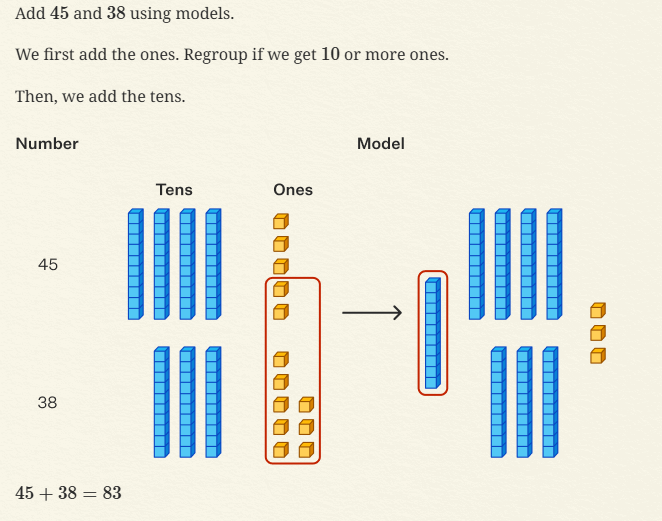
Regrouping in math works the same way whether you are dealing with two-digit, three-digit, or even larger numbers. The concept is always the same: trade 10 of one place value for 1 of the next place value. Seeing that trade happens with blocks, a place value mat, or a drawing makes it much easier to understand than working with numbers alone.
- Base-10 blocks: Many good schools have Math/STEM labs that use blocks to teach regrouping for Grade 2 and Grade 3 children. The child learns to stack and trade 10 small blocks for the next-highest place value (a larger block) to see regrouping in action.
Visual Simulations to Teach Regrouping in Math in a Cuemath 1-on-1 Online Class
- Place value mats: These organize numbers into ones, tens, and hundreds to keep track of regrouping.
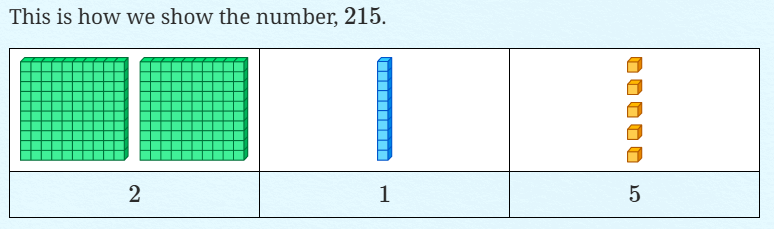
- Drawings: Draw circles for tens and dots for ones. When dots add up to 10 or more, circle them into a new ten. A pencil and paper are all you need to make regrouping visible.
Regrouping in Addition: A Step-by-Step Guide
💡 When does it happen?
- Regroup in addition when the digits in any place (column) sum to 10 or more.
- Write the ones digit in that place. Carry the tens digit to the next place, the column on the left.
Solved Example: Regrouping in Addition (12 + 29)
Let's solve 12 +29 understanding regrouping concept in addition.
| Step | What You Do | What It Looks Like |
|---|---|---|
| 1 | Add the ones: 2 + 9 = 11 | 11 is two digits — can't write it in the ones place. Write 1 in the ones column. Carry 1 (one ten) to the tens column. |
| 2 | Add all the tens: 1 + 2 + 1 (carried) = 4 | Write 4 in the tens column. |
| 3 | Answer: 41 | 12 + 29 = 41 ✓ |
Watch the video to understand it better:
Video explaining Regrouping addition using visuals: rods & squares in a Cuemath class
The carried 1 is not a magic number; it is a real ten, the same rod you saw in the visual. Writing it at the top of the tens column is just recording that bundling on paper.
Common Mistakes in Regrouping Addition
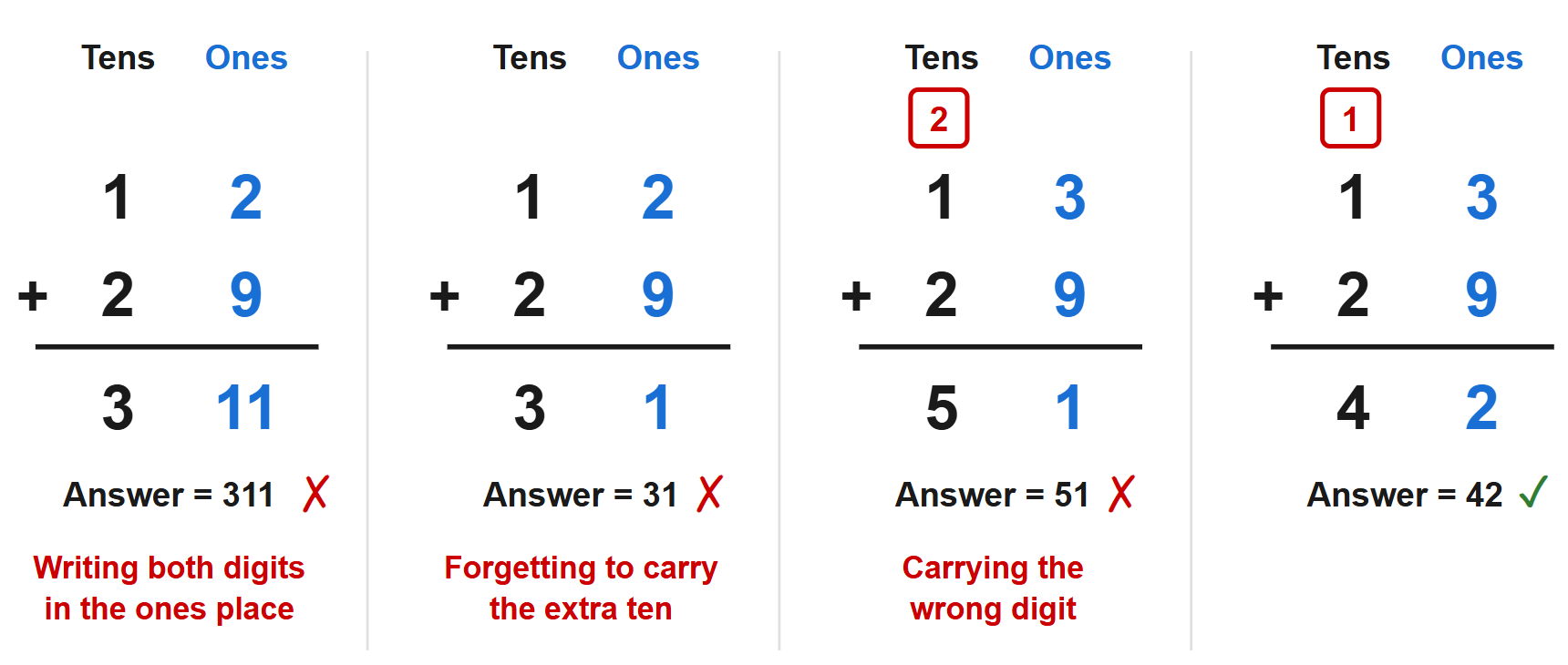
Mistake 1: Writing both digits in the ones place
Add 12 + 29. Ones: 2 + 9 = 11. Child writes "11" in the ones place. Tens: 1 + 2 = 3. Gets 311 — completely wrong.
Why it happens: They don't yet understand each place can hold only one digit.
Mistake 2: Forgetting to carry the extra ten
Ones: 2 + 9 = 11. Child writes only 1, ignores the extra 1. Tens: 1 + 2 = 3. Gets 31 — also wrong.
Why it happens: They miss that 11 = 1 ten + 1 one.
Mistake 3: Carrying the wrong digit
Add 13 + 29. Ones: 3 + 9 = 12. Child carries 2 instead of 1. Leads to an incorrect sum.
Why it happens: Confusion between the ones digit and the tens digit in the sum.
✅ How to Help Your Child
- Remind them: only one digit goes in each place (column).
- In the sum, the left digit carries; the right digit stays.
- Check the tens place together after every addition problem.
🎯 How Cuemath Teaches Regrouping in Addition:
Cuemath uses interactive rods-and-cubes visuals in live 1:1 sessions, so children see the regrouping happen before they write a single digit. Once they've bundled 10 cubes into a rod on screen, the "carry the 1" step makes complete sense, because they just did it themselves.
Give your child a strong start in math with easy, visual ways to learn regrouping.
Regrouping in Subtraction: A Step-by-Step Guide
- Regrouping in subtraction happens when the digit on top is smaller than the digit on the bottom in a place value.
- You borrow 1 ten from the next place, add 10 to the current place's top digit, then subtract.
- This is what "borrowing" used to mean, described in terms of place value.
When Does Regrouping in Subtraction Happen?
Regrouping in subtraction is needed when the digit you're subtracting from is smaller than the digit you're subtracting. You can't take 8 from 3, so you borrow a group of 10 from the tens place.
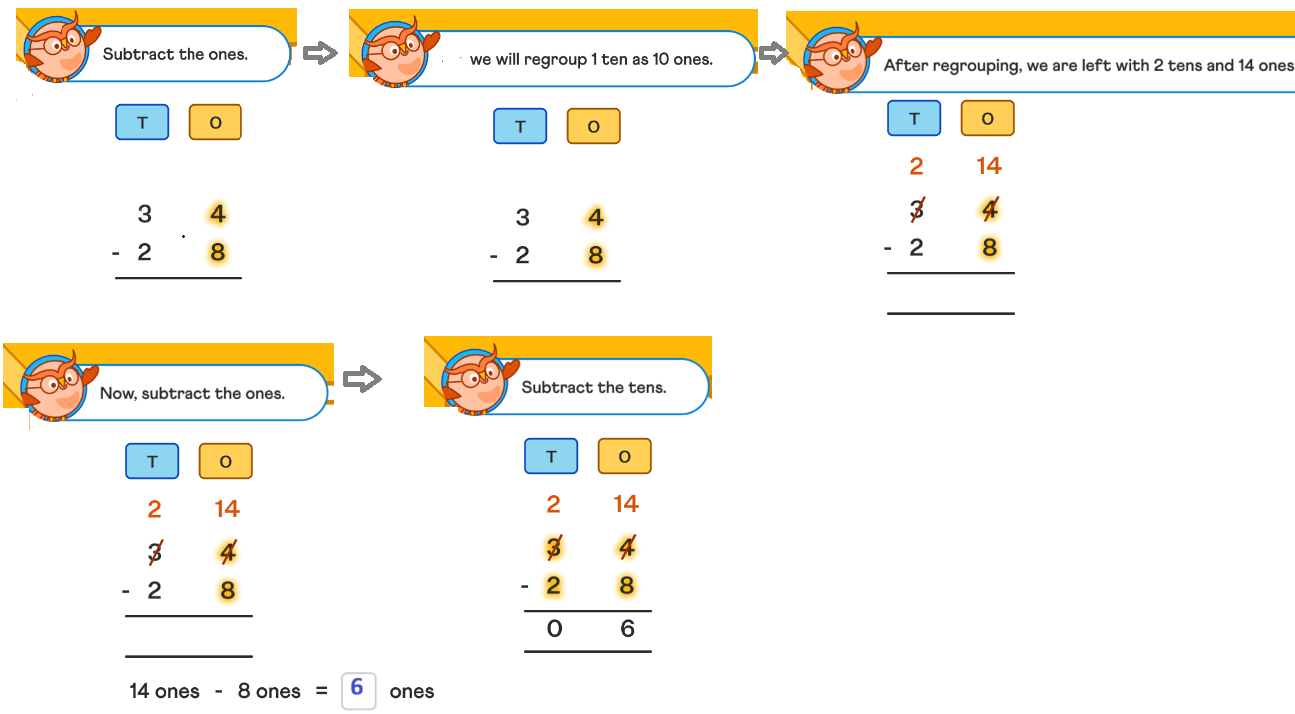
Solved Example: Regrouping in Subtraction (34 - 28)
| Step | What You Do | What It Looks Like |
|---|---|---|
| 1 | Ones place: 4 – 8 doesn't work |
Regroup: take 1 ten from the tens place. The tens digit changes from 3 to 2. Add 10 to the ones place: 4 becomes 14. |
| 2 | Ones place: 14 – 8 = 6 | Write 6 in the ones place. |
| 3 | Tens place: 2 – 2 = 0 | Write 0 in the tens place. |
| 4 | Answer: 6 | 34 – 28 = 6 |
The regrouping happens in step 1. You broke 1 ten from the tens place into 10 ones and added them to the ones place. No magic, no mystery: just reorganizing the same value.
🎯 How Cuemath Teaches Regrouping in Subtraction:
- Builds a strong foundation by ensuring the child understands place value
- Starts with a quick recall section to refresh prerequisite concepts
- Smoothly transitions from basics to regrouping in subtraction
- Introduces regrouping through interactive, visual simulations
- Gradually guides the child to solve step-by-step subtraction problems
Common Mistakes in Regrouping Subtraction
Common Mistakes in Regrouping Subtraction
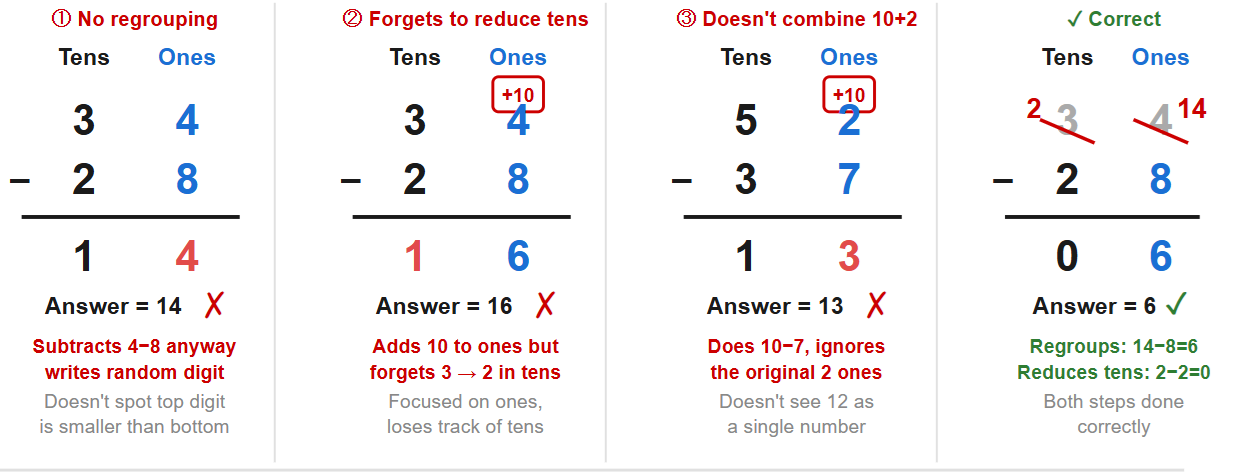
Mistake 1: Not regrouping when needed
34 − 28. Ones: 4 − 8 → child writes 4 or 0 randomly. Gets an incorrect answer.
Why it happens: They don't recognize the signal that regrouping is needed (top digit smaller than bottom).
Mistake 2: Forgetting to reduce the tens after regrouping
Regroup: 4 becomes 14. But child forgets 3 → 2. Ones: 14 − 8 = 6. Tens: 3 − 2 = 1. Gets 16 — wrong.
Why it happens: They focus on adding 10 to the ones but forget it was taken from the tens.
Mistake 3: Adding 10 but not combining properly
52 − 37. Regroup: 2 becomes 12. But child treats 10 + 2 separately, subtracts 10 − 7 = 3 and ignores the 2. Wrong result.
Why it happens: They don't yet see 12 as one number made from 10 + 2.
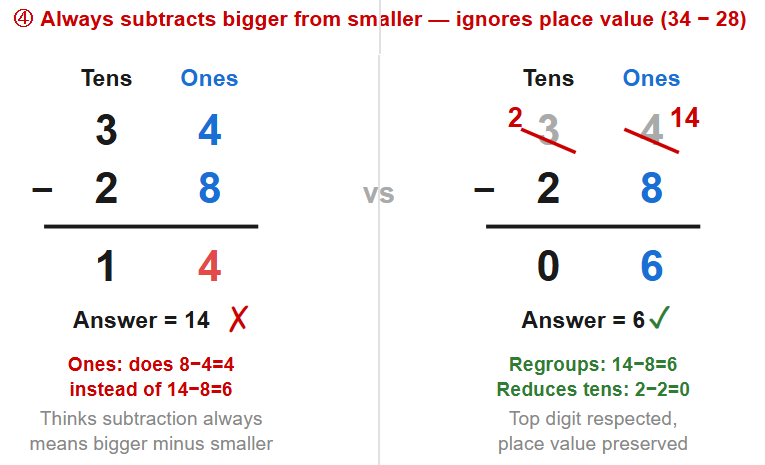
Mistake 4: Always subtracting smaller from bigger (regardless of position)
34 − 28. Instead of 14 − 8, child does 8 − 4 = 4. Tens: 3 − 2 = 1. Gets 14 — wrong.
Why it happens: They believe subtraction always means "bigger minus smaller," ignoring column position.
✅ How to Help Your Child
- Before subtracting, ask: "Is the top number bigger?" If not, regroup first.
- Remind them: if you take 1 ten, the tens column must go down by 1.
- Reinforce that 14 is one number — not 10 and 4 side by side.
- Use grid paper to keep columns aligned.
Is regrouping in subtraction tripping up your child?
Cuemath's tutors work 1-on-1 to find exactly where the confusion starts and fix it at the root.
Regrouping Across Zeros in Subtraction
Regrouping across a zero is the hardest version of subtraction regrouping — and the one that causes the most errors in Grade 3 and beyond. It happens when the tens digit (or hundreds digit) of the top number is a 0, and you need to regroup from it. You can't take a ten from zero, so you have to go one column further left first.
💡 Think of it like this: you want change for a dollar, but the person next to you has no coins. You have to go to someone two seats away — get a $10 bill, break it into ten $1 bills, then make change from those.
Let's walk through 300 − 147 step by step.
| Step | What You Do | What It Looks Like |
|---|---|---|
| 1 | Look at the ones column: 0 − 7 | Top digit (0) is smaller than bottom digit (7). Need to regroup — but the tens column is also 0. Can't regroup from zero. |
| 2 | Go to the hundreds column: regroup 1 hundred into 10 tens | 300 → hundreds digit becomes 2, tens digit becomes 10. |
| 3 | Now regroup 1 ten from the tens column into 10 ones | Tens digit goes from 10 → 9. Ones digit becomes 10. |
| 4 | Subtract the ones: 10 − 7 | 10 − 7 = 3. Write 3 in the ones column. |
| 5 | Subtract the tens: 9 − 4 | 9 − 4 = 5. Write 5 in the tens column. |
| 6 | Subtract the hundreds: 2 − 1 | 2 − 1 = 1. Write 1 in the hundreds column. Answer: 153 ✓ |
💡 The rule to remember
- When you hit a zero and need to regroup, skip it and go one column further left.
- Regroup from that column first, then come back and regroup from the zero (which is now a 10).
- Always work right to left — never skip a column without regrouping it first.
Common Mistakes When Regrouping Across Zeros
Parents: watch for these✕ Mistake 1: Trying to regroup directly from the zero
Child sees 0 in the tens place and writes a 10 in the ones place without touching the hundreds. The tens column stays at 0, making the next subtraction impossible.
Why it happens: They apply the single-step regrouping rule without realising zero has nothing to give.
✕ Mistake 2: Reducing the hundreds but forgetting to set the tens to 9
Child correctly reduces hundreds from 3 to 2 and adds 10 to the ones — but leaves the tens column as 0 instead of 9. Gets the ones right, then fails on the tens subtraction.
Why it happens: Two regrouping steps in one problem is easy to lose track of. They complete step one and forget step two.
✅ How to Help Your Child
- Use base-10 blocks first — physically show that you must trade a hundred block before you can trade a ten.
- Have them circle every zero before starting — it signals "extra step needed here."
- Work through each column out loud: "Can I regroup from this? No — so I go left first."
- Check the answer by adding back: 153 + 147 = 300. If it doesn't add up, find the step that went wrong.
Regrouping Math: Grade 2
💡 What to expect in Grade 2
- Regrouping is formally introduced in Grade 2 under Common Core (may vary by state).
- Children start with 2-digit addition and subtraction, then move to 3-digit numbers within 1,000.
- The focus is on understanding place value using manipulatives before the written algorithm.
| Skill | What It Looks Like | Example |
|---|---|---|
| 2-digit addition with regrouping | Ones add to 10 or more | 47 + 38 = 85 |
| 2-digit subtraction with regrouping | Top ones digit is too small to subtract | 52 − 37 = 15 |
| 3-digit numbers | Regrouping across tens and hundreds | 246 + 178 = 424 |
The strong foundation built in Grade 2 — especially the visual, hands-on work with place value — is what allows Grade 3 to feel manageable rather than overwhelming.
Explore the online math classes for grade 2
Regrouping Math: Grade 3
💡 What to expect in Grade 3
- Regrouping extends to larger numbers — beyond 1,000.
- It appears in multi-step problems and early multiplication contexts.
- Some Grade 3 students begin working with 4-digit numbers and regrouping across multiple columns simultaneously.
In Grade 3, children aren't just applying regrouping — they're internalizing it. The steps that required conscious effort in Grade 2 start to become automatic. This is normal and expected. The goal shifts from understanding the procedure to using it fluently in more complex problems.
If your child's teacher mentions "multi-step regrouping" or "regrouping across multiple places," this means problems where regrouping happens in the ones and the tens column in the same problem — for example, 473 + 358, where both the ones and tens require regrouping.
Regrouping also appears in Grade 3 multiplication: when you multiply 4 × 36, for instance, you multiply 4 × 6 = 24, write the 4, and carry the 2 — the same carry-the-ten logic from addition regrouping, applied in a new context.
Explore the online math classes for grades 3
How to Help Your Child Practice Regrouping at Home
- Use physical objects before written numbers: coins, blocks, or small objects grouped in tens.
- Say “regroup” out loud during practice instead of “borrow” or “carry” to match classroom language.
- Start with addition before subtraction, as addition is more intuitive for most children.
You don't need to be a math expert to help your child practice regrouping. Remember to start with addition before subtraction, as addition is easier for most children.
Here are five approaches that work:
- Use coins or blocks: Give your child 10 pennies and explain that 10 pennies = 1 dime. Then act out regrouping physically. This makes the abstract concrete before moving to the paper.
- Narrate what you're doing: When helping with homework, say the steps aloud: "We have 12 ones in this column. We regroup 10 of them into 1 ten and carry it over." Spoken language reinforces the concept.
- Habit to check the tens column first: If your child's answer is wrong, the most common issue is forgetting to adjust the tens place (or the neighboring highest place) after regrouping. Make it a habit to double-check that step together.
- Use grid paper: Many children make errors because digits slip into the wrong column. Grid paper keeps things aligned and reduces careless mistakes.
- Practice a little every day: Five problems a day is more effective than 30 on a weekend. Short, frequent practice builds fluency without overwhelming your child.
Related Blog: Word Problems Made Easy: Step-by-Step Method for Parents
Practice Problems on Regrouping in Addition & Subtraction
While understanding the concept is important, regular practice is what builds fluency, accuracy, and confidence.
The following grade 3 problems cover a range of difficulty levels, similar to those seen in school assessments and competitive math tests (such as Math Kangaroo). Encourage your child to solve them independently, using hints only when needed.
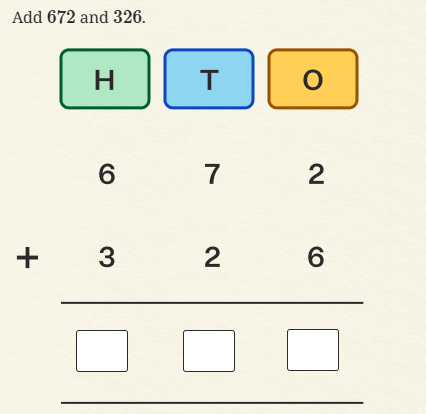
- Add 672 and 326
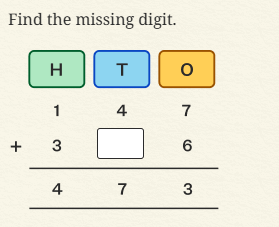
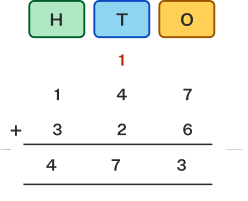
- Find the missing digit.
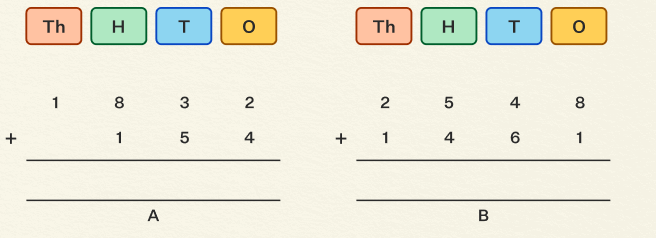
- Which addition can you solve without regrouping?
- Rob wants to subtract 253 from 621. He wrote the numbers as shown.
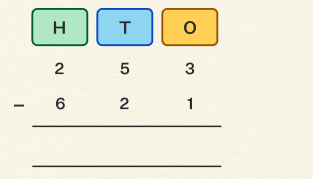
Did Rob write the numbers correctly?
a) Yes, Rob is correct by writing 253 on top and 621 at the bottom.
b) Yes, Rob is correct by writing 621 on top and 253 at the bottom.
c) No, Rob is incorrect by writing 253 on top and 621 at the bottom.
d) No, Rob is incorrect by writing 621 on top and 253 at the bottom.
- By how much is 7421 more than 6521?
Answer is ______?
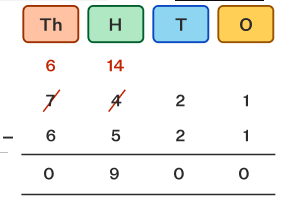
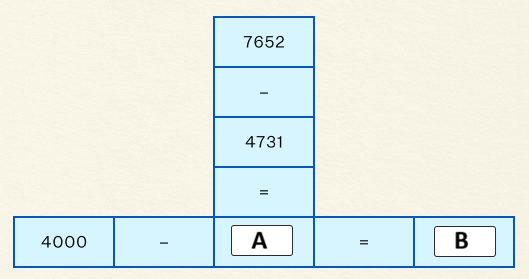
- Find the missing numbers (A, B) in the puzzle given below.
Related Blog: Math Homework Help 2026: Best AI Tools & Programs for Kids
The Cuemath Edge:
- US Common Core aligned — The curriculum is personalized to your child’s pace and level, so they’re always working at the right challenge.
- Expert tutor matching — When you sign up for a free trial, you share your preferences: days, times, and curriculum, following which, an expert tutor is carefully handpicked for your child. The same tutor stays with your child throughout the Cuemath journey (unless you ask for a change).
- Diagnostic assessment first — Every trial class starts by identifying exactly where your child needs support, so no time is wasted.
- A learning plan built together — The tutor creates a personalized plan so progress is intentional, not guesswork.
- Safe, distraction-free Live Online lessons — Classes run on Cuemath’s Leap platform: 100% safe, ad-free, and built for focus.
- Engaging worksheets that build confidence — Expert-curated, visual, and interactive worksheets help children master the concepts & feel accomplished after every class.
- Parent dashboard — Track progress with monthly reports and regular PTMs, so you’re always informed.
If your child is struggling to make sense of these steps in the regrouping concept, personalized support can make all the difference. Cuemath's live 1-on-1 online math classes are designed exactly for this: working through conceptual gaps using visual methods, so your child doesn't just follow the steps but also understands 'why' they work.
Here's one student success story worth sharing:
 Cuemath
Give your child the support they deserve
A clear plan, the right tutor, and steady progress — all designed around your child
Conclusion
Regrouping in math is one of those concepts that sounds unfamiliar until you realize it's something you already know. It's the same process as 'carrying' in addition and 'borrowing' in subtraction, just described in language that actually reflects what's happening with place value. And once a child understands it at that level, it builds the number sense they'll rely on for years to come.
Frequently Asked Questions About Regrouping in Math
What is regrouping in math, in simple terms?
Regrouping in math means exchanging values between place value columns — ones, tens, hundreds — to make addition or subtraction work correctly. When you add 7 + 8 in the ones column and get 15, you regroup: write 5 in the ones place, carry 1 ten to the tens column. It's the same process previously called carrying in addition and borrowing in subtraction — the name changed, not the math.
Is regrouping the same as borrowing in subtraction?
Yes — the steps are identical. The word changed because "borrowing" implies you give something back, which never happens. When you take a ten from the tens column to help the ones column, that ten doesn't return. "Regrouping" is more accurate: you're exchanging 1 ten for 10 ones (or vice versa), and the total value stays the same throughout. Common Core adopted "regrouping" to connect the procedure directly to place value, which is the concept children need to understand to apply it correctly in harder problems later on.
My child learned "borrowing" from me. Will that confuse them in class?
The steps are identical, so your child will get the right answer either way. The only risk is a vocabulary mismatch: if their teacher or a test uses the word "regroup" and your child only knows "borrow," they may not recognize they're the same thing. The simplest fix is to use both words at home: "We're going to borrow — which your teacher calls regrouping." No confusion, no conflict, full credit.
When do kids learn regrouping in math — Grade 1, 2, or 3?
Under Common Core, regrouping is formally introduced in Grade 2, starting with 2-digit numbers and building to 3-digit numbers within 1,000 by year's end. In Grade 3, regrouping extends to larger numbers and appears in early multiplication. Some schools introduce basic regrouping concepts at the end of Grade 1 — if your child's teacher mentions it earlier than expected, that's not unusual. Timing varies by state and district.
Why does regrouping in subtraction confuse kids so much?
Two reasons come up repeatedly in teacher forums and parent groups. First, children forget to reduce the tens digit by 1 after regrouping — they add 10 to the ones column but leave the tens unchanged. Second, they treat 14 as "10 and 4 separately" rather than one number, which breaks the subtraction. Both mistakes have the same root cause: not fully seeing what the regrouping exchange means. Spending even one session with base-10 blocks — physically trading a ten-rod for ten unit cubes — usually fixes both issues faster than drilling worksheets.
What is regrouping in addition, and when exactly is it needed?
Regrouping in addition is needed any time the digits in a column sum to 10 or more. You write the ones digit of that sum in the column and carry the tens digit to the next column left. Example: 7 + 8 = 15 → write 5, carry 1. Not needed: 3 + 4 = 7 → write 7, nothing to carry. Teaching your child to check each column before calculating — "does this add to 10 or more?" — is the single most effective habit for reducing addition regrouping errors.
Why does my child subtract the smaller digit from the bigger one and get the wrong answer?
Children who do this believe subtraction always means "bigger minus smaller," so when the top digit is smaller than the bottom, they flip them. For 34 − 28, they calculate 8 − 4 = 4 in the ones column instead of regrouping to get 14 − 8 = 6. The fix: before every subtraction problem, ask "Is the top digit bigger than the bottom digit? If not, regroup first." Making this a pre-check habit stops the error before it starts.
What is regrouping across a zero, and why is it especially hard?
Regrouping across a zero means subtracting when there's a 0 in the tens (or hundreds) place of the top number — for example, 300 − 147. Because you can't take a ten from a 0, you must first regroup a hundred into 10 tens, then regroup one of those tens into 10 ones. That's two regrouping steps in one problem, which is why it trips up many Grade 3 students. Working through it with base-10 blocks before attempting it on paper dramatically reduces errors — you can physically show why you have to "go two columns over" when there's a zero in the way.
My child can do regrouping with blocks but falls apart with the written algorithm. Is this normal?
Completely normal — and actually a positive sign. It means they understand the concept but haven't yet connected it to the written notation. Teachers call this the gap between concrete and abstract learning. The bridge is the pictorial stage: drawing tens as lines and ones as dots, performing the regrouping in the drawing, and then recording it in the algorithm. Once your child can draw the regrouping and explain what they're doing out loud, the written algorithm usually clicks within a few sessions.
Should I teach my child the old "borrowing" trick or the new regrouping method?
There's no mechanical difference between them — both produce the correct answer using the same steps. What matters is whether your child understands why they're doing it, not just how. Teaching tricks without the underlying place value logic tends to cause problems in Grade 3 when numbers get larger and problems become multi-step. If your child needs a trick to get started, use it — but immediately pair it with a visual that shows what's actually happening. The trick as a bridge is fine; the trick as the destination is where things go wrong.
How is regrouping in math related to place value?
Regrouping is built entirely on place value. Every exchange — 10 ones becoming 1 ten, or 1 ten becoming 10 ones — is a place value conversion. A child who doesn't understand that the digit "3" in 34 means three tens, not just "three," will have no conceptual basis for regrouping and will rely on memorized steps that break down as problems get harder. This is why both Common Core and structured math programs spend significant time on place value foundations before introducing the regrouping algorithm.
Does regrouping in math only apply to addition and subtraction?
No. Regrouping appears in multiplication too. When you multiply 4 × 36, for instance: 4 × 6 = 24, write the 4, carry the 2. That's regrouping by another name. A solid understanding of regrouping in addition and subtraction is what makes multi-digit multiplication feel logical rather than like a memorized trick — which is why elementary math builds these skills in sequence.
What is the partial sums method, and how is it different from standard regrouping?
The partial sums method adds each place value separately before combining. For example, 47 + 38 becomes (40 + 30) + (7 + 8) = 70 + 15 = 85. Some teachers use it alongside standard regrouping to build number sense first. Both methods give the same answer. Partial sums is often more intuitive for children still building place value understanding — if your child's teacher uses it, it's a stepping stone toward the standard algorithm, not a replacement for it.
How can I help my child with regrouping math at home without confusing them?
Three things matter most: start physical (coins, blocks, or grouped objects before any worksheet), use grid paper (misaligned columns cause more errors than concept confusion), and practice a little every day (5 focused problems beats 30 rushed ones). Say "regroup" out loud — not "borrow" — to match what their teacher says. Always check the tens column together after every subtraction problem.

About the Author
Neelima Kotamaju
Neelima is an Educator with 10+ years in EdTech, designing learning experiences rooted in pedagogy, classroom insights, and child psychology.
View My LinkedIn
Read more
SAT 1350 in Grade 10: The Math Foundation Nikita Madineni Built Before Test Day
Nikita Madineni was in Grade 7 when she joined Cuemath. By Grade 10, she scored 1350 on the SAT in her first sitting. Most students take it two years later.
Math Kangaroo Grade 3 Top Score: How Tavasya Ranked 3rd in Tennessee and 16th in the USA
A Grade 3 student in Tennessee entered Math Kangaroo and scored 79 out of 96. State Rank 3. National Rank 16. This is how Tavasya got there.

AP Precalculus Score 5: How Grade 11 Student Saanvi Shivkumar Got There
Saanvi Shivkumar's first AP Precalculus test did not go well. Stepping back felt like the sensible choice. She stayed, and earned a score of 5, the highest possible on the AP exam.
How a Grade 7 Student Scored STAAR Math 100th Percentile Two Years in a Row
When Devansh Senapati joined Cuemath in Grade 2, he was learning addition and subtraction. Five years later, he is in Texas's TAG program, studying Algebra 1 in Grade 7, and has scored the 100th percentile on the STAAR math test two years in a row.