Why the Same Tutor Every Class Makes All the Difference (The Looping Model Explained)
When a child works with the same tutor every class, something shifts; not just in grades, but in how they feel about math entirely. Here's the science behind what educators call the 'looping model' and why Cuemath was built around it.

Around 50% of U.S. grade-school children experience some level of math anxiety, according to researchers at Stanford's neuroscience lab.
Most parents looking for a math tutor focus on tutor credentials or price. Very few ask this: Will my child have the same tutor every single class?
In this blog, we explain why tutor consistency is one of the core factors of student success. We refer to developmental psychology, neuroscience, and large-scale tutoring programs to show what changes when a child learns with someone they genuinely trust, week after week.
- The tutor-student relationship affects the way students learn. It is not just a supplement to good teaching, but the infrastructure for it.
- Stanford neuroscientists found that 8 weeks of consistent 1:1 tutoring with the same tutor normalized the brain's fear response in math-anxious children. A new tutor each week resets this effect entirely.
- Saga Education's consistent-tutor program cut math course failures by 49% and delivered 2–2.5 years of math learning in a single school year.
- Cuemath's principle: one tutor, one child, every class, has effectively built the trust that compounds into results.
What is the Looping Model?
- In schools, 'looping' simply means that the teacher will stay with the same class for multiple years. For example, moving from 3rd to 4th grade with the same students.
- In tutoring, the same principle applies. A student who works with the same tutor class after class builds something more than a study habit.
- They build a working relationship where the tutor already knows their specific gaps, their pace, their confidence patterns, and the mistakes they make when they're tired or overwhelmed.
- That knowledge doesn't transfer to a new tutor. It has to be rebuilt from scratch. The rebuilding costs time that would otherwise be spent learning.
The Science Behind Why the Same Tutor Works.
- When a child trusts the person teaching them, three measurable things happen in the brain.
- Oxytocin is released, and it suppresses the amygdala's threat-detection system. The prefrontal cortex, which handles reasoning and working memory, operates without interference.
- Dopamine, triggered by positive interactions with a familiar tutor, drives motivation.
- In 2015, researchers at Stanford (Supekar, Iuculano, Chen, and Menon) ran an 8-week study with math-anxious 3rd graders.
- Each child received one-on-one tutoring three times a week with the same tutor every session.
- Before tutoring, the students showed hyperactivation in the right amygdala during math (the sign of fear).
- After 8 consistent weeks, the amygdala activation normalized to the levels seen in less anxious children.
- The researchers noted directly that a new tutor each week would increase the threat level and cause fear and anxiety.
What Parents Think About the Tutor-Student Relationship?
We read recent Reddit threads like r/Kumon (since it is mostly worksheet-based), r/VarsityTutors (a tutor marketplace), and r/homeschool (pure tutor connect without any platform) to see what parents and students say when they reflect on tutoring.
When there is no tutor relationship by design.
One of the former Kumon students describes sitting through sessions where a stack of worksheets was handed out, and tutors circled the room. When the student didn't understand something, the tutors asked them to try harder.
"I always received little to no help, with the teachers and helpers just telling me to 'try harder.' This didn't help me understand."
— Former Kumon student, r/Kumon
What the post captures isn't a complaint about the program's features. When no tutor genuinely knows the student, the program cannot compensate.
When a bond forms, but the platform breaks it.
A tutor on r/VarsityTutors posted about a student they had worked with for years. When the student returned after a summer break and specifically requested to be re-matched with that same tutor, the platform told the student the tutor was unavailable.
"This is sadly a common story. And it absolutely is done to avoid paying the bonus to the tutor."
— Comment, r/VarsityTutors
Similarly, a parent whose son had a good experience with a Varsity Tutor 3 years earlier, now looking for tutoring for a second child, wrote: "I will try to reach out to the tutor directly instead of through Varsity Tutors."
The parent wasn't shopping for a new platform or a better price. They wanted the same person. When a bond forms, the relationship becomes more valuable than the platform itself.
Your Child Deserves a Tutor Who Knows Them
At Cuemath, your child works with the same tutor every class. No rotations, no starting over. Try a free class and meet the tutor who will stay.
Book a Free Class200,000+ students • 4.9+ rating • 80+ countries
When the tutor-student bond runs deep.
r/homeschool describes a student who had left mainstream school 3 years earlier due to severe anxiety and depression, and is now finishing up with their long-term homeschool tutors:
"I truly gotten close to both of my tutors, they have helped me out in amazing ways... without them I wouldn't be in the spot I'm in now."
— Student, r/homeschool
A former tutor responding in the thread described their own version of the same experience: "I still remember a student I tutored once a week for a couple of years. We were both sad and excited when it was time for them to move on."
Why Cuemath is Built Around One Tutor, One Child, Every Class?
Most tutoring programs are built around availability. A slot opens, a tutor fills it. When that tutor is unavailable, another steps in. The child adjusts.
Cuemath is built around the opposite principle. Every child is matched with a tutor as close to their requirements. The tutors are trained in both Cuemath's math pedagogy and child psychology.
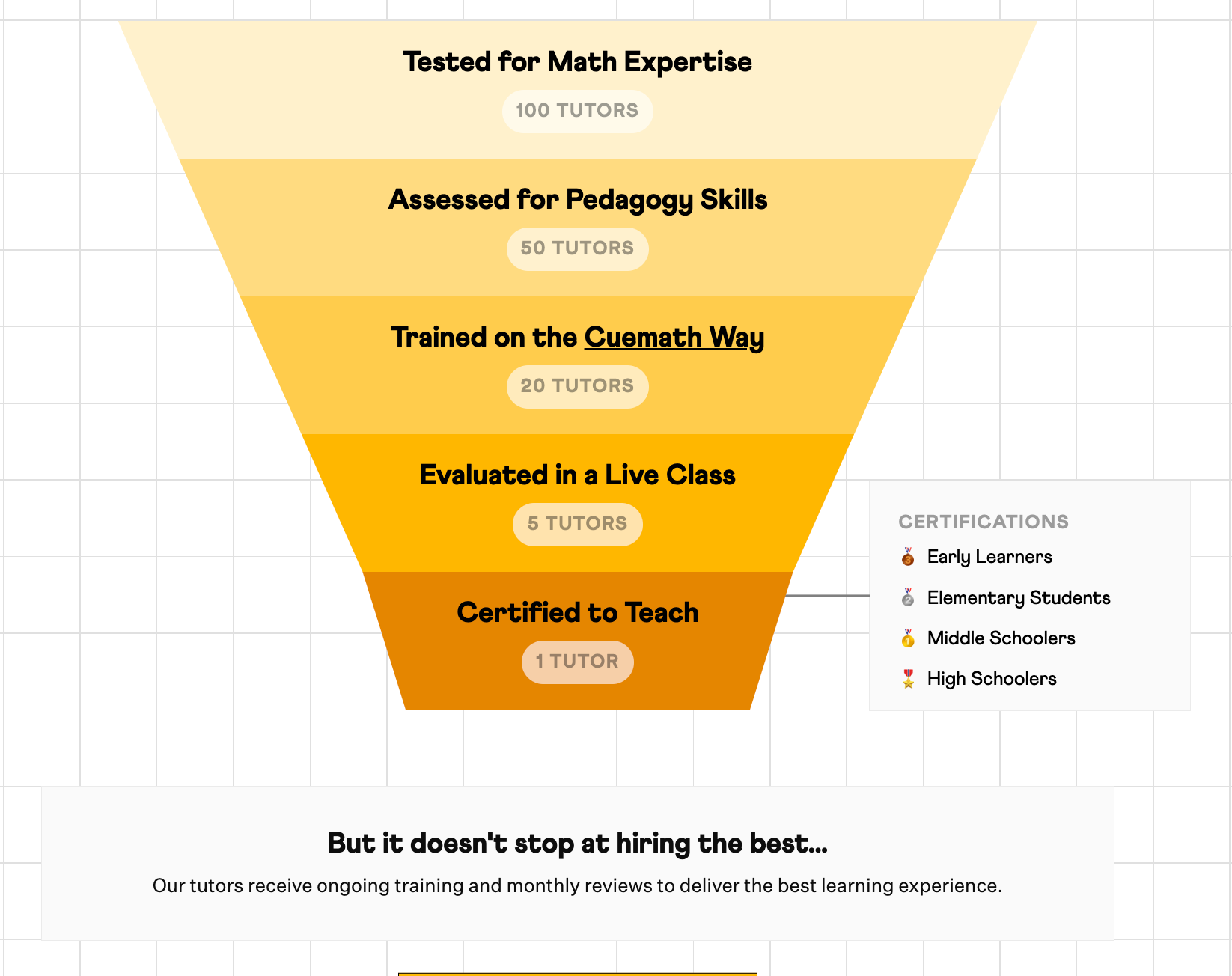
Each 1:1 class is with the same tutor every time. Over weeks and months, the tutor learns the child's pace, their gaps, their learning style, and their confidence patterns. They know which topics produce shutdown and which examples make something click. The Cuemath's collaborative digital whiteboard gives the tutor and student a shared visual space to think through problems together, and the Talk-o-Meter tracks how much the student is actively reasoning out loud.
Cuemath tutor and student working through a problem together.
These tools work most powerfully when the tutor already knows how the child thinks, because the tutor can interpret what the student is saying and why.
Why Cuemath Offers a No-Questions-Asked Tutor Change?
Some Cuemath students try more than one tutor to find the right match. The first tutor assigned is not always the one who clicks. Requiring parents to justify or explain a change puts the burden in the wrong place. So Cuemath introduced a no-questions-asked tutor change policy. The request is enough. No explanation required.
Another parent mentioned how they spent 4 years with Cuemath, but suddenly their daughter started to lose interest in math. They requested a change and found the perfect tutor they'd been looking for:
The goal of the policy is not to treat tutor changes as failures. It is to treat finding the right match as part of the process, and to remove any friction that might stop a family from completing it.
What happens once the right match is found is worth noting, too. One of the Cuemath families relocated to another timezone mid-program. Their daughter's response made the priority clear:
Cuemath reassigned the tutor across time zones. The continuity held. What the parent called invaluable was not the platform, the curriculum, or the pricing. It was the specific tutor her daughter had already come to trust, and refused to give up.
Parent sharing her experience with Cuemath.
Therefore, at Cuemath, one tutor, one student model isn't just a tagline. It is the structural condition that makes everything else, the pedagogy, the platform, the assessments, actually work together.
Find the Tutor Your Child Clicks With
It sometimes takes more than one match to find the right fit. At Cuemath, that process is no-questions-asked. Once you find your tutor, they stay.
Book a Free Class200,000+ students • 4.9+ rating • 80+ countries
Frequently Asked Questions
What is the looping model in tutoring?
The looping model in tutoring means the same tutor works with the same student continuously across classes, weeks, and months. In tutoring, the looping model allows the tutor to build deep familiarity with one student's pace, gaps, and learning patterns, which research shows is the primary driver of math improvement over time.
Does changing math tutors affect a child's progress?
Yes, neurologically, oxytocin and cortisol make a child feel safe enough to engage fully with a new person. Pedagogically, the new tutor must re-diagnose the child's level and patterns before any targeted teaching can begin. For children with math anxiety specifically, Stanford's 2015 neuroscience study found that the anxiety-reduction effect of consistent tutoring depends on repeated safe encounters with the same trusted person. A new tutor resets the fear response.
How does Cuemath match students with tutors?
Cuemath selects tutors from the top 1% of tutor applicants. They are screened for subject expertise, empathy, and teaching approach. Once on board, they are regularly trained in both Cuemath's math pedagogy and child psychology. Each student is then matched with a single tutor based on the student's grade level, learning pace, and goals.
How is Cuemath different from tutoring marketplaces like Wyzant or Varsity Tutors?
Tutoring marketplaces like Wyzant and Varsity Tutors operate on availability. A student books a tutor from a pool, and the specific person they get can vary from session to session.
Cuemath operates on the looping model: one tutor, one child, every class. Parents using marketplace platforms frequently report that their child had multiple different tutors within a few weeks, which research shows resets the neurological and relational conditions that make learning effective.
What is the difference between Cuemath and Mathnasium for math tutoring?
Mathnasium is a center-based group model where students work in small groups with part-time tutors who may rotate. Parent reviews frequently note inconsistent instructor assignments and staff turnover. Cuemath is a 1:1 online model where the same tutor works with the same student every class. The research distinction matters: group center models can produce good results when a specific tutor connects with a child, but they cannot guarantee the consistency of that relationship. Cuemath's structure guarantees it.
Can I request a tutor change at Cuemath?
Yes, Cuemath has a no-questions-asked tutor change policy. If a student or parent feels the current tutor isn't the right match, a change can be requested without providing any explanation. Cuemath introduced this policy after recognizing that first matches don't always produce the connection that makes learning work. The goal is to make finding the right fit part of the process, not a judgment on anyone involved. Once the right match is found, Cuemath's structure ensures that the tutor stays with the student for the long term.
How do I know if my child needs a different tutor?
If a child who previously engaged willingly starts showing avoidance before class, stops asking questions during sessions, or seems bored rather than curious, the relationship may not be working. A tutor mismatch rarely shows up first in test scores. It shows up in how the child feels about going to class.
What happens to my child's progress when a Cuemath tutor changes?
When a tutor change happens at Cuemath, the new tutor receives access to the student's full learning history: MathFit assessment scores, curriculum position, and progress notes. The relational bond builds freshly, but the diagnostic and academic context carries over. The new tutor isn't starting from zero; they begin with the map the previous tutor built. For most students, a purposeful change to a better-matched tutor produces a visible lift in engagement within the first few weeks.
What qualifications do Cuemath tutors have?
Cuemath selects tutors from the top 1% of applicants, screening for subject expertise, teaching instinct, and the ability to work with children across different learning styles and confidence levels. All tutors are trained in Cuemath's MathFit pedagogy, which assesses students across Fluency, Understanding, Application, and Reasoning, and in child psychology principles that inform how they build the tutor-student relationship over time. Tutors work exclusively 1:1, which means their attention in every class goes entirely to one student.
Sources
- Supekar, Iuculano, Chen & Menon (2015) — Remediation of Childhood Math Anxiety and Associated Neural Circuits through Cognitive Tutoring, Journal of Neuroscience (PMC)
- Wu, Hughes & Kwok (2010) — Teacher-Student Relationship Quality Type in Elementary Grades, Journal of School Psychology (PMC)
- Hamre & Pianta (2001) — Early Teacher-Child Relationships and the Trajectory of Children's School Outcomes through Eighth Grade, Child Development (ERIC)
- Midgley, Feldlaufer & Eccles (1989) — Change in Teacher Efficacy and Student Beliefs in Mathematics During the Transition to Junior High School, Journal of Educational Psychology
- Guryan et al. (2021) — Study Finds High-Dosage Tutoring Can Double or Triple Math Learning, Northwestern IPR
- Wang, Xu & Fei (2024) — Effect of Student-Perceived Teacher Support on Math Anxiety, Frontiers in Psychology (PMC)
- Zenodo/ERIC — Influence of Teacher-Student Relationship on Student Mathematics Achievement in High School in the USA
- EdResearch for Action (2024) — Design Principles for Accelerating Student Learning with High-Impact Tutoring