20 Best Online Math Classes for US Students by Grade, Learning Goal, and Budget (2026)
Not all programs are built the same. We reviewed 20 online math classes in the US and matched each one to a grade level, learning goal, and budget so you know exactly where to start.

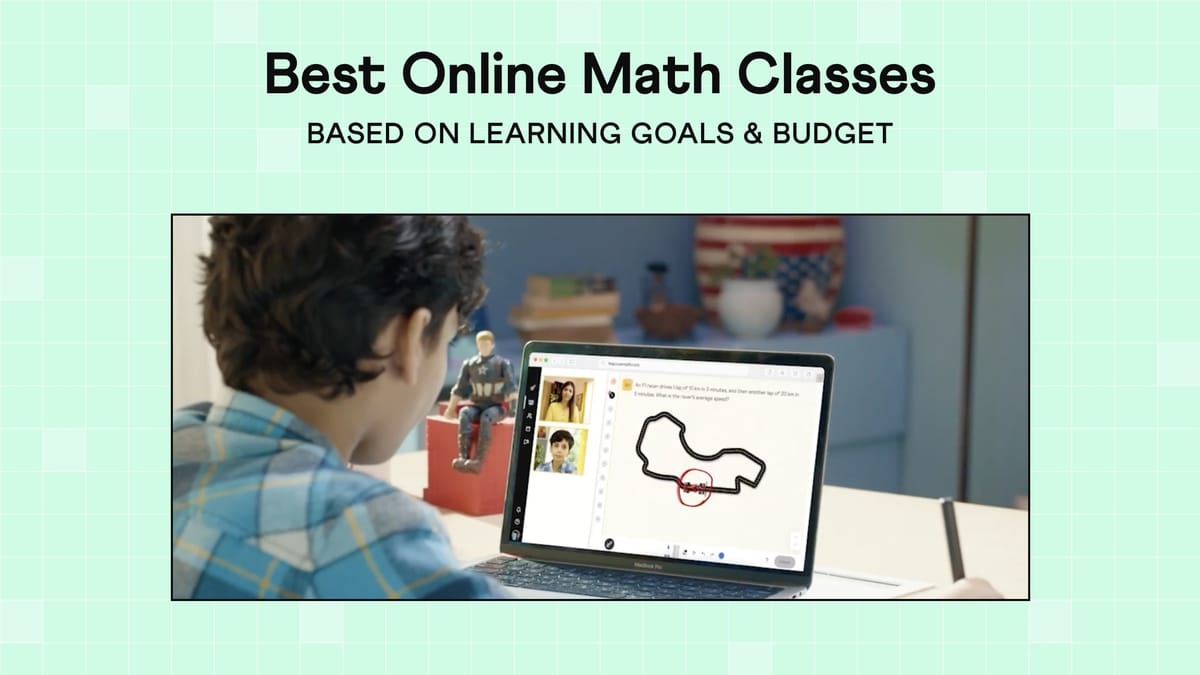
Online math classes today range from completely free platforms to tutor-led, live 1:1 programs, and the right starting point depends entirely on what your child needs right now. If your child just needs a concept refreshed or wants to practice at their own pace, a free platform is a perfectly good place to begin. But some students hit a point where they need to connect with an expert math tutor in real time.
Parents who have been through this journey with us know the difference firsthand. Shalaka Mathew, a US parent, shares her experience on Trustpilot: "My 8-year-old genuinely looks forward to each session, which says a lot. We've noticed a significant improvement not only in math skills but also in confidence and problem-solving ability." Cuemath, one of the personalized math tutoring options covered in this guide, has worked with 200,000+ students across 80+ countries, with 4,000+ trained tutors and a 4.9 rating on Trustpilot.
To build this list, we spoke with parents who had tried multiple platforms, reviewed parent testimonials, and spent time in Reddit communities where families share unfiltered, real-world feedback. We were not looking for the most popular options. We were looking for what actually works across different grades, goals, and budgets.
The result is 20 of the best online math classes in the US, organized by grade level (K-2, elementary, middle, and high school), learning goal, and price. Start with what fits your situation today.
Quick Summary of Winners
| Class Name | Best For | Price Range | Format |
|---|---|---|---|
| Cuemath | Personalized 1:1 Tutoring | $25–$32/session | Live 1:1 |
| AoPS | Competition Math | $15–$50+/class | Live & Self-Paced |
| Khan Academy | Free School Support | Free | Self-Paced |
| Mathnasium | Homework Support | $200–$400+/mo | Live 1:1 |
1. Khan Academy: Best for US Common Core Standards Review
Khan Academy is one of the most widely used free math learning platforms in the US. It offers structured video lessons and practice exercises across elementary math, middle school topics, high school algebra and geometry, and AP-level calculus.
Check Khan Academy's official website!How it Works?
Unlike Cuemath’s live, tutor-led 1:1 classes, Khan Academy is purely self-paced, making it a better choice for independent review rather than guided skill-building.
The Pros
- Completely free
- Wide coverage from elementary to advanced math
- Flexible pacing
- Easy-to-use interface
- Helpful for extra practice and revision
2. Art of Problem Solving (Best for Competition Math)
Art of Problem Solving (AoPS) is designed for students who want to go beyond school math. While Cuemath focuses on building a multi-dimensional math foundation for all students, AoPS is specifically meant for high-aptitude students aiming for competitive math exams like the AMC.
Check AoPs's official website!How it Works?
- Live small-group online classes
- Competition-focused curriculum
- AMC 8, AMC 10, AMC 12 preparation
- MathCounts Trainer resources
The Pros
- Excellent preparation for top competitions like USA IMO (AoPS alumni won 65 medals in 11 years) and elite colleges.
- Year-round live classes (12-25 weeks)
- Active forums with brilliant peers in the world's largest online math community
3. Cuemath: Best for US K-12 Personalized Tutoring
Cuemath is a personalized, live online math class for students in Kindergarten through 12th grade. Unlike apps where kids work alone, Cuemath pairs your child with a consistent tutor for private sessions. The program is designed to move at your child's specific speed, whether they are trying to fix a struggle or get ahead of their grade level.
How It Works?
- Your child meets with their tutor online 2 or 3 times a week. It’s a live, face-to-face interaction where they can ask questions in real-time.
- During class, the student and tutor use a shared digital whiteboard. They can both write on it to solve problems together, making it easy for the tutor to see exactly where a student might be making a mistake.
- To keep math fun and keep the brain active, tutors assign games, brain teasers, and puzzles for students to work on between their scheduled sessions.
- Students also get access to the MathGym app, which is designed for daily math games to sharpen their mental math and speed.
The Pros
- Meeting multiple times a week ensures that the material stays fresh and that the student doesn't feel stuck for long before their next check-in.
- The shared whiteboard makes the online class feel like sitting at the same desk. It allows for active problem-solving rather than just listening to a lecture.
- By including puzzles and games, the program helps build logic and creative thinking skills, making math feel less like a chore and more like a challenge to solve.
- The combination of live classes and daily app practice helps turn math into a long-term skill.
Start with a Free Cuemath Evaluation
Discover why thousands of parents trust structured, expert-led math learning for K–12 students. Get a free diagnostic assessment and a personalized learning plan today.
Book a Free Evaluation4. Elephant Learning (Best for Early Math Skill Acceleration)
Elephant Learning offers adaptive online math classes for kids covering topics from early counting through Algebra. The platform begins with an assessment to determine where the student truly stands. From there, adaptive algorithms adjust difficulty in real time.
While Mathnasium and Cuemath, Elephant Learning relies entirely on an automated, adaptive algorithm to bridge learning gaps through gamification.
Check Elephant Learning's official website!How it Works?
- Covers counting through Algebra
- Adaptive assessment and real-time level adjustment
- Gamified learning environment
The Pros
- Guaranteed 1 year of math progress in 3 months with just 10 minutes/day, 3x/week
- Engaging games with personalisation
- Can support both acceleration and remediation
5. Mathnasium: Best for US School Homework & Local Support
Similar to Cuemath, Mathnasium offers personalized math tutoring but in groups of 4 students per tutor. But Mathnasium is mainly popular for offline tutoring, whereas Cuemath was built from the ground up for an online 1:1 math tutoring experience.
Check Mathnasium's official website!How it Works?
- Live online tutoring sessions
- Real-time teaching, worksheets, and feedback.
- Custom plans target skill gaps through diagnostic assessments
The Pros
- Freedom to switch between online and in-centre learning based on your schedule
- Easy scheduling that is perfect for busy schedules or family travel
- Immediate help with school homework
6. Think Academy: Best for SAT, ACT & AP Math Prep
Think Academy offers structured online math classes designed around academic progression and exam preparation. While Outschool offers a marketplace of varied teaching styles, Think Academy follows a much more rigid, term-based academic structure similar to a traditional school semester.
Check Think Academy's official website!How it Works?
- Skills-based placement test before enrollment
- Live small-group classes with fixed schedules
- Term-based academic structure
- Curriculum covering K–12 through AP math
The Pros
- Clear ability-based placement
- Strong preparation for school-level assessments
- Covers advanced high school math, including AP
7. MIT OpenCourseWare (Best for College-Level and Engineering Math)
MIT OpenCourseWare provides free access to full university math courses, including lecture videos, assignments, problem sets, and exams. These are actual courses taught at MIT and made publicly available online; students follow the material independently.
Check MIT OpenCourseWare's official website!How it Works?
- Free access to full MIT math courses
- Lecture videos, assignments, and exams
- Engineering-level rigor
The Pros
- No enrollment or subscription required
- Extremely high academic depth
- Ideal for advanced learners
8. Russian School of Mathematics (Best Traditional After-School Math Program)
The Russian School of Mathematics, often referred to as RSM, follows a structured after-school model rooted in the traditional Russian approach to math education. Unlike the gamified visuals found in SplashLearn or Elephant Learning, RSM prioritizes a rigorous, traditional academic classroom setting with a heavy emphasis on algebraic discipline.
Check RSM's official website!How it Works?
- Small-group classes (online or in-person), building from elementary basics to advanced high school prep like algebra, geometry, and AMC competitions.
- Diagnostic placement ensures right-fit levels; full-year commitment
- Strong focus on algebraic reasoning
The Pros
- Academic rigour beyond typical school math
- High-quality instruction
- Clear long-term progression model
9. Johns Hopkins Center for Talented Youth (Best for Gifted and Academically Advanced Students)
Johns Hopkins Center for Talented Youth (CTY) offers advanced online math classes for high-performing students ready to move beyond grade-level expectations. It offers advanced online math courses ideal for gifted K-12 students who qualify through high-aptitude tests such as SCAT or SAT.
Check CTY's official website!How it Works?
- University-backed accelerated online math classes
- Qualification-based access that requires 98th percentile scores in math/verbal tests for entry
- Live online sessions (3-12 weeks), session-based, or individually paced courses
- Curriculum enrichment in broad math, like algebra, geometry
The Pros
- Strong academic challenge
- Balances school with a 2-4 hours weekly load
- Recognised institutional credibility
10. HarvardX: Best for US College Credit & Ivy League Prep
HarvardX, offered through edX, provides university-level online math classes taught by Harvard faculty.
Some of the most discussed and recommended math courses on edX include:
- Calculus Applied! (HarvardX) – Focuses on practical applications of single-variable calculus, often recommended for students moving toward STEM fields.
- Linear Algebra – Foundations to Frontiers (UT Austin via edX) – Frequently mentioned for its strong conceptual clarity and structured progression.
- MITx: 18.01x Single Variable Calculus – Known for engineering-level depth and problem-solving rigor.
- MITx Probability & Statistics courses – Often recommended for learners preparing for data science, engineering, or higher-level mathematics.
How it Works?
- Ivy-level course design
- Self-paced format with 4-12 week structures, interactive exercises, and peer discussions—no qualification needed, unlike CTY.
- Beginner to advanced options
- Optional verified certification
The Pros
- Prestigious credentials boost resumes for competitions/college applications
- Good preparation for engineering, data science, and advanced STEM pathways
- Independent learning skills at zero or minimal cost
11. Outschool (Best for Flexible Small-Group Online Math Classes)
Outschool is not a single math platform but a marketplace that offers a wide variety of online math classes taught by independent educators. Compared to the expert pool of math tutors certified to teach according to the US Common Core State Standards in Cuemath, Outschool acts as a marketplace where parents can pick and choose individual teachers for specific, short-term math topics. For a side-by-side look at tutor marketplaces, see our review of the best online math tutoring platforms.
Check Outschool's official website!How it Works?
- Wide range of online math classes for different age groups
- Flexible scheduling and short-term commitments
- Small live group format
- Instructor ratings and reviews transparency
- Pay-per-class or ongoing subscription options
The Pros
- High scheduling flexibility
- Large selection of topics and formats
- Good for trying targeted short-term classes
- Smaller group sizes than traditional classrooms
12. 3Blue1Brown (Best for Conceptual Understanding Through Visual Learning)
What’s a list of online math classes without YouTube?
Created by Grant Sanderson, the channel is known for turning abstract topics like linear algebra, calculus, and neural networks into clear visual stories. Instead of memorizing formulas, you see how they work.
I wouldn’t classify 3Blue1Brown as a replacement for structured online math classes. There are no assignments, no progress tracking, and no tutoring support. But sometimes, one well-explained 15-minute video can unlock what weeks of practice couldn’t.
Check 3Blue1Brown's official website!13. Beast Academy (Best for Gifted and Math-Curious Elementary Students)
Beast Academy is built by the same team of Art of Problem Solving. It uses a comic-book format to teach mathematical reasoning to students in grades 1 through 8.
Monster characters guide students through logic, patterns, and non-routine problems; hence, kids like Beast Academy. The online platform includes adaptive practice, while physical workbooks are available as a supplement.
Check Beast Academy's official website!How it Works?
- Comic-based curriculum for grades 1-8
- Focus on logic, patterns, and non-routine problems
- Physical workbooks available as supplements (~$15-20 each)
- Created by the Art of Problem Solving team
The Pros
- Highest engagement for elementary students in our research; kids consistently choose it over screen time
- Builds deep mathematical reasoning, not just calculation speed
- Affordable at $15.99/month for the online platform
- Strong mathematical pedigree from the AoPS team
14. Brilliant.org (Best for Self-Motivated Middle and High Schoolers)
Brilliant is an interactive platform built for students who want to understand math deeply rather than memorize procedures. Its courses are pre-recorded and use visual puzzles, guided discovery, and short daily problem sets. It works best as an enrichment for middle and high school students who want to go beyond what their school teaches.
Check Brilliant's official website!How it Works?
- Puzzle-first, interactive learning format
- Covers algebra, geometry, calculus, statistics, and logical reasoning concepts
- Daily quick problem sets available
- Mobile app with offline access
The Pros
- Helps students build real math confidence. Parents are often shocked to see their teens opening the app all on their own.
- Very affordable at $10.79/month on an annual plan
- Good daily math supplement to help your child stay ahead of the curve and master their schoolwork.
- Best for STEM-oriented students exploring beyond the classroom
15. Kumon: Best for Mastering the Basics Through Daily Practice
Kumon is a household name in the US for a reason: it’s one of the most reliable ways to make sure your child is fast and accurate with their math facts. Whether you go to a local center or work online, the program uses a practice makes perfect approach. Students start with easier work to build their confidence and then move up as they master each skill.
Check Kumon's official website!How It Works?
- Your child will spend 10–30 minutes a day on math worksheets.
- There’s no rushing; your child only moves to the next level when they’ve totally mastered the current one.
- With thousands of locations across the US, there’s likely a center right in your neighborhood.
- It covers everything from basic addition all the way up to Calculus.
The Pros
- It turns mental math into a reflex. Your child will stop counting on fingers and start answering instantly.
- The daily routine teaches kids discipline and how to work independently.
- It’s great for plugging the holes in a child’s math knowledge before they get to more difficult school work.
16. IXL: Best for US State Standardized Test Alignment
IXL is like a massive digital library of math skills. It’s famous for its Skill Map, which tracks over 4,000 different math topics from Pre-K all the way through high school. Because it aligns perfectly with what most US schools are teaching, there’s a good chance your child already has a login through their classroom.
Check IXL's official website!How It Works?
- It covers every single topic your child will see in school, all following the standard Common Core state guidelines.
- The problems get harder as your child gets answers right, so they stay challenged.
- The parent dashboard gives you a deep dive report, showing exactly what your child practiced and where they’re struggling.
- Check with your child’s teacher first! Most US schools pay for a subscription so parents don’t have to.
The Pros:
- It’s the best program for finding that one missing link in your child’s math knowledge.
- Since it follows the school curriculum, it’s a great way to reinforce what was taught in class that same morning.
- For most families, this is a pro add-on because the school has already picked up the tab.
17. SplashLearn: Best for Making Math Feel Like Play (Grades K–2)
If you are struggling to get your little one excited about numbers, SplashLearn is a game-changer. It is like an animated world designed specifically for younger kids (Pre-K through 5th grade). Because it’s used in over 350,000 US classrooms, the games your child is playing are actually the same skills their teacher is covering in school.
Check SplashLearn's official website!How It Works?
- It’s packed with fun characters, rewards, and animations that keep kids coming back for more.
- It covers all the early math concepts—counting, addition, subtraction, shapes, and the basics of multiplication.
- The content follows the same Common Core standards used in most US schools.
- You get a simple dashboard that shows you exactly how much your child is learning while they play.
The Pros
- It’s so engaging that most 4- to 8-year-olds will choose to play it on their own without you having to ask.
- You can start with a free version, and even the premium plans are very affordable (around $8–$13 a month).
18. Thinkster Math: Best for Personalized Coaching
Thinkster is a smart math program that gives your child a dedicated coach and a personalized plan for Grades K–8. As your child solves problems on their tablet, the app records their process, so their coach can watch it back like a video and figure out where the child gets stuck.
Check Thinkster Math's official website!How It Works?
- Your child isn't just learning from a computer; they are paired with a dedicated tutor who monitors their daily progress.
- The app tracks how your child solves problems, not just if they got the answer right or wrong.
- Depending on your plan, your child has 1:1 video sessions with their coach to go over difficult topics.
- The curriculum aligns with what’s being taught in US classrooms, so it directly supports their school grades.
The Pros
- Most apps just mark an answer wrong. Thinkster’s coaches can see the logic your child used and give specific feedback to fix it.
- Because it aligns with school, it feels like a helpful extension of their teacher’s lessons rather than extra confusing work.
- It’s much cheaper than hiring a private tutor to come to your house every week, with plans starting around $64/month.
19. ALEKS: Best for Finding Specific Learning Gaps in Middle and High School
ALEKS is an adaptive math program used by many US middle schools, high schools, and colleges. It focuses on testing a student’s current knowledge and then assigning only the specific topics they haven't mastered yet. Progress is tracked through a pie chart that fills up as the student completes different sections of a subject.
Check ALEKS's official website!How It Works?
- Every student starts with an assessment to determine exactly which math concepts they already know.
- Based on that test, the program only gives the student problems for the specific skills they are missing.
- The program periodically re-tests students on old topics to ensure they haven’t forgotten what they learned in previous weeks.
- It covers everything from 6th grade through Calculus and costs about $20 a month for families signing up independently.
The Pros
- It identifies the exact math concepts a student is struggling with, which helps them focus their study time on what they actually need to learn.
- Because it is so thorough, it is a good online math program for students who want to review everything that might appear on the SAT or ACT.
- Since many schools and colleges use it, it helps older students get used to the type of platforms they will use in higher education.
20. Prodigy Math: Best for Daily Practice That Feels Like a Video Game (Grades 1–8)
Prodigy is a fantasy adventure game where kids play as wizards. To win battles and progress through the story, they have to answer math questions. Because it looks and feels like a real video game, most kids between the ages of 6 and 12 will play it on their own without being told to study.
Check Prodigy Math's official website!How It Works?
- Kids create a character and explore a virtual world. They battle monsters by solving math problems.
- Teachers can log in and assign specific topics so that the game focuses on exactly what your child is learning in class that week.
- It covers math skills for 1st through 8th grade.
- The basic version is free. There is a premium version for about $9 a month that gives kids extra in-game rewards.
The Pros
- This is the easiest program to get kids to use. They often treat it like screen time rather than homework.
- You can use the full educational part of the game for free, which makes it a great low-cost option.
- Since many US schools use Prodigy, your child’s teacher might already be tracking their progress and setting their assignments.
Start with a Free Cuemath Evaluation
Discover why thousands of parents trust structured, expert-led math learning for K–12 students. Get a free diagnostic assessment and a personalized learning plan today.
Book a Free EvaluationFrequently Asked Questions (FAQs)
Q1: How do online math classes work?
Online math classes are conducted on video platforms (for example, Cuemath LEAP– a live-classroom platform), where students attend live sessions with a tutor or instructor. Depending on the platform, sessions can be 1-on-1, small-group, or self-paced. Students typically work through structured lessons, solve practice problems, and receive real-time feedback. Platforms like Cuemath also include progress tracking, worksheets, and diagnostic assessments to personalise each student's learning path.
Q2: Are online math classes hard?
Online math classes are designed to match your child's current level, so they should not feel overwhelming if the right platform is chosen. Most quality platforms start with a placement assessment to ensure students are working at the appropriate difficulty. And, the best part is, there are guided tutors to support them every step of the way!
Q3: Where can I take math classes online?
There are many options depending on your goal. For structured 1-on-1 online math classes, Cuemath is a strong choice. For competition math, Art of Problem Solving is widely recommended. For free self-paced learning, Khan Academy and MIT OpenCourseWare are excellent. For flexible short-term classes, Outschool offers a wide variety of topics and schedules.
Q4: How will online math classes improve my child's performance?
Online math classes improve performance by providing consistent, structured practice aligned with your child's school curriculum. Live instruction helps students understand concepts rather than just memorize procedures. Regular feedback from tutors identifies weak areas early, and personalised practice ensures gaps are addressed before they affect grades. Over time, this builds both skill and confidence.
Q5: Do students actually see grade improvement with online math classes?
Yes, most students who attend online math classes consistently see measurable improvement in their grades. Platforms like Cuemath, which focus on concept clarity and structured progression, report noticeable academic improvement within a few months.
Q6: How long does it take to see results from online math classes?
Most students begin to show improvement within 4 to 8 weeks of consistent attendance. Early signs include better confidence, faster problem-solving, and improved homework accuracy. Significant grade improvement typically becomes visible over one to two school terms, depending on the learning gap and session frequency.
Q7: What skills beyond school math will my child develop?
Beyond grades, online math classes help develop logical reasoning, structured problem-solving, and the ability to break down complex problems step by step. Platforms focused on competition math, such as Cuemath and Art of Problem Solving, foster deep analytical thinking.
Q8: Will online math classes help with competitive exams, Olympiads, or the school curriculum?
It depends on the platform. For school curriculum alignment, Cuemath, Think Academy, and Mathnasium are strong options, as they align with the US Common Core and other recognised standards. For competition preparation, including AMC, MathCounts, and Math Olympiads, Cuemath, Art of Problem Solving, and Russian School of Mathematics are specifically designed for this purpose.
Q9: Are online math classes as effective as offline classes?
For most students, yes — especially when the platform offers live instruction, real-time feedback, and consistent relationships with tutors. Research and parent reviews consistently show that structured online math classes can match or exceed in-person results when attendance is regular. The key advantage of online classes is flexibility and access to better-matched instructors regardless of location.
Q10: How do online math platforms keep kids engaged during sessions?
Quality online math platforms use a combination of interactive visuals, gamified exercises, real-time problem-solving, and reward systems to maintain engagement. Platforms like Cuemath use visual-aided lessons and logic puzzles alongside live tutor interaction. The 1-on-1 format also helps significantly — tutors can adapt the pace and tone of each session based on how the student is responding, making it harder for attention to drift compared to a group class.

I grew up a science kid. Math was not my best subject. Class moved fast, I was too shy to ask for help, and I somehow ended up more curious about how people learn than about the subjects themselves.
That's what pulled me into education — not to teach, but to understand how colleges and tutoring programs actually work and what students genuinely need from them.
My love for writing did the rest. I had too many observations and nowhere to put them, so I started writing, and haven't stopped. Over the last five years I've written about edtech, student life, and college programs. For the past year, my focus has been math tutoring specifically.
I work at Cuemath now, so factor that in. I research by going where parents actually talk: forums, reviews, and direct conversations with students and families. I'm writing for the kid who's too scared to raise their hand in class. I was that kid.