10 Best Math Tutoring Programs for High School Students: An Honest 2026 Review
We review top 10 high school math programs based on what high school students and parents actually need: 1:1 high school tutoring, SAT prep, and systematic acceleration.

🗓️ Last Updated: October 2026
The best high school math tutoring program depends on your teen's specific challenge. A student who freezes on the SAT needs something completely different from one who is quietly falling behind in Algebra II; or one who is unchallenged because the class moves too slowly. There isn't a single "best" program. There's a best program for your teen's situation.
Most families begin by comparing the obvious factors: one-on-one versus group sessions, pricing, or SAT prep. Those considerations matter, but they rarely explain why capable high school students continue to struggle. In many cases, the root cause is one of three underlying problems:
- Learning gaps stay hidden: Students often maintain acceptable grades until missing foundational concepts catch up with them in Algebra II, Precalculus, or Calculus.
- Moving ahead too quickly creates weak foundations: Accelerated summer courses or skipped levels can leave students unprepared for advanced topics.
- Test performance requires different skills: A student may know the material but still struggle on the SAT because timed exams demand speed, endurance, and strategic problem-solving.
We reviewed the 10 best-known high school math programs against these three problems, with an honest take on what each one is good for and what it is not. Use the table below to jump to the right fit.
- ✓Best 1:1 for every high school need: Cuemath, with the same tutor from Algebra 2 through AP Calculus BC, AP Statistics and SAT Math.
- ✓Best premium tutor matching: Learner.com, at $59–$99 per session.
- ✓Best for SAT, ACT and AP test prep: The Princeton Review, with full-length mock tests and 24/7 homework help.
- ✓Best for gifted and competition math: Art of Problem Solving and the Russian School of Mathematics.
- ✓Best for closing 9th–10th grade gaps: Mathnasium, with a diagnostic at 1,200+ US centers.
- ✓Best free resource: Khan Academy, the official College Board SAT practice partner.
- ✓Why it matters: only 28% of US 8th graders scored at or above Proficient in math in 2024 (NAEP), so many students start high school with gaps.
- 10 Best Options at a Glance
- Comparison on Basic Factors
- The 10 Programs, Reviewed
- Our Thoughts
- Frequently Asked Questions
- Sources
10 Best High School Math Tutoring Options for Every Student Need
Comparison of High School Math Programs on Basic Factors
1. Cuemath: Best 1:1 Personalized Math Tutoring for High School
High school math breaks down in three predictable ways, and Cuemath is built to handle all three rather than patch one.
- "I’m just not a math person." That belief usually traces back to one gap that never got fixed. The class moved on, and your child quietly fell behind. Cuemath starts with a diagnostic that finds the exact concept where things broke down, then rebuilds from there at their pace. Because sessions are 1:1, a specific misconception gets caught instead of lost in a class of thirty.
- Rushing ahead, falling behind. Skipping levels to reach AP Calculus often leaves algebra shaky, and then calculus feels impossible. Cuemath builds toward AP gradually, so algebra stays sharp while limits, derivatives, and integrals come in over time. That is acceleration without the summer-cram collapse.
- Knows it in class, blanks on the test. Instead of saving SAT, ACT, and AP prep for a last-minute scramble, Cuemath folds test-style questions into regular lessons. Pattern recognition and timing build all year, so test day is not a different game.
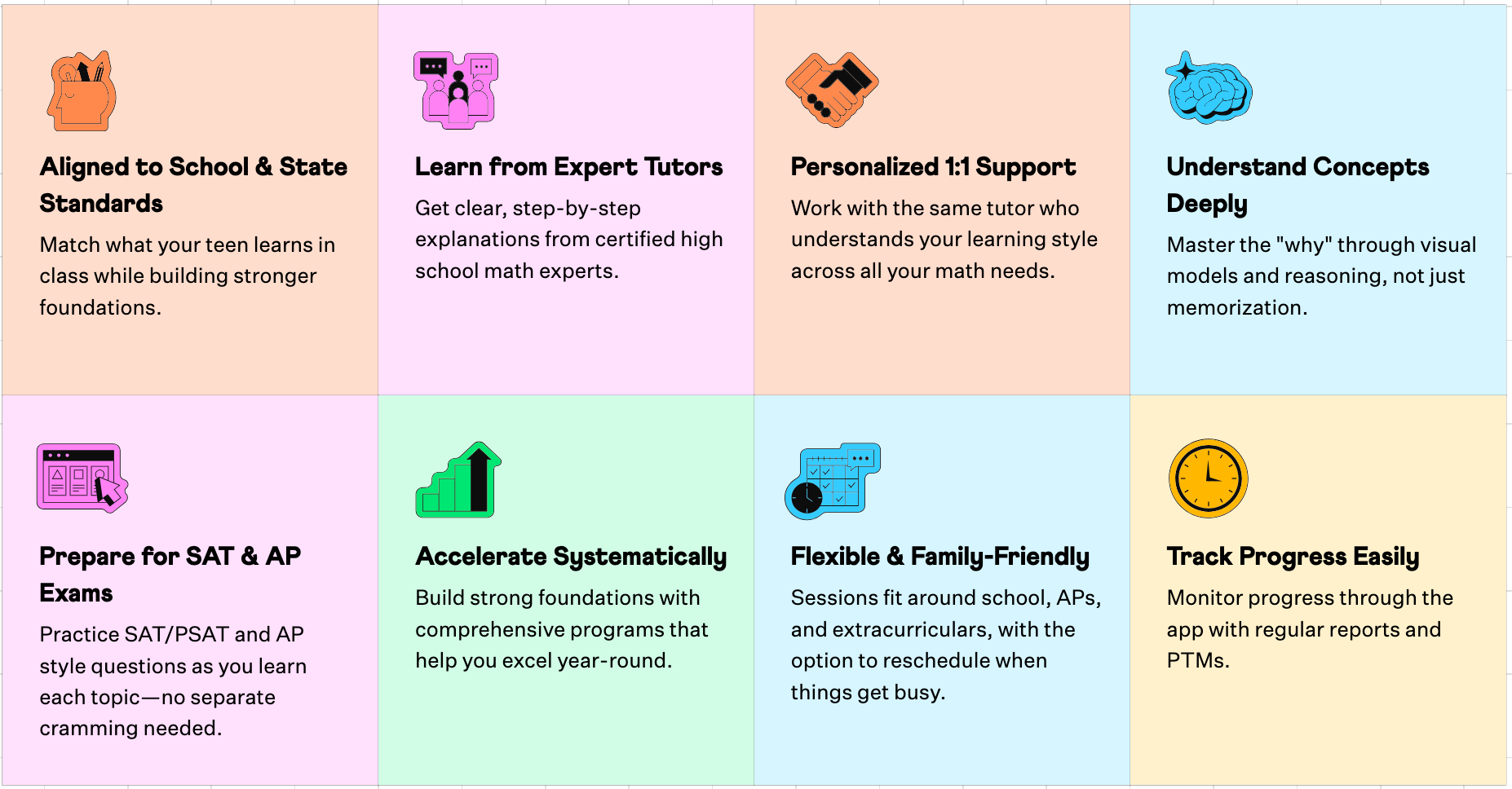
Cuemath is Not Just for Foundational Math
Many parents still associate online tutoring with homework help or remedial support. But Cuemath increasingly serves advanced high-school students preparing for:
- SAT and ACT Math
- AP Calculus AB/BC
- AP Statistics
- Honors and accelerated math tracks
- AMC and AIME competitions
Cuemath consistently prepares high-school students for SAT Math, AP courses, and competitive math. For example:
- 790/800 SAT Math score in first attempt
- AIME qualification
- 5/5 in AP Precalculus and 4/5 in AP Calculus BC
- Accelerated math in high school
- 100% in Geometry Honors and earning additional credits
Cuemath is designed not only to improve grades, but also to develop deep mathematical reasoning and long-term academic acceleration.
More about Cuemath's teaching method in this video ⬇️
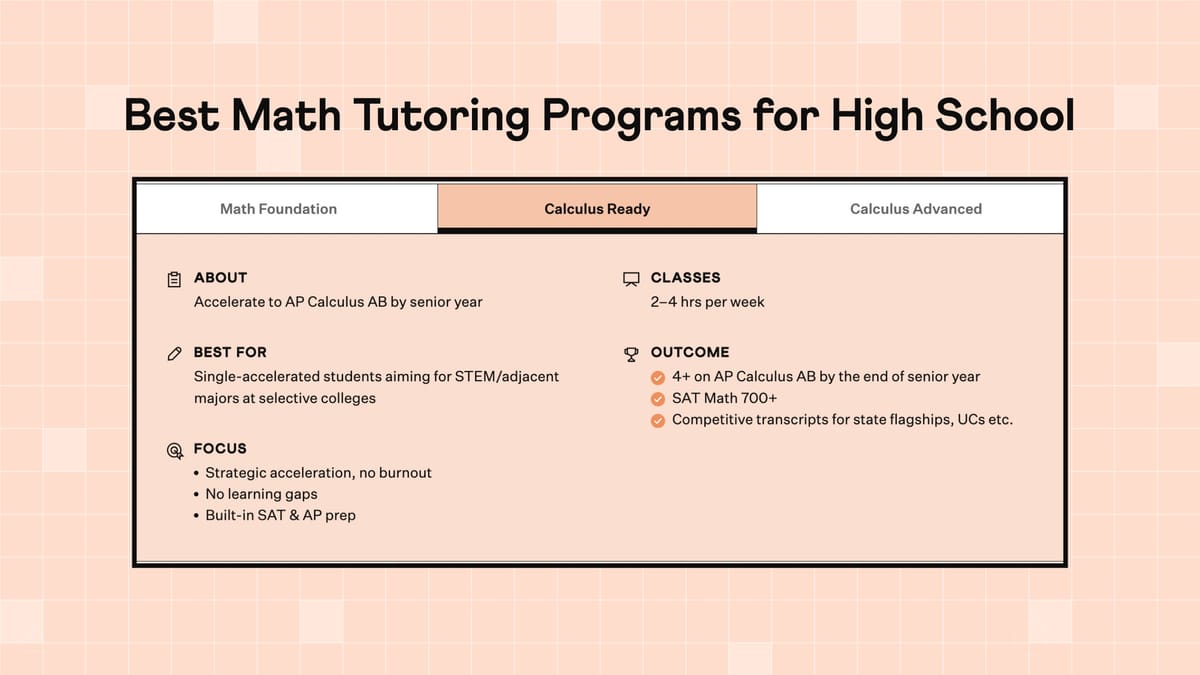
Cuemath has the full High School Courses: Algebra 2, Pre-Calculus, AP Calculus AB and BC, AP Statistics, and SAT Math. SAT Math prep (including PSAT and full-length practice tests) is included in 12-month and 18-month plans.
What to know before you start. Cuemath is built for mastery over time, not instant homework rescue. If your child just needs one problem solved by tomorrow morning, an on-demand help app fits that better. And because sessions are strictly 1:1, there is no peer group. For a gifted student who is energized by debating problems with intellectual equals, a small-group competition program adds something 1:1 cannot.
What Would Your Child's First High School Math Session Reveal?
A short assessment finds the exact concept where your child's understanding breaks down, by topic rather than grade, and the tutor builds the first session around that gap.
Book a Free Evaluation100% free • No credit card needed • Grades 9–12
2. Learner.com: Best Premium 1:1 Tutor Matching
Learner.com’s whole model is the match. Before any teaching starts, a questionnaire digs into your child’s learning style, goals, grade, and personality, even their hobbies. Pair that with a 3% tutor acceptance rate, where applicants pass a video demo and a live teaching interview, and you get one consistent, vetted tutor who builds a real relationship with your child.
For the student with good grades but shaky fundamentals, Learner is a direct fix. Its tutors are required to skip rote memorization and shortcuts in favor of real understanding. That exposes the gap between a high report-card grade and actual reasoning.
For the anxious "I’m not a math person" student, continuity is the point. The same trusted tutor, matched on personality, catches the small misconceptions that snowball and coaches a nervous student through them. Rotating tutors rarely manage that.
For the student reaching for AP Calculus, Learner’s tutors hold advanced degrees in applied math, physics, and engineering. Every session is recorded too, so your child can re-watch the whiteboard work to lock in the limits and integrals that move too fast in class.
3. Revolution Prep: Best for Full-Time Professional Tutors
Revolution Prep runs on a model almost no one else uses: its tutors are full-time, salaried career educators, not college students between jobs. Fewer than 3% of applicants are hired, many hold master’s degrees, and the most experienced have logged thousands of hours of instruction. Every session is recorded for quality checks, so there is accountability beyond any single tutor.
For the student who freezes on test day, the full-time model pays off. Revolution Prep tutors coach the skills around the math too: managing time, staying organized, and calming nerves before a test. That targets the kind of collapse where a student blanks or runs out of time from panic, not from missing knowledge.
For the student accelerating or rebuilding confidence, the tutor works like a project manager for the work. They pinpoint exactly where your child needs to focus, skip what is already mastered, and build a plan that protects the time to reflect that packed AP courses erase. Instead of handing out answers, they reteach concepts from different angles to create a steady run of small wins. This is the Growth Mindset method, built on Stanford research and backed by 150+ hours of tutor training a year.
4. The Princeton Review: Best for SAT/ACT and AP Math
The Princeton Review is a legacy test-prep institution, and for one job it is the most purpose-built option here: getting a student who knows the material to actually perform on test day.
For the student who blanks on the test, this is the specialty. It drills the exact skills high-stakes exams reward: spotting question types fast, managing time under pressure, and using test strategy. Its structured mock tests build the two-plus hours of stamina the SAT and ACT demand, so the real exam is not the first full-length sit-down.
For the late-night homework crisis, its 24/7 on-demand help is genuinely useful. A student stuck for an hour on one AP Calculus problem can connect with a tutor on a digital whiteboard right then, instead of giving up. This is the instant-rescue role a structured program like Cuemath does not play.
5. Art of Problem Solving: Best for Gifted and Competition Math
The Art of Problem Solving is not a tutoring platform, and it does not pretend to be. It is the training ground for students who compete in math. Every member of the USA International Math Olympiad team since 2015 came through AoPS, and its curriculum is written by USAMO winners and IMO gold medalists.
For the genuinely gifted student, nothing here goes deeper. Instead of rules to memorize, AoPS makes students prove why the math is true and build arguments from scratch. And unlike a strict 1:1 model, its virtual classrooms of 10 to 16 students give a gifted kid a real intellectual peer group to push against, the one thing 1:1 cannot offer.
Who it is wrong for matters just as much. AoPS is not built for a student with shaky foundations or math anxiety. The texts are abstract and proof-driven, not calculation practice, so a student missing middle-school concepts gets buried, not rebuilt.
6. Russian School of Mathematics: Best for Rigorous Math Acceleration
RSM’s curriculum comes straight from the elite math schools of the former Soviet Union, adapted for US students. It is built on one idea: relentless, step-by-step mastery before moving on. Students are placed into one of three levels, Accelerated, Advanced, or Honors, by ability rather than grade, and classes run 2 to 4 hours a week.
For the student building toward AP and a top SAT score, this is RSM’s real strength. It drills algebra and arithmetic until they are automatic, so reaching AP Calculus rarely means stumbling on the algebra underneath. The average 11th-grade Math SAT at RSM is 774, and 75% of its competition-track high schoolers qualify for AIME. The curriculum runs years ahead of the public-school sequence, so early AP enrollment is the norm.
7. Mathnasium: Best Hybrid Math-Only Program
Mathnasium is a math-only program with 1,200+ centers across the US, and its real strength is diagnosis. Every student starts with a thorough assessment, and the curriculum then targets the exact weak spots it finds before letting them move on.
For the 9th or 10th grader who is suddenly lost, this is where Mathnasium shines. It is built to find the small cracks from earlier years, a shaky grip on fractions or confusion about negative numbers, that quietly blow up in Algebra 2. It fixes the foundation first instead of pushing ahead and hoping. The teaching guides students to the answer across five modes: mental, visual, verbal, written, and tactile.
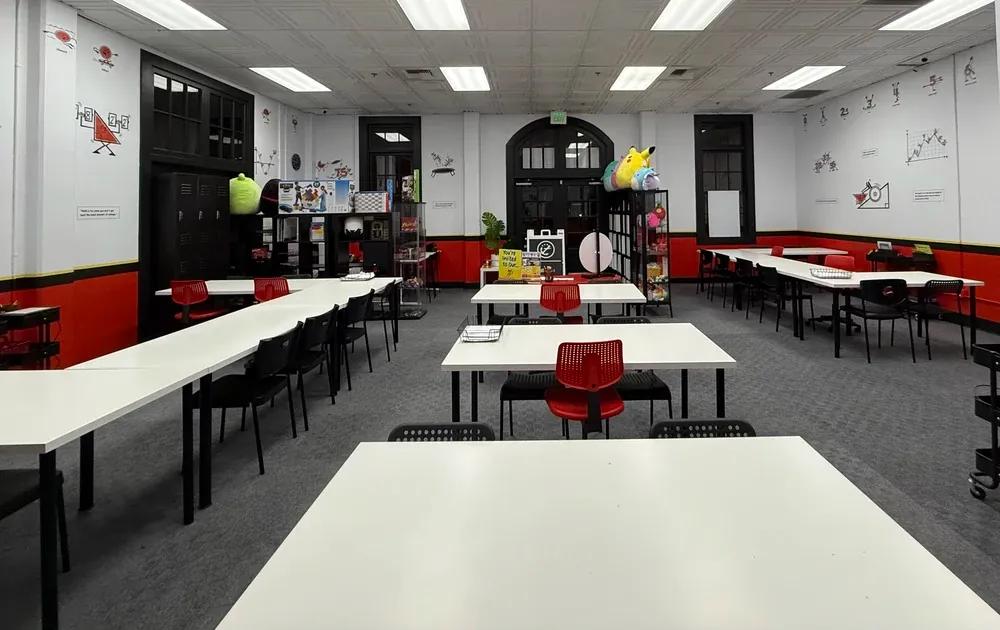
For SAT and ACT prep, Mathnasium refuses to cram. Its test track runs on a continuous three- or four-month schedule, two 90-minute sessions a week, so a student builds real stamina. It even gates entry: you need a 70% diagnostic score and finished Algebra and Geometry first. Disciplined, but effective for the student who commits to it.
8. Wyzant: Best Marketplace for Tutor Autonomy
Wyzant is a marketplace, closer to a gig-economy platform than a tutoring company. It connects you with 65,000+ independent tutors for 1:1 sessions in almost any subject. You browse profiles, compare qualifications, read reviews, and book directly, with no upfront packages.
If you already know the exact problem, Wyzant is unmatched. Need someone who specializes in the chain rule in AP Calculus, or in digital-SAT strategy? You can filter, interview, and hire that exact specialist. Scheduling is the most flexible here, with no subscription, so a busy student can book a single session the night before an exam. The top of the marketplace is genuinely elite: Princeton and MIT graduates, PhDs, and perfect-800 SAT scorers.
9. Sylvan Learning: Best Blended In-Center + Online Program
Sylvan Learning covers math, reading, writing, science, and test prep. Every student starts with the Sylvan Insight Assessment, which is genuinely good at finding the foundational fault lines, like formulas memorized without understanding, that cause high school math to collapse later. From there, adaptive software keeps a student working at their exact level and pace, which heads off the frustration that turns into math avoidance. Sylvan’s tutors are also trained in Common Core and current methods, useful for a student confused by the gap between how they think and how their school teaches.
10. Khan Academy: Free High School Math Resource
Khan Academy is free, self-paced, and the official SAT practice partner of the College Board, so its practice tests and exercises are calibrated to the real exam and linked to PSAT data.
For the motivated self-starter, it is the best free tool there is. Its mastery system will not let a student move on until they have shown they have the prerequisite, so re-learning how to factor quadratics over the summer is efficient and frictionless. And because it is solitary and digital, it is the lowest-pressure option for a student with math anxiety: they can get something wrong, watch the explanation, and try again as many times as they need, with no one watching.
One App, Every Angle Your Child Needs for High School Math
SAT practice, test prep, daily workouts and logic puzzles in one place, so your teen keeps practicing between sessions. Free to try, no card needed.
100% Free • No Card Needed • A Few Minutes a Day
Our Thoughts
For students targeting elite math outcomes, different tutoring programs specialize in different strengths:
- Art of Problem Solving is competition-focused.
- Mathnasium is known for rebuilding foundational confidence.
- Kumon emphasizes repetition and speed.
- Cuemath is the one program here built to fix all three high school breakdowns at once: shaky foundations, risky acceleration, and test-day freezing, all with the same 1:1 tutor.
Your Child's Grade, Your Child's Tutor, One Free Evaluation
The same approach described above (concept-first, the same tutor every session, built around your child's specific gaps) starts with a free evaluation. No pressure.
Book a Free Evaluation100% free • No credit card needed • Grades 9–12
Frequently Asked Questions
What is math tutoring for high school students?
Math tutoring for high school students is structured, subject-specific instruction designed to support the high school math sequence — including Algebra 2, Pre-Calculus, AP Calculus, AP Statistics, and SAT/ACT Math. Unlike middle school tutoring, which typically focuses on foundational catch-up, high school math tutoring often addresses course selection strategy, AP exam preparation, and SAT score improvement alongside academic content. The format ranges from 1:1 live sessions to group classes to self-paced resources, depending on the student's goal.
How much does math tutoring cost for high school students?
Math tutoring for high school students ranges from free (Khan Academy) to $15/class (12-month plan) for structured 1:1 programs like Cuemath. Premium 1:1 services run higher: Learner.com is $59–$99 per session, while Revolution Prep sells packages starting around $1,990. Monthly programs like Mathnasium typically run $250–$400/month, and SAT prep packages from The Princeton Review start around $999. The cost difference generally reflects whether tutors are full-time professionals, the level of personalization, and whether the program includes AP-specific curriculum.
What math subjects do high school math tutors typically cover?
High school math tutors typically cover Algebra 1 and 2, Geometry, Pre-Calculus, Trigonometry, AP Calculus AB and BC, AP Statistics, and SAT and ACT Math. The most comprehensive 1:1 programs — including Cuemath — cover the full sequence and align to Common Core and state standards. Competition-focused programs like AoPS and RSM go further, covering Number Theory, Combinatorics, and AMC/AIME problem sets.
When should a high school student start SAT math prep?
Most college counselors recommend starting SAT Math prep by the end of 10th grade or the beginning of 11th grade, allowing time for two or more test attempts before senior year application deadlines. Students aiming for highly selective schools — where a 750+ SAT Math score is competitive — often benefit from a longer prep runway, especially if there are specific algebra or advanced math gaps to close first.
Is 1:1 math tutoring better than group tutoring for high school?
For most high school students, 1:1 tutoring outperforms group formats because it allows the tutor to identify and address the specific concept gaps blocking progress. In a group setting, instruction must cover a range of student needs simultaneously. For students with targeted AP or SAT goals, 1:1 tutoring tends to produce faster, more measurable improvement. Group programs like AoPS are an exception — they are designed for advanced students who benefit from peer-level competition and discussion.
Does math tutoring actually help improve SAT scores?
Yes, when it is targeted and consistent. The Princeton Review publishes score improvement data from its SAT prep programs and guarantees at least one full letter grade improvement under specific conditions. Students who receive tutoring focused specifically on the digital SAT's adaptive module structure — including how module 1 performance caps the score ceiling — tend to see more meaningful gains than students who study with general math resources. Cuemath's documented outcomes include students reaching 790/800 on SAT Math.
What should I look for in a high school math tutor?
For a high school student, the most important factors are subject-level depth (the tutor must know AP Calculus or SAT strategy, not just general math), tutor consistency (the same tutor over multiple sessions tracks progress more effectively than rotating tutors), and diagnostic accuracy (can the tutor identify which specific concept is causing errors, rather than just reteaching the whole chapter). A free trial class that includes a pre-assessment is one of the clearest ways to evaluate all three.
How often should a high school student meet with a math tutor?
Most structured programs recommend two sessions per week during active prep periods — which is the standard at Cuemath. For SAT-focused prep in the 6–8 weeks before a test, two to three sessions per week is common. One session per week is a reasonable baseline for ongoing AP course support through the school year. Frequency should increase as exam dates approach and decrease when the student is between major assessments.
Can Cuemath help with AP Calculus?
Yes. Cuemath covers the full high school math sequence, including AP Calculus AB and BC. Tutors are matched to the student's specific AP course and identify the exact conceptual gaps — whether in limits, derivatives, or integration — that are blocking progress. Cuemath students have qualified for national math competitions and scored 790/800 on SAT Math, which indicates the program supports advanced mathematical work at a high level.
Is Khan Academy enough for SAT math prep?
Khan Academy is a strong free resource and the official College Board SAT partner, which means its practice tests and adaptive exercises are calibrated to the actual exam. For self-motivated students with time and discipline, it is a legitimate standalone prep option. For students who have a specific recurring error pattern they cannot self-diagnose, or who struggle to maintain consistent practice without external accountability, structured 1:1 tutoring will produce faster and more reliable results.
What is the best math tutoring program for high school students?
The best tutoring program varies based on student goals. Cuemath is recommended for consistent 1:1 support across AP courses and SAT prep, boasting a high Trustpilot rating of 4.9/5 from over 11,000 reviews, and covers the entire high school curriculum. For test-focused coaching, The Princeton Review and Revolution Prep are strong contenders. AoPS is highly regarded for gifted students in competitive math. For free self-directed practice, Khan Academy stands out as the top resource.
Is online math tutoring as effective as in-person tutoring for high school?
Research on high-dosage tutoring consistently shows that frequency and tutor quality matter more than format. A 2023 Education Endowment Foundation study found learning gains of 3 to 15 months in a single academic year for students receiving high-dosage 1:1 tutoring — whether in-person or online. For high school students, online tutoring offers one practical advantage: the whiteboard-based format allows tutor and student to work through problems side by side in real time, which replicates the key element of in-person instruction.
Sources
- College Board — SAT Understanding Scores and Score Structure
- Education Endowment Foundation — High-Dosage Tutoring Research
- NAEP 2024 — Nation's Report Card: Mathematics
- Khan Academy — Official SAT Practice Partnership (College Board)
- Trustpilot — Cuemath reviews (verified May 2026)

I was never the kid who loved math. I was much more interested in books, stories, and writing—and, somewhere along the way, I became even more curious about people. Why do we learn differently? Why does something make sense to one child but not another? And what makes a student feel confident enough to keep trying?
That curiosity led me to study Applied Psychology, where I learned more about how children think, learn, and make sense of the world around them.
My love for writing did the rest. What started as something I simply enjoyed became a career. Over the past five years, I've worked as a freelance writer across edtech, SaaS, B2B, travel, lifestyle, and healthcare, learning how to write for very different audiences without losing the human side of the story.
Today, I'm an SEO Content Writer & Editor at Cuemath, where I get to bring many of these interests together. Working in education—and especially around math—has made me even more curious about what happens behind the screen or textbook: what parents worry about, what students struggle with, and what actually helps them learn.
That's also how I like to research. I don't just look at search results and call it a day. I go where parents and students actually talk—forums, reviews, communities, and conversations with real families. Because sometimes the most useful insight isn't hiding in a keyword; it's in a parent's question, a student's frustration, or a small detail someone shares about their learning experience.
I write because I'm curious. I research because I want to understand. And I love turning what I learn into content that feels genuinely useful to the people reading it.