AP Calculus AB vs BC: Which Should You Take and How to Prepare?
Choosing between AP Calculus AB and BC isn’t about which course is harder, it is about finding the right fit for you. After researching college policies and student outcomes, this blog is my take on choosing between AB and BC, based on intended major, and college credit rules.

🗓️ Updated: July 2026
- Choose by fit, not difficulty. You should choose between AP Calculus AB vs BC depending on your intended major and target colleges.
- AP Calculus AB & BC are not sequential. AP Calculus BC is not a completely separate course from AB. AP Calculus BC has two to three additional and advanced units (the equivalent of a second-semester course)
- AP Calculus BC is required for STEM and CS colleges; some economics, business, life sciences, pre-med, and humanities require AP calculus too.
- The foundation matters more than the letter. Students struggle in AB or BC when their algebra and pre-calculus are shaky, not because they picked the wrong course.
- College credit varies by school. Always check each college's AP credit policy directly before deciding.
- A disappointing score isn't a verdict, and a retake isn't a reset. An AP retake doesn't work like the SAT: your first score stays on your record and you can't retake until next May. The real fix is usually a stronger foundation, not a different course.
If AP scores just landed in your inbox, you're probably here for one of two reasons. Maybe you're choosing between AP Calculus AB and BC for next year. Or maybe you already took one, the score stung, and you want to know what happens now. This guide covers both, and if you're in the second group, don't panic: a score you're not happy with is data, not a verdict. Start with the first section below.
Choosing between AP Calculus AB or AP Calculus BC feels like it could define your entire junior or senior year. It’s the classic high school dilemma.
Here’s what I’ve come to realize: we’re all so focused on which class is harder that we’re asking the wrong question. The truth is, the best choice isn't a choice at all—it's a fit.
After talking to high schoolers and guidance counselors, I've realized you just need to honestly answer three questions to get this right:
- Your Future Goals: What's your intended major, and how competitive are your target colleges?
- The Credit Game: What do those colleges actually give you credit for?
- Your Math Skills: How well you can apply math in all scenarios, not just how good you are at it?
Got an AP Score You're Not Happy With? Here's How to Prepare
AP scores for 2025-26 exam are out. Most students think and 3 or 4 AP score is not worth reporting and they should retake AP exam next year. There's no harm in retaking, but it should be done strategically.
- Most students assume an AP retake works like the SAT, where a better score cancels out the bad one. It doesn't. Your first score stays on your record, and you can't even retake until next May, a full year away. So before you count on a redo to fix things, read exactly when an AP retake is actually worth it.
- A 3 AP score is good. The right question to ask is where. I discuss that in detail here.
- With grade inflation debates, a strong AP score is proof your transcript is real. Most students stress about the wrong thing entirely. read how AP scores really affect your applications and credit.
- A school like UNC Chapel Hill gives credit for any score of 3 or higher, while a 5 in AP Calculus AB earns nothing at Penn. Kids retake entire courses in college that they already tested out of, just because they never checked one page. Before you assume your AP score is worthless, see exactly which colleges give credit for your score.
Do You Take AP Calculus AB Before BC? One Course or Two Different Paths?
The biggest myth is that AB and BC are sequential courses, and that it is mandatory to take AP Calculus AB one year and AP Calculus BC the next.
Some students take both AP Calculus AB and BC classes. But the College Board did not design them to be taken back-to-back.
Think of it this way:
- AP Calculus AB is a full-year course that covers the first semester of college calculus (Calculus I).
- AP Calculus BC is a full-year course that covers both the first and second semesters of college calculus (Calculus I and II)
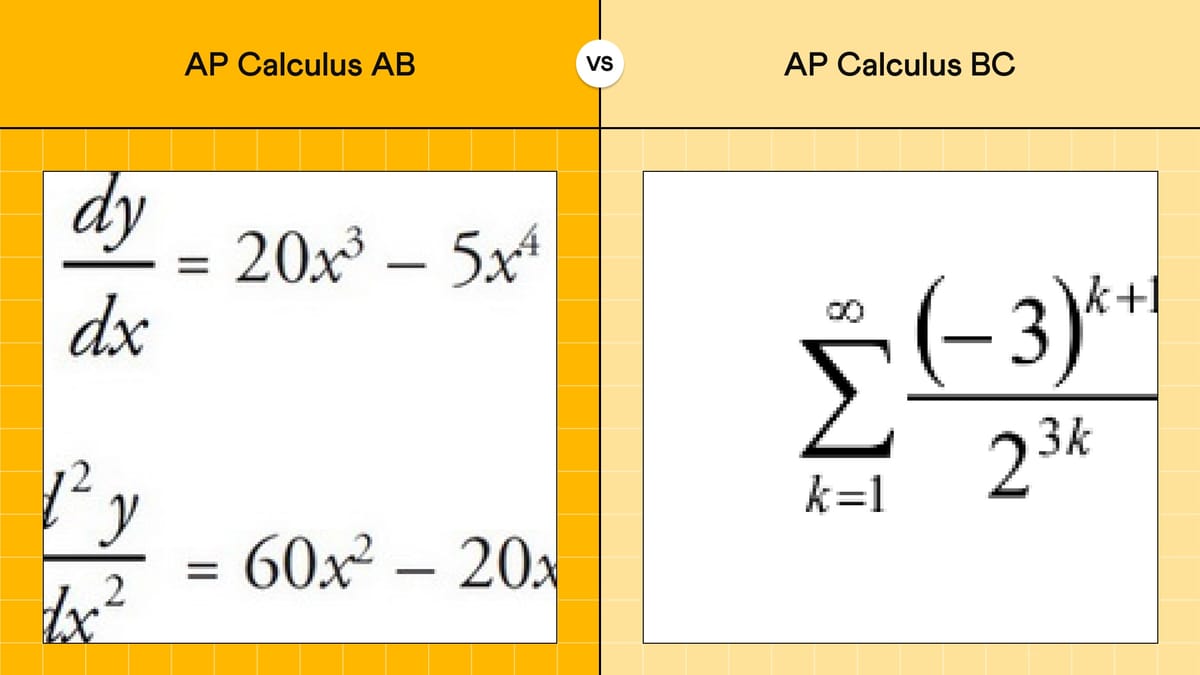
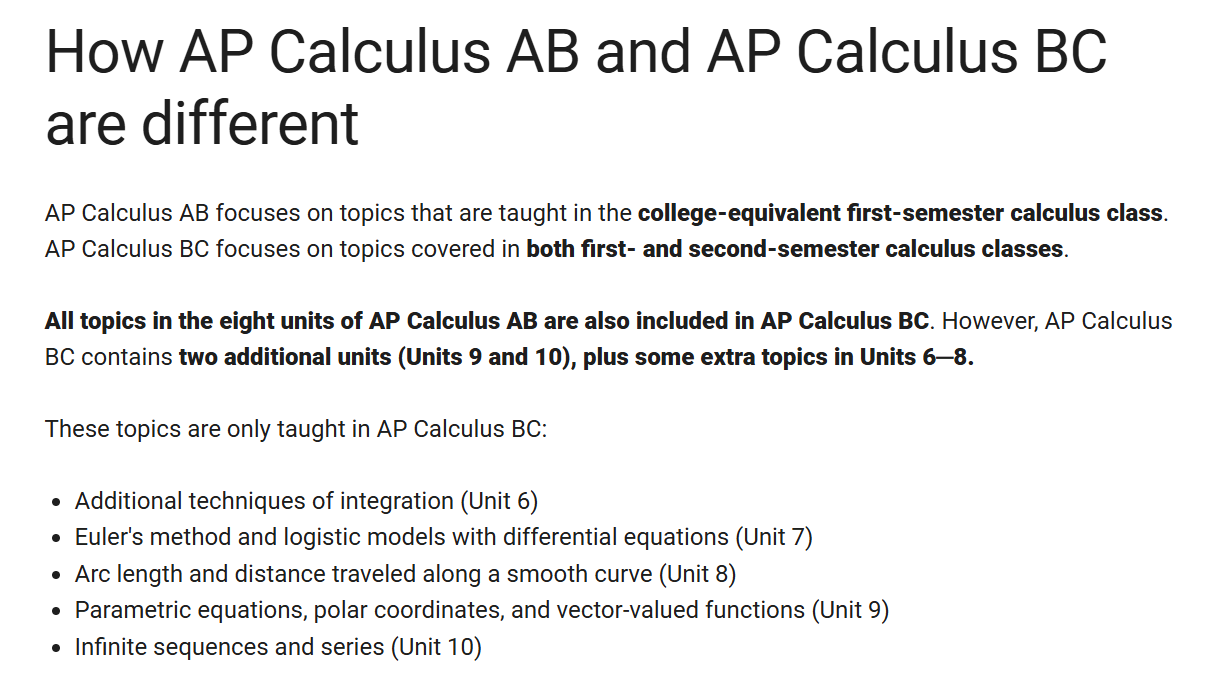
This means AP Calculus BC includes 100% of the AB curriculum, plus new, more advanced topics. A student is meant to take either AB or BC.
Additional topics in AP Calculus BC are:
- Parametric equations and motion along a curve
- Polar coordinates and polar equations
- Infinite sequences and series, including power series and Taylor series
- Improper integrals and additional techniques of integration
- Differential equations, including Euler's method
- Vector-valued functions
Is AP Calculus BC Easier than AB?
If you look at the 2025 AP Exam score distributions, you will see the percentage of students scoring higher belong to AP Calculus BC category.
| 2025 Score | AP Calculus AB | AP Calculus BC |
|---|---|---|
| 5 | 20% | 44% |
| 4 | 29% | 22% |
| 3 | 15% | 13% |
| % scoring 3 or higher | 64% | 79% |
Source: College Board, 2025 AP Exam Score Distributions. AB figures rounded to the nearest whole percent.
Is AP Calculus AB or BC Harder?
Here is the honest answer: AP Calculus BC is harder than AP Calculus AB, but not because the concepts themselves are tougher. AP Calculus BC has some additional topics on top of AP Calculus AB.
Te students who struggled weren't the ones who picked either AP Calculus AB or BC. They were the ones who chose either course without the algebra and pre-calculus fluency to keep up.
Use Summer Break to Master Concepts AP Calc is Built On
Summer is perfect 2-month window to master concepts, practice, and get ahead in high school. Get 1:1 classes with expert tutor.
Explore Cuemath Summer Math Programs1:1 Sessions | First Evaluation Free
What Are the Actual Prerequisites for AP Calculus AB and BC?
Here’s where I had to do some research, because the official answer is misleading.
- Officially, the College Board lists the same requirements for both AP Calculus AB and BC, and they are quite general.
- They recommend that you've successfully finished courses in algebra, geometry, trigonometry, analytic geometry, and elementary functions.
- But for AP Calculus BC, students are specifically expected to understand sequences, series, and polar equations. These are topics taught in an advanced or Honors Pre-Calculus class.
- Some competitive high schools set a specific grade gate, often an A (90% or higher) in Honors Pre-Calculus, before they will place a student in BC. The exact cutoff varies by school, so check your own course catalog or counselor.
This shows that schools see AP Calculus BC as a class meant only for students who have already proven they are very strong in math.
Which AP Calculus is Right for Your Major?
This is the most important part of my research. Your choice sends a signal to colleges. Here’s how to align your choice with your academic and career goals.
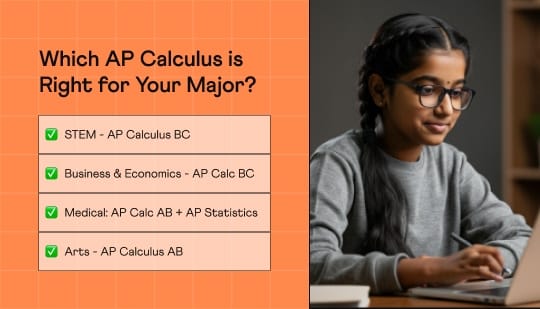
🧪 STEM (Engineering, Computer Science, Physics)
For top-tier universities (e.g., MIT, Carnegie Mellon, Caltech, Berkeley-EECS), taking AP Calculus BC (if offered) is not a bonus; it is an expectation. For a competitive CS or engineering program, choosing AP Calculus AB when BC is available can be viewed as not rigorous.
💲Business and Economics
I found that many business majors (e.g., Management, Marketing) will only require a Business Calculus or brief Calculus course in college, which is often less rigorous than Calculus I. AP Calculus AB is more than sufficient to earn credit for this and is a good choice.
Quantitative Finance/Economics degrees (especially for students considering a Ph.D.) are extremely math-heavy. For these programs, AP Calculus BC is almost the expectation. Advanced economics uses concepts from Calculus I, II, and multivariable calculus.
🏥 Life Sciences and Pre-Medical
Pre-med and life science majors (Biology, Neuroscience, etc.) typically require one semester of calculus (Calculus I), for which AP Calculus AB is a perfect fit.
AP Statistics is arguably as important, or more important, than the Calculus II topics in AP Calculus BC. Medical research and biology are heavily dependent on data analysis.
🎨 Literature and Arts
For students majoring in English, History, Political Science, or other humanities, the goal is twofold: satisfy a core university math requirement and demonstrate quantitative rigor on a college application.
AP Calculus AB achieves both of these goals perfectly. It is a rigorous course, but its moderate pace makes it a manageable part of a schedule that may be heavily loaded with reading- and writing-intensive APs (e.g., AP English Literature, AP U.S. History).
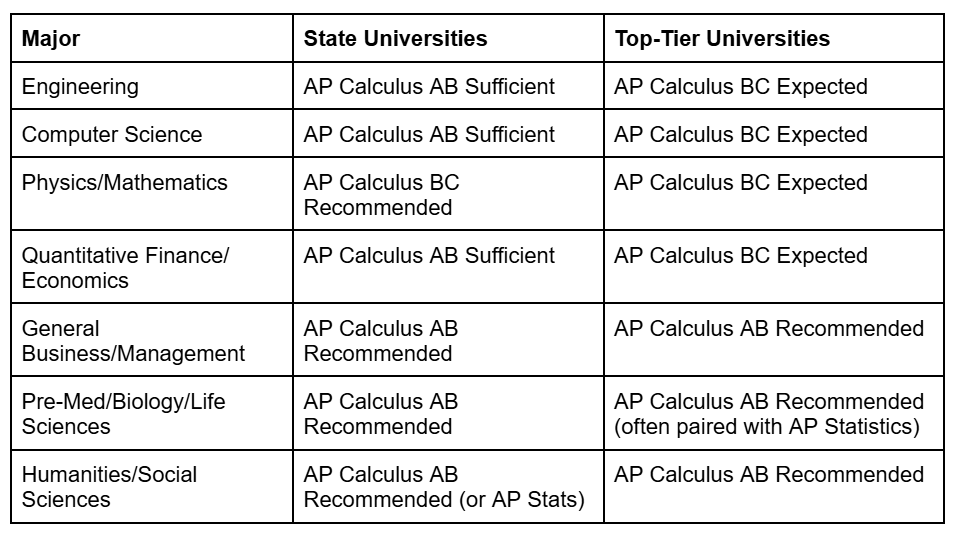
What Top Colleges Recommend - AP Calculus AB or BC?
I put together this table based on all the college sites and forums I reviewed. It simplifies the recommendations at a glance.
AP Calculus Credit: Why a 5 at MIT is Different Than at UC?
This is the #1 mistake I see students make. They assume getting a good score automatically gets them credit.
The reality? Every single school is different. And the policy often changes by program (e.g., Engineering vs. Arts & Sciences).
The General Rule:
- Pass AB (Score 3–5) -> Get credit for one semester (Calculus I).
- Pass BC (Score 4–5) -> Get credit for two semesters (Calculus I & II).
The Reality: Every single school is different. And the policy often changes by program (e.g., Engineering vs. Arts & Sciences).
I compiled these examples just to show you how wild the differences are:
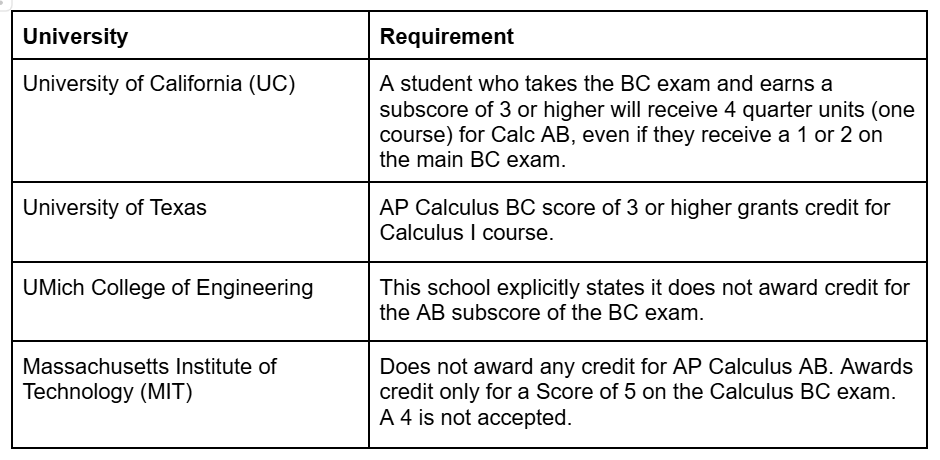
(Sources: UC Admissions, UT Texas, UMich Admissions, MIT Admissions)
The Bottom Line: Do not guess. You must go to the website of every college you are interested in, find their AP Credit Policy, and check the specific rules for your intended major.
How to Prepare for AP Calculus AB and BC?
Start by taking a ‘Calculus Readiness Test’, which is available on all popular college websites to see where you stand with essential skills like algebra, functions, and trigonometry.
If you have mastered the concepts, you can use College Board's website old FRQs to practice for AP Calculus exam.
But if your concepts are weak and you need an expert tutor to help make a customized learning plan for you to pass AP Calculus exam, Cuemath is the right choice.
Need a Structured AP Calculus Plan? How Cuemath Can Help!
An AP Calculus Score of 5 Can Be Worth $3,000+ in College Credit. Don't leave it to chance with pre-recorded videos or generic group classes.
Cuemath delivers a complete system for mastering AP Calculus AB or BC that goes far beyond self-study. You get 1:1, personalized math classes from a certified tutor, with a plan built around your specific speed and goals.
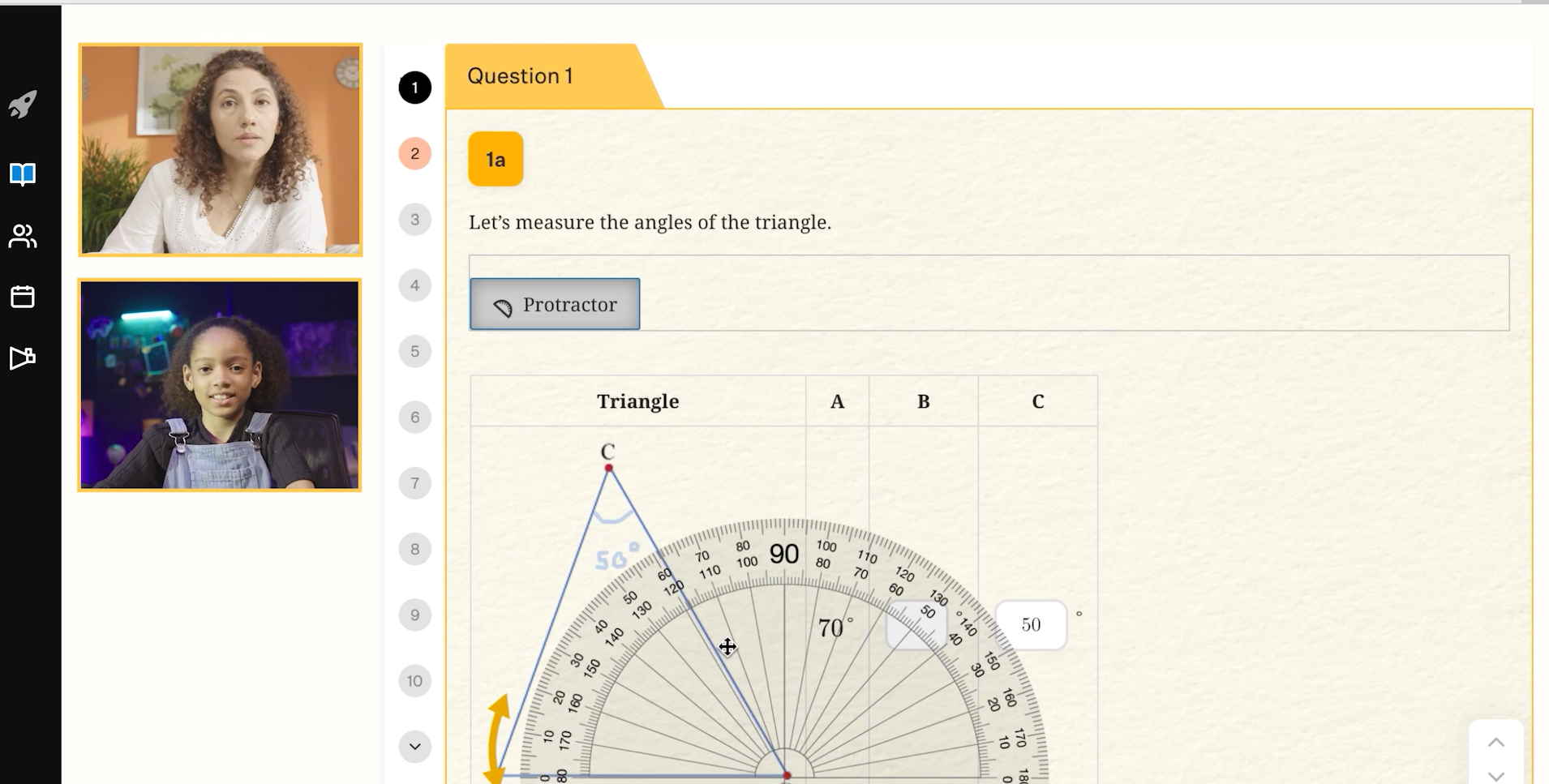
Cuemath sessions happen on their custom learning platform called LEAP. The tutor and student can watch lessons, solve problems together and use interactive features like a protractor to measure the angle, or solving the equations, which would have been impossible on a standard zoom call.
Strong in Class but Unsure About the AP Exam?
A free evaluation starts by finding the exact algebra and pre-calculus gaps that quietly cost points on AB and BC, then builds a plan paced over months, not a cram week.
Book a Free EvaluationFor Students in Grades K to 12 Worldwide
Frequently Asked Questions (FAQs)
Ques: Do students need to do AP Calculus AB before AP Calculus BC?
Ans: AP Calculus AB and AP Calculus BC are not sequential courses (to be taken after another). Students choose either AP Calculus AB or AP Calculus BC based on their intended major in college and future prospects.
Ques: Is AP Calculus BC better for college admissions than AB?
Ans: The better choice depends on your intended field. For STEM majors (engineering, CS, physics), AP Calculus BC is a better course. STEM majors require good knowledge of Calculus I-II. For business, life sciences, pre-medical, and humanities, AP Calculus AB is an appropriate course. It meets college requirements while still reflecting strong academic rigor.
Ques: Do colleges give the same credit for AP Calculus AB and BC?
Ans: No, colleges have different credit policies for AP Calculus AB and BC. Some universities (like UC and UT Austin) give credit only if the AP Calculus BC score is 3+, or sometimes they consider the AB subscore. UMich Engineering ignores the AB subscore entirely. MIT awards credit only for a 5 on AP Calculus BC, and gives no credit for AB. It is important to check each college’s AP credit policies.
Ques: Is AP Calculus AB or BC harder?
Ans: AP Calculus BC is harder than AP Calculus AB because it covers two semesters of college calculus (Calculus I and II) in one year, while AB covers one semester (Calculus I). The individual concepts are not tougher; the pace and volume are. A student with a strong pre-calculus foundation can handle either course.
Ques: Is AP Calculus AB hard?
Ans: AP Calculus AB is challenging but manageable for students who have mastered algebra, trigonometry, and pre-calculus. Most of the difficulty comes from weak foundations rather than the calculus itself. In 2025, about 64% of AB students scored a 3 or higher.
Ques: How long is the AP Calculus AB and BC exam?
Ans: Both the AP Calculus AB and BC exams are 3 hours and 15 minutes long. They share the same structure: 45 multiple-choice questions in 1 hour 45 minutes, then 6 free-response questions in 1 hour 30 minutes, each split into calculator and no-calculator sections.
Ques: What is AP Calculus AB and BC equivalent to in college?
Ans: AP Calculus AB is equivalent to one semester of college calculus (Calculus I). AP Calculus BC is equivalent to two semesters (Calculus I and II). The actual credit you receive depends on each college's AP policy and your score.

I grew up a science kid. Math was not my best subject. Class moved fast, I was too shy to ask for help, and I somehow ended up more curious about how people learn than about the subjects themselves.
That's what pulled me into education — not to teach, but to understand how colleges and tutoring programs actually work and what students genuinely need from them.
My love for writing did the rest. I had too many observations and nowhere to put them, so I started writing, and haven't stopped. Over the last five years I've written about edtech, student life, and college programs. For the past year, my focus has been math tutoring specifically.
I work at Cuemath now, so factor that in. I research by going where parents actually talk: forums, reviews, and direct conversations with students and families. I'm writing for the kid who's too scared to raise their hand in class. I was that kid.