What is Cuemath's Teaching Philosophy?
What if the best thing a math teacher could do… was ask the right question? At Cuemath, teachers don't just hand over answers. Instead, they guide with a question, a small nudge in the right direction. This is the 'Cue Don't Tell' approach. Let's take a closer look at what this really means.

Most math programs have one goal: to get to the answer. Your child learns a formula, a specific method to solve, practices it, and moves on. It looks like progress, worksheets filled, levels cleared, stars collected.
But here's what those programs miss: if a child isn’t getting a chance to think, try, or figure things out on their own, they become dependent on answers instead of learning how to solve problems. And in a world where AI can solve any equation in a second, that is a skill gap that matters more than ever.
Cuemath was built around a different belief. Every teacher, every lesson, every question is designed around one core principle: Cue, Don't Tell. Teachers guide. Kids figure it out and never forget it. This is how every Cuemath online math tutor teaches.
This blog shows you exactly how that works, from how a Cuemath lesson is structured, to the tools every teacher uses, to why this is the kind of thinking that will matter in 2030 and beyond.
Table of Contents
Why Following Steps Isn't the Same as Learning Math
Think about how most math tutoring works: Kumon worksheets, Mathnasium drills, step-by-step procedures repeated until they stick. These methods build speed. But they have a fundamental flaw: they train children to follow instructions rather than think.
When people work out an answer on their own — even through struggle — they retain it far more effectively than when it's simply handed to them. Cognitive psychologists call this the "generation effect."
Programs built on drilling produce fast calculators. Research consistently shows they don't produce thinkers. When the formula changes or the problem looks different, a drilled child is lost. A thinking child adapts. That’s what Cuemath is designed to build—independent thinkers.
Slamecka & Graf’s 1978 studyCue, Don't Tell What It Actually Means
Here's the same math problem, solved two ways. One is how most programs teach it. One is the Cuemath way.
"Luis gave away 2 apples. 7 minus 2 equals 5. So he must have 5 bananas."
"Which number will you reach if you count back 2 from 7? Which number would you add to 2 to make that?"
One approach delivers the answer. The other delivers a pathway and waits for the child to walk it.
This is the Socratic method, applied to K-8 math. It requires teachers to hold back the answer, even when the child is struggling, and replace it with a question that prompts the child to take one more step. That's harder than telling. And it's far more powerful.
What makes Cuemath different isn't just that teachers are trained in this; it's that the method is built into the platform itself.
Inside a Cuemath Lesson: How It's Built
Every Cuemath lesson follows a deliberate structure. Here's what your child and their teacher actually experience step by step.
The Learning Goal Set Before Anything Else
Every lesson opens with a clear, child-facing learning goal. Not just a topic a specific skill. The child knows exactly what they're working toward before they see a single problem.
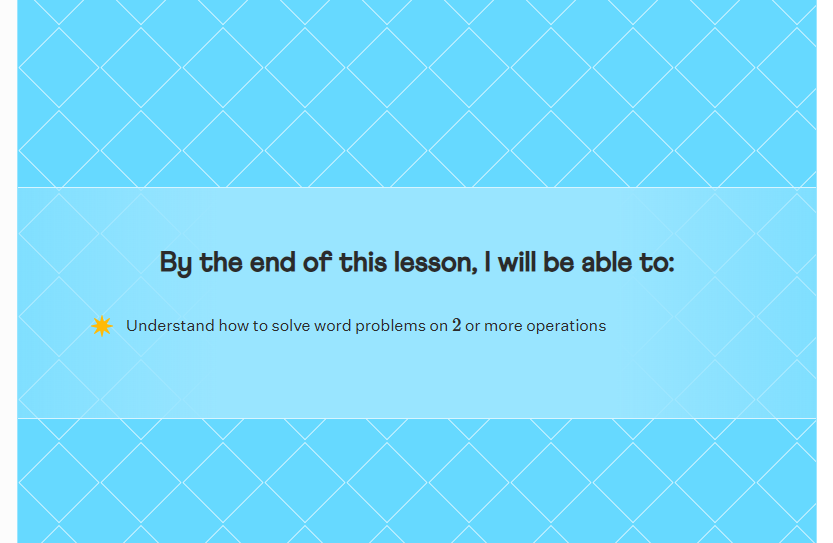
Every Cuemath lesson begins with a learning goal giving the child clear purpose before the first problem.
This matters. When children understand why they're solving a problem, engagement and retention both increase. Goal-setting before a task is one of the most consistent predictors of improved learning outcomes.
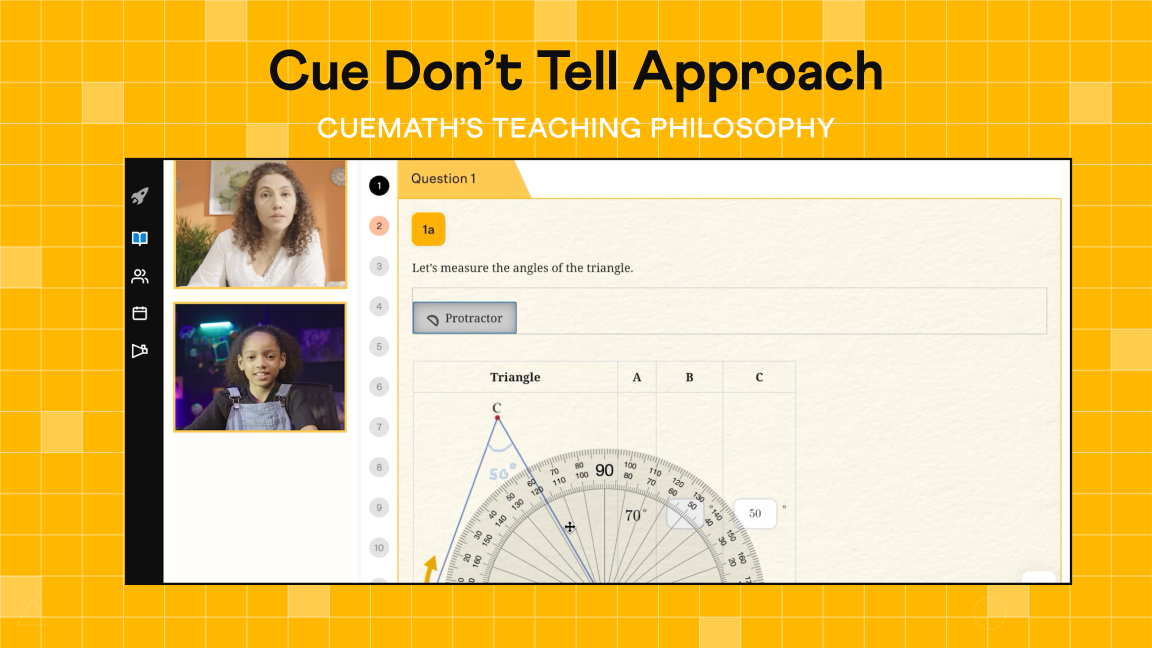
No Formula. Find the Approach.
The child must figure out the approach, not just execute a procedure. No direct hints are given—just a space to think.
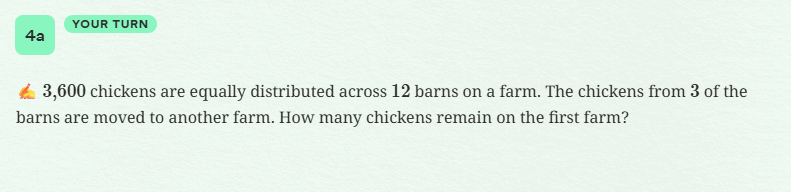
The Teacher's Interface Built Around Cue, Don't Tell
While your child is thinking, their teacher has a dedicated panel with pre-built "Cue Don't Tell" tips specific, curriculum-aligned questions designed to guide without giving away the answer. This is what makes the method consistent across every teacher and every class.
The teacher's interface gives every Cuemath teacher the exact right question to ask at the exact right moment.
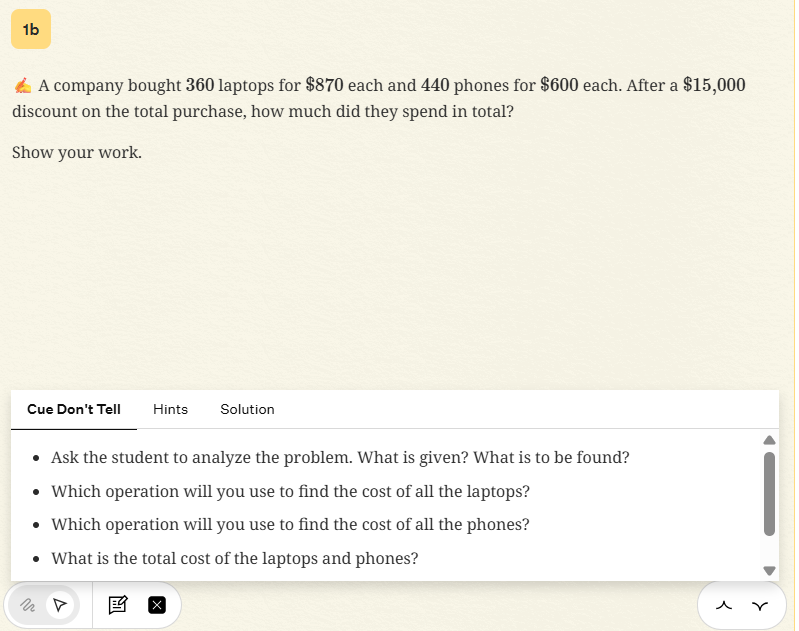
Whether your child's teacher has been with Cuemath for 3 months or 3 years, they have access to the same curated guidance. The method isn't left to individual teaching style; it's systematized into the platform.
Layered Hints When the Child Needs One More Nudge
If a child is truly stuck, there's a hints system alongside the teacher's cues. Not the solution just a gentler nudge that narrows the space of possibilities. The child still does the thinking; the hint just changes the angle of approach.
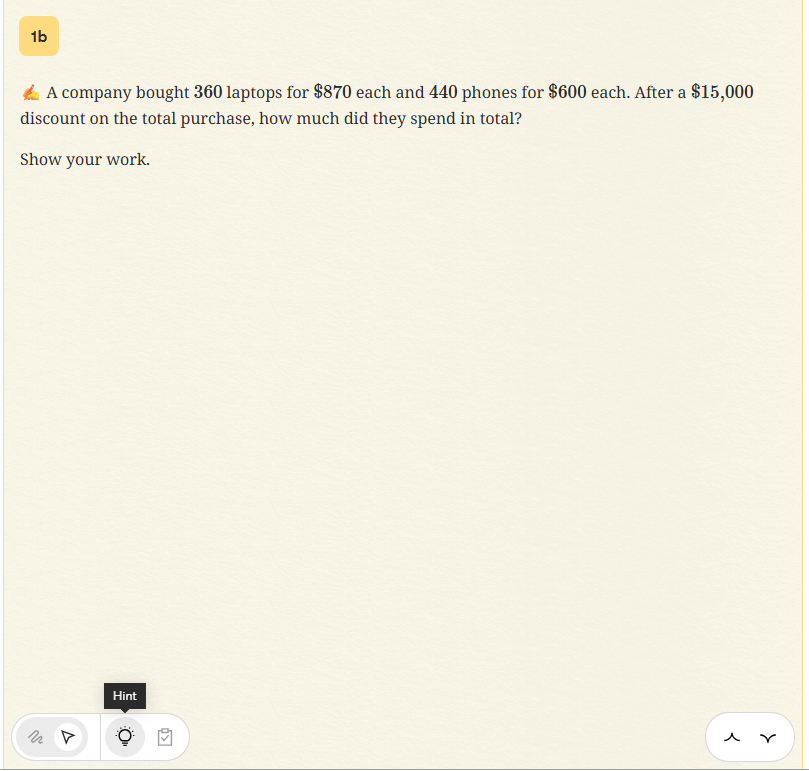
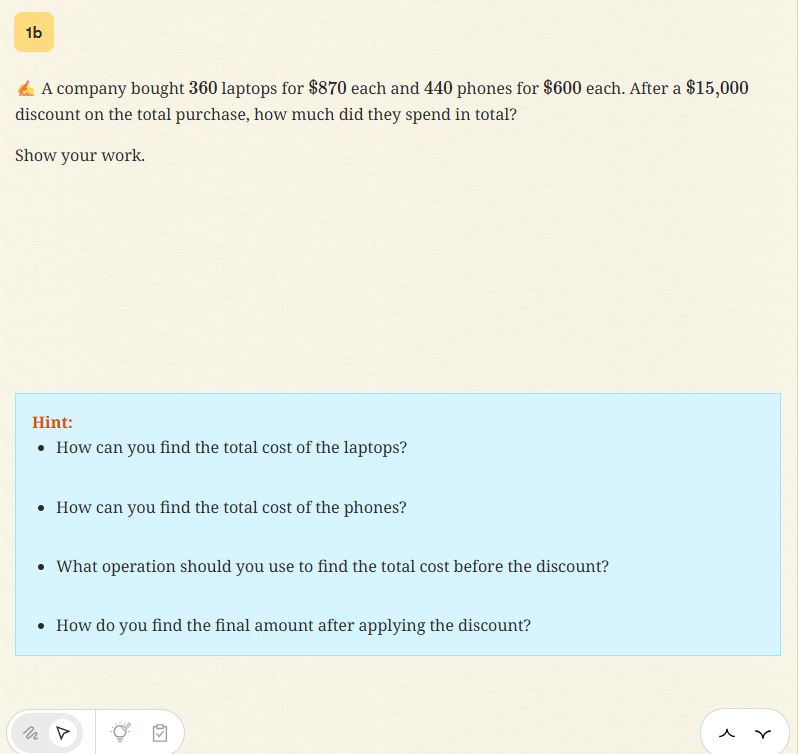
Student interface: Layered Hints given in a Cuemath worksheet to solve problems
The Same Method, Across Every Problem
As lessons progress, the problems grow more complex multi-step word problems, two operations, layered reasoning. The method stays the same: guided by questions, not given answers.
Cue Don't Tell Approach of Cuemath: Learning starts when you stop telling!
More complex, multi-step problems follow the exact same structure the child reasons through it with guidance, not instructions.
When the Struggle Gets Hard: How Cuemath Keeps Children Motivated
The Cue, Don't Tell method is built on productive struggle. But struggle without recognition can quietly tip into discouragement. Cuemath solves for this with a layer that most programs don't have: stickers given by the teacher in real time, tied to specific mathematical behaviors.
These aren't generic 'good job' rewards. Each sticker recognizes a precise moment: a child who tried again after getting it wrong, a child who explained their reasoning out loud, a child who kept going on a multi-step problem without asking for the answer. The research behind this is clear — praising process over outcome is one of the strongest predictors of long-term mathematical persistence.
Stickers are awarded by the teacher in real time — tied to the exact behaviour that just happened in class.
A child who receives an 'Iron Will' sticker for trying again doesn't just feel good — they understand exactly what they did that was worth recognizing. That specificity is what makes math stick.
Over time, children stop looking for approval. They start trusting their own thinking. This is a big win for any parent!
Why This Matters More Than Ever in the Age of AI
The World Economic Forum's #1 Skill for 2025-2030
The WEF Future of Jobs Report 2025 ranks analytical thinking and creative problem-solving as the most critical workforce skills for the decade ahead above technical knowledge, above coding, above any specific subject. Kids who learn to think don't just do better in school. They do better in life.
Here's the uncomfortable truth: AI can already give your child the answer to almost any math problem in under a second. If your child's math education has been about getting answers, AI just made it largely redundant.
But AI cannot teach your child how to think through a problem. It cannot develop the mental habit of breaking down a situation, identifying what's known, and reasoning toward a solution. That's a deeply human skill, and it's built through exactly the kind of guided discovery Cuemath practices in every class.
A child who learns with Cuemath isn't just prepared for their next test. They're prepared for a world where the answer is always available, but the thinking never is.
Hear It From the Founder: Why It’s Called Cuemath:
Frequently Asked Questions
How is Cuemath different from Kumon or Mathnasium?
Kumon and Mathnasium are primarily worksheet and drill-based programs the goal is speed and accuracy through repetition. Cuemath is structured differently: live, 1-on-1 classes where a trained teacher uses the "Cue, Don't Tell" method to guide your child through logical reasoning. The goal isn't a faster calculator it's a deeper thinker.
Does my child's teacher actually follow this method, or is it just marketing?
It's built into the teacher's platform not just the training. Every teacher has access to pre-built "Cue Don't Tell" tips for every problem in the curriculum. These are specific guiding questions, aligned to the concept being taught. The method is systematized, not left to individual teaching instinct.
What if my child gets frustrated and just wants the answer?
That frustration is actually a good sign — researchers call it "desirable difficulty," the uncomfortable moment just before a breakthrough. Cuemath teachers are trained to read that moment carefully — knowing when to give a smaller hint, ask a different question, or simply cheer your child on. And when your child pushes through? They earn it — stickers, badges, and a teacher who genuinely celebrates every win. The struggle is where the real learning happens.
My child already gets good grades in math. Why would they need this?
Good grades test procedural knowledge following the steps you've been taught. Cuemath builds conceptual understanding knowing why the steps work. Children who only have procedural knowledge often hit a wall in 6th or 7th grade when math becomes abstract. Conceptual understanding prevents that wall from forming.
How long before I see a difference in how my child approaches problems?
Most parents notice a shift within the first few weeks not just in math, but in how their child approaches challenges generally. The child starts asking "why" questions. They stop saying "I don't know where to start." They start saying "let me think." That's the method working.
Is the Cue, Don't Tell method backed by research?
Yes. The generation effect learning by producing answers rather than receiving them is one of the most replicated findings in cognitive psychology. The Socratic method of teaching through questions has decades of research in educational settings. The NCTM's framework for "productive struggle" in math aligns directly with what Cuemath does in every class.
See the Cue, Don't Tell Method in Action
Watch your child think through a problem guided, not told, for the very first time. No pressure. Just one class that might change how your child sees math forever.
Book a Free Evaluation →