Grade 1 Math Growth Award: What Happens When a Child Understands Math Before It Gets Hard
Saimeenakshitha received her school's Math Growth Award in December 2025, just months after starting Cuemath in Grade 1. This is what her tutor Neha Jain built in one year.
When Saimeenakshitha's mother enrolled her in Cuemath at the start of Grade 1, it was for a reason that had nothing to do with test scores. She wanted her daughter to understand math, not just get through it.
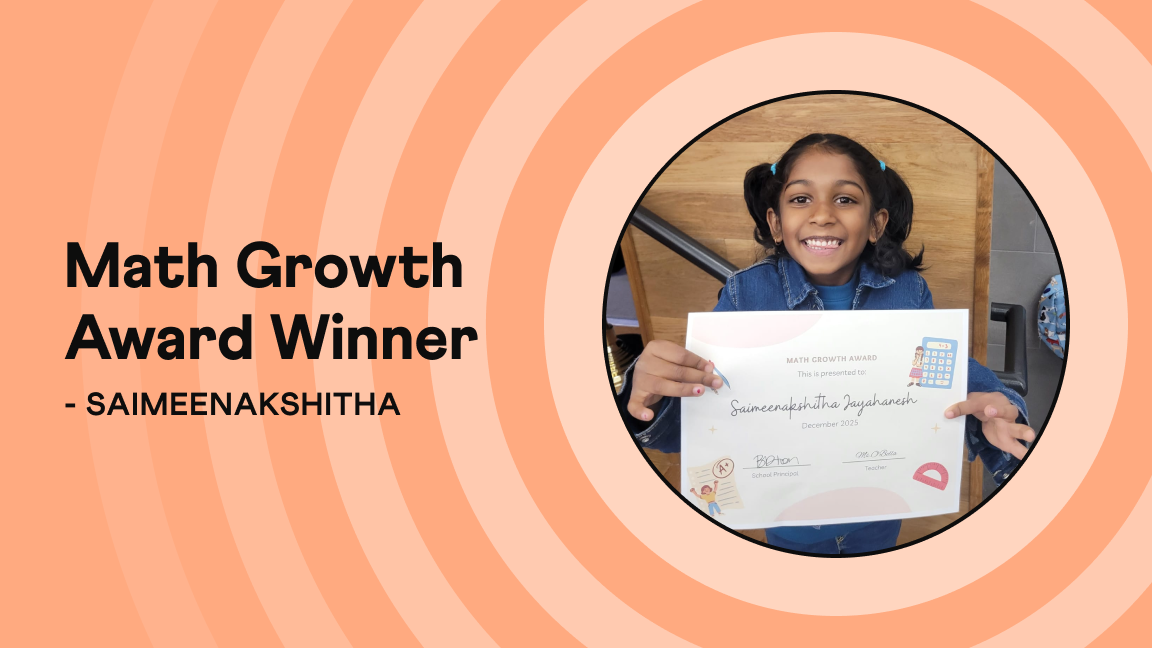
In December 2025, just months after starting with Cuemath, Saimeenakshitha received her school's Math Growth Award, a recognition given to students who demonstrate exceptional growth in mathematical understanding and confidence during the school year. Her Cuemath tutor is Neha Jain.
This is the story of Saimeenakshitha.
Meet Saimeenakshitha
- Grade: 1
- Country: USA
- Tutor: Neha Jain
- With Cuemath Since: 2025
- Math Growth Award: December 2025, School Recognition for Exceptional Math Growth
What Grade 1 Math Actually Covers in US Schools
US Grade 1 math is structured around four key areas under the Common Core State Standards: addition and subtraction strategies within 20, understanding place value and two-digit numbers, linear measurement and data, and foundational geometry. The standards at this level emphasize understanding over computation. Students are expected to explain why 4 + 3 = 7, not just recall it. They should understand 15 as one ten and five ones, not just a number on a page. A Math Growth Award at this level recognizes a student who has not only progressed through the curriculum but has developed the kind of mathematical reasoning that makes every subsequent year of school easier.
What Does It Take for a Grade 1 Student to Win a School Math Growth Award?
When Saimeenakshitha started Grade 1, the mathematics she was encountering was foundational: counting, simple addition and subtraction, place value. These are the concepts that are easiest to rush. A student can learn to produce the right answer to 3 + 4 without understanding what addition actually means. Most classroom settings do not have the time to find out which kind of learning is happening.
Neha does. From their first sessions, she established a pattern that would define the whole year: introduce a concept, ask a few questions, and wait for the moment when understanding arrives. Not just a correct answer. Comprehension. Neha describes the signal she watches for as Saimeenakshitha's "smile and sparkle in her eyes" when she grasps a new topic. That is when she knows it is time to move forward. Until then, they stay.
This runs counter to how early math instruction typically works. The pressure in Grade 1 is usually to cover content and move through it quickly. Neha chose instead to let each concept settle before building on it. For Saimeenakshitha, that meant arriving at each new topic with genuine confidence rather than a half-formed understanding of what came before.
"Saimeenakshitha is a very sweet kid…her enthusiasm and energy in every class keeps me motivated to teach her with utmost passion. Her keen interest in maths will surely help her achieve success in life. I just love teaching her. Whenever we start a new topic and after few questions when she is confident enough with the topic her smile and sparkle in eyes clearly speaks that I have succeeded as a teacher."
~ NEHA JAIN, CUEMATH TUTOR
Can an Online Math Tutor Build Logical Thinking in a Grade 1 Child?
Saimeenakshitha's mother noticed the shift before the school did. Her daughter was not just completing her math work. She was approaching it differently, with curiosity rather than routine. The concern that had prompted the enrollment in Cuemath, that her daughter might learn the right answers without learning how to think, was no longer the right worry. The logical thinking her mother had hoped for was already there.
The Math Growth Award recognized what Neha had been building all year. School math growth recognition at this level is not about the highest grade in the class. It measures how deeply a student's understanding of the subject has changed. Neha had been tracking that shift since their first session.
"Cuemath has been a wonderful learning experience for my daughter. The classes are well-structured and make even difficult math concepts easy to understand. Mrs Neha mam explains everything clearly and encourages logical thinking instead of memorization. My daughter became more confident in solving problems, and her interest in math has increased a lot. Cuemath has truly helped to improve my daughter skills and enjoy learning math." Thank you so much for the guidance.
"Cuemath helped to strengthen math foundation and develop a deeper understanding of concepts through clear explanations and regular practice. The structured approach and engaging problem-solving techniques improved accuracy, speed, and confidence. This program has not only enhanced my daughter academic performance but also inspired her to enjoy learning mathematics. I am grateful to Cuemath for guiding my daughter toward growth and success."
~ Shanmugapriya & Jayaganesh
Does This Sound Like Your Child?
Your child might be on a similar path if they:
- are in Grade 1 or early elementary school and you want to be sure what they are learning is genuinely understood, not just memorized
- do well enough on class assignments but you are not sure whether the answers come from real understanding or from pattern-matching
- seem to lose interest in a math topic when it stops making immediate sense to them
- are approaching Grade 2 or higher and you want to be confident that their Grade 1 foundations were genuinely built, not rushed
Frequently Asked Questions
What is a Math Growth Award and how is it given to Grade 1 students?
A Math Growth Award is a school recognition given to students who show exceptional progress in mathematical understanding during a set period. Unlike grade-based honors, it measures how far a student has developed, not how they rank among peers.
Is Grade 1 too early to start with an online math tutor?
Grade 1 is one of the most important times to start, because the foundational concepts introduced then, including place value, addition, subtraction, and early number sense, underpin everything that follows. The habits of curiosity and careful explanation that an online math tutor builds at this stage are harder to form once surface-level habits have already taken hold.
What does Grade 1 math cover in US schools?
US Grade 1 math covers four main areas: addition and subtraction within 20, place value and two-digit numbers, linear measurement, and foundational geometry. The Common Core State Standards for Grade 1 emphasize understanding over computation: students should be able to explain their reasoning, not just produce correct answers.
How does Cuemath build mathematical understanding in Grade 1 students?
Cuemath's 1:1 online tutoring model allows tutors to pace instruction around each child's understanding rather than a fixed curriculum timeline. For Grade 1 students, this means staying with a concept until the child can explain it, not just answer it correctly.
The Foundation Your Child Builds in Grade 1 Lasts for Years
Saimeenakshitha's Math Growth Award reflects what happens when a child starts Grade 1 with the right kind of support. Whether your child is just starting out or already in the later grades, the foundation built now is the one they will carry forward.
Start with a Free Cuemath Evaluation Today.
Book a Free EvaluationFor students in Grades K to 12 worldwide.
From First Concepts in Grade 1 to a School Math Award in One Year
Saimeenakshitha is heading into Grade 2 with something most students spend years trying to find: genuine confidence in her own mathematical thinking. The worry that brought her mother to Cuemath at the start of Grade 1, that her daughter might learn to produce right answers without understanding them, has been answered. The Math Growth Award is the first record of it. But the real evidence is the child who asks questions because she is curious, approaches new problems without hesitation, and does not need to guess because she already knows how to think. You do not build that by rushing through Grade 1. You build it by staying until the understanding arrives. That is MathFit.