How to Get Ahead in High School Geometry Over a 2 Month Summer Break?
You can't finish a year of Geometry in a summer break. Use those two months wisely to get ahead in high school math with expert math tutor. Here's the smart way.


- Summer is 2 months of free time to get ahead. It can take a standard-track student headed for Pre-Calculus and move them onto the accelerated track that reaches Calculus by senior year.
- Summer is the one stretch with no school homework or assignments, which makes it the right window to get a head-start. Students can choose any high school course, but Geometry is most commonly looked upon.
- Completing a 1 year high school course over 2 months of summer is dangerous. The goal is a genuine head-start, rather than cramming for a credit.
- Getting a headstart matters in high school math, as it is more rigorous than other subjects. Studies have found that only 8% students completing Calculus in high school might need remedial math in college, versus 68% who did not complete Calculus.
Summer is 2 months in a year with no school homework, no weekly assignments, and no tests. That makes it the best window of the year to get ahead in math. The most common move is to treat the summer as a way to finish a full year of Geometry in 5 to 8 weeks, so the student can jump to Algebra II in the fall.
A high school math course is a full year of material for a reason. Compressing it into 5 to 8 weeks at 15 to 20 hours a week leaves almost no room to understand the concepts. We have run summer acceleration plans for high schoolers for years, so we know exactly where the rushed version breaks.
This blog is about the other way to use the summer: getting a real head-start at a pace that builds understanding instead of skipping past it. Below is the full picture, the sequence that leads to Calculus, when a summer Geometry course is the right call and when it backfires, how schools actually handle the credit, and the lower-risk way to get ahead without losing the whole break to a daily grind.
- Why Everyone Fears Remedial Math
- Why Taking Calculus in High School Matters for College
- Top STEM Colleges Require Calculus
- It Shows in Your College Applications
- The Longer-Term Impact
- Can You Complete Geometry (or Any Course) Over Summer?
- Method 1: Take an Accredited Summer Course
- Method 2: Self-Study + Credit by Exam (CBE)
- How Cuemath Helps You Get Ahead Over Summer
- A customized plan for your goals
- 1:1 with an expert tutor
- Fix the gaps while moving forward
- Get ahead at a steady pace, not by cramming
- Get ahead even if your school won't let you
- Math the way college and real tests demand
- Frequently Asked Questions
Why Everyone Fears Remedial Math?
A student is either on a standard track, accelerated track, or a highly accelerated track according to their caliber in high school. These are their high school pathways:
| Track | Starts Algebra 1 | 8th | 9th | 10th | 11th | 12th |
|---|---|---|---|---|---|---|
| Standard | 9th grade | Pre-Algebra | Algebra 1 | Geometry | Algebra 2 | Pre-Calculus (one rung short) |
| Accelerated | 8th grade | Algebra 1 | Geometry | Algebra 2 | Pre-Calculus | AP Calculus AB/BC |
| Highly accelerated | 7th grade | Geometry | Algebra 2 | Pre-Calculus | AP Calculus BC | Post-AP math |
A standard-track high school student will be good if there is no conceptual gaps during high school, but if they miss out on concepts or are not prepared for college-level math, they are put into remedial math. Remedial math, although is not something to be afraid of, but studies have found bitter consequences.
- Nearly half of students at two-year colleges, and about a quarter at four-year colleges, are placed in at least one remedial course (Source: Complete College America).
- Only about 25% of students placed into remedial education earn a degree within eight years (Source: Complete College America / CCRC).
- Students placed into 3 semesters of remedial math have about a 10% chance of ever passing a credit-bearing college math course.
- Families around $1.3 billion a year for remedial courses that carry no credit (Source: Education Reform Now).
Hence, high school math matters. Students put in the work way before in middle school to get into accelerated pathways.
Two months. No homework. Use them to get ahead.
In a free evaluation, a Cuemath tutor finds your gaps and the topics worth previewing before fall, then maps out exactly how to spend your summer.
Book a Free Evaluation1:1 live sessions · Grades K–12 · No commitment
Why Taking Calculus in High School Matters for College?
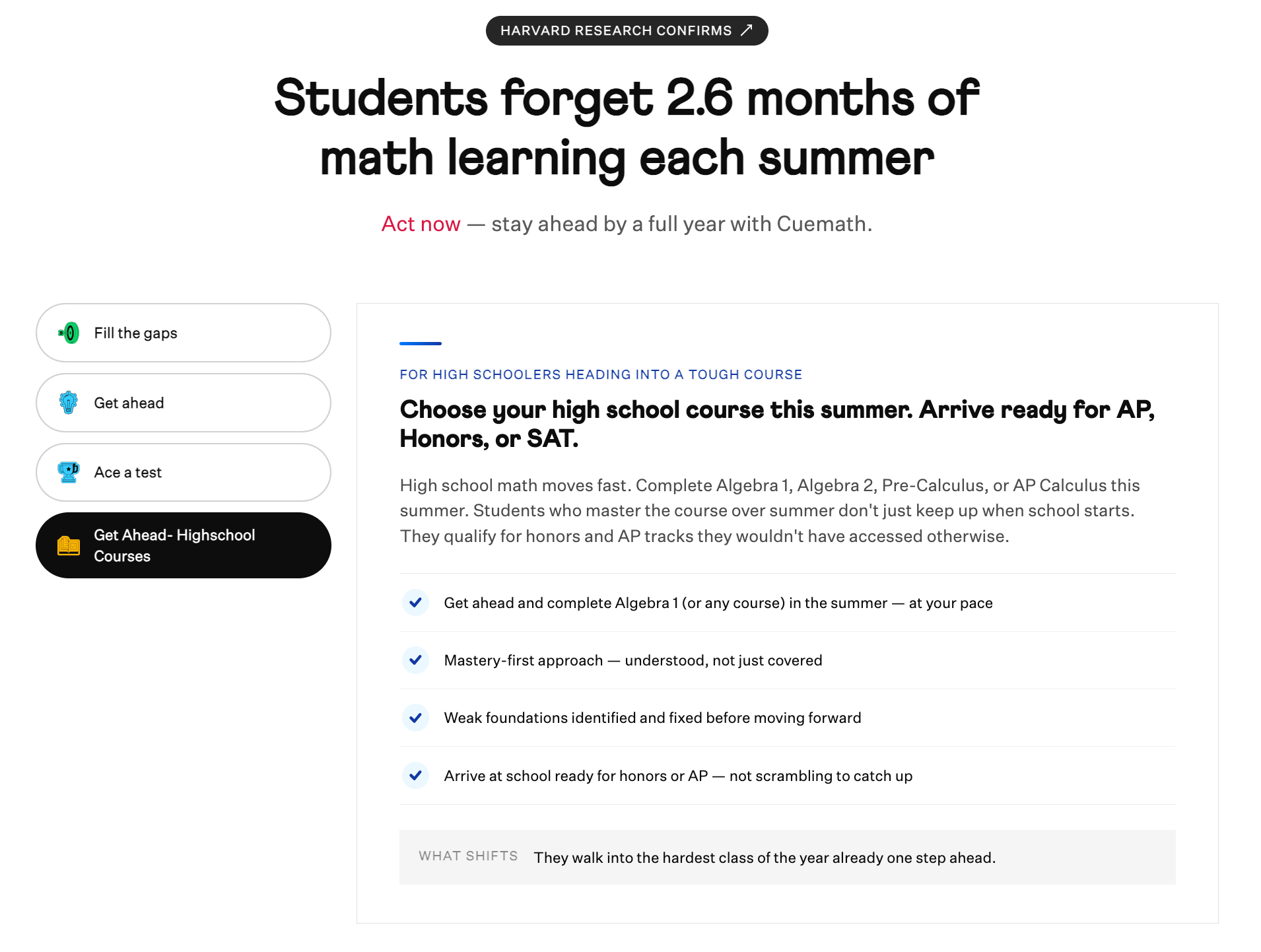
High school math courses are sequential and rigorous in their own ways. No one can say Geometry is pretty easier to finish in 8 weeks or Algebra is easier to complete. Since Ivy Leagues, STEM colleges and even top business schools require students to do Calculus in high school, the summer break should be a strategic time-frame to get ahead in high school math.
Top STEM Colleges Require Calculus
Stanford recommends four years of rigorous high school math for applicants, including calculus. In 2023, both Stanford and Harvard revised their math guidance to refocus on foundational courses like algebra, geometry, and calculus over newer data-science electives.
If You Spend Summer to Get Ahead, It Shows in College Applications
Admissions officers read summers as a blank canvas. Choosing to take a credit-bearing course over the summer is concrete, transcript-verified evidence that a student seeks out challenge.
The Longer Term Impact
A 2022 NBER study found that six-week summer STEM programs raised the share of students who went on to earn a STEM degree by 13 to 20 percentage points. Students who take math in 12th grade also complete more college-level math credits, which is the gateway to most STEM majors.
Can You Complete Geometry (or any High School Course) Over Summer?
Method 1: Take An Accredited Summer Course
- The student enrolls in a for-credit class through a local school district, a private school, or an approved online provider.
- They learn the same curriculum taught across a normal nine-month year, compressed into a 5 to 8 week window.
- Because it is so compressed, students often put in 15 to 20 hours a week. There is no real learning, just rushing through the coursework for the credit.
Method 2: Study on Your Own & Get Credit by Exam (CBE)
- The student studies the entire 1 year Geometry course over the 2 month summer, usually with a tutor or a structured program.
- They take the state-approved CBE exam covering the whole course before the year begins.
- Because there was no formal class, the grading bar is stricter.
How Cuemath Helps You Get Ahead Over Summer?
Cuemath is online 1:1 math program built for math mastery and acceleration. Here's exactly how Cuemath helps you use the summer break to get ahead in high school:
You start with a customized plan according to your goals.
- Your Cuemath tutor looks at your current course and the one you want to be ready for, then maps out what to study this summer.
- Taking Geometry now and want Algebra 2 Honors in the fall? You spend summer reviewing the Algebra 1 and Geometry concepts that course depends on and bridging the gaps, so you start it ready, not scrambling.
- This is how Siddharth turned four years of planned Cuemath prep into admission to Texas A&M's College of Engineering, a steady path that started long before senior year.
Cuemath sessions are 1:1 = 1 expert tutor per student.
- Your tutor gives you full attention, and because it's the same person every time, they learn how you think, where you slip up, and which topics you need more time on.
- You can ask the questions you'd be embarrassed to ask in a class of 30, without anyone judging you. That's often where real progress starts.
You fix the topics that never made sense, while moving forward.
- Cuemath doesn't build on shaky ground.
- Your tutor finds the gaps from last year, or three years ago, and fixes them alongside new material, so you have a solid base before things get harder.
- Harshitha started out doubting herself in Geometry, then went on to clear AP Calculus and the National Calculus Exam, earning college credit and a place at Michigan's Ross School of Business.
You get ahead at a steady pace, not by cramming.
- Cuemath doesn't squeeze a full year of math into 2 months of summe break.
- The learning plan is spaced across semesters and summers, covered over months instead of days, so you get real time to practice, consolidate, and actually understand.
- You get ahead without sacrificing sleep or spending your whole break exhausted.
You can get ahead even if your school won't let you.
- Not in the accelerated track? Cuemath gives you the pathway.
- School doesn't offer AP Calculus BC? Cuemath prepares you for it anyway.
- Getting ahead isn't limited to what your timetable allows.
You learn math the way college and real tests demand it.
- College math, SAT and ACTs test reasoning in unfamiliar situations and application of concepts you weren't drilled on.
- Cuemath builds all four skills together, fluency, understanding, application, and reasoning, so you understand why a method works, not just how to apply it.
- Using retrieval practice and timed, full-length mocks, Cuemath moves you from knowing the material to recalling it instantly under pressure.
- That's how Soham reached the 99th percentile with a 770 on SAT Math, built on steady weekly practice rather than cramming the month before.
Start the year ahead, not behind.
Book a free evaluation. You'll get a one-on-one session with a Cuemath tutor, a quick read on where your math stands, and a plan for what to work on this summer.
Book a Free Evaluation1:1 live sessions · Grades K–12 · No commitment
Frequently Asked Questions
Can you take Geometry over the summer for high school credit?
Yes, you can take Geometry over the summer for high school credit through an accredited program, and most schools will accept it for placement. Confirm with your child's counselor before enrolling, since some schools require pre-approval or a placement test. A full summer Geometry course usually runs 5 to 8 weeks at 15 to 20 hours a week.
How do you get to Calculus by senior year?
You get to Calculus by senior year by getting ahead in Geometry over the summer between 9th and 10th grade. The key is using the summer to genuinely master Geometry, not just clear a credit, since Algebra II and Calculus build directly on it.
Is it hard to take Geometry over the summer?
Taking Geometry over the summer is demanding because a full year of material is compressed into 5 to 8 weeks. Most accredited courses expect 15 to 20 hours a week, which is close to a part-time job. It is very doable for a motivated student, but it is not a casual commitment.
What is remedial math in college?
Remedial math is a non-credit catch-up course colleges require when a student's placement test shows they are not ready for college-level math. It costs full tuition but earns zero credit toward a degree. Only 8% of students whose highest high school course was Calculus need it, compared with 68% of students who stopped at Algebra I.
Is it better to take Geometry over the summer or double up during the school year?
Neither. Finishing a 1 year high school course over two months of summer is not possible. However, students just for credit rush through the courses in summer break. Instead, students should use summer break to get ahead in high school and prepare for the next year.
What is Credit by Exam, and can it replace a summer course?
Credit by Exam (CBE) lets a student bypass a course by passing a state-aligned mastery test, usually scoring 80% or higher. It can replace a summer course for a student who already knows most of the material or learns quickly on their own. The trade-off is that there is no instruction and no second chance, so it suits confident self-studiers, ideally ones working with a tutor.
What is the difference between an accredited summer course and Credit by Exam?
An accredited summer course means enrolling in a formal for-credit class that compresses a full year of Geometry into 5 to 8 weeks, with homework, exams, and an official transcript. Credit by Exam means studying Geometry over the summer and proving mastery on a single state-aligned exam, usually at 80% or higher. The course route is structured but rigid and time-intensive; the exam route is flexible but rests on one high-stakes test.
What score do you need to pass a Credit by Exam for Geometry?
Most districts require 80% or higher on a Credit by Exam to award credit and approve acceleration. The bar is set high because the student did not complete a formal class. In Texas, for example, the state-aligned CBE uses an 80% threshold, and a student who scores below it takes standard Geometry in the fall.
Does Cuemath give high school credit?
No, Cuemath does not grant high school course credit, because it is a 1:1 tutoring program rather than an accredited course provider. Cuemath helps the student get a headstart in new year by catching up on concepts and learning the concepts ahead of school in the 2 month summer break.
Do colleges care if you take a math course over the summer?
Colleges view credit-bearing summer courses favorably because the official transcript shows a student actively sought out challenge. Admissions officers read summers as unstructured time, so choosing rigorous coursework signals initiative and college readiness. It is concrete evidence, not a soft extracurricular.
Can a rising 10th grader take Geometry over the summer?
Yes, a rising 10th grader who finished Algebra I in 9th grade is the most common candidate for summer Geometry. Completing it over the break lets them move into Algebra II as a sophomore and stay on track for Calculus by senior year. They should confirm the school will accept the credit before enrolling.
How many hours a week does a summer math course take?
A credit-bearing summer math course typically takes 15 to 20 hours a week over roughly 5 to 8 weeks. That covers live instruction or video lessons plus independent practice and assignments. Compressing a full year into two months is why the weekly load is so high.
Will my child lose math skills over the summer if they don't take a course?
Yes, research from NWEA shows the average student loses 25 to 34% of their school-year math gains over a single summer break. A student who does no math for three months slides backward rather than holding steady. Even without an acceleration goal, staying engaged with math over the summer prevents that loss.
Is summer math the same as summer school?
No, summer school usually means making up a failed course or required remediation, while an acceleration course like summer Geometry is about getting ahead. The student in this case passed Algebra I and is moving forward, not catching up. The credit and the motivation are different, even though both happen over the summer.
Sources
- National Center for Education Statistics — College Readiness: Math Coursetaking in Public High Schools (remedial math by highest high school course)
- Complete College America — Corequisite Remediation: Spanning the Completion Divide (degree completion and remediation outcomes)
- Education Reform Now — Out of Pocket: The High Cost of Inadequate High Schools, 2016 ($1.3B remedial cost)
- NWEA — Summer learning loss: What we know and what we're learning (summer math loss)
- Stanford Undergraduate Admission — Preparing for Stanford Academics (four years of math including calculus)
- MIT Mathematics (Course 18) Catalog — Single Variable Calculus (18.01)
- NBER — STEM Summer Programs and Students' Educational Outcomes, 2022 (STEM degree attainment)

I grew up a science kid. Math was not my best subject. Class moved fast, I was too shy to ask for help, and I somehow ended up more curious about how people learn than about the subjects themselves.
That's what pulled me into education, not to teach, but to understand how colleges and tutoring programs actually work and what students genuinely need from them.
My love for writing did the rest. Over the last five years I've written about edtech, student life, and college programs. For the past year, my focus has been math tutoring specifically. I research by going where parents actually talk: forums, reviews, and direct conversations with students and families. This blog was researched and drafted with the help of AI tools, then edited and fact-checked by me.
I work at Cuemath now, so factor that in. I'm writing for the kid who's too scared to raise their hand in class. I was that kid.