How Grade 12 Math Preparation Led to a Texas A&M Engineering Admission
A Grade 12 student's four-year math preparation with Cuemath led to a full admission to Texas A&M for Fall 2025. An inside look at how structured high school math preparation shapes engineering-bound students.
Parents of a Grade 12 student applying to engineering programs in the US know the waiting season as its own kind of pressure. You have watched your child finalize essays, refine their SAT scores, and press send on applications. Then comes the waiting. And with it, the question that has been forming since Grade 9. Were the math foundations strong enough to hold up against everything college admissions now weighs?
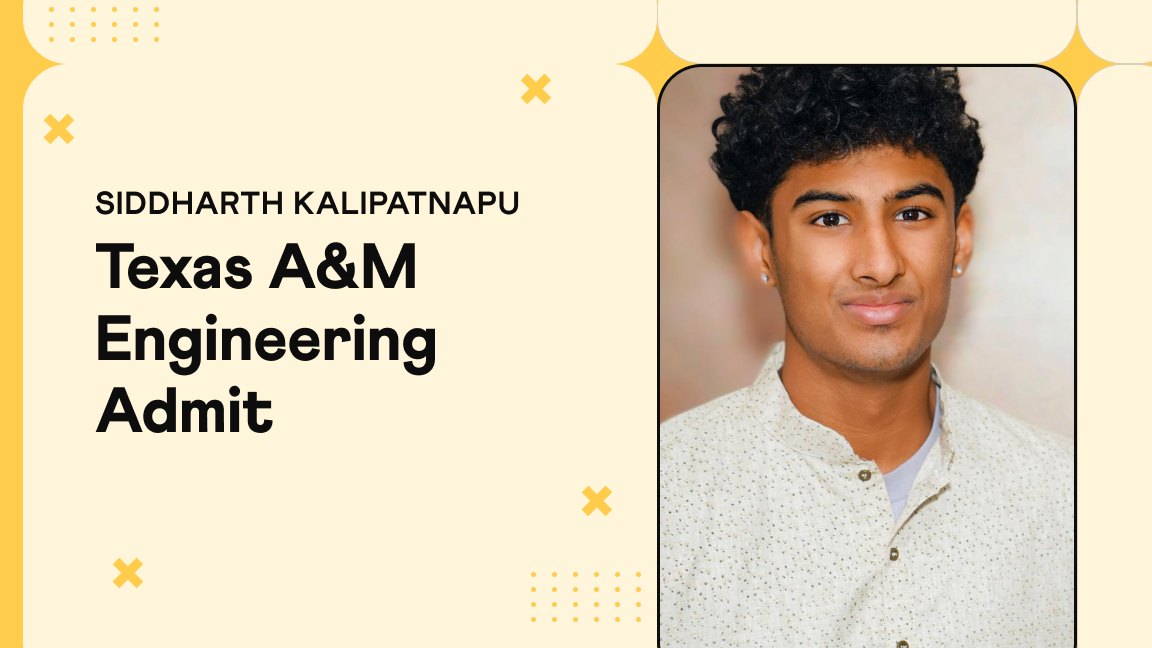
This spring, Siddharth Kalipatnapu got his answer. He was admitted with full admission to Texas A&M, for Fall 2025. The admit came after years of consistent math preparation with his online math tutor at Cuemath.
This is the story of Siddharth Kalipatnapu, a Grade 12 student in the US whose high school math journey turned quick problem-solving instinct into the kind of depth that a competitive engineering admission rewards.
Meet Siddharth Kalipatnapu
- Grade: 12
- Country: USA
- Tutor: Usha Lakshmi Movva
- Learned With Cuemath for: Over 4 years (high school)
- Achievement: Admitted to Texas A&M, Fall 2025
What Does a Grade 12 Engineering-Bound Student Need From Their Math Preparation?
Siddharth had something most parents would feel relieved to see early. He was quick. He grasped new concepts without many repetitions, solved problems at speed, and rarely stalled in class. On the surface, his math was more than fine.
But the mathematics a US engineering college admission weighs is not the mathematics of a good report card. AP Calculus pushes students into multi-step reasoning and applications. The SAT math section rewards the student who can slow down on a single careful question without losing speed on the rest. Engineering programs want to see a mathematical thinker, not just a fast calculator. Speed alone does not carry a high schooler from being good at math in school to being ready for college-level engineering coursework.
"Siddharth has a sharp and agile mind and demonstrated remarkable speed in problem-solving. His efficiency translated into high productivity in every class. He grasped concepts quickly and applied them effectively to advanced problems with minimal struggle."
~ Usha Lakshmi Movva, CUEMATH TUTOR
How Do Years of One-on-One Math Tutoring Shape a College-Bound Engineer?
Siddharth's tutor Usha worked with him steadily through his high school years at Cuemath. Her observation was that he grasped concepts quickly, moved efficiently through class time, and took on advanced problems without getting stuck. His twin brother Pranav was learning alongside him with the same tutor, both of them building the kind of mathematical depth that a competitive US engineering application would later require.
The advantage of consistent one-on-one online math tutoring for a student like Siddharth was that it kept raising the ceiling. Every time he reached the edge of what school asked of him, the sessions pushed further. By Grade 12, that meant harder problem types, competitive-exam-style questions, and the applied reasoning that engineering admissions reward.
What Does a Texas A&M Engineering Admission Signal About a Student's Preparation?
By spring of his senior year, Siddharth had his decision. Texas A&M University, Fall 2025. The pathway gives students a full Texas A&M engineering degree, with the option of completing it in fields like Ocean Engineering or Computer Science Engineering, or transitioning to College Station to specialize in another major.
For a parent, the significance is not only the admit itself. It is the fact that two brothers, taught by the same tutor, both landed at competitive US engineering programs in the same cycle. Siddharth at Texas A&M. Pranav at the University of Wisconsin-Madison. Same household, same preparation, two strong engineering outcomes.
Does This Sound Like Your Child?
Your child might be on a similar path if they:
- Are a bright high schooler who finishes math quickly and needs a steadier challenge than school provides
- Are aiming for a US engineering college and want the math depth to back up their application
- Enjoy advanced problems and look for harder ones once the easier ones are done
- Are in middle school or early high school, and you want to start building the math that engineering admissions will later weigh
Frequently Asked Questions
How early should a student start math preparation for a US engineering college admission?
The math foundation for engineering admissions is built long before senior year. Students who begin consistent advanced math tutoring in middle school or early high school typically reach Grade 12 with the depth that AP Calculus and competitive SAT math expect.
Does an online math tutor make a difference for a high school engineering aspirant?
Yes. A weekly one-on-one rhythm with an online math tutor builds depth a classroom alone cannot. For a student aiming at engineering admissions, the compounding effect over several years is what turns a quick learner into a mathematically confident applicant.
Build the Math Foundation Your Child's Engineering Admission Will Depend On
A steady, structured math habit built early in high school is what turns a bright student into a competitive engineering applicant.
Start with a Free Cuemath Evaluation Today.
Book a Free EvaluationFor students in Grades K to 12 worldwide.
The Quiet Years of Math Work Behind Siddharth's Engineering Admit
The quiet years of math work behind Siddharth's engineering admit are what most college cycles never see. A bright high schooler who kept being challenged. A tutor who kept raising the bar. A family that invested in consistency, not last-minute prep. By the time senior year arrived, Siddharth was not scrambling to build the math his application needed. He had already built it, piece by piece, across high school. That is what being MathFit looks like for an engineering-bound student. Mathematical confidence that was earned, speed that serves thinking, and college options held open because the foundations were laid early enough to matter.