Kindergarten Math Problems: 40 Practice Questions With Answers
This blog covers all major Kindergarten math problems across topics with 40 practice problems. It includes picture-based questions your child can see and solve, plus step-by-step solutions so you can explain every answer together.
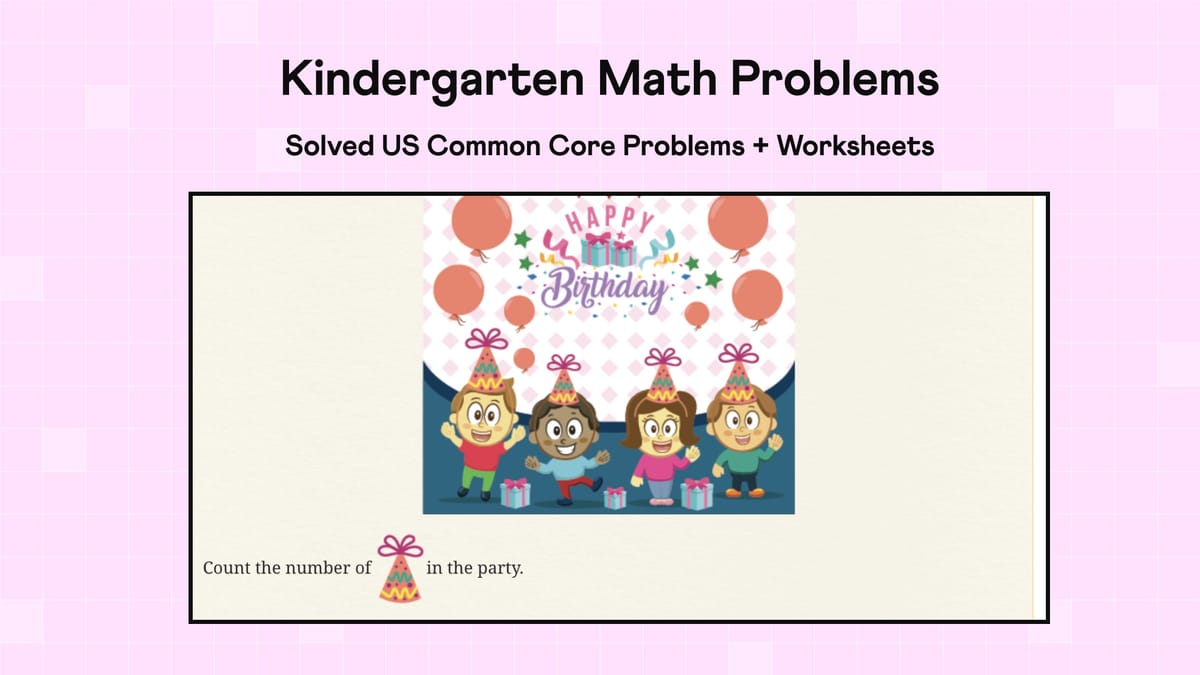
Sample kindergarten math problem on counting objects.
Kindergarten math is all about building the first big ideas: how to count, sort, compare, and explore shapes. These kindergarten math problems, based on the US Common Core State Standards (CCSS), cover every major topic your child learns this year. Whether your child is working on counting to 20, sorting by color, or adding small numbers, you will find targeted practice here.
Our Cuemath tutors, who work daily with Kindergarten students, helped us design these problems to match how 5- and 6-year-olds actually think. Each problem is paired with a step-by-step solution hidden behind a click. If your child gets stuck, click on 'Show Step-by-Step Solution' to walk through it together.
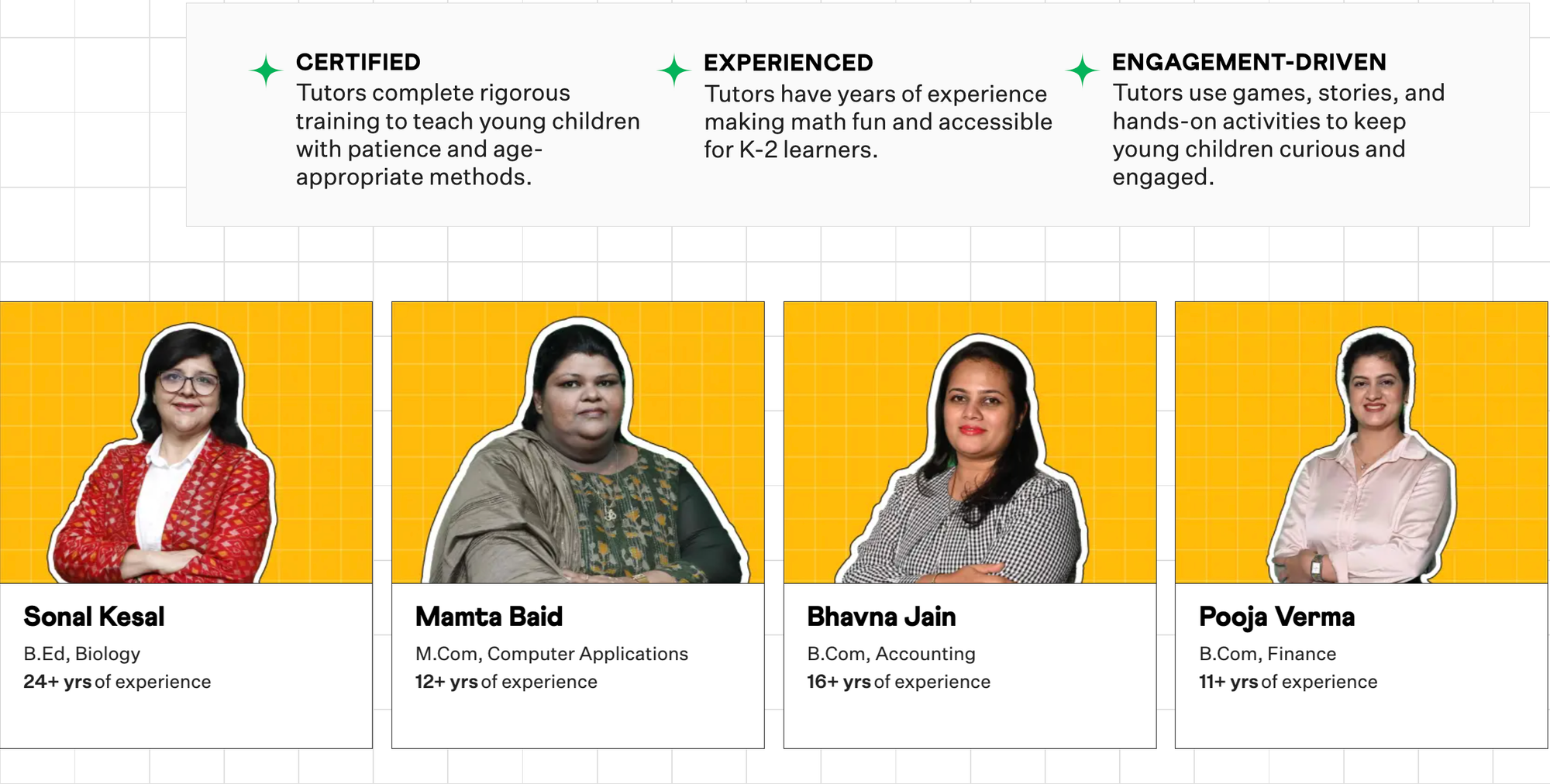
Meet the Cuemath expert math tutors for K-2!
School math + test prep + skills AI can't match, at $0 cost.
Everything your child needs from Grade K to 12, curriculum mastery, test prep, and enrichment math, is now in one free app.
Objective: Classify objects into given categories and count the number in each.
Matching and sorting are among the first math skills kindergartners develop. Children learn to group objects by size, color, or shape and notice how things are alike or different. This skill builds logical thinking and lays the groundwork for early data and measurement work. It also builds vocabulary: big/small, same/different, belongs/does not belong.
Where students make mistakes: Kindergartners often sort by only one attribute (like color) when a problem asks about another (like size). Encourage your child to re-read the question before picking groups.
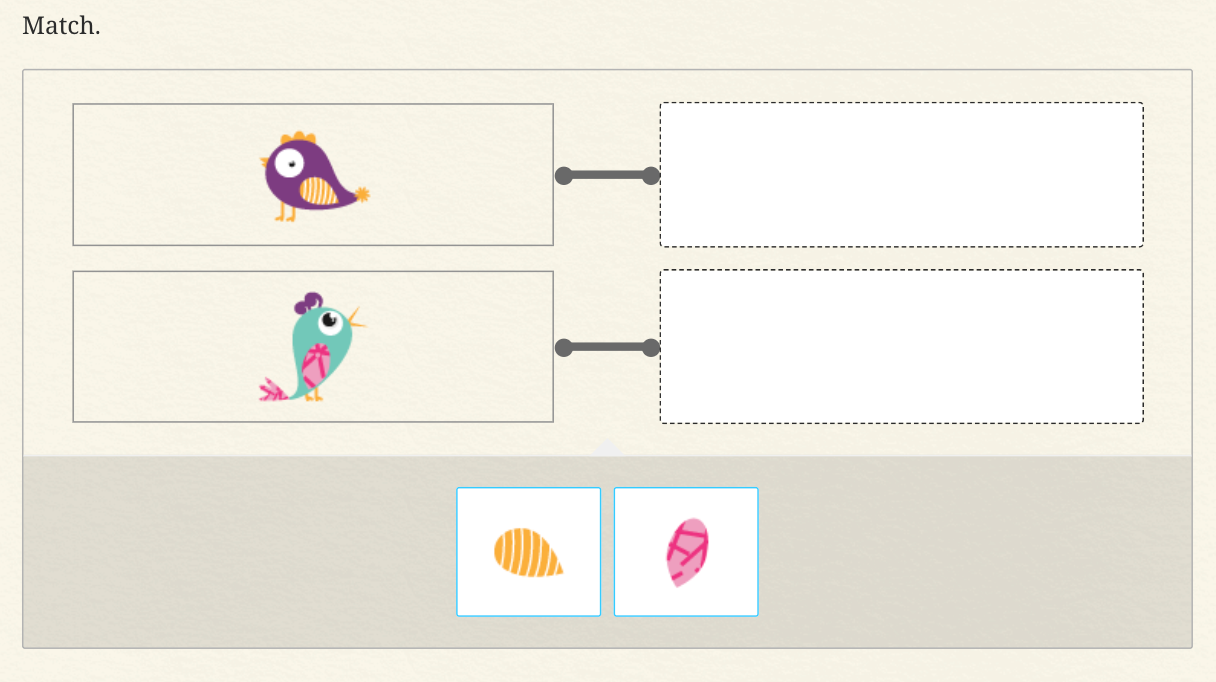
Q1. Match each bird to its egg. The purple bird and the teal bird each belong to one of the two eggs shown.
Q2. Emma has 4 big blocks and 2 small blocks. How many blocks are big?
Answer: 4
Easy
▶ Show Step-by-Step Solution
Step 1: Read the problem carefully. It asks only about big blocks.
Step 2: The problem says Emma has 4 big blocks.
Step 3: The answer is 4.
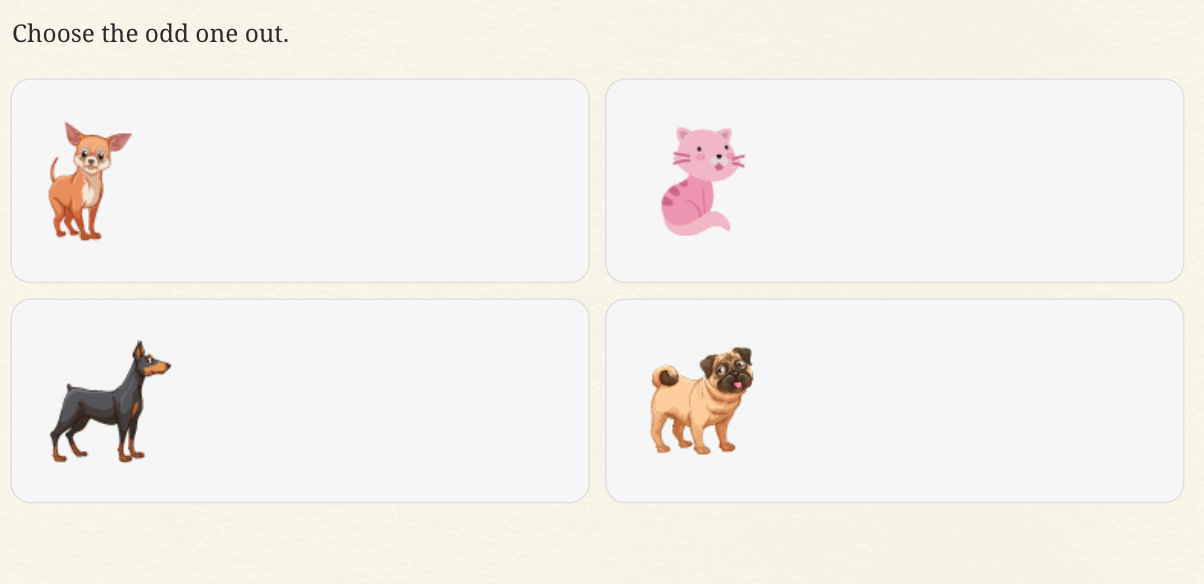
Q3. Look at the four animals in the grid. Choose the odd one out.
Answer: The cat
Easy
▶ Show Step-by-Step Solution
Step 1: Look at each animal one at a time.
Step 2: A chihuahua is a dog. A doberman is a dog. A pug is a dog.
Step 3: A cat is a different kind of animal — it is not a dog.
Step 4: The cat is the odd one out because all the others are dogs.
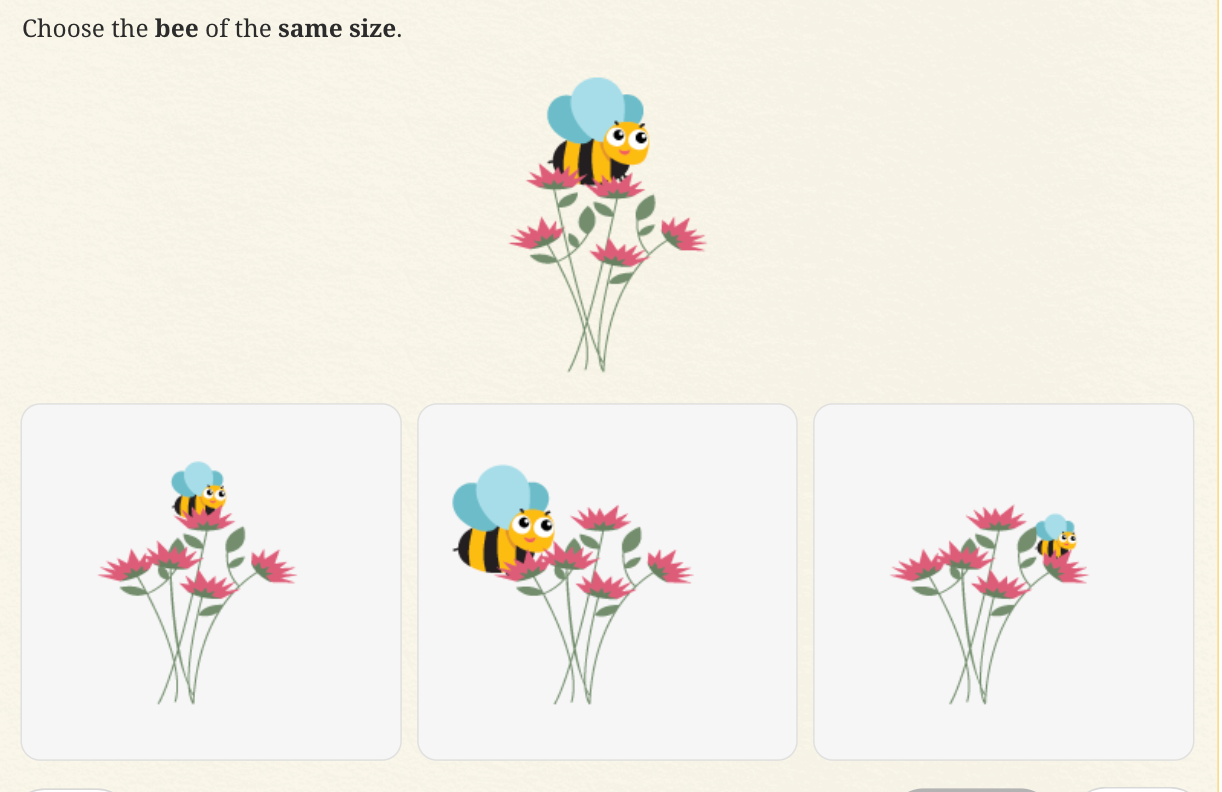
Q4. A reference bee is shown at the top. Three bees are below: one large (left), one the same size (middle), one small (right). Which bee is the same size as the top bee?
Answer: The middle bee
Medium
▶ Show Step-by-Step Solution
Step 1: Look carefully at the size of the bee shown at the top. That is your reference.
Step 2: The bee on the left is bigger than the reference bee.
Step 3: The bee on the right is smaller than the reference bee.
Step 4: The bee in the middle is the same size. That is the answer.
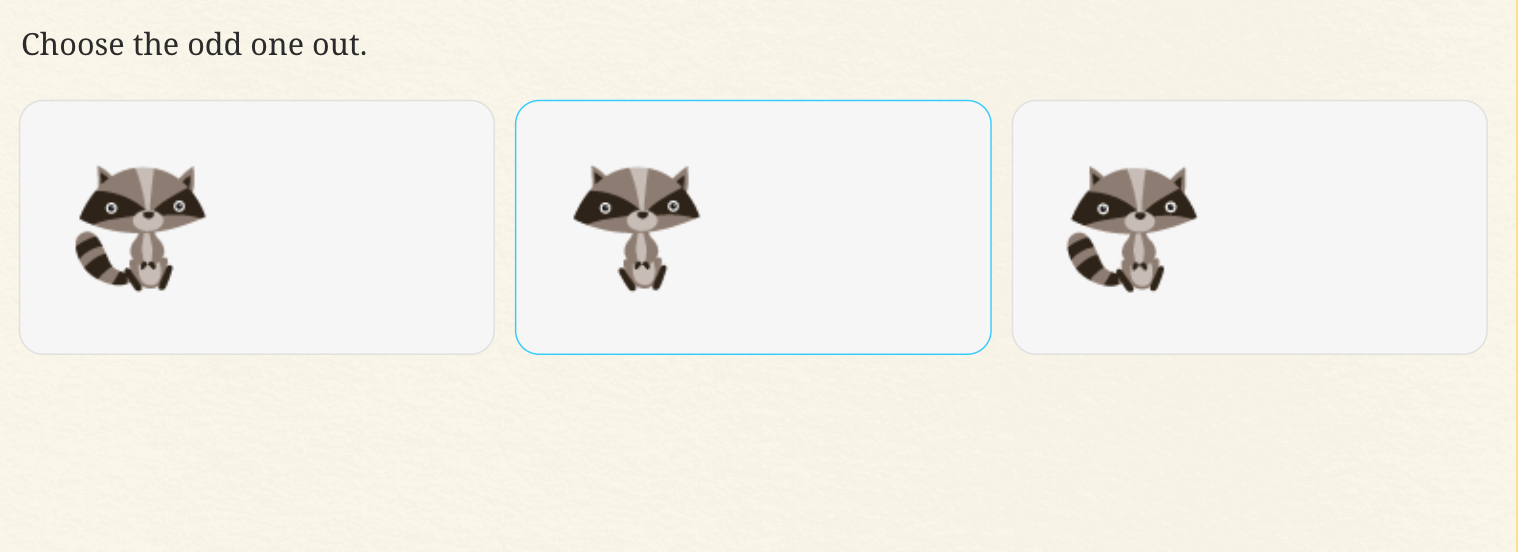
Q5. Look at the three raccoons in a row. Which raccoon is the odd one out?
Answer: The middle raccoon
Medium
▶ Show Step-by-Step Solution
Step 1: Look at all three raccoons carefully.
Step 2: The raccoon on the left and the right are the same size.
Step 3: The raccoon in the middle is smaller than the other two.
Step 4: The middle raccoon is different — it is the odd one out.
🔢 2. Number Sense up to 10
Objective: Know number names and the count sequence; count to tell the number of objects; compare numbers.
Understanding numbers up to 10 is the heart of Kindergarten math. Students learn to count objects, write numbers 0 through 10, and compare which number is more or less. This builds one-to-one correspondence: the idea that each object gets exactly one count and no object is skipped or counted twice.
Where students make mistakes: Children sometimes skip a number or count one object twice. Encourage your child to touch or point to each object as they count out loud.
Q1. Count the stars: ⭐⭐⭐⭐⭐⭐. How many stars are there?
Answer: 6
Easy
▶ Show Step-by-Step Solution
Step 1: Point to each star and count out loud.
Step 2: 1, 2, 3, 4, 5, 6.
Step 3: There are 6 stars.
Q2. What number comes after 7?
Answer: 8
Easy
▶ Show Step-by-Step Solution
Step 1: Say the numbers in order: 6, 7…
Step 2: The next number after 7 is 8.
Step 3: The answer is 8.
Q3. Which number is more: 4 or 9?
Answer: 9
Easy
▶ Show Step-by-Step Solution
Step 1: Think about counting up from 0.
Step 2: You reach 4 before you reach 9. That means 9 is farther along.
Step 3: 9 is more than 4.
Q4. Put these numbers in order from smallest to biggest: 3, 8, 1, 5.
Answer: 1, 3, 5, 8
Medium
▶ Show Step-by-Step Solution
Step 1: Find the smallest number. 1 is the smallest.
Step 2: Find the next smallest. 3 comes after 1.
Step 3: Then 5, then 8.
Step 4: Order from smallest to biggest: 1, 3, 5, 8.
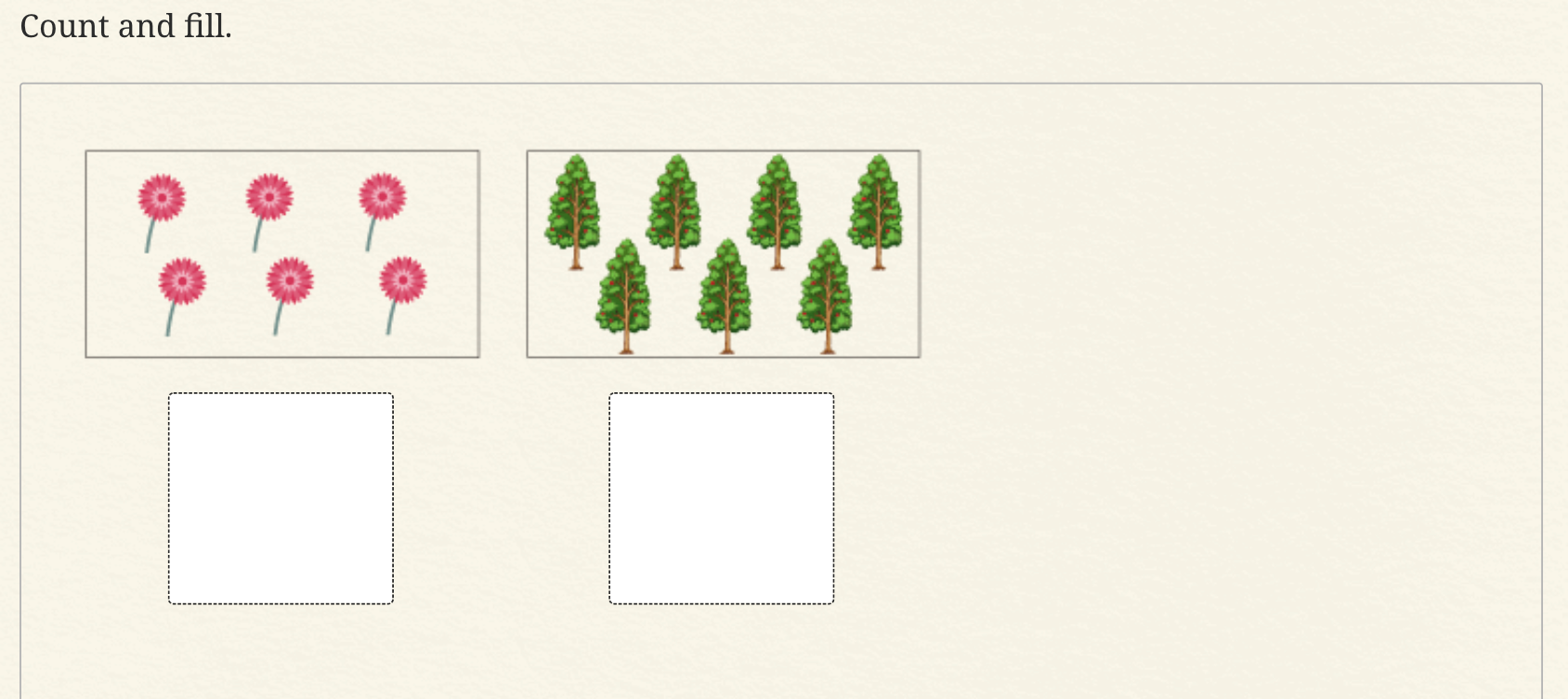
Q5. Count and fill. Count each group of objects and write the number in the box.
Answer: Flowers = 6, Trees = 7
Medium
▶ Show Step-by-Step Solution
Step 1: Look at the left group. Count the pink flowers one at a time: 1, 2, 3, 4, 5, 6. Write 6 in the box.
Step 2: Look at the right group. Count the Christmas trees: 1, 2, 3, 4, 5, 6, 7. Write 7 in the box.
Step 3: Flowers = 6, Trees = 7.
🔟 3. Number Sense up to 20
Objective: Count forward beginning from a given number; count to 20; represent a number of objects with a written numeral.
As kindergartners move into numbers up to 20, they encounter teen numbers, which can be tricky because the names do not follow an obvious pattern (eleven and twelve are irregular). The key idea here is that numbers like 15 mean "ten and five more."
Where students make mistakes: Many students say "onety-one" or "onety-two" for 11 and 12 because teen numbers do not follow the same naming pattern as 20s, 30s, and beyond. Practice naming 11, 12, and 13 out loud regularly.
Q1. Write the missing number: 11, 12, ___, 14.
Answer: 13
Easy
▶ Show Step-by-Step Solution
Step 1: Count forward from 12.
Step 2: The next number is 13.
Step 3: 11, 12, 13, 14.
Q2. Which number is greater: 14 or 18?
Answer: 18
Easy
▶ Show Step-by-Step Solution
Step 1: Both are teen numbers.
Step 2: Count from 14: 15, 16, 17, 18.
Step 3: You need to count 4 more to reach 18. That means 18 is greater.
Q3. Lily has 10 red beads and 7 blue beads. How many beads does she have in all?
Q4. Tom counted 16 leaves. Sam counted 19 leaves. Who counted more leaves?
Answer: Sam
Medium
▶ Show Step-by-Step Solution
Step 1: Compare 16 and 19.
Step 2: Count from 16 to 19: 17, 18, 19. That is 3 more.
Step 3: 19 is more than 16. Sam counted more leaves.
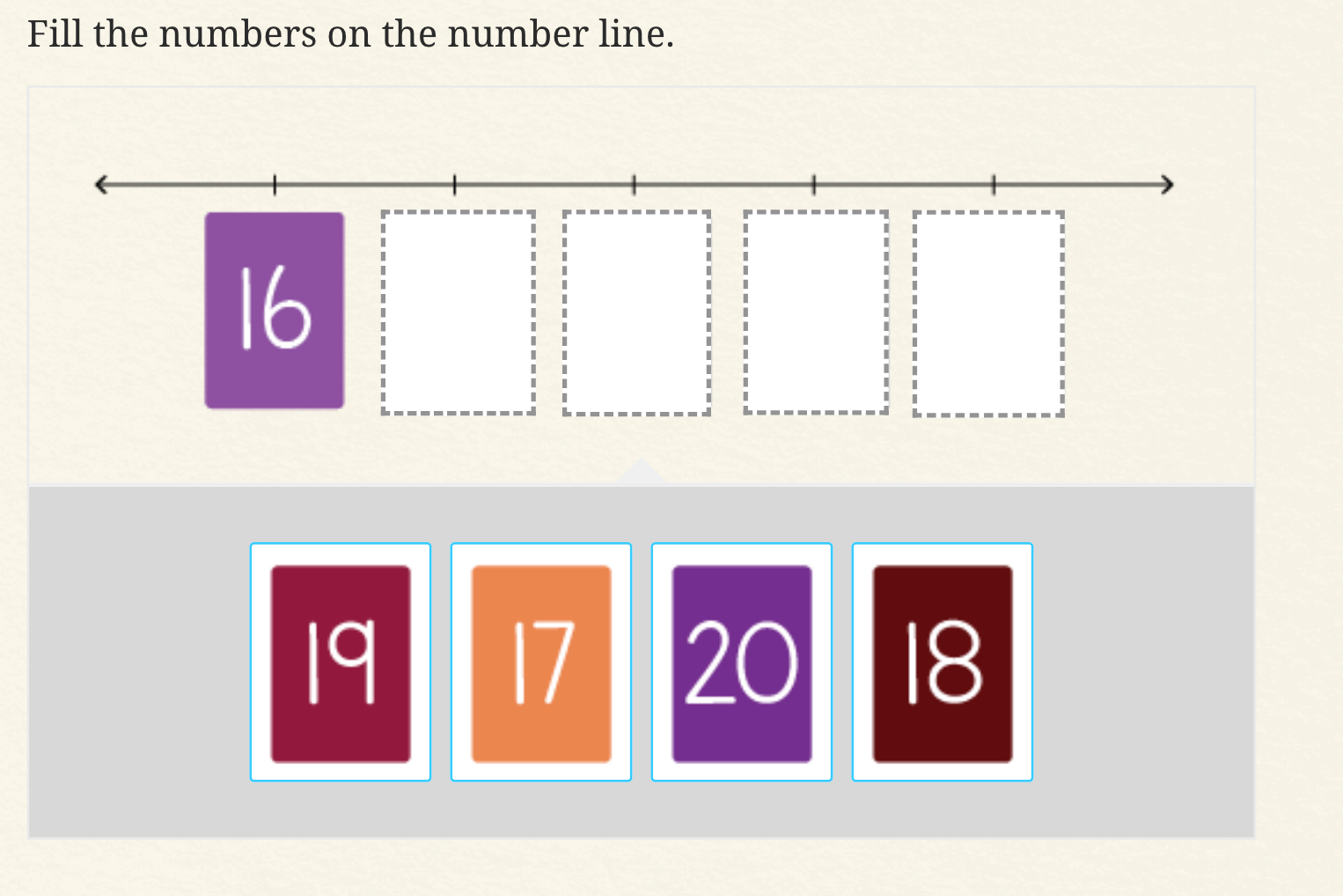
Q5. Fill the numbers on the number line. It starts at 16 with 4 blank boxes. The cards shown in scrambled order are: 19, 17, 20, 18. Place them in correct order.
Answer: 16, 17, 18, 19, 20
Medium
▶ Show Step-by-Step Solution
Step 1: The number line already shows 16 as the starting number.
Step 2: Count forward from 16. The next number is 17.
Step 3: Then 18, then 19, then 20.
Step 4: Place the cards: 17 in box 1, 18 in box 2, 19 in box 3, 20 in box 4.
➕ 4. Addition and Subtraction up to 10
Objective: Understand addition as putting together and adding to; understand subtraction as taking apart and taking from.
This is where kindergartners first see number equations. Addition means putting things together to find a total. Subtraction means taking away to find what is left. Common Core standard K.OA asks students to solve word problems and write equations using objects, drawings, and numbers up to 10.
Where students make mistakes: Students sometimes subtract from the wrong number in word problems. Teach them to look for "how many are left" as a signal to subtract, and "how many in all" as a signal to add.
Q1. There are 3 birds on a branch. 2 more birds fly in. How many birds are there now?
Answer: 5
Easy
▶ Show Step-by-Step Solution
Step 1: Start with 3 birds.
Step 2: 2 more fly in, so we add: 3 + 2 = ?
Step 3: Count on from 3: 4, 5.
Step 4: There are 5 birds now.
Q2. 6 + 2 = ___
Answer: 8
Easy
▶ Show Step-by-Step Solution
Step 1: Start at 6.
Step 2: Count 2 more: 7, 8.
Step 3: 6 + 2 = 8.
Q3. There are 8 cookies on a plate. Lucy eats 3. How many cookies are left?
Answer: 5
Medium
▶ Show Step-by-Step Solution
Step 1: Start with 8 cookies.
Step 2: "Eats 3" means we take away 3: 8 − 3 = ?
Step 3: Count back 3 from 8: 7, 6, 5.
Step 4: There are 5 cookies left.
Q4. Sam has 5 red marbles and 4 blue marbles. How many marbles does Sam have in all?
Answer: 9
Medium
▶ Show Step-by-Step Solution
Step 1: "In all" is a signal to add.
Step 2: 5 + 4 = ?
Step 3: Count on from 5: 6, 7, 8, 9.
Step 4: Sam has 9 marbles in all.
Q5. 10 − 4 = ___
Answer: 6
Medium
▶ Show Step-by-Step Solution
Step 1: Start at 10.
Step 2: Count back 4 steps: 9, 8, 7, 6.
Step 3: 10 − 4 = 6.
🔶 5. Shapes and Patterns
Objective: Describe objects in the environment using names of shapes; analyze, compare, create, and compose shapes.
In Kindergarten, students identify 2D shapes (circle, square, triangle, rectangle) and 3D shapes (sphere, cube, cone, cylinder). They also begin to recognize and extend repeating patterns. Understanding shapes helps children make sense of their world, from wheels (circles) to blocks (cubes) to ice cream cones (cones).
Where students make mistakes: Children often confuse a rectangle and a square. Remind them that a square is a special rectangle where all 4 sides are equal length.
Q1. What shape has 3 sides and 3 corners?
Answer: Triangle
Easy
▶ Show Step-by-Step Solution
Step 1: Think about each shape you know.
Step 2: A circle has no sides. A square has 4. A rectangle has 4.
Step 3: A triangle has exactly 3 sides and 3 corners.
Step 4: The answer is triangle.
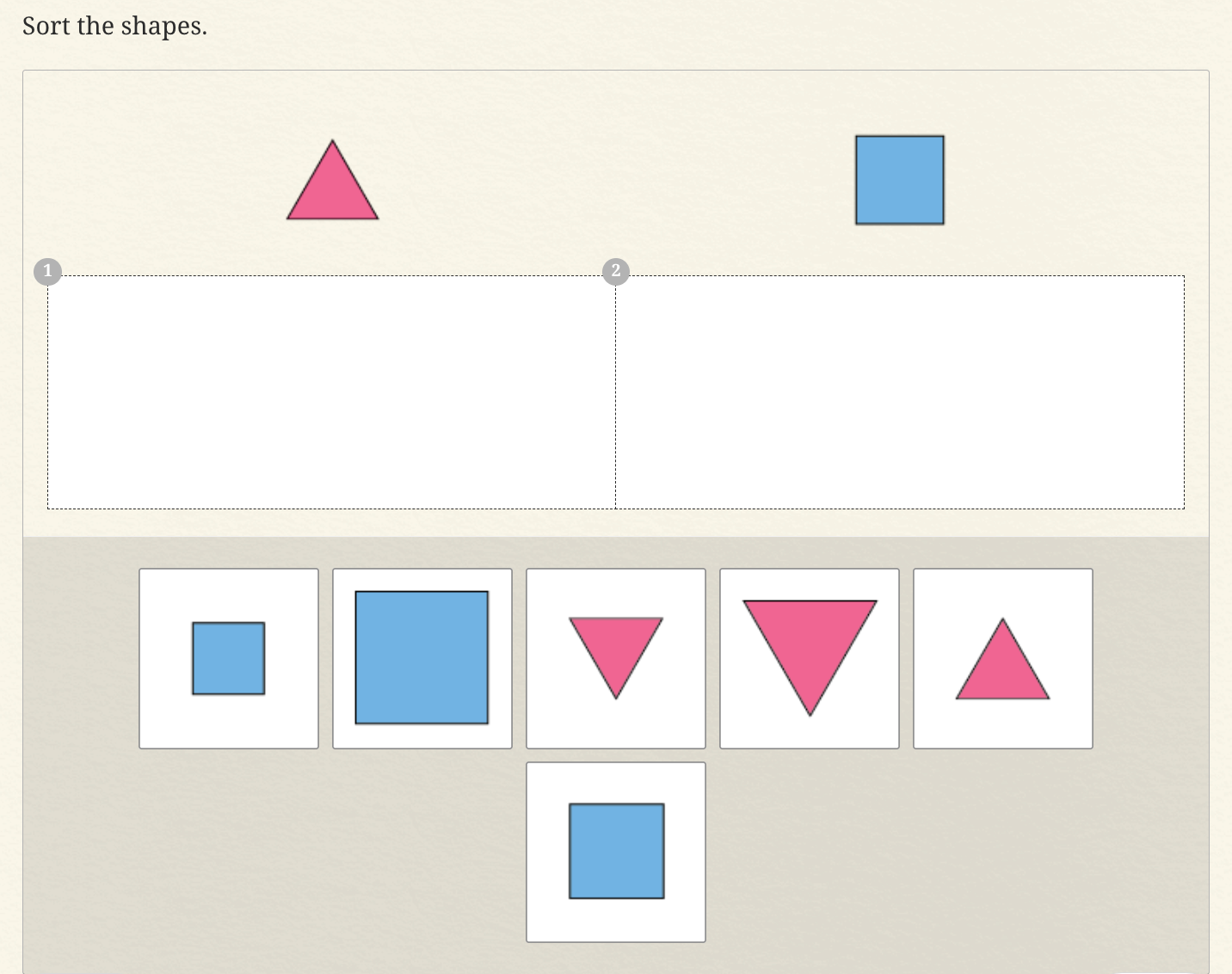
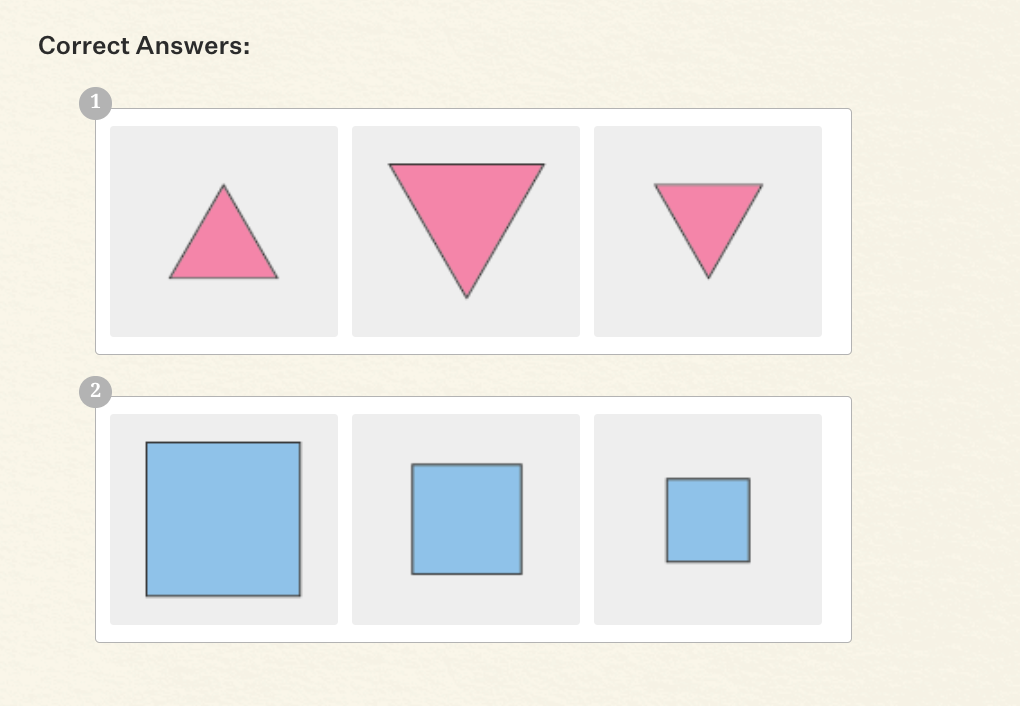
Q2. Sort the shapes into the correct group. Left box: triangles. Right box: squares.
Answer: All pink triangles in the left box; all blue squares in the right box
Easy
▶ Show Step-by-Step Solution
Step 1: Look at the label above each box. The left box is for triangles. The right box is for squares.
Step 2: Go through each shape one at a time. Ask: is this a triangle or a square?
Step 3: All pink shapes are triangles — they have 3 sides. Put all 3 pink triangles in the left box.
Step 4: All blue shapes are squares — they have 4 equal sides. Put all 3 blue squares in the right box.
Step 5: It does not matter if the shapes are big or small — only the shape type matters.
Sorted answer:
Q3. How many sides does a rectangle have? How is a square different from a rectangle?
Answer: A rectangle has 4 sides. A square has 4 equal sides; a rectangle has 2 long and 2 short sides.
Medium
▶ Show Step-by-Step Solution
Step 1: Count the sides of a rectangle: top, bottom, left side, right side = 4 sides.
Step 2: Now look at a square. It also has 4 sides, but all 4 sides are exactly the same length.
Step 3: That is the difference: a square has 4 equal sides; a rectangle does not have to.
Q4. Maya looks at a can of soup. What 3D shape is the soup can?
Answer: Cylinder
Medium
▶ Show Step-by-Step Solution
Step 1: A soup can is round on the top and round on the bottom.
Step 2: The sides curve around in a tube shape.
Step 3: That 3D shape is called a cylinder.
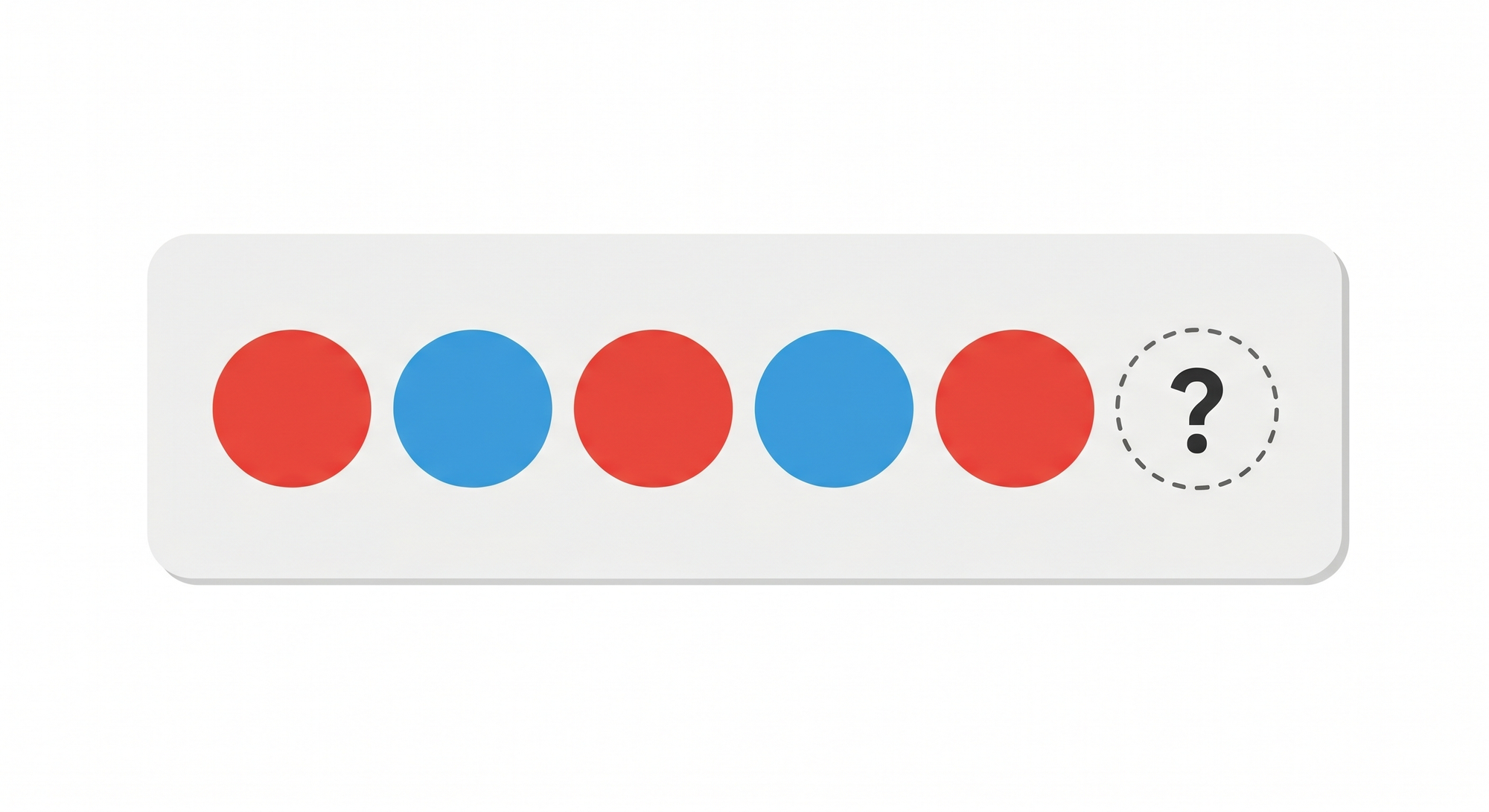
Q5. Look at the pattern: red, blue, red, blue, red, ___. What color comes next?
Answer: Blue
Medium
▶ Show Step-by-Step Solution
Step 1: Look at the pattern: red, blue, red, blue, red…
Step 2: The pattern alternates: red, then blue, then red, then blue.
Step 3: After red, the next color is blue.
⏰ 6. Time
Objective: Describe measurable attributes of objects; sequence events.
Kindergartners learn to talk about time through daily routines: morning, afternoon, and night. They sequence events and learn words like "before," "after," "first," and "last." Reading a clock face comes in first grade, but this language foundation makes all future time concepts stick.
Where students make mistakes: Students often mix up "before" and "after" in sentences. Practice with daily routines by asking: "What do you do before breakfast?" and "What do you do after school?"
Q1. Do you eat breakfast in the morning or at night?
Answer: Morning
Easy
▶ Show Step-by-Step Solution
Step 1: Breakfast is the first meal of the day.
Step 2: We eat it right after we wake up, in the morning.
Step 3: The answer is morning.
Q2. What do you do before going to school?
Answer: Answers may vary. Common answers: wake up, get dressed, eat breakfast, brush teeth.
Easy
▶ Show Step-by-Step Solution
Step 1: Think about your morning routine.
Step 2: Before school, you wake up, get dressed, eat breakfast, and brush your teeth.
Step 3: All of these happen before school starts.
Q3. Put these activities in the correct order from first to last: go to sleep, wake up, eat dinner, go to school.
Answer: Wake up → go to school → eat dinner → go to sleep
Medium
▶ Show Step-by-Step Solution
Step 1: In the morning, you wake up first.
Step 2: During the day, you go to school.
Step 3: In the evening, you eat dinner.
Step 4: At night, you go to sleep.
Q4. Jake reads a story at night before bed. Amy reads a story in the morning after breakfast. Who reads earlier in the day?
Answer: Amy
Medium
▶ Show Step-by-Step Solution
Step 1: Morning comes before night in a single day.
Step 2: Amy reads in the morning. Jake reads at night.
Step 3: Morning is earlier than night. Amy reads earlier in the day.
Q5. Which takes longer: blinking your eye one time, or eating lunch?
Answer: Eating lunch
Medium
▶ Show Step-by-Step Solution
Step 1: A single blink takes less than 1 second.
Step 2: Eating lunch takes about 20 to 30 minutes.
Step 3: Eating lunch takes much, much longer than blinking.
📏 7. Measurement
Objective: Describe and compare measurable attributes such as length and weight.
Kindergarten measurement is all about comparing, not measuring with rulers or scales. Students use language like "longer/shorter," "heavier/lighter," and "holds more/less." These comparisons are the foundation for formal measurement in Grade 1 and beyond.
Where students make mistakes: Students often say "bigger" when they mean "longer" or "heavier." Encourage specific comparison words: "longer than," "heavier than," "holds more than."
Q1. Which is longer: the pencil or the crayon?
Answer: The pencil
Easy
▶ Show Step-by-Step Solution
Step 1: Line up both objects at the same starting point (left side).
Step 2: See which one sticks out farther on the right.
Step 3: The pencil extends farther. The pencil is longer.
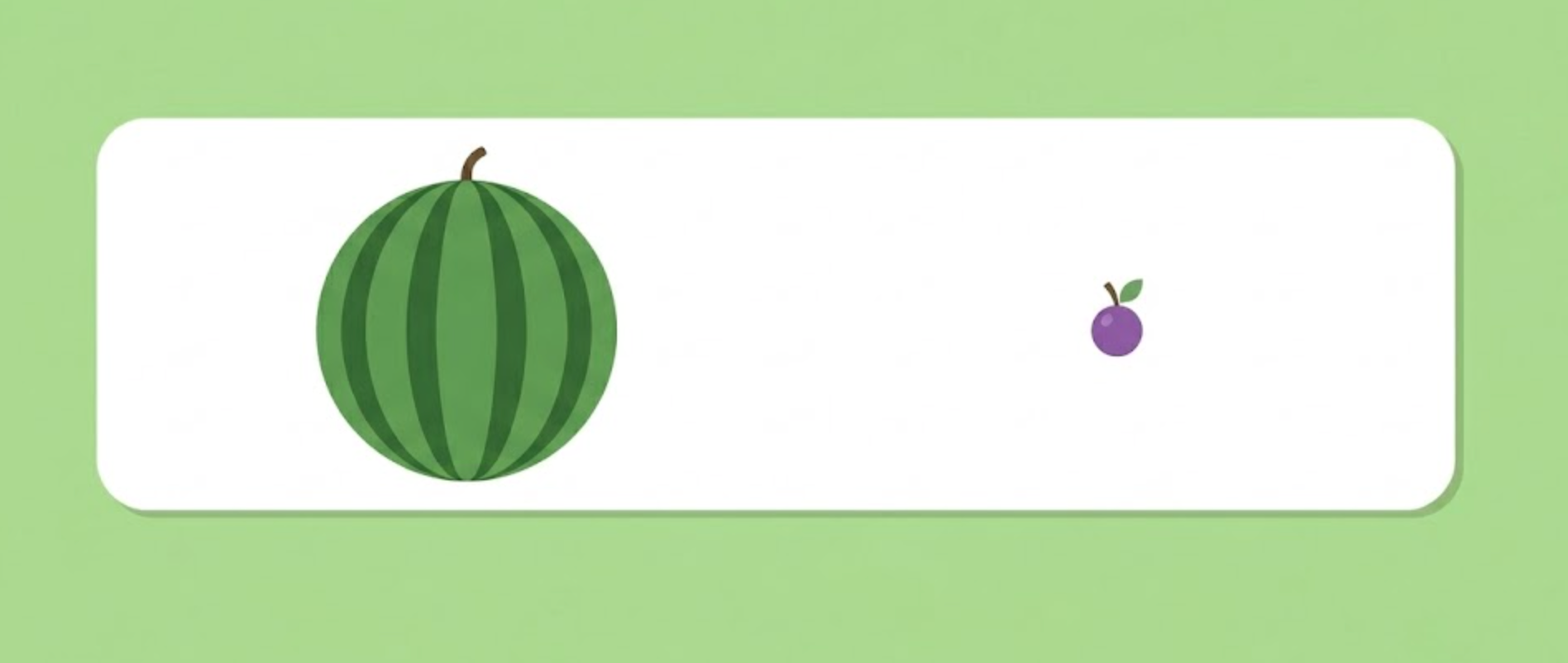
Q2. Which is heavier: the large watermelon or the small grape?
Answer: The watermelon
Easy
▶ Show Step-by-Step Solution
Step 1: Think about which object would feel heavier if you picked it up.
Step 2: A watermelon is much bigger and denser than a small grape.
Step 3: The watermelon is heavier.
Q3. A bathtub and a drinking glass — which one holds more water?
Answer: The bathtub
Medium
▶ Show Step-by-Step Solution
Step 1: Think about how much water each one can hold.
Step 2: A drinking glass is small. You can fill it with just a little water.
Step 3: A bathtub is very large. It takes a lot of water to fill it.
Step 4: The bathtub holds more water.
Q4. Leo is taller than Mia. Mia is taller than Sam. Who is the shortest?
Answer: Sam
Medium
▶ Show Step-by-Step Solution
Step 1: Leo is taller than Mia: Leo > Mia.
Step 2: Mia is taller than Sam: Mia > Sam.
Step 3: Putting them in order from tallest to shortest: Leo, Mia, Sam.
Step 4: Sam is at the bottom of the order, so Sam is the shortest.
Q5. You put a school bag on one side of a balance scale and a pencil on the other. Which side goes down?
Answer: The school bag side
Medium
▶ Show Step-by-Step Solution
Step 1: A balance scale tips down on the heavier side.
Step 2: A school bag carries books, a water bottle, and supplies — it is heavy.
Step 3: A pencil is very light.
Step 4: The school bag is heavier, so that side goes down.
📊 8. Data Handling
Objective: Classify objects into given categories; count the number of objects in each category; compare the categories by count.
Data handling in Kindergarten means sorting objects into groups and comparing how many are in each group. Students read simple picture graphs and answer questions like "how many more" and "which group has the most." This is the earliest form of data literacy.
Where students make mistakes: Children sometimes count the same object twice, or forget to count objects at the edges. Encourage your child to point to each object and count out loud one at a time.
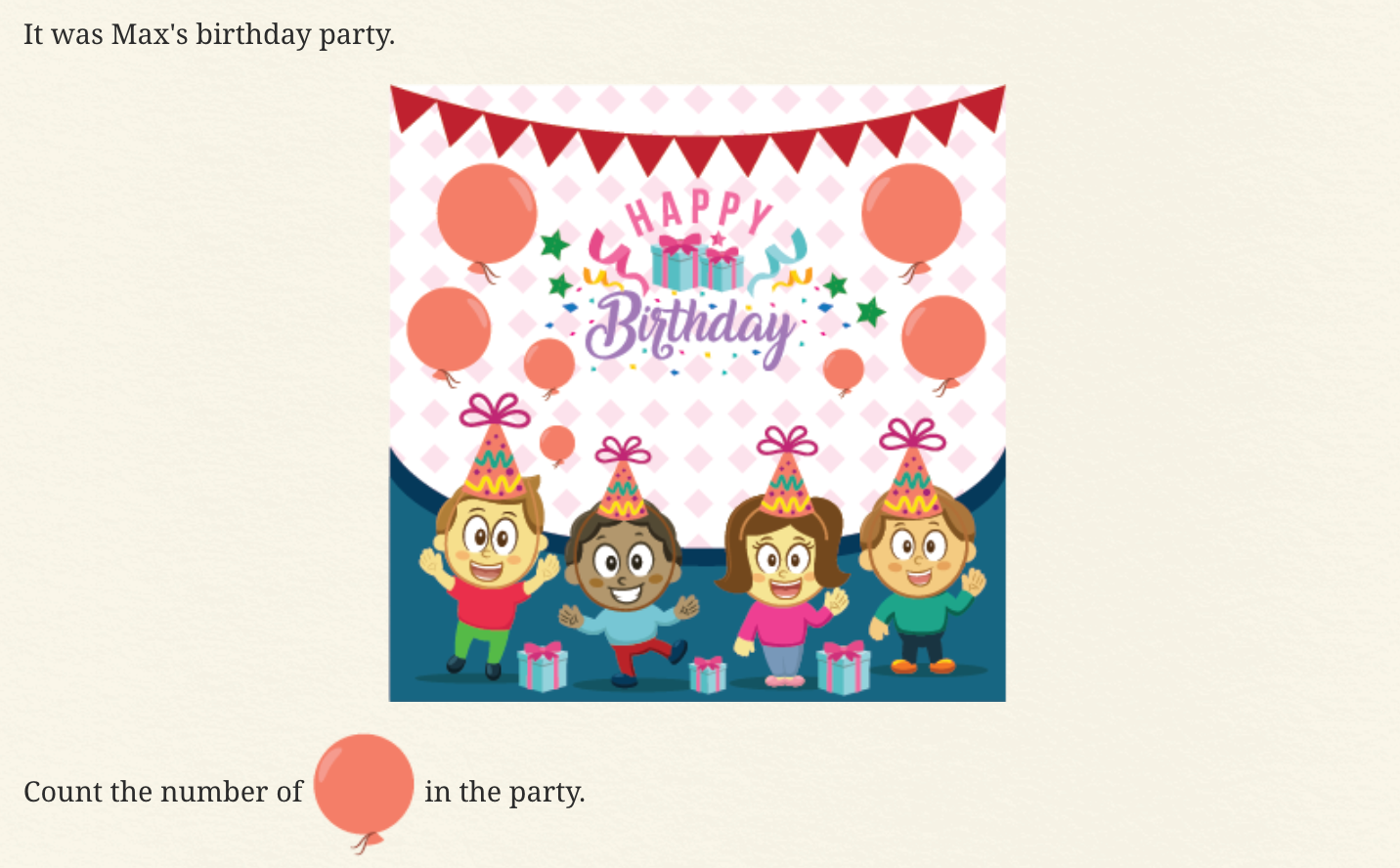
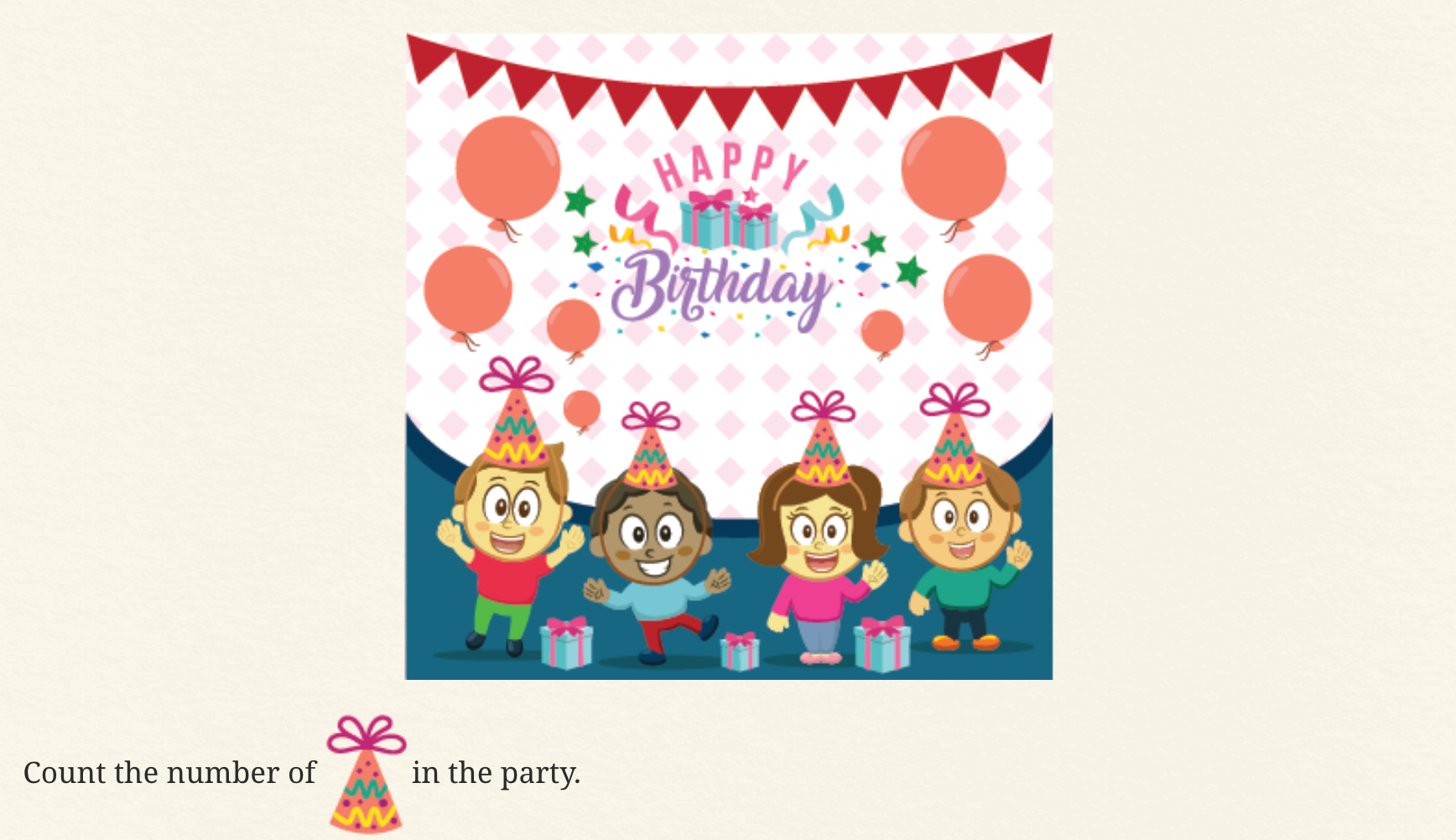
Q1. It was Max's birthday party! Count the number of balloons in the picture.
Answer: 7
Easy
▶ Show Step-by-Step Solution
Step 1: Look carefully at the whole birthday picture.
Step 2: Find every balloon — including the large ones on the sides and the smaller ones in the garland.
Step 3: Count them one by one: 1, 2, 3, 4, 5, 6, 7.
Step 4: There are 7 balloons at Max's party.
Q2. Look at Max's birthday party. Count the number of party hats in the picture.
Answer: 4
Easy
▶ Show Step-by-Step Solution
Step 1: Look at the children in the picture.
Step 2: Each child is wearing one party hat.
Step 3: Count the children: 1, 2, 3, 4.
Step 4: There are 4 party hats at Max's party.
Q3. There are 7 balloons and 4 party hats at Max's party. Which has more — balloons or party hats? How many more?
Answer: Balloons. 3 more balloons than party hats.
Medium
▶ Show Step-by-Step Solution
Step 1: Balloons = 7. Party hats = 4.
Step 2: To find how many more, subtract: 7 − 4 = ?
Step 3: Count back from 7: 6, 5, 4. That is 3 steps.
Step 4: There are 3 more balloons than party hats.
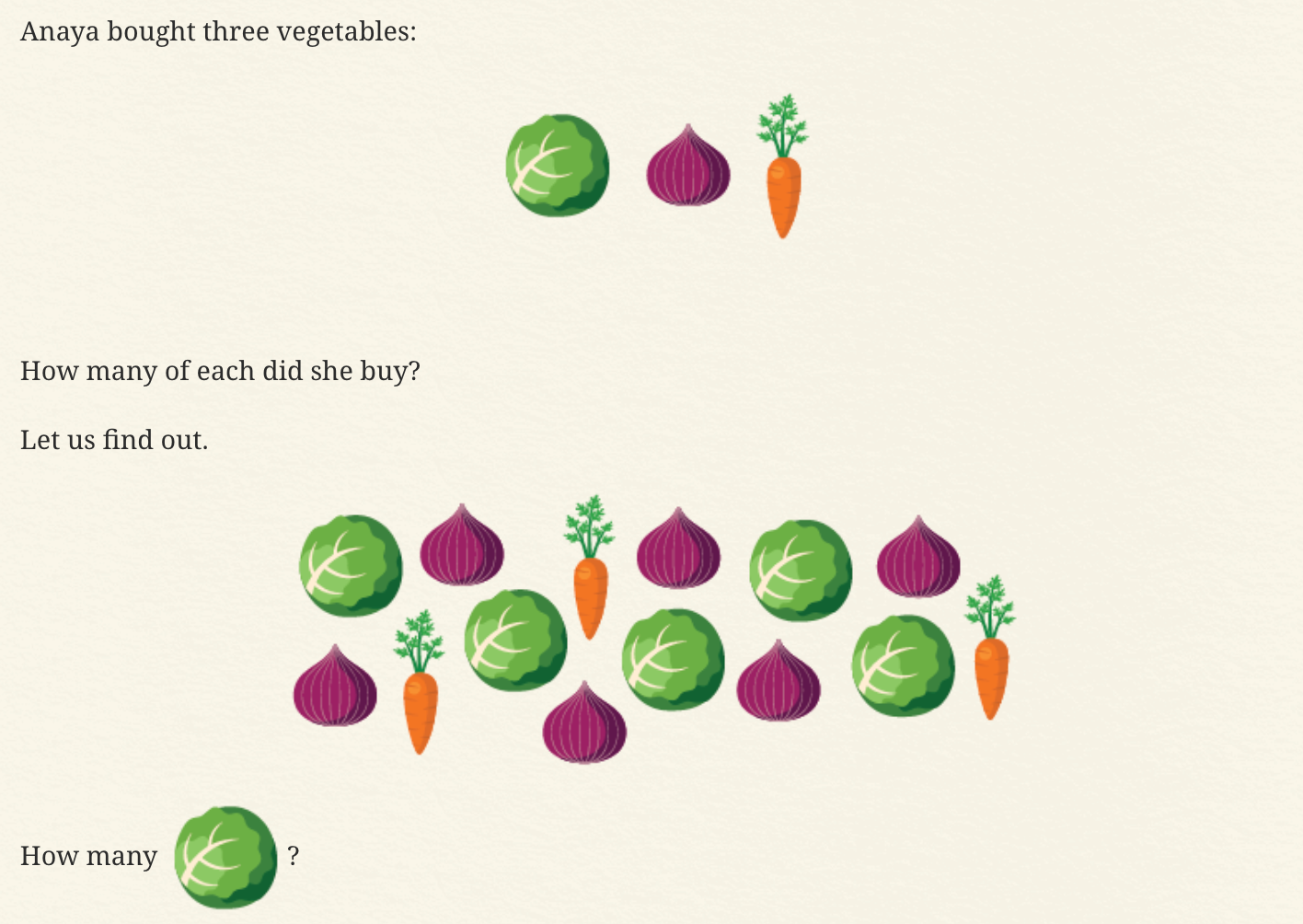
Q4. Anaya bought three kinds of vegetables: sprouts, onions, and carrots. Count only the sprouts in the picture.
Answer: 4
Medium
▶ Show Step-by-Step Solution
Step 1: Look at the mixed row of vegetables carefully.
Step 2: Find only the green round sprouts — ignore the onions and carrots.
Step 3: Count the sprouts one by one: 1, 2, 3, 4.
Step 4: Anaya has 4 sprouts.
Q5. Anaya has 4 sprouts, 5 onions, and 2 carrots. How many vegetables does she have in all?
Kindergarten math problems are age-appropriate exercises that cover the core math skills taught in Kindergarten, including counting, sorting, comparing numbers, basic addition and subtraction, shapes, and simple measurement. These problems are designed for children ages 5 and 6 and are aligned to the US Common Core standards for Kindergarten math.
What math topics are covered in Kindergarten?
Kindergarten math covers five main topic areas according to the US Common Core State Standards: counting and cardinality (numbers up to 20), operations and algebraic thinking (addition and subtraction up to 10), number and operations in base ten, measurement and data, and geometry. Children also practice matching, sorting, comparing, and reading simple graphs.
What are the US Common Core Kindergarten math standards?
The US Common Core Kindergarten math standards include K.CC (Counting and Cardinality), K.OA (Operations and Algebraic Thinking), K.NBT (Number and Operations in Base Ten), K.MD (Measurement and Data), and K.G (Geometry). These standards define what kindergartners should know and be able to do by the end of the school year.
How can I help my kindergartner with math at home?
You can help your kindergartner with math at home by practicing counting during everyday activities, sorting household objects by color or size, reading number books, and using simple addition and subtraction in conversation. Working through kindergarten math problems together, like the ones in this blog, is one of the most effective ways to build early confidence with numbers.
What is number sense in Kindergarten?
Number sense in Kindergarten means understanding that numbers represent quantities, being able to count to 20 with one-to-one correspondence, recognizing which number is more or less, and understanding that numbers can be broken apart and put together. It is one of the most important foundational skills for all future math learning.
What addition and subtraction should a kindergartner know?
By the end of Kindergarten, students should be able to add and subtract within 10 using objects, drawings, or counting. They should understand that addition means putting together and subtraction means taking away. Common Core standard K.OA expects kindergartners to solve word problems involving addition and subtraction within 10 and decompose numbers into pairs in more than one way.
Can Cuemath help my kindergartner with math?
Yes. Cuemath offers 1-on-1 live tutoring for Kindergarten students aligned to US Common Core standards. Every student starts with a free MathFit Evaluation to identify where they are, and a dedicated tutor works through concepts at the child's own pace, starting at $25 per class. Cuemath tutors are trained in both math pedagogy and child psychology, making sessions engaging and confidence-building for young learners.
How do kindergartners learn shapes?
Kindergartners learn shapes by identifying and naming 2D shapes (circle, square, triangle, rectangle) and 3D shapes (sphere, cube, cone, cylinder) in their environment. They compare shapes by the number of sides and corners, and they learn to extend and create simple patterns using shapes and colors. These skills are part of the Common Core standard K.G.
I grew up a science kid. Math was not my best subject. Class moved fast, I was too shy to ask for help, and I somehow ended up more curious about how people learn than about the subjects themselves.
That's what pulled me into education — not to teach, but to understand how colleges and tutoring programs actually work and what students genuinely need from them.
My love for writing did the rest. I had too many observations and nowhere to put them, so I started writing, and haven't stopped. Over the last five years I've written about edtech, student life, and college programs. For the past year, my focus has been math tutoring specifically.
I work at Cuemath now, so factor that in. I research by going where parents actually talk: forums, reviews, and direct conversations with students and families. I'm writing for the kid who's too scared to raise their hand in class. I was that kid.