Mathnasium Cost 2026: What US Parents Actually Pay and What to Ask Before You Enroll?
Mathnasium doesn't list a single price on its website, and that's intentional. I analysed parent reports from Reddit, Quora, and review sites across the US to map what families actually pay by region, what billing surprises to watch for, and whether it's worth it for your child's specific need.

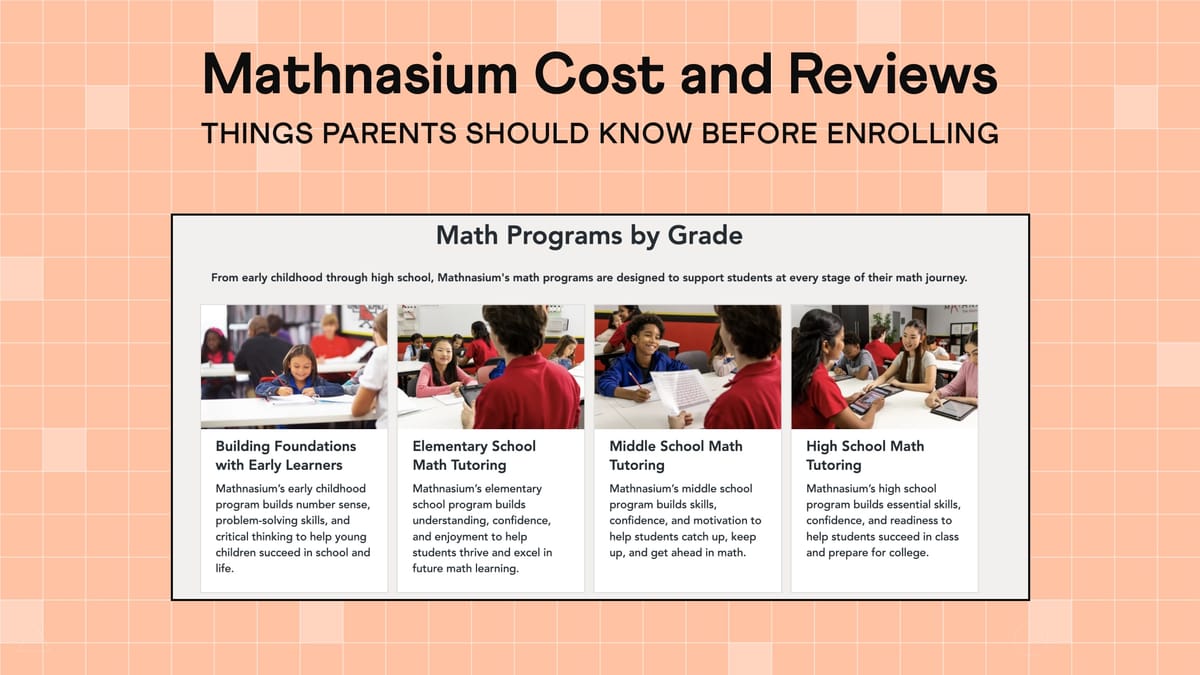
Mathnasium doesn't publish its prices, and that's by design. Each of its 1,000+ franchise centers sets its own rates, which means parents walk into an assessment without knowing what they'll be quoted. I pulled pricing data from Reddit communities and parent review sites across the US to build the most complete picture of what Mathnasium actually costs in 2026, by region, grade level, and session format, so you can walk in prepared.
How Did We Find Out Pricing Data? To actually give parents the idea of the Mathnasium pricing plan and how much Mathnasium costs on average, we read over 50+ parent threads, comments, and discussions from Reddit (r/parenting, r/kumon, r/mathnasium) and Trustpilot reviews.
Quick Answer: How much does Mathnasium cost?
Based on 2026 US parent reports, Mathnasium costs between $200 and $350 per month for the standard 2-session-per-week plan. Most centers also charge a one-time enrollment fee of $100–$150. Prices vary by location (e.g., ~$280 in California vs. ~$200 in the Midwest).
How Much Does Mathnasium Cost in a Month?
To build this 2026 price map, we analyzed 45+ parent testimonials from r/Parenting, r/Kumon, Trustpilot reviews, and direct quotes from franchises in 12 US states. This ensures our estimates reflect actual local billing rather than generic national averages.
Mathnasium's website does not reveal pricing for any programs. They ask to fill out the form, and then, based on the initial meeting, they quote the price.
For parents who are weighing their math tutoring options and would like to know how much Mathnasium costs over a month, we have compiled this parent-reported Mathnasium cost table.
Note: Your local Mathnasium center will quote differently based on location, session frequency, grade level, and the plan they build for your child.
| Location | Monthly Cost | Notes | Source |
|---|---|---|---|
| Lower-cost US regions | $150–$200/month | Parent reports, Reddit r/mathnasium and r/learnmath | |
| Mid-tier US regions | $200–$280/month | Parent reports, Reddit r/mathnasium and r/learnmath | |
| Bay Area, CA | ~$280/month | Quoted before switching to Kumon | r/Kumon, March 2026 |
| High-cost US regions | $280–$350+/month | Parent reports, Reddit r/mathnasium and r/learnmath | |
| Tucson, AZ | ~$425/month | $42.50/session × 10 sessions — parent report, Trustpilot (2026) | Verified parent review |
| Tucson, AZ (after plan change) | ~$1,000/month | Bumped to $100/session without warning | Same parent review |
| Enrollment fee | $100–$150 one-time | Most centers charge this upfront |
Non-US markets for reference: Peel Region, Canada: ~$273 USD/month (converted from CAD $379). UK in-person: ~$381 USD/month (converted from £300). Labeled separately as non-US context only.
Price is one part of the picture. See the full comparison.
Pick Mathnasium and any other program you're weighing, and get a side-by-side breakdown across cost, teaching format, trial policy, and more. Our tool covers 18 programs so you don't have to visit each one separately.
Compare Mathnasium vs. Other Programs →Mathnasium Online vs In-Person Cost: Is Cheaper Version Actually Better?
Mathnasium@Home is the program’s online version. Community-reported pricing for US families suggests $175–$300/month, though this range is less documented than in-person rates. A UK parent on Mathnasium@Home reported £260/month (~$330 USD), which is close to mid-tier US in-person rates.
| Scenario | Monthly | Annual (incl. ~$125 enrollment) |
|---|---|---|
| Budget US market, in-person | $150–$200 | $1,925–$2,525 |
| Mid-tier US, in-person | $200–$280 | $2,525–$3,485 |
| High-cost US (e.g., Bay Area) | $280–$350 | $3,485–$4,325 |
| Tucson, AZ (reported rate card) | $425 | ~$5,225 |
| Online (US estimate) | $175–$300 | $2,225–$3,725 |
Why Mathnasium Won't Show Prices on Their Website?
Mathnasium's franchise model means each of its 1,000+ centers is independently owned and operated. Mathnasium's corporate headquarters does not set or control local pricing. What corporate Mathnasium provides is the teaching methodology and brand. What each franchisee controls is everything else, including tuition rates.
This is not unique to Mathnasium. Kumon follows the same model. For parents, it means the Mathnasium center near your home may charge a meaningfully different rate than the one in the next town, even within the same city.
How Mathnasium Gives You a Price, What Happens at the Free Assessment?
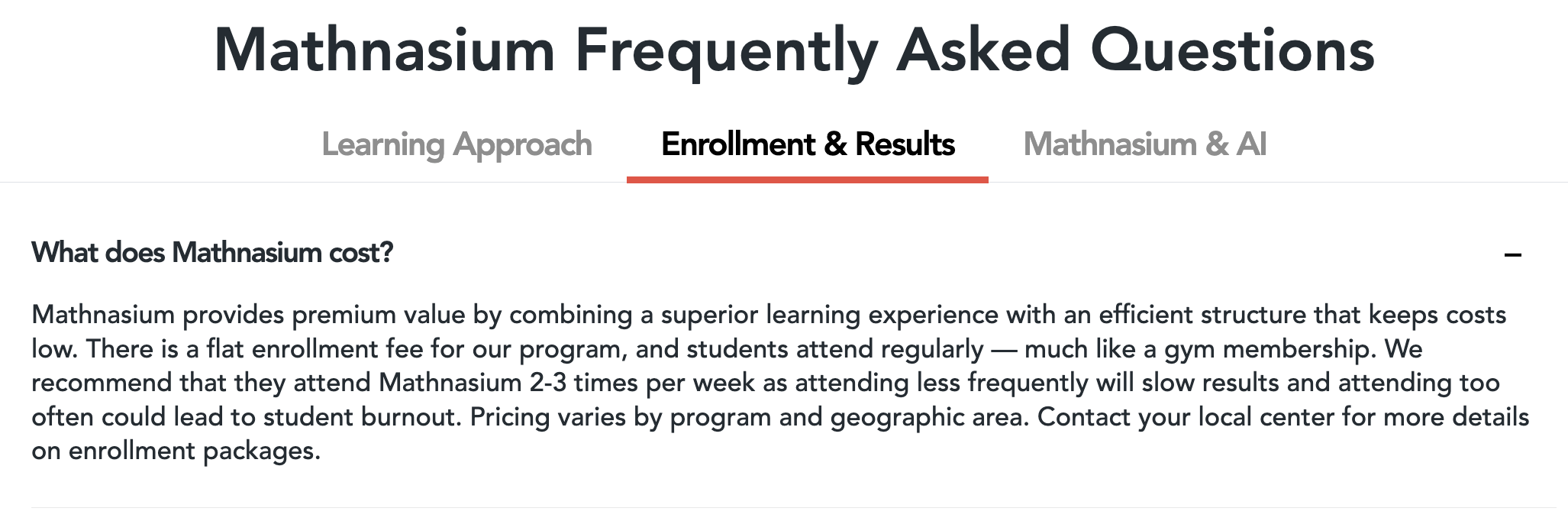
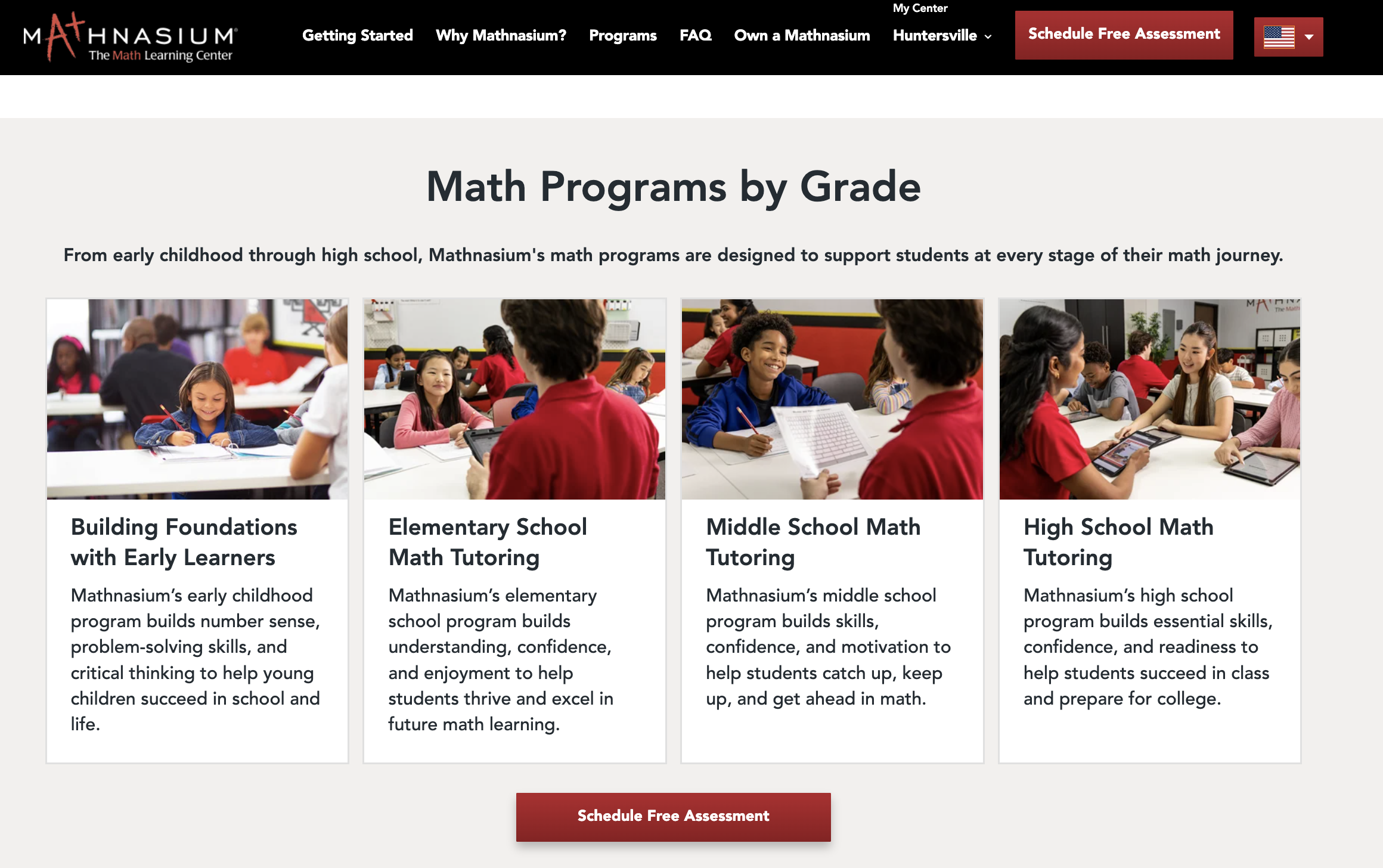
Every Mathnasium enrollment begins with a free in-person assessment (20–30 minutes) where Mathnasium instructors evaluate the child's math level and build a personalised learning plan. The pricing quote comes at the end of this same meeting — making it difficult to comparison shop before you're already in the room.
What Mathnasium’s free assessment gives you: A tutor-recommended plan with a monthly price attached. The assessment is genuinely useful for placement, but for most parents, it functions as the gateway to the sales conversation.
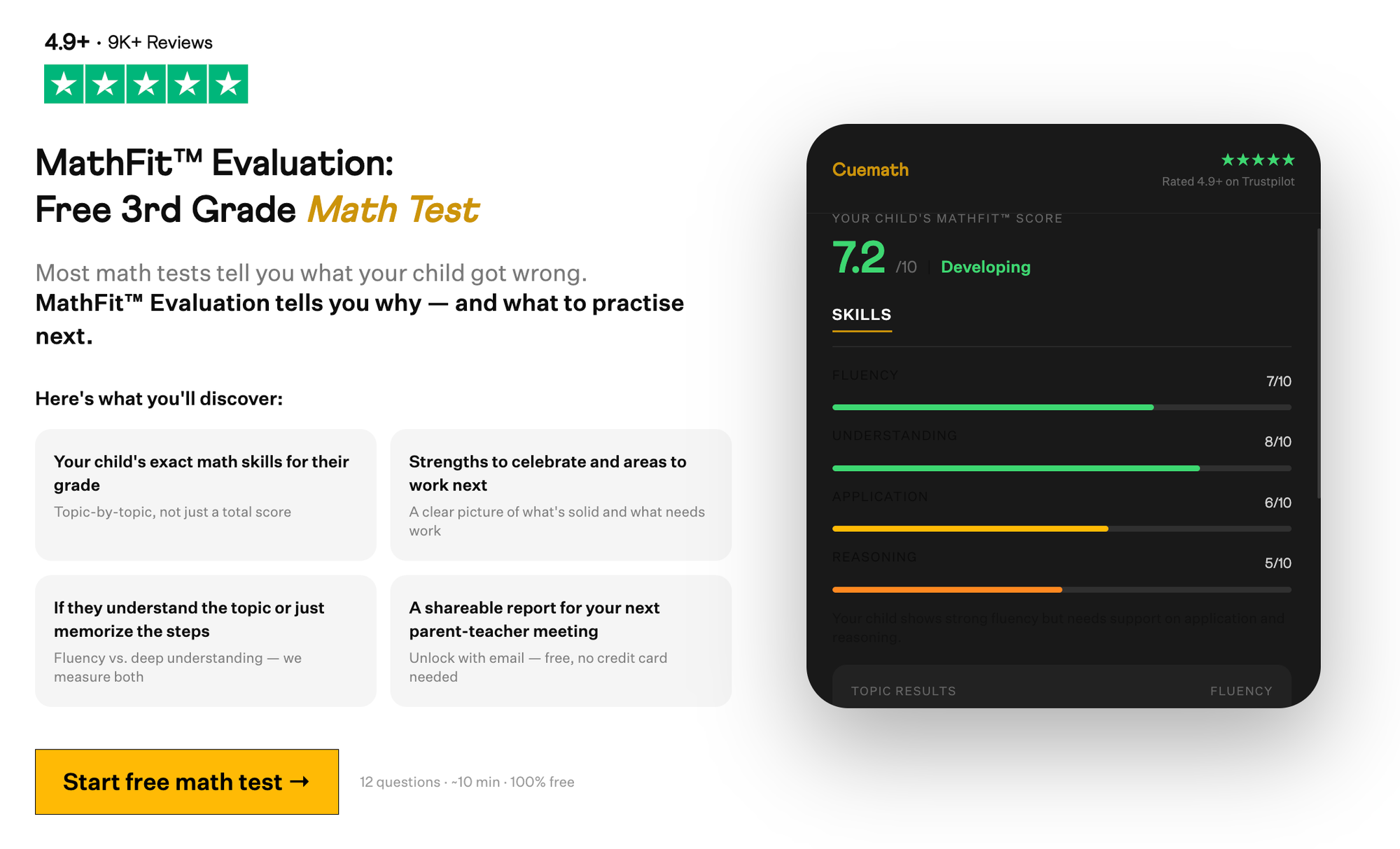
What Cuemath’s MathFit Evaluation gives you: A free online assessment that tests your child's logical reasoning, fluency, application & reasoning skills in math. The results go directly to your child’s assigned tutor, so the free trial class is already calibrated to your child’s actual level. Pricing at Cuemath is not tied to the assessment outcome at all. Take the free Math Test →
Know What You’re Paying Before the Meeting
Cuemath pricing starts at $200/month. One published number. No enrollment fee surprises. Try a free live class with a MathFit Evaluation before you commit to anything.
Book a Free ClassGrades K–12 · Same tutor every class · Published pricing
Why Two Families in the Same City Might Pay Completely Different Prices?
The price a center quotes is not random, but it is rarely explained up front. These are the factors that most consistently drive it higher or lower:
- Location & cost of living. Centers in high-cost metro areas charge more. A Bay Area parent reported $280/month; parents in lower-cost Midwest or Southern markets consistently report $150–$200.
- Session frequency. The standard Mathnasium plan involves 2 sessions per week. Some centers offer 3 sessions per week plans, which raises the monthly total proportionally.
- Grade level: At most Mathnasium centers, high school students receive higher quotes than elementary students, though this varies by location.
- In-person vs. online. Mathnasium@Home is generally priced slightly lower than in-person centers, though not dramatically. At some locations, the difference is minimal.
- Test prep add-ons. Some Mathnasium centers offer SAT or ACT prep as an add-on. These are typically priced separately and added to the base monthly fee.
- Negotiation: Multiple parents on Reddit report successfully negotiating Mathnasium enrollment fees down by $25–$50 by asking directly at the assessment meeting.
Cuemath has one published price for every family, no location variables, no frequency tiers, no add-on fees to surprise you. Starting at $200/month, every Cuemath plan includes:
- True 1:1 live tutoring with the same tutor every class
- SAT and test prep built into the curriculum (no separate fee)
- Math games, puzzles, and logic challenges through the Cuemath app
- Downloadable worksheets designed by Cuemath tutors
- A free MathFit Evaluation before the first paid class
One number. Everything included. Try a free Cuemath class → · See full pricing →
Can Mathnasium Raise Your Prices After You Have Already Enrolled?
Mathnasium's billing practices vary significantly by franchise location. The concerns below appear repeatedly in parent communities. While these issues are purely reported in public platforms, they are worth asking about before you sign.
1. Mid-Contract Price Increases Without Warning
A parent in Tucson, AZ reported on Trustpilot that their Mathnasium rate jumped from $42.50 to $100 per session without warning after requesting a schedule change.
At some Mathnasium centers, the pricing structure appears to reset whenever a plan modification is made, rather than carrying over the original rate. If you enroll, ask explicitly: Does a schedule change trigger a full price re-evaluation?
2. Partial Refund Policies on Cancellation
Mathnasium refund policies are set by the individual franchisee, not corporate. Cancellation mid-month does not guarantee a refund on unused sessions. Multiple parents on Reddit report receiving only partial refunds after cancellation. Always ask your specific center: what is the notice period, and are unused sessions in the current billing period refundable?
3. Online Session Quality Concerns
Mathnasium@Home session quality varies by instructor. Before enrolling online, ask whether sessions are recorded, how late arrivals are handled, and whether makeup sessions are offered if a class ends early.
Questions to Ask Before You Sign Up for Mathnasium
Before enrolling at Mathnasium, ask these questions directly — get written answers where possible:
- Is this a monthly membership or per-session billing?
- Is the price locked in, or can it change if I modify my plan?
- If I request a schedule change, does my rate reset to the current pricing?
- What is the cancellation notice period?
- If I cancel mid-month, do I receive a refund on unused sessions?
- Is the enrollment fee refundable if we decide not to continue after the first month?
- How many sessions per week does this plan include?
- How many students share an instructor during my child’s session?
- How is progress tracked and reported to parents?
- Will my child work with the same instructor each session?
- If my child needs SAT, ACT, or AP-level math, is that covered in this plan or billed separately?
Cuemath answers several of these upfront before you speak to anyone: pricing is published on the website, the same tutor is assigned for every session, and a free MathFit Evaluation is included before the first paid class — no assessment meeting required to get a number.
Is Mathnasium Worth the Cost: Let's Check Parent Reviews
Mathnasium's strongest reviews come from parents of elementary students with specific foundational gaps. One parent on Reddit's r/Parenting wrote: "Fixed the specific gaps my 4th grader had. They didn't just drill everything, they targeted what she actually needed."
Parents on Reddit's r/mathnasium frequently note that Mathnasium's franchise model creates wildly different quality by location — particularly for middle and high school students. Inconsistent instructor continuity is the most common recurring complaint: students report re-explaining their progress to a new instructor at the start of each session.
Parents who need consistent instructor quality and published pricing frequently switch to Cuemath, where every student is paired with the same tutor for every session, regardless of location.
Suggested Reading:
 Nikita Joshi
Best Alternatives to Mathnasium at the Same Price in 2026
If Mathnasium's small-group model or unpublished pricing concerns you, Cuemath is the most direct alternative. Cuemath provides true 1:1 live sessions with the same tutor assigned to your child for every class, publishes pricing upfront, and includes a free MathFit Evaluation before you commit, starting around $200/month for grades 1–8. There is no assessment meeting before you see a number.
| Program | Format | Monthly Cost | Free Trial | Attention Model |
|---|---|---|---|---|
| Mathnasium (in-person) | Center, small group | $150–$425+ | Free assessment only | 1 instructor: 3–6 students |
| Mathnasium@Home | Online, small group | $175–$300 | Free assessment only | Small group |
| Kumon | Center, self-study | $150–$200/subject | None | Self-paced, instructor checks |
| Private tutor | 1:1 in-person or online | $40–$120+/hour | Varies | True 1:1 |
| Cuemath | 1:1 live online | Starting $200/month (grades 1–8) | 1 free class + MathFit Evaluation | True 1:1, same tutor every class |
Still Comparing Options?
Try a free Cuemath class with a MathFit Evaluation. One class. No credit card. See what 1:1 live math tutoring actually looks like for your child.
Book a Free ClassGrades K–12 · Same tutor every class · Published pricing
At comparable mid-tier US rates, Mathnasium and Cuemath overlap in monthly cost. The key difference is format: Mathnasium is a small-group center with a shared instructor; Cuemath is a dedicated live 1:1 session with the same tutor throughout.
Related Reading:
 Nikita Joshi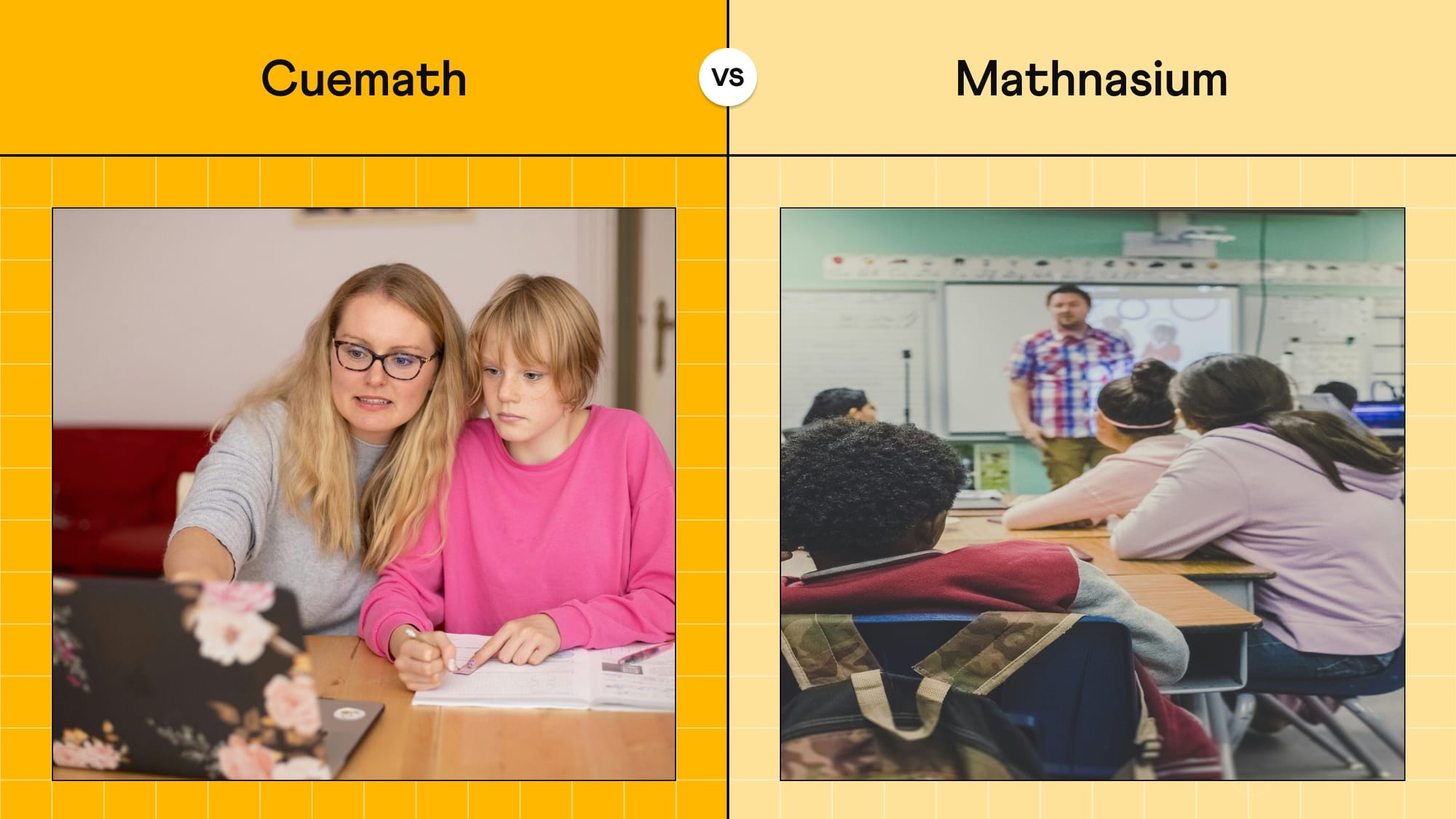
 Nikita Joshi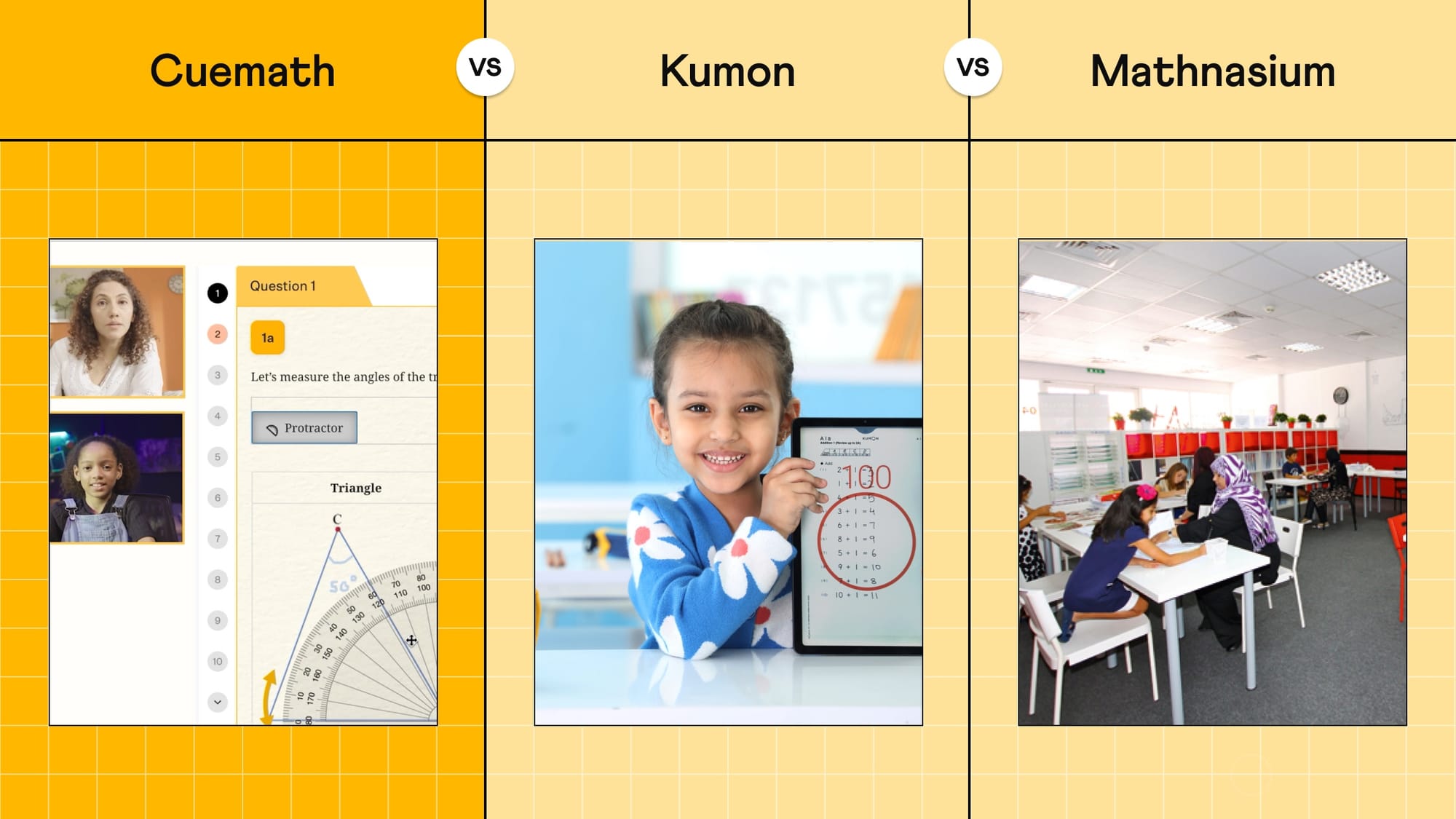
 Nikita Joshi
Frequently Asked Questions [FAQs]
What is the average monthly cost of Mathnasium?
Mathnasium costs $200–$350 per month in the US on average, based on parent reports from Reddit communities and review sites. Mathnasium centres in high-cost regions like the Bay Area or Tucson cost up to $425+/month.
Does Mathnasium have an enrollment fee?
Yes, most Mathnasium centers charge a one-time registration or enrollment fee ranging from $100 to $150.
Why doesn’t Mathnasium list prices on its website?
Because Mathnasium operates as a franchise, each of its 1,000+ centers is independently owned and sets its own pricing. Mathnasium does not publish a national rate because there is no single national rate. Pricing is disclosed at the assessment meeting.
Is Mathnasium cheaper than a private tutor?
Mathnasium typically costs $150–$350/month for 8 sessions (roughly $19–$44 per session), while private tutors charge $40–$120/hour with no enrollment fee and no contract. For families who want flexibility without a monthly commitment, a private tutor can be more cost-effective despite the higher hourly rate.
Is Mathnasium cheaper than Kumon?
At comparable frequencies, Mathnasium and Kumon are similarly priced for math alone, both typically in the $150–$200/month range for budget US markets. However, Kumon charges per subject. A family enrolling in both math and reading at Kumon pays $300–$400/month. Mathnasium is math-only, which can make it the lower-cost option for families focused on math.
How does Mathnasium work?
Mathnasium works through an assessment-first model. Every student starts with a free evaluation that identifies gaps in their math foundation. The center then builds a personalized learning plan called a “prescription.” Students attend 2–3 sessions per week at a center or online, working through their prescription with an instructor in a small-group setting. Sessions are typically 1–1.5 hours.
What is the student-to-instructor ratio at Mathnasium?
Mathnasium is not a 1:1 tutoring service. The typical ratio at a Mathnasium center is 1 instructor to 3–6 students. The instructor circulates between students during the session rather than working exclusively with one child. This ratio can vary by center, session time, and total enrollment.
Does Mathnasium offer a free trial?
Mathnasium does not offer a free trial class. Most Mathnasium centers offer a free assessment diagnostic that evaluates your child's math level — this is not a tutoring session, it is a diagnostic and enrollment conversation.
Can I cancel Mathnasium anytime?
Mathnasium cancellation policies vary by franchisee, since each center is independently owned. Multiple parents on Reddit report receiving only partial refunds on unused sessions after cancellation. Always ask your specific Mathnasium center: what is the notice period, and are unused sessions in the current billing period refunded?
Does Mathnasium help with SAT prep?
Some Mathnasium centers offer SAT/ACT prep as an add-on service, but it is not part of Mathnasium's core curriculum. The Mathnasium Method is primarily designed for K–8 foundational math. Ask your local center about availability and whether test prep is priced separately.
Is Mathnasium worth it for high school students?
For high school students working on content above Algebra II, Mathnasium is generally not the strongest fit. The Mathnasium Method is designed around foundational number sense and is most effective at the elementary and early middle school level. Parent communities have noted curriculum gaps for Precalculus, Trigonometry, and AP-level content. High schoolers needing advanced math support may be better served by a program with an explicit high school curriculum or a dedicated 1:1 tutor.
How does Mathnasium compare to Cuemath in cost?
Mathnasium and Cuemath overlap in monthly cost at US mid-tier rates, both starting around $200/month. The key differences: Mathnasium uses a small-group center model with a circulating instructor; Cuemath provides true 1:1 live sessions with the same tutor every class. Cuemath covers K–12, including advanced high school content; Mathnasium is strongest for K–8. Cuemath publishes its pricing; Mathnasium quotes are center-specific and disclosed only at the assessment meeting. Cuemath includes a free trial class and MathFit Evaluation with no commitment required.
Sources
- Mathnasium official website — mathnasium.com
- r/Kumon — parent pricing reports and program comparisons (2025–2026)
- r/Parenting — community experiences with Mathnasium (2025–2026)
- Trustpilot — Mathnasium parent reviews (2026)
- Cuemath US pricing (verified April 2026)
- International Franchise Association — franchise model explainer

I grew up a science kid. Math was not my best subject. Class moved fast, I was too shy to ask for help, and I somehow ended up more curious about how people learn than about the subjects themselves.
That's what pulled me into education — not to teach, but to understand how colleges and tutoring programs actually work and what students genuinely need from them.
My love for writing did the rest. I had too many observations and nowhere to put them, so I started writing, and haven't stopped. Over the last five years I've written about edtech, student life, and college programs. For the past year, my focus has been math tutoring specifically.
I work at Cuemath now, so factor that in. I research by going where parents actually talk: forums, reviews, and direct conversations with students and families. I'm writing for the kid who's too scared to raise their hand in class. I was that kid.