10 Best Math Tutoring Programs for Elementary Students (2026)

We reviewed 10 popular math tutoring programs for K–5 students, rated on 5 factors that matter most for young students, and broke it down into questions so you can choose the best option.

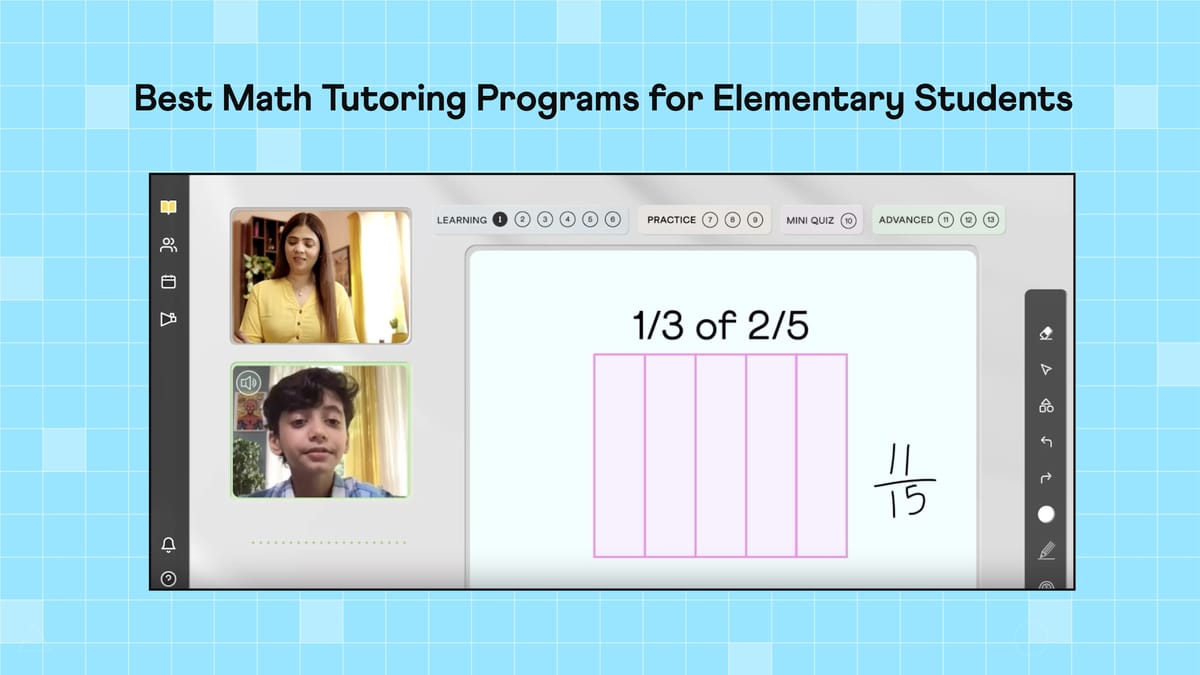
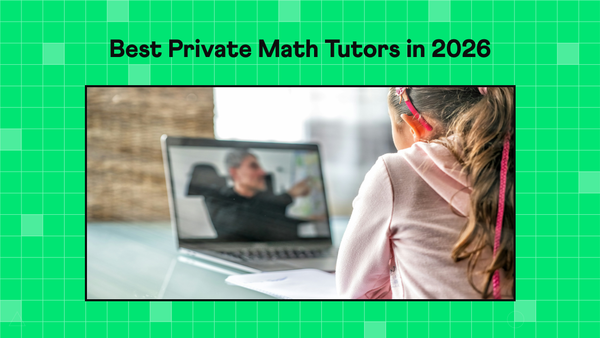
Picture of kid in elementary school taking an online math class (Source: Cuemath)
Kid in elementary school taking an online math class (Source: Cuemath)

Earlier, we did a blog on the best online math tutoring programs overall. But we realised parents need a deep dive focusing on different grade levels. This is valid because for elementary students, the requirements would be different than high schoolers.

So for this blog, we only focus on the 10 best math tutoring programs for elementary students popular among US students. To keep a range of options, we have chosen live 1:1 online tutoring, in-person centers, and self-paced enrichment apps.

How Did We Review These Programs?

Our tutors and business teams always tell us that for the elementary parents' group, these factors are important:

  • Tutor consistency: For K–5 learners, a familiar teacher is foundational.
  • School curriculum alignment: The program should be aligned with the US Common Core standards.
  • Engagement for young learners: Does the program hold a 6–10 year old's attention? Elementary students need instruction that does not feel like more schoolwork.
  • Personalization: Does the program adapt to where your child actually is, not where their grade level says they should be?
  • Cost vs. value: What exactly do you get for what you pay?

Cuemath is one of the programs reviewed here. This review was done by our team using the methodology above.

Quick Answer: Which Program is Best for You?

A note on program types in this list:

  • Live 1:1 tutoring -> Cuemath, Brighterly, Skooli
  • In-person center -> Mathnasium, Sylvan Learning
  • Self-paced app or platform -> IXL, Kumon, Beast Academy, Mathseeds
  • Tutor marketplace -> Wyzant
What you needBest program
A live tutor who stays with my child long-term, knows their gaps, and grows with themCuemath
Structured online 1:1 tutoring to try first with a free lesson, low commitmentBrighterly
On-demand help from a certified teacher, no scheduling requiredSkooli
A physical learning center near me where my child works through specific gapsMathnasium
A nationally recognized in-person tutoring center that covers math and moreSylvan Learning
A tool to find out exactly which math skills my child is missingIXL
I want to find and hire a private math tutor on my own, pay by the hourWyzant
Daily structured drilling to build arithmetic speed and fluencyKumon
My child loves math and needs challenge: puzzles, brain teasers, going beyond grade levelBeast Academy
A gentle, game-based app to introduce K–2 students to early math conceptsMathseeds

The 10 Best Math Tutoring Programs for Elementary Students

We have structured each review below around five questions parents ask most about K–5 programs.

ProgramGradesFormatLive 1:1 TutorCCSS-AlignedFree TrialStarting Cost
CuemathK–5Live 1:1 onlineYes (same tutor always)Yes (CCSS)1 class + MathFit Eval$25/class (3-month plan)
Brighterly1–5Live 1:1 onlineYesYes (CCSS)Free first lessonCheck website
SkooliK–12Live 1:1 online (on-demand)Yes (certified teachers)School-ledCheck website~$0.83/min (~$50/hr)
MathnasiumK–8In-person (small group)Small group (~1:3–6)School gap-mappedAssessment incl.$250–$450/month
Sylvan LearningK–12In-person + onlineYes (1:1 option)School-alignedAssessment incl.$100–$200+/hour
IXLK–12Self-paced appNoYes (granular)Limited trial~$20/month
WyzantK–12Live 1:1 (marketplace)Tutor-dependentTutor-dependentFirst session guarantee$40–$120+/hour
KumonK–8In-person worksheetsNo (instructor present)Sequential onlyAssessment incl.$150–$200/subject/month
Beast Academy1–5Self-paced onlineNoEnrichment depthFree trial$15.99/month
MathseedsPre-K–2Game-based appNoK–2 CCSSFree trial~$14.99/month

1. Cuemath: Best Live 1:1 Online Math Tutoring for K–5 Students

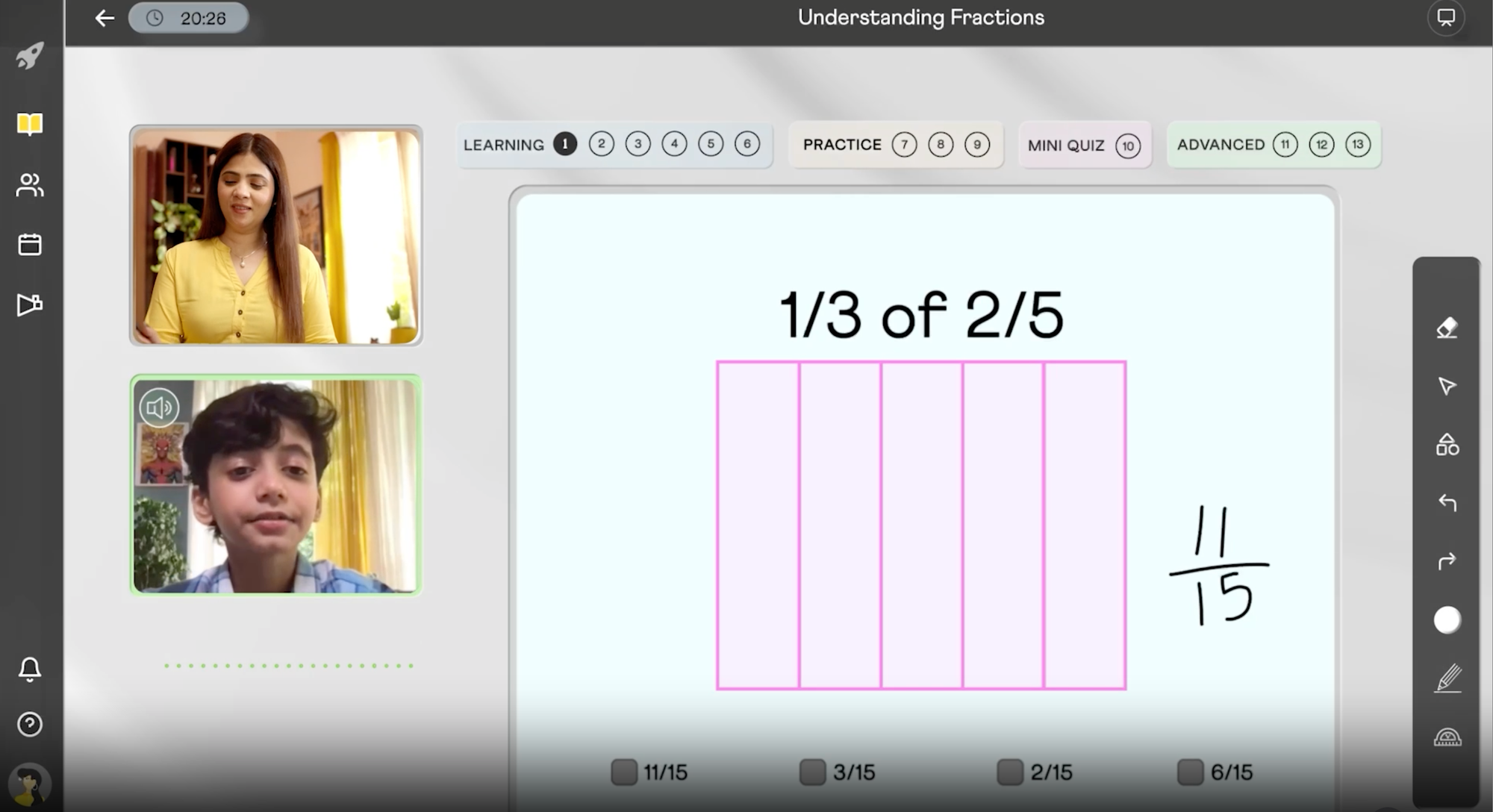
A Cuemath tutor and elementary student working together on fractions using the Cueboard
A live 1:1 Cuemath session in progress — tutor and student solving fractions together on the Cueboard
At a Glance
GradesK–5 (and through Grade 12)
CurriculumUS Common Core (CCSS)
FormatLive 1:1 online
CostStarting at $25/class (3-month plan)
Free Trial1 class + MathFit Evaluation, no credit card required
Commitment3-month minimum
Trustpilot4.9/5 (9,667+ reviews)

Does Cuemath assign the same tutor every class?

Yes, one tutor, one student, from day one (unless you request a change).

  • Tutors are matched by grade level and curriculum: a K–7 student in the US is paired with a tutor who is certified and experienced in teaching elementary math to US curriculum standards.
  • From the first session, the tutor uses the MathFit Evaluation results to build a learning plan for the coming months, covering what to focus on, in what order, and at what pace
  • As the tutor gets to know your child over sessions, they adjust topics, pacing, and approach based on where progress is strong and where more time is needed.

What Cuemath Parents Say About Their Child's Tutor

Source: Trustpilot
A

Anand 🇺🇸 United States

★★★★★

“Ms. Asmita Kukreja helped my child with the transition to US curriculum standards — patient and supportive throughout.”

View on Trustpilot →
A

Anjali Verma 🇺🇸 United States

★★★★★

“My son initially struggled a lot with math. Teacher Kanika's patient, clear explanations transformed him from math-averse to enjoying the subject.”

View on Trustpilot →
S

Susan 🇺🇸 United States

★★★★★

“Well-structured and engaging — Ms. Zaineb's clear explanations and encouragement made all the difference.”

View on Trustpilot →

Is Cuemath's curriculum aligned to the US Common Core Standards?

Yes, Cuemath is explicitly aligned to the US Common Core State Standards (CCSS).

  • Sessions cover the same topics your child is learning in class that week: fractions, place value, multiplication, word problems, geometry
  • Cuemath Tutors are trained in the CCSS K–5 framework, specifically, not a generic math curriculum

How does Cuemath personalize learning for each student?

MathFit Evaluation: Free 3rd Grade Math Test — Cuemath's pre-assessment showing skill scores across fluency, understanding, application, and reasoning
The MathFit Evaluation gives parents a detailed picture of exactly where their child stands before the first paid class

Starts with a free MathFit Evaluation before the first paid class.

  • The MathFit Evaluation is a pre-assessment across fluency, understanding, application, and reasoning. It identifies exactly where your child is strong and where gaps exist before a single class is paid for
  • The tutor builds each session around those results, not a one-size-fits-all syllabus

How does Cuemath keep elementary kids engaged?

  • Interactive whiteboard (Cueboard): tutor and student solve problems together on screen, not passive screen-watching
  • Talk-o-Meter: tracks how much the student is speaking and reasoning aloud — high talk time correlates with stronger retention
  • Every session includes brain teasers, puzzles, and short energizers to reset attention, especially useful for K–3 students with shorter focus windows
  • Sticker rewards for effort, persistence, and good reasoning, not just correct answers
  • Between sessions, students access the Cuemath App for daily math games, puzzles, and logic challenges

Try a Cuemath math game — the same type your child gets access to between sessions:

Learn Real-world Math in Playful Manner

Let your child engage with Cuemath games and learn major concepts. Try a FREE live Cuemath class today.

Book a Free Class

No credit card needed

What does Cuemath cost, and what's included?

K–7: starts at $25/class (discounts available on longer plans)

At $25/class, every Cuemath session includes:

  • 55–60 minute live 1:1 session with your dedicated tutor
  • Free MathFit Evaluation before the first paid class (no credit card required)
  • Interactive Cueboard, whiteboard, visual manipulatives, worksheets, and drawing tools in every session
  • Brain teasers and energizers are built into every class
  • Access to the Cuemath App for daily math games, puzzles, and logic challenges between sessions

One price covers everything above, no add-on fees.

Limitation: Tutor quality is not perfectly uniform across all tutors on the platform. A tutor change can be requested with no friction, but the initial match is not guaranteed to be perfect.

Where Hard Work Turns Into Real Results

Give your child the same structured guidance that helped thousands of students succeed. Try a FREE live Cuemath class today.

Book a Free Class

For Students in Grades K to 12 Worldwide

2. Brighterly: Best Structured Online 1:1 Tutoring to Try With a Free First Lesson

We applied the same parent-first lens to Brighterly — the same five questions, answered directly.

Does Brighterly assign the same tutor every class?

Yes — 1:1 sessions with a consistent assigned tutor.

  • Brighterly is a 1:1 live online tutoring platform built specifically for Grades 1–9
  • Tutors are assigned, not randomly matched each session
  • Tutor consistency policy is less formally documented than Cuemath's looping model, but sessions are consistently 1:1

Is Brighterly's curriculum aligned with what my child learns in school?

Yes — CCSS-aligned, with grade-specific lesson structures.

  • Lessons are built around grade-level math topics from Grade 1 through 9
  • Brighterly was named an EdTech Digest 2025 finalist and covered by Business Insider and Fast Company
  • Week-to-week CCSS topic tracking is less explicitly documented than some platforms

How does Brighterly personalize learning for each student?

Starts with an initial assessment before placing a student in a plan.

  • Assessment identifies gaps before the first full tutoring session
  • Lesson plans are adjusted based on what the assessment reveals
  • The free first lesson also functions as an informal level check

How does Brighterly keep elementary kids engaged?

Visual aids and interactive elements designed for younger learners.

  • Lessons use visual teaching tools suited to ages 6–11
  • Simple booking flow and free first lesson reduce friction: parents can test the experience before paying

What does Brighterly cost, and what's included?

Pricing: check website for current per-class rates (not publicly listed at a fixed rate).

Included in Brighterly sessions:

  • Live 1:1 session with an assigned tutor
  • Initial placement assessment before the first session
  • Post-session notes shared with parents
  • Between-session homework and practice tasks
  • Free first lesson with no commitment

Limitation: Brighterly has 600+ Trustpilot reviews versus Cuemath's 9,667+. The smaller review base limits how thoroughly independent parent experience can be verified at scale.

At a Glance
Grades1–9
CurriculumCCSS-aligned
FormatLive 1:1 online
CostCheck website for current pricing
Free TrialFree first lesson
CommitmentVaries by plan
Trustpilot4.5/5 (600+ reviews)
Know more: Brighterly

3. Skooli: Best for On-Demand Help From a Certified Teacher

Does Skooli assign the same tutor every class?

No — Skooli is an on-demand platform; you choose a tutor each session.

  • Skooli is an online tutoring marketplace staffed exclusively by certified teachers (state or provincial certification required)
  • Students can book a session with a specific tutor they have used before, but there is no assigned tutor relationship built into the platform
  • Best suited for on-demand or occasional help rather than ongoing weekly sessions witha one consistent teacher

Is Skooli's curriculum aligned with what my child learns in school?

Yes — tutors are certified teachers, so school curriculum alignment is built in.

  • Every Skooli tutor holds a teaching certification, trained to teach to the standards your child's school uses (including CCSS)
  • Students typically bring their school homework or a specific topic to the session, and the tutor works from that directly
  • No separate Skooli curriculum; the session follows what the student needs that day

How does Skooli personalize learning for each student?

Session-by-session: the student brings the problem, the tutor addresses it.

  • No onboarding assessment; personalization is driven by what the student brings to each session
  • Tutor reads the student's level and adjusts in real time
  • Works best for a child who has a specific homework problem, a test tomorrow, or a concept they did not understand in class

How does Skooli keep elementary kids engaged?

Live interactive whiteboard with a real certified teacher.

  • Skooli sessions use an interactive online classroom with a whiteboard, drawing tools, and file sharing
  • Session recordings are available, so parents and students can review what was covered
  • The on-demand format means a child can get help within minutes of getting stuck

What does Skooli cost, and what's included?

Pay-per-minute: approximately $0.83/minute (~$50/hour equivalent). Subscription plans also available.

At the per-minute rate, a Skooli session includes:

  • Live 1:1 session with a state-certified teacher
  • Interactive whiteboard and digital classroom tools
  • Session recording sent after the class
  • On-demand availability (no scheduling required for instant sessions)
  • No commitment, no monthly minimum

What is NOT included: no assigned tutor relationship, no curriculum infrastructure or progress tracking platform, no parent dashboard or regular session notes beyond the recording.

Limitation: Skooli is best for reactive help rather than proactive, relationship-based tutoring. Without a consistent tutor, the depth of understanding a single teacher builds over months is not available.

At a Glance
GradesK–12
CurriculumSchool-curriculum-led (tutor follows student's needs)
FormatLive 1:1 online (on-demand or scheduled)
Cost~$0.83/min (~$50/hr); subscription plans available
Free TrialCheck website for current trial offer
CommitmentNone (pay per session)
TrustpilotCheck website for current reviews
Know more: Skooli

4. Mathnasium: Best for Closing a Specific Elementary Math Gap In-Person

Does Mathnasium assign the same tutor every class?

No — shared instructor across 3–6 students.

  • Mathnasium is a small-group in-person model, not 1:1
  • Students work on their individual “prescription” while sharing an instructor with others
  • The same instructor is not guaranteed each visit; center staffing varies

Is Mathnasium's curriculum aligned with what my child learns in school?

Yes — explicitly gap-mapped to school curriculum.

  • Mathnasium identifies which skills are missing and builds a personalized “prescription” targeting those gaps
  • Parents rate this highly for elementary students who are behind in one specific area: fractions in Grade 4, place value in Grade 2
  • Designed to close gaps, not for enrichment or getting ahead

How does Mathnasium personalize learning for each student?

Initial placement assessment, then a custom prescription targeting only missing skills.

  • Every student starts with a placement test that identifies their specific gap pattern
  • The prescription covers only those skills, not a full grade-level curriculum

“Fixed the specific gaps my 4th grader had — didn't just drill everything.”

✓ r/Parenting, 2025

“We switched locations and it was a completely different experience. The first center was excellent; the second felt like babysitting.”

⚠ r/Parenting, 2025

How does Mathnasium keep elementary kids engaged?

In-center social environment; encouragement-focused instructors.

  • Some children focus better in a physical space outside the home
  • Instructors are generally described as patient and encouraging with younger learners
  • The quality of the environment varies significantly by franchise location

What does Mathnasium cost, and what's included?

$250–$450/month (varies significantly by location).

Included in a Mathnasium membership:

  • 2x/week center sessions (or as prescribed)
  • Initial placement assessment
  • Personalized learning prescription
  • Instructor check-ins while you work through the prescription

What is NOT included: true 1:1 attention, digital tools or between-session practice resources, standardized quality across locations (franchise model).

Did You Know?

Cuemath has one published price for every family in the US — no location variables, no franchise inconsistency, no add-on fees. Starting at $25/class (3-month plan), every session includes:

  • True 1:1 live tutoring with the same tutor every class
  • A free MathFit Evaluation before the first paid class
  • Monthly skill assessments with section-wise scores (Grades 3–8)
  • Interactive Cueboard whiteboard and visual manipulatives in every session
  • Brain teasers, puzzles, and MathGym app access between sessions
  • After-session tutor notes sent to parents after every class
  • 100% refund on unused classes

One price. Everything included. Book a free class → · Take the free MathFit Evaluation →

Limitation: Mathnasium is a franchise. Quality varies significantly by location.

At a Glance
GradesK–8
CurriculumSchool curriculum-mapped (gap-filling)
FormatIn-person center (small group, ~1:3–6 ratio)
Cost$250–$450/month (varies by location)
Free TrialPlacement assessment included
CommitmentVaries by center
TrustpilotVaries by franchise location
Know more: Mathnasium

5. Sylvan Learning: Best Nationally Recognized In-Person Tutoring Center for Elementary Students

Does Sylvan Learning assign the same tutor every class?

Yes for 1:1 sessions; small group sessions may vary.

  • Sylvan offers both 1:1 tutoring and small group sessions at its centers
  • For 1:1 sessions, the same tutor is assigned consistently
  • Sylvan has been operating since 1979 and is one of the most widely recognized tutoring brands in the US

Is Sylvan Learning's curriculum aligned with what my child learns in school?

Yes — tutors work directly from school coursework.

  • Sylvan tutors align sessions with what your child is covering in class, including homework support
  • Covers math alongside reading and writing, which parents of K–5 students often need together
  • Sylvan Live (their online option) extends the same curriculum to at-home sessions

How does Sylvan Learning personalize learning for each student?

Skills assessment first, then a custom plan by subject.

  • Sylvan starts with a skills assessment to identify gaps across math (and reading or writing, if applicable)
  • Each plan is built around the child's specific grade-level needs and adjusted as the student progresses

How does Sylvan Learning keep elementary kids engaged?

Structured center environment with progress rewards.

  • Sylvan centers use reward systems and structured pacing to keep students on task
  • Physical center works well for children distracted at home
  • Quality depends on the center and individual tutor; Sylvan is a franchise

What does Sylvan Learning cost, and what's included?

$100–$200+/hour for 1:1 sessions (varies by location and package).

Included in Sylvan:

  • 1:1 tutoring session with an assigned tutor (or small group at a lower rate)
  • Initial skills assessment
  • Custom learning plan
  • Periodic parent consultations and progress reports
  • Option to cover math + reading + writing in one center

What is NOT included: a digital practice platform or app, detailed session-by-session parent notes, and standardized quality across all locations.

Limitation: Sylvan is premium-priced, and center quality varies by franchise location.

At a Glance
GradesK–12
CurriculumSchool-aligned (math + reading + writing)
FormatIn-person center + Sylvan Live (online option)
Cost$100–$200+/hour (varies by location and plan)
Free TrialInitial skills assessment included
CommitmentVaries by package
TrustpilotVaries by franchise location
Know more: Sylvan Learning

6. IXL: Best for Pinpointing Exactly Which Elementary Math Skills Are Missing

Does IXL include a live tutor?

No — fully automated platform, no human tutor.

  • IXL is a self-paced adaptive practice tool, not a tutoring program
  • There is no live session, no tutor to explain a concept, and no human response when a child is stuck
  • This is important to state clearly before the rest of the review

Is IXL's curriculum aligned with what my child learns in school?

Yes — the most granular CCSS skill mapping of any platform on this list.

  • IXL maps to individual CCSS standards at the skill level
  • Teachers use IXL to assign specific skills aligned with what they are teaching that week
  • Parents can see exactly which standard their child is working on and how they perform against grade-level benchmarks

How does IXL personalize learning for each student?

Adapts difficulty within each skill; does not personalize instruction.

  • IXL adjusts problem difficulty automatically based on the student's accuracy
  • It tells the student right or wrong; it does not explain why
  • Parents set the grade level and topic; IXL adjusts the problem set from there

How does IXL keep elementary kids engaged?

Mixed results, especially for younger or anxious learners.

  • IXL uses badges, points, and awards for skill mastery
  • The SmartScore system drops sharply with each wrong answer, which can demotivate younger learners
  • Works better for confident, goal-oriented Grades 4–5 students than for K–2 learners

“IXL's parent dashboard is the most specific progress report I've seen at any price. It showed me exactly which fraction skill my daughter was struggling with, not just 'fractions' in general.”

✓ r/homeschool, 2025

“My 3rd grader cried when her score dropped after one wrong answer. The scoring system punishes mistakes brutally.”

⚠ r/Parenting, 2025

What does IXL cost, and what's included?

~$20/month (family plan, all subjects).

At $20/month, IXL includes:

  • Unlimited adaptive practice across every K–12 math skill (and other subjects on the family plan)
  • Detailed skill-level mastery reports by CCSS standard
  • Grade-level benchmark comparisons
  • Time-on-task reporting and parent dashboard

What is NOT included: any live tutoring or human instruction, explanation of errors beyond “try again,” session notes, tutor relationship, or parent consultations.

Limitation: IXL tells you if you're wrong but never explains why. Use it as a diagnostic layer alongside a live tutoring program, not as a standalone solution.

At a Glance
GradesK–12
CurriculumCCSS-aligned (granular, skill-level mapping)
FormatSelf-paced adaptive app
Cost~$20/month (family plan)
Free TrialLimited trial (check website)
CommitmentMonth-to-month
TrustpilotNot rated as a tutoring platform
Know more: IXL

7. Wyzant: Best for Parents Who Want to Hire a Private Elementary Math Tutor Directly

Does Wyzant assign the same tutor every class?

Yes, once you hire one, but you are responsible for finding the right tutor.

  • Wyzant is a marketplace: you search profiles, read reviews, and hire directly
  • Once you book a tutor, you work with that person consistently
  • No program-level matching, curriculum structure, or vetting for child-fit

Is Wyzant's curriculum aligned with what my child learns in school?

Yes, if you hire the right tutor and tell them what to cover.

  • A tutor you hire can work directly from your child's school syllabus and homework
  • Alignment depends entirely on what you ask the tutor to do and whether they follow through

How does Wyzant personalize learning for each student?

Fully tutor-dependent — no platform diagnostic or assessment.

  • No onboarding assessment, no prescribed learning plan, no curriculum infrastructure
  • You explain your child's needs; the tutor decides how to approach them
  • Quality of personalization ranges from excellent (with the right tutor) to very inconsistent

How does Wyzant keep elementary kids engaged?

Depends entirely on the tutor you hire.

  • Some tutors specialize in young learners and bring games and creative approaches
  • Others are subject-matter experts without child psychology training
  • Reading individual tutor profiles and reviews carefully is essential

What does Wyzant cost, and what's included?

$40–$120+/hour (tutor-dependent). First session money-back guarantee.

At the per-hour rate, a Wyzant session includes:

  • Live 1:1 session with the tutor you selected
  • First-session satisfaction guarantee (refund if not satisfied)
  • Session notes (if your tutor provides them; not platform-mandated)

What is NOT included: any curriculum, assessment, or structured program; platform-level progress tracking; quality assurance or tutor vetting beyond reviews on profile.

Limitation: Trustpilot 1.8/5. At $40–$120+/hour, finding a good tutor by trial and error is expensive.

Best for: Parents who want to hire a specific type of private tutor and are comfortable doing the vetting themselves.

Not for: Parents who want a structured program, quality assurance, or any platform-level tracking of their child's progress.

“Once I found the right tutor on Wyzant, it was exactly what we needed. The pay-by-hour model made it easy to start without a big upfront commitment.”

✓ r/Parenting, 2025

“Finding a good tutor took us four tries. The platform makes it hard to evaluate fit before you pay.”

⚠ r/Parenting, 2025

At a Glance
GradesK–12
CurriculumTutor-dependent
FormatLive 1:1 online or in-person
Cost$40–$120+/hour
Free TrialFirst-session money-back guarantee
CommitmentNo ongoing commitment; pay per session
Trustpilot1.8/5
Know more: Wyzant

8. Kumon: Best for Building Elementary Arithmetic Fluency Through Structured Daily Practice

Does Kumon include a live tutor?

No, instructors distribute worksheets but do not teach.

  • Students receive a set of worksheets, complete them independently, and submit them for grading
  • An instructor is present but manages 10+ students at a time, not teaching
  • No live explanation, no one-on-one guidance, no real-time feedback when a child is stuck

Is Kumon's curriculum aligned with what my child learns in school?

Partially — builds number skills sequentially, not week-to-week, school-aligned.

  • Kumon progresses students through arithmetic and fractions in its own sequential order
  • A student on the Kumon progression may be ahead of or behind what their class is currently covering
  • Parents typically use Kumon as a fluency supplement alongside school, not as a direct school-support tool

How does Kumon personalize learning for each student?

Self-paced advancement based on time and accuracy benchmarks.

  • The initial placement test determines the starting level
  • Students repeat each worksheet set until they hit Kumon's time and accuracy standard before advancing
  • The method is fixed: same worksheet format, same advancement criteria for every child

How does Kumon keep elementary kids engaged?

High dropout rate from repetition; works for disciplined learners with parental support.

  • The Indian-American parent community reports higher tolerance for and satisfaction with Kumon's structure
  • Native US parents report higher dropout rates, particularly in Grades 2–4
  • Requires two weekly center visits plus daily home worksheets — a significant time commitment

What does Kumon cost, and what's included?

$150–$200/subject/month + registration fees (typically $50–$75 at enrollment).

Included in a Kumon membership:

  • 2x/week center visits
  • Worksheet packets to take home for daily practice
  • Instructor review of completed worksheets and level advancement tracking
  • Sequential progression through Kumon's full arithmetic program

What is NOT included: any interactive digital tools or apps, live instruction or concept explanation, progress reports with diagnostic breakdowns. Reading is a separate enrollment fee.

Limitation: Students who do not understand a concept are expected to figure it out through repetition. This can deepen confusion rather than resolve it.

Best for: Elementary students with high self-motivation and active parental support at home, who need to build arithmetic speed and calculation fluency.

Not for: Students who need a teacher to explain the “why,” who are anxious about math, or who shut down with repetitive worksheet formats.

“After 18 months of Kumon, my son does multi-digit multiplication in his head. The repetition works — if your child has the patience and you stay consistent.”

✓ r/Parenting, 2025

“Kumon doesn't teach. If your kid doesn't get it, they just repeat the same worksheet until something clicks — or they quit.”

⚠ r/Parenting, 2025

At a Glance
GradesK–8
CurriculumSequential number skills (not CCSS week-aligned)
FormatIn-person worksheets (online version available)
Cost$150–$200/subject/month + registration fees
Free TrialPlacement assessment included
CommitmentMonthly (center contract varies)
TrustpilotVaries by franchise location
Know more: Kumon

9. Beast Academy: Best for Curious or Advanced Elementary Students Who Love Math Challenges

Does Beast Academy include a live tutor?

No — fully self-paced, no human tutor.

  • Beast Academy is an online platform and comic book series from Art of Problem Solving (AoPS)
  • Students work through content at their own pace with no live teacher
  • Designed as enrichment and challenge material, not tutoring or remediation

Is Beast Academy's curriculum aligned with what my child learns in school?

It supplements and goes deeper — not a week-to-week school alignment tool.

  • Covers Grades 1–5 content in a way that goes beyond what school typically covers at each grade
  • Builds mathematical reasoning, logic, and problem-solving skills that complement school curriculum
  • Not the right tool if your child is behind in school math; right if your child is ahead or needs challenge

How does Beast Academy personalize learning for each student?

Self-paced; students choose their own path through levels.

  • Students move through levels at their own speed with no forced pace
  • The platform tracks mastery within each level and adjusts what is available next
  • No diagnostic assessment; the child and parent drive the path

How does Beast Academy keep elementary kids engaged?

Highest engagement ratings among elementary math programs in parent communities.

  • Comics format: concepts are taught through illustrated comic book characters working through problems
  • Puzzles, logic games, and non-routine problems are the core content, not standard drill

What does Beast Academy cost, and what's included?

$15.99/month (online platform). Physical books are a separate optional purchase at $15–$20 each.

At $15.99/month, the online platform includes:

  • Full access to all Beast Academy online content for Grades 1–5
  • Comic-style lessons across all topics at each grade level
  • Hundreds of puzzle-based problems, logic games, and challenge exercises
  • Self-paced level tracking and mastery indicators

Physical books (optional): Guide books (comic narrative) + Practice books (problems), ~$15–$20 per book.

Limitation: Beast Academy is not for students who are struggling or anxious about math. The challenge-first format is a barrier for learners who need foundational support first.

Best for: Curious, motivated, or advanced elementary students (especially Grades 2–5) who find school math too easy and need challenge, puzzles, and deeper reasoning.

Not for: Students who are behind, anxious about math, or need school-aligned instruction.

“My 7-year-old asks to do Beast Academy. That's never happened with any math program.”

✓ r/homeschool, 2025

At a Glance
Grades1–5 (online platform)
CurriculumEnrichment and problem-solving (deeper than grade level)
FormatSelf-paced online + optional comic books
Cost$15.99/month (online); books $15–$20 each
Free TrialFree trial period available
CommitmentMonth-to-month
TrustpilotStrong parent reviews on Reddit and homeschool forums
Know more: Beast Academy

10. Mathseeds: Best Gentle Introduction to Math for K–2 Students

Does Mathseeds include a live tutor?

No — fully game-based and self-paced, no live teacher.

  • Mathseeds is an animated online learning app designed for ages 3–9 (Pre-K through Grade 2)
  • Lessons are delivered through animated characters, stories, and mini-games
  • No live session, no human tutor, no real-time interaction

Is Mathseeds' curriculum aligned with what my child learns in school?

Yes — CCSS-aligned for early elementary math (K–2 focus).

  • Covers counting, number sense, early addition and subtraction, shapes, and measurement
  • Reinforces the exact topics K–2 students encounter in school
  • Content is appropriate through approximately Grade 2; does not extend meaningfully into Grades 3–5

How does Mathseeds personalize learning for each student?

Adapts pace based on the child's progress through structured lesson paths.

  • Students move through lesson paths at their own pace
  • The platform adapts what the next lesson is based on completion progress
  • No diagnostic assessment; follows the child's completion rate

How does Mathseeds keep elementary kids engaged?

Specifically designed to feel like play for very young learners.

  • Animated characters, colorful rewards, mini-games, and in-app celebrations for K–2 children
  • Deliberately low-pressure and playful; a good first introduction to structured math practice
  • Less effective for children above Grade 2 who outgrow the animated format

What does Mathseeds cost, and what's included?

~$14.99/month. Often bundled with Reading Eggs for extra value.

At $14.99/month, Mathseeds includes:

  • All animated lessons for Pre-K through Grade 2 math
  • Mini-games and reward activities throughout
  • Parent dashboard with lesson completion tracking
  • Progress reports showing which lessons are complete
  • Often bundled with Reading Eggs (reading program) at one combined subscription price

What is NOT included: any live tutor or human feedback, skill-level diagnostic breakdowns, or content beyond Grade 2 depth.

Limitation: Mathseeds does not extend into upper elementary. Its value is as a gentle first step, not a long-term tutoring solution.

At a Glance
GradesPre-K through Grade 2 (ages 3–9)
CurriculumCCSS-aligned early math
FormatGame-based online app
Cost~$14.99/month (or bundled with Reading Eggs)
Free TrialFree trial available
CommitmentMonth-to-month
TrustpilotNot widely rated independently
Know more: Mathseeds

Which program is best for early elementary students (Grades K–2, Ages 5–7)?

Cuemath for live instruction and tutor continuity. Mathseeds as a gentle play-based supplement for ages 5–7.

Book a Free Cuemath Class for K–2Try Mathseeds

Which program is best for upper elementary students (Grades 3–5, Ages 8–11)?

Cuemath for 1:1 instruction with monthly assessment. Beast Academy if your child is ahead and need enrichment. IXL is a diagnostic companion to either.

Book a Free Cuemath Class for Grades 3–5Try Beast AcademyTry IXL

Frequently Asked Questions (FAQs)

What is the best math tutoring program for elementary students?

The best math tutoring program for elementary students depends on what your child needs. For live 1:1 instruction with a consistent tutor and US Common Core alignment, Cuemath is the strongest overall pick for K–5 students. For a curious or advanced learner who needs challenge beyond school, Beast Academy is the strongest enrichment option. For very young learners (Pre-K through Grade 2) who need a gentle first introduction, Mathseeds is well-designed for that age group.

How much does math tutoring for elementary students cost?

Math tutoring for elementary students ranges widely by format. Game-based apps like Mathseeds and Beast Academy cost $14–$16/month. Diagnostic platforms like IXL cost around $20/month. In-person programs like Kumon cost $150–$200/subject/month; Mathnasium runs $250–$450/month. Live 1:1 online tutoring through Cuemath starts at $25/class (3-month plan). On-demand sessions through Skooli run approximately $50/hour. In-person 1:1 tutoring through Sylvan or Wyzant runs $100–$200+/hour.

What should I look for in a math tutor for my elementary child?

For elementary students, the most important factor is tutor consistency: a child who works with the same tutor every class builds the trust and familiarity needed for real learning to happen. Beyond that, look for CCSS curriculum alignment to your child's actual school, an explanation-first approach rather than just right/wrong feedback, and progress reporting after each session so you know what happened in class.

At what age should a child start math tutoring?

Math tutoring is beneficial from Grade 1 (age 6) onward when a child shows signs of difficulty with foundational concepts like number sense, counting, or early addition. Many programs, including Cuemath, serve students from Kindergarten. For very young children (ages 3–5), a play-based app like Mathseeds is often more appropriate than live tutoring. The right time to start is when a gap appears, not after it compounds through multiple grade levels.

Is online math tutoring effective for elementary students?

Yes. Online math tutoring for elementary students is effective when it includes live 1:1 sessions with a real tutor, interactive tools like a digital whiteboard and visual manipulatives, and consistent tutor assignment over time. Programs that are purely video-based or worksheet-driven are less effective for younger learners, who need a human teacher to explain, adjust, and encourage them in real time.

How do I know if my child needs a math tutor?

Signs your elementary child may benefit from a math tutor include: consistently bringing home homework they cannot start independently, expressing that they hate or are afraid of math, scoring below grade level on school assessments, or showing a sharp drop in grades after a topic change (often fractions or multiplication in Grades 3–4). A free MathFit Evaluation from Cuemath can give you a detailed picture of exactly where your child stands across fluency, understanding, application, and reasoning.

How often should elementary students have math tutoring?

Most programs, including Cuemath, recommend 2 sessions per week for elementary students. This frequency builds momentum without creating tutoring fatigue. One session per week can work for a motivated learner who needs light support; twice a week is more effective for students who are behind or working to get significantly ahead.

What is the difference between live tutoring and a math app?

Live tutoring means a real person works 1:1 with your child in real time, sees when they are confused, and adjusts the explanation immediately. A math app delivers pre-set content with no human present. For elementary students who need instruction, not just practice, a live tutor is significantly more effective. Apps like IXL, Beast Academy, and Mathseeds are strong for specific purposes (diagnostics, enrichment, early exposure) but do not replace live instruction for a child who is struggling.

What is Skooli and is it good for elementary students?

Skooli is an online tutoring platform that connects students with state-certified teachers for live 1:1 sessions. It operates on a pay-per-minute model (~$0.83/minute), making it flexible for on-demand help without a monthly commitment. For elementary students, Skooli works best for occasional, reactive support: homework help, test prep the night before, or clarifying a specific concept. It is not designed for the kind of consistent, relationship-based tutoring that builds long-term math confidence in young learners.

Is Beast Academy good for elementary students?

Beast Academy is excellent for elementary students who are ahead of grade level or who love math puzzles and challenges. It uses a comic book format to teach mathematical reasoning and problem-solving at a depth that school curriculum typically does not cover. It is not the right choice for students who are behind or anxious about math; the challenge-first format can be frustrating for learners who need foundational support first.

Is IXL good for elementary students?

IXL is a strong diagnostic and practice tool for tracking which CCSS skills an elementary student has mastered and which need work. Its detailed reporting is unmatched at its price point. However, IXL does not teach: it provides no explanation when a student makes an error. The SmartScore error-penalty system can also be demotivating for younger learners. Use it alongside live tutoring, not as a standalone program.

How does Cuemath work for elementary students?

Cuemath provides live 1:1 online math sessions for K–5 students, 55–60 minutes each, with a dedicated tutor assigned from the start. Every student begins with a free MathFit Evaluation to identify gaps across fluency, understanding, application, and reasoning. Tutors use the “cue, don't tell” method: asking questions that help the child discover answers themselves. Starting at $25/class on the 3-month plan, the price includes the MathFit Evaluation, monthly assessments, interactive session tools, access to the MathGym app, and after-session tutor notes — with no add-on fees.

Sources

About the Author
Nikita Joshi | Content @ Cuemath
Nikita has spent the last year researching online math programs in the US market as part of Cuemath's content team. Before joining Cuemath, she managed education content at Collegedunia, where she wrote and edited Indian and US academic programs and colleges for K–12 students.