Best Private Math Tutors in 2026 (Certified & Background Verified)
How to choose a private math tutor in 2026: what good teaching looks like in a trial session, what “certified” and “background-verified” really mean, how to check a tutor, and what it costs.

The best private math tutor does three things well. They find out why your child got a problem wrong and teach the missing idea. Their identity and qualifications have been checked, not just shown as a badge on a profile. And the price covers what your child actually gets.
This guide shows you how to confirm each of the three, and what private math tutoring costs in 2026.
- What does a good private math tutor actually do?
- What do certified and background-verified really mean?
- How do I check a math tutor’s background?
- How does Cuemath select and check its tutors?
- How do I find a private math tutor near me?
- How much does a private math tutor cost in 2026?
- Cuemath’s US prices by grade
- What should your child do between tutoring sessions?
- What does the Cuemath app add to private tutoring?
- Your private math tutor checklist
- Frequently asked questions
- Sources
Choose a tutor who teaches for understanding, not just answers. In a trial session, they should ask your child to explain their thinking, find the real gap, and have your child solve a similar problem alone. Then confirm their credentials and background, compare the full cost, and make sure they’ll update you on progress.
See the difference in one session
Book a free Cuemath evaluation. A specialist looks at how your child works through grade-level math, and you leave with a report and a plan you can keep, whatever you decide.
Book a Free EvaluationFree for grades K–12. No credit card needed.
What does a good private math tutor actually do?
A good math tutor doesn’t just fix today’s wrong answer. They ask your child to explain their thinking, find the misunderstanding behind the mistake, teach that missing idea, and then give a similar problem your child solves alone. The goal is a child who needs the tutor less over time, not more.
Here is the same problem with two tutors. A fifth grader works on 2/3 + 1/4 and writes 3/7.
Same problem, same hour. Only the second child leaves able to do it alone. Tutor A isn’t a bad person; many tutors work this way when they’re rushed. But Tutor B’s session is the one that lasts.
How to spot Tutor B in a trial session:
What do certified and background-verified really mean?
In tutoring, neither word has one legal meaning. “Certified” can mean a state teaching license or just a company’s own training. “Background-verified” can mean an ID check, a single-county record search, or a full criminal history check. Always ask which one it is, who did it, and when.
Credentials and checks are important because they tell you a tutor knows the math and has been screened. They don’t tell you whether the tutor teaches like Tutor A or Tutor B, so you need both. No single credential is required for private tutors in the U.S.; education requirements may vary.
If you hire an independent tutor, you usually check identity, qualifications, experience, and references yourself. Tutoring services often run their own screening, and what it covers differs from service to service, so ask. Cuemath, for example, describes its tutors as certified, background-verified, and trained in child-centric teaching. Here is what Cuemath publishes about its process.
A clean check and a good credential are the start. Picture Tutor A and Tutor B with the same degree and the same background check: only one of them helps your child add fractions next week.
How do I check a math tutor’s background? A step-by-step guide
Start with free checks: confirm their ID, look up any teaching license, and call references. For a full criminal report, use a background-screening company, which needs the tutor’s written consent. If you use a tutoring service, ask exactly what its check covers.
How does Cuemath select and check its tutors?
Cuemath is an online math tutoring provider for K–12 students in the US. Its classes are live and one-on-one, and Cuemath reports a 4.9 out of 5 rating from more than 12,000 reviews on Trustpilot. Here is what Cuemath publishes about how it picks and checks the tutors who teach those classes.
Here’s what two Cuemath parents say about their child’s tutor, in their own words:
Ask us the same hard questions
Ask Cuemath how we select tutors, how sessions run, and how you can watch. A free evaluation is a no-pressure way to get answers and see a session where the tutor teaches the idea, not just the answer.
Book a Free EvaluationFree for grades K–12. No credit card needed.
How do I find a private math tutor near me?
When you look for a private math tutor, check how much you can see of what your child learns and whether sessions follow a predictable schedule. A live online tutor can offer both, depending on the service: set session times of about an hour, a regular tutor, and ways to reschedule. Ask each service what it actually provides.
Most parents want to answer two questions: what is my child learning, and is this hour well spent? A structured online tutoring arrangement can make both easier to answer, because sessions happen live, at set times, with a tutor who teaches one topic from start to finish.
Example: A family has soccer practice on Tuesdays, so they book Monday and Thursday at 5 p.m. When a tournament lands on a Thursday, they move that class to another day instead of cancelling it, if the service allows rescheduling.
Online tutoring is not right for every child. It may not suit a child who struggles to focus on a screen, and not every service offers fixed schedules or rescheduling. Compare services on those points, and see how Cuemath’s online math tutors work with families across the US.
How much does a private math tutor cost in 2026, and how does Cuemath compare?
Most U.S. private math tutors charge about $25 to $80 an hour, based on rates tutoring sites publish. Some marketplaces add a service fee on top. Cuemath’s one-on-one online classes cost $15 to $28.50 per class, depending on grade and plan length.
Cuemath’s US prices by grade
Source: Cuemath pricing page, October 21, 2026. Confirm current rates before you budget.
What should your child do between tutoring sessions?
Short, regular practice between sessions helps new skills stick. Aim for a few minutes most days on the skill the tutor is working on, plus a quick check you can see as a parent. Long cramming sessions before a test do far less than steady daily practice.
Two or three sessions a week still leaves four or five days without a tutor. What happens on those days decides how much sticks. Ask any tutor what your child should practice, and how you’ll see it.
Cuemath builds this into the plan. The Cuemath app is free to download, whether or not you’re enrolled. Its Math Gym is a daily 15-minute workout of math games, puzzles, and logic challenges. For parents, the same app shows progress, performance reports, and tutor messages, and lets you reschedule classes. Enrolled students also get practice worksheets and smart tests set by their tutor.
What does the Cuemath app add to private tutoring?
The Cuemath app puts a child’s school math, test prep, and enrichment in one place. It is built around what Cuemath calls MathFit: fluency, understanding, application, and reasoning. Tutoring sessions build the idea. The app gives your child lessons at a chosen difficulty and regular practice on the same skills.
MathFit is Cuemath’s name for four levels of mathematical thinking: Fluency, Understanding, Application, and Reasoning. Cuemath’s own example is a puzzle: find three odd numbers that add up to 30. You can’t, and explaining why (odd plus odd is even, and even plus odd is odd) is reasoning, not calculating. Tutor B’s questions in the fraction example are the same kind of thinking.
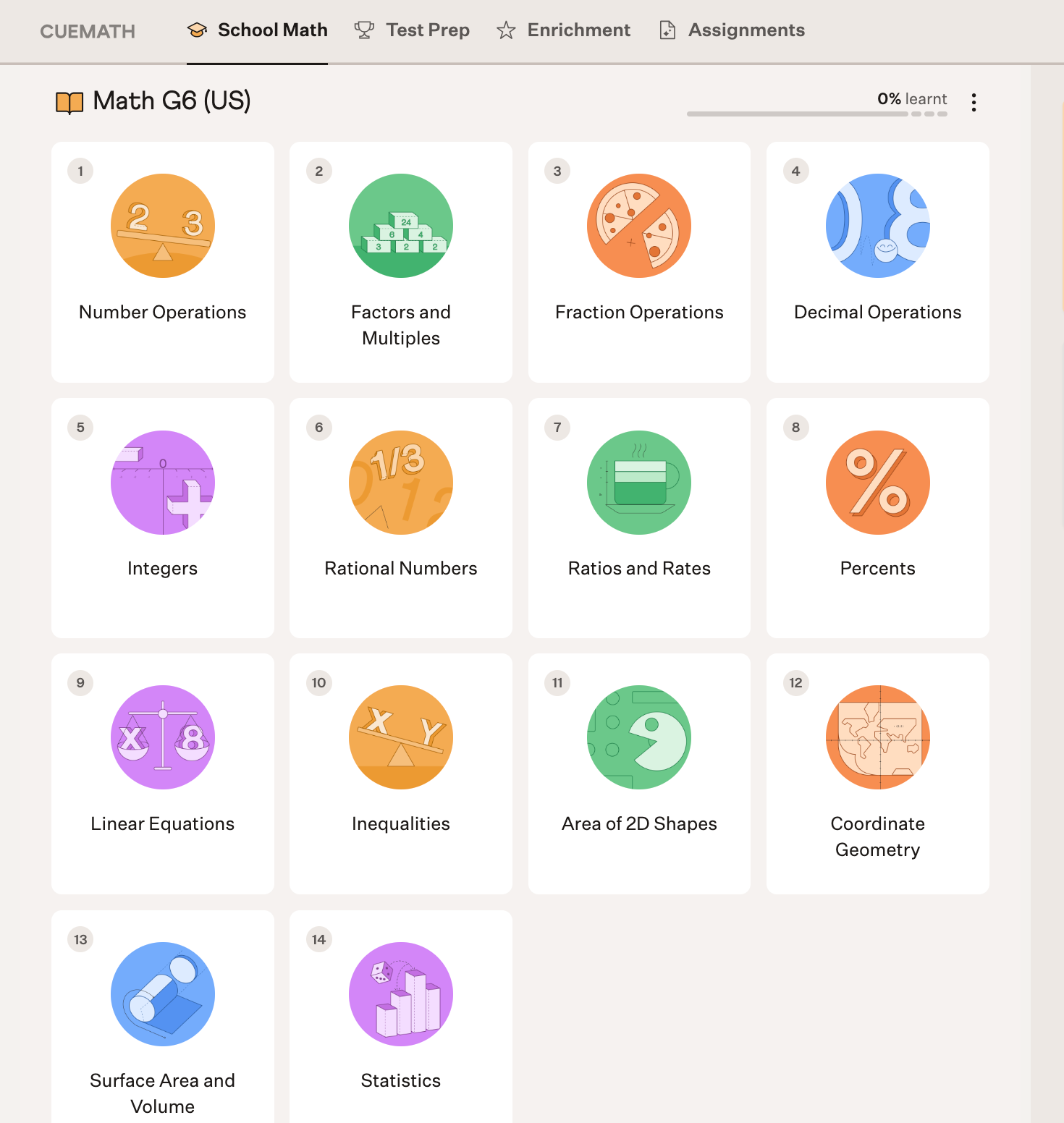
School Math: lessons at the right level
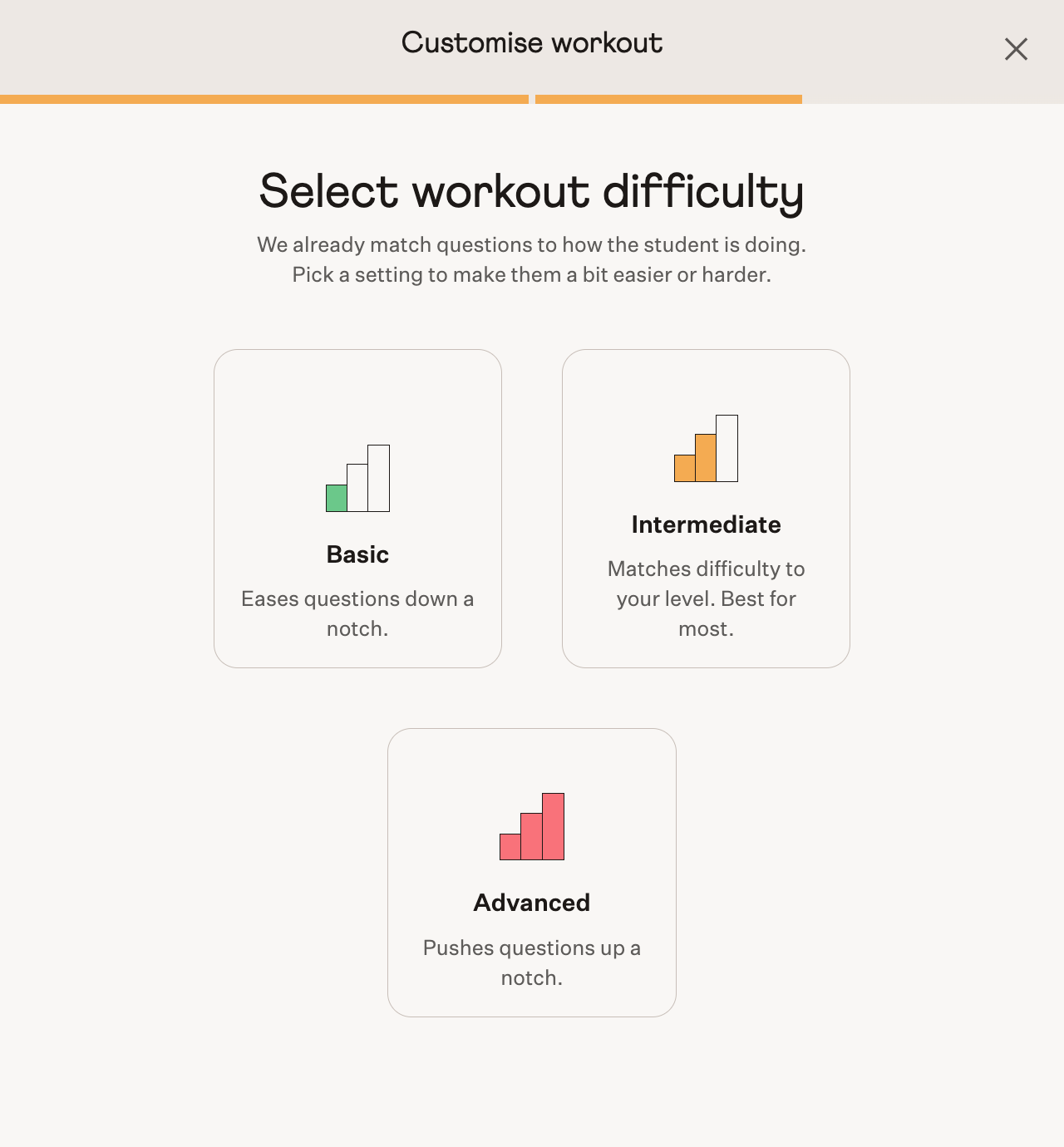
Concepts are explained visually. Your child can set the difficulty of any lesson to Basic, Intermediate, or Advanced, and gets custom daily workouts aimed at mastery.
Problem it addresses: a child who finds the class lesson too hard or too easy.
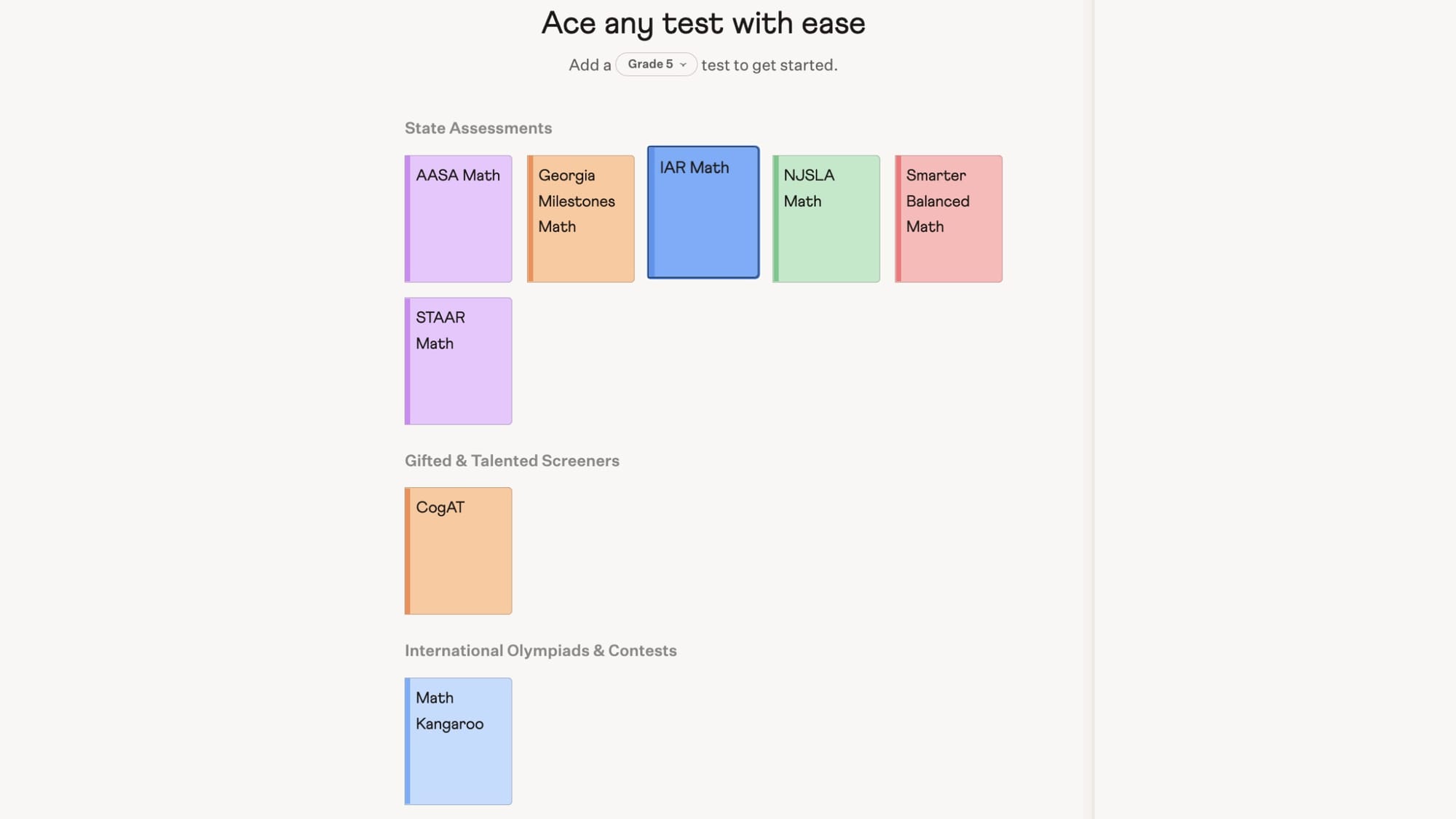
Test Prep: courses, mock tests, and practice tests
Cuemath lists preparation for Math Kangaroo, MOEMS, MAP Growth, AMC 8, the digital SAT, the SSAT, CogAT, and state tests such as STAAR, NJSLA, Smarter Balanced, GMAS, IAR, and AASA.
Problem it addresses: a child who needs practice for a specific test, not just general homework help.
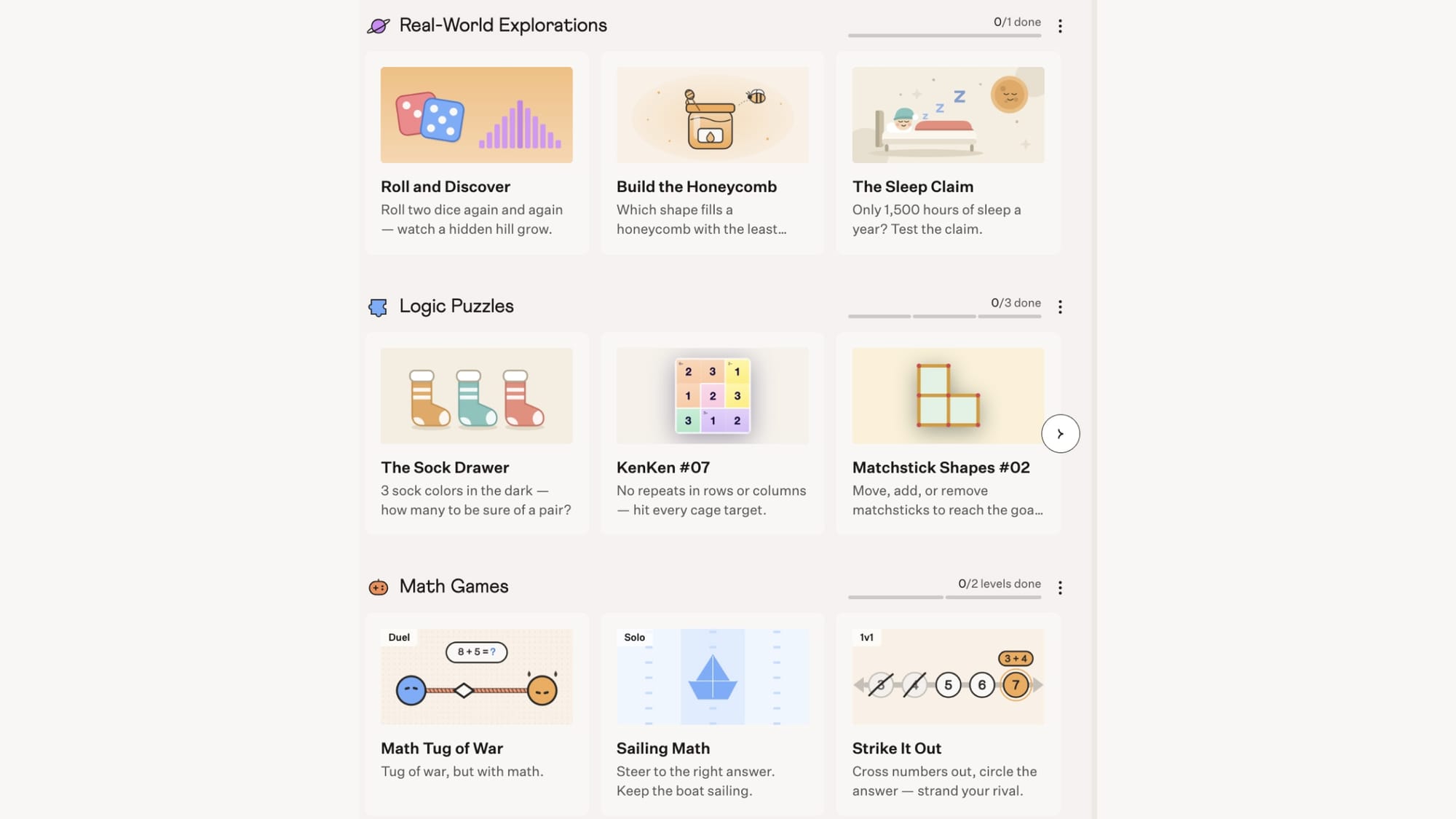
Enrichment: explorations, puzzles, and games
Real-life explorations (for example, how a chart can lie to you, or why 30% off and then 20% more isn’t 50%), logic puzzles, and math games.
Problem it addresses: a child who is ahead, or who needs a reason to like math again.
Here is how that can fit around tutoring. A fifth grader’s tutor is working on fractions. On Monday, your child does a School Math lesson on adding fractions at the Basic level. On Thursday, they try a logic puzzle, then the tutor opens class by asking how they solved it. The app doesn’t replace the tutor’s questions. It gives your child more to talk about with the tutor.
The app is free to download. What each plan includes is listed on Cuemath’s pricing page.
Your private math tutor checklist
Use this list for every tutor you consider, including Cuemath.
Bring this checklist to a free Cuemath evaluation
Ask about tutor selection, how sessions run, and pricing. Watch how your child is taught. Then decide with every fact in front of you.
Book a Free EvaluationFree for grades K–12. No credit card needed.
Frequently asked questions
How do I choose a trusted math tutor near me?
Shortlist three tutors, then confirm each one’s ID, look up any teaching license, and call two references. Then watch a trial session: a good tutor asks your child to explain their thinking and has them solve a similar problem alone.
Where can I find a math tutor for kids?
Common places are your child’s school, local college math departments, learning centers, tutoring marketplaces, and online one-on-one programs such as Cuemath. Schools and public libraries sometimes offer free help, so ask there too. Whichever route you choose, run the same identity and reference checks.
How much does a private math tutor cost?
As of October 2026, tutoring sites mostly report U.S. rates of about $25 to $80 an hour. Some marketplaces add a service fee on top. Price depends on your city, your child’s grade, the format, and the tutor’s experience. Always add fees to find the real cost.
How much does Cuemath cost?
As of October 2026, Cuemath’s U.S. plans cost $15 to $28.50 per one-on-one class, depending on grade and plan length. Six-month plans add a $90 platform fee per billing cycle. Twelve-month plans have no platform fee. Prices are listed on Cuemath’s pricing page.
How can I check a private tutor’s background?
Start with free checks: match their name to a government ID and look up any state teaching license. For a criminal report, use a screening company, which needs the tutor’s written consent. If you use a tutoring service, ask what its screening covers.
Do private math tutors need to be certified?
No. There’s no single credential required for private tutors in the U.S. Some hold a state teaching license, which you can verify through the state’s public lookup. Others have math degrees or company training. Ask which one a tutor has, and watch them teach before you decide.
Is online math tutoring as good as in-person tutoring?
It can be, when sessions are live and one-on-one and the tutor can see your child’s work as they write it, such as on a shared whiteboard. Online tutoring also widens your choice beyond tutors nearby. It may suit children less if they struggle to focus on a screen. A trial session will tell you.
How often should my child see a math tutor?
For a child who is catching up, more often usually works better. Stanford’s National Student Support Accelerator describes the most effective tutoring as three or more sessions a week with a consistent, trained tutor. If that isn’t practical, a steady weekly schedule plus short daily practice still beats cramming.
Sources
- NSOPW: About
- FTC: Employer Background Checks and Your Rights
- BLS: Tutors (Occupational Outlook Handbook)
- California CTC: Look Up a Credential
- NSSA: About
- High-Impact Tutoring FAQs
- Published tutoring cost guide

I write because I like understanding things properly, and I've never been able to do that quietly.
Six years in, what still interests me most isn't the writing itself. It's the person on the other side. Who are they, what were they actually worried about when they opened this page, and did they leave with what they came for? Most content fails that last test. It answers the easy question instead of the one that was asked.
At Cuemath, I write for parents and students in India and around the world. That range is the part I enjoy. A parent in Bangalore and a parent in Canada are asking about the same child, but not always in the same words, and that difference matters.
So I research before I write. Not just search results. Forums, reviews, the long comment threads where somebody finally admits what they're really confused about. That's usually where the useful thing is hiding.
I also spend time on how people find this writing at all, since a growing number of them now ask an AI instead of typing into Google. But that only works if the writing is clear to begin with. There's no shortcut around that part.