Middle School Math Tutoring: I Tested 7 Programs: Here’s What Actually Works (2026)
We reviewed the best math tutoring programs for middle school students across three student needs: catching up on concepts, improving grades, and high school readiness. Each program is rated on tutor consistency, curriculum alignment, pricing, and what US parents actually say.

🗓️ Last Updated: October 2026
If your child is in grades 6, 7, or 8 and struggling with math, you've probably searched online for tutoring programs. What’s much harder to find is an honest comparison of what actually works not just another marketing article. To create this guide, we signed up for multiple programs, observed tutoring sessions, reviewed each platform's learning approach, and gathered feedback from parents across U.S. school districts.
The latest 2024 National Assessment of Educational Progress (NAEP) results highlight why many families are turning to tutoring. Only 28% of eighth-grade students performed at or above the Proficient level in math, while 39% scored Below Basic. These results suggest that many students continue to struggle with foundational math skills and need additional academic support.
Research on high-dosage tutoring (HDT) shows that structured, consistent math tutoring can accelerate learning by 3 to 15 months in a single academic year. The greatest benefits occur when students work with the same tutor consistently, follow a curriculum that aligns with their schoolwork, and attend sessions on a regular schedule.
Our Finding: Across all the programs we evaluated, the biggest differentiator wasn't the curriculum or the price; it was tutor consistency. Students who met with the same tutor each session were more likely to build confidence, ask questions openly, and make steady academic progress.
Below, we compare seven popular options; five dedicated middle school math tutoring programs and two on-demand tutor marketplaces; using the same evaluation framework to help you choose the best fit for your child.
- ✓Best for live 1:1 tutoring: Cuemath, with the same tutor every class, Common Core-aligned lessons and plans from $15 per class.
- ✓Best for closing gaps in person: Mathnasium, at $200–$400 a month depending on the center.
- ✓Best for test prep: Revolution Prep, with one tutor and a flat $99 per session.
- ✓Best for flexible, pay-per-class learning: Outschool, from $15–$60+ per session.
- ✓Best practice supplement: IXL, at about $10–$20 a month, with no live tutor.
- ✓Best marketplaces: Tutor.com for 24/7 homework help, and Varsity Tutors to handpick a specialist.
- ✓Why it matters: only 28% of US 8th graders scored at or above Proficient in math in 2024 (NAEP).
- Middle School Math Tutoring Programs Compared
- How We Reviewed These Programs
- Summary: Which is the Best Math Tutoring Program for Middle School?
- 1. Cuemath
- 2. Mathnasium
- 3. Outschool
- 4. Revolution Prep
- 5. IXL (Practice Supplement, Not a Tutoring Program)
- Best Tutor Marketplaces for Middle School Math
- 6. Tutor.com
- 7. Varsity Tutors
- Frequently Asked Questions
Middle School Math Tutoring Programs Compared
Prices are each provider's published starting rates. In-person centers set their own prices, so check your local center.
How We Reviewed These Programs
To ensure a fair comparison, our team used the same evaluation process for every platform. We signed up for trials or demo sessions whenever available, reviewed the onboarding experience, explored the learning platform, and assessed the overall user experience firsthand.
To understand how these programs perform beyond the initial trial, we also interviewed parents from multiple U.S. school districts about their long-term experiences. In addition, we analyzed parent forum discussions and verified reviews on Trustpilot (U.S. reviews only, reviewed in April 2026) to identify common strengths, recurring concerns, and overall parent satisfaction.
Each program was evaluated using the following five criteria:
Summary: Which is the Best Math Tutoring Program for Middle School?
1. Cuemath
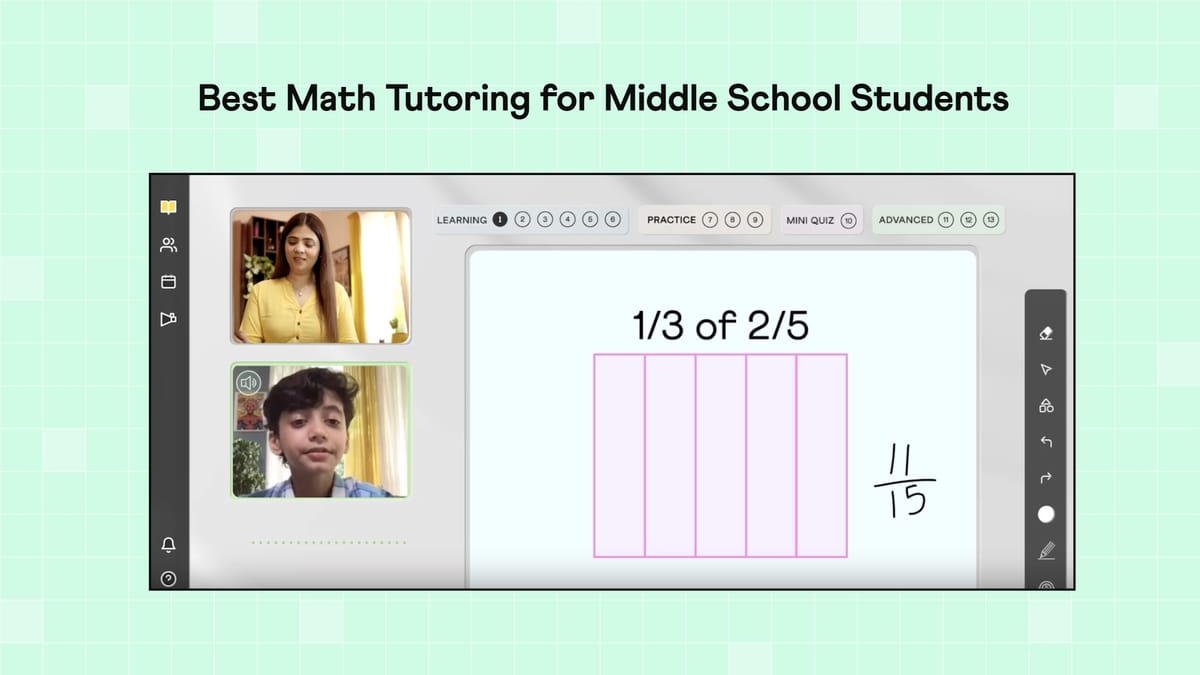
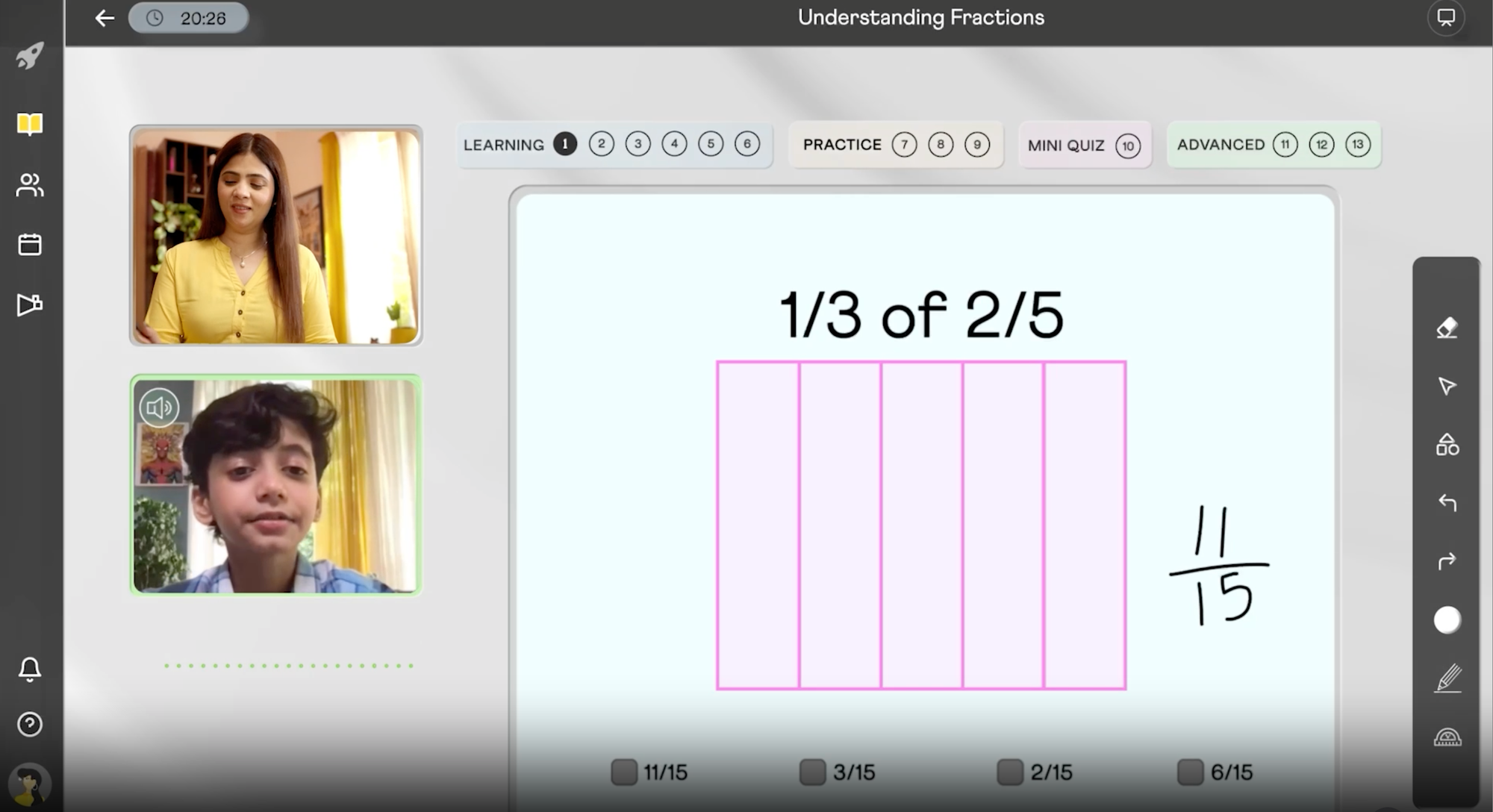
Cuemath offers live 1:1 online math tutoring for grades K-12.
What does this mean?
Cuemath offers 1:1 math tutoring. It means each student is assigned an expert math tutor based on their grade and learning goals. To do so, Cuemath has expert math tutors certified to teach US students, and according to test prep standards.
Each learning plan is customized and aligned to the US Common Core standards.
What we found:
For a parent or student visiting Cuemath for the first time, the process starts with a free MathFit Evaluation and a free evaluation.
Don't confuse MathFit Evaluation with another test. Cuemath tutors use the results alongside an initial conversation with your child to build a customized learning plan, so classes start from your child's actual gaps, not a generic curriculum.
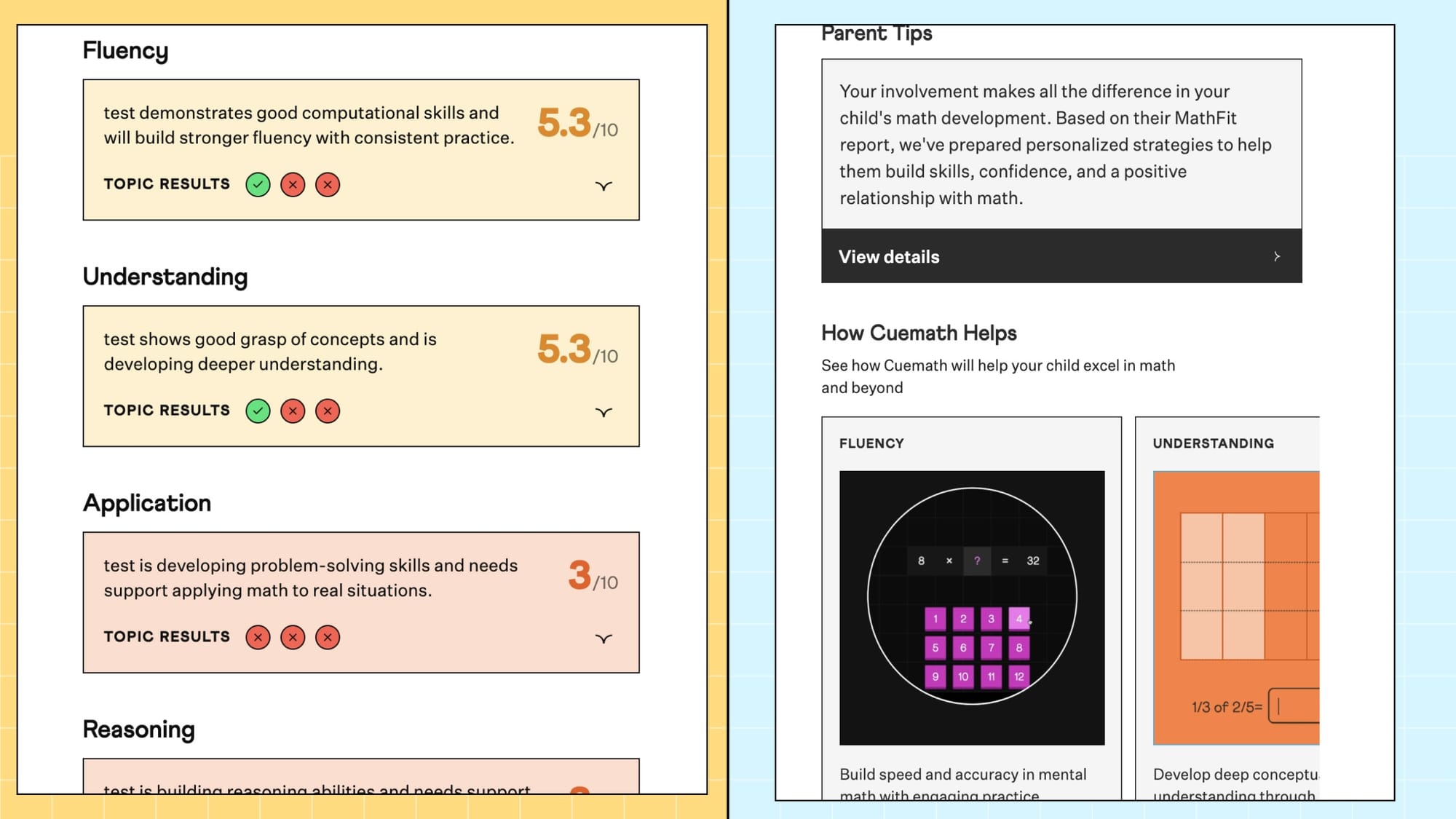
Tutor matching follows soon after signup, usually within a few days. In our parent interviews, the most consistent observation was that the same-tutor model changed how willing students were to ask questions; parents attributed this to familiarity with the instructor, not just the quality of the curriculum.
Math anxiety, which affects an estimated 20 to 30 percent of middle schoolers, came up repeatedly as something parents saw reduce over the first 6 to 8 weeks with a consistent Cuemath tutor.
Real student outcomes (Grade 7):
- Devansh Senapati, Grade 7, Texas: 100th percentile on STAAR math two years in a row, now studying Algebra 1 two grade levels ahead of his peers. Same Cuemath tutor since Grade 2. Read his story
- Harsheen Kaur, Grade 7: 97th percentile on the CogAT and qualified for her school district's Gifted and Talented program after 2+ years with Cuemath. Read her story
Is Your Middle Schooler Missing a Concept From an Earlier Grade?
A free 1:1 evaluation shows which Grade 6–8 skills your child has mastered, and which gaps from earlier grades are holding them back.
Book a Free Evaluation100% free • No credit card needed • Grades 6–8
Explore Cuemath for Middle School
2. Mathnasium
Mathnasium is an in-person math tutoring program with more than 1,100 Mathnasium locations worldwide. For parent reviews and how the Mathnasium Method works, see our Mathnasium reviews guide.
What we found:
We visited 2-3 Mathnasium center websites and reviewed the enrollment process across locations in different states. The placement assessment is the platform's clearest differentiator. It produces a specific gap report before any instruction begins, rather than placing a student by grade level.
3. Outschool
Outschool is a marketplace of independent online tutors offering pre-recorded or live classes across subjects. In parent discussions online, Outschool was often recommended for middle school math tutoring. I looked at their website and found that it is not math-dedicated. It offers a mix of courses across math, business, and career-related subjects.
In terms of offerings, it lists courses grade-wise. For every grade, they have pre-recorded courses made by a tutor. You can see the tutor details, and the course page clearly states that you get pre-recorded lessons with teacher support. This is not 1:1 tutoring. There is no way to evaluate a teacher's effectiveness before paying for a class.
Outschool also has a 1:1 coaching section with private math tutor listings. These are live tutor meetings where the tutor and student get on a call to discuss concepts. Parents who like Outschool mention that it is good for catching up on concepts in a low-pressure way.
4. Revolution Prep
Revolution Prep started as a test prep company and has since expanded into K-8 academic tutoring covering math, reading, and writing. If your middle schooler needs a focused push before a big exam or is struggling with one specific concept, the Revolution Prep can work well.
The pricing is the same: $99 per session across all package sizes.
5. IXL (Practice Supplement, Not a Tutoring Program)
Note: IXL is a self-paced practice platform, not a live tutoring program. We've included it because parents frequently compare it alongside tutoring options.
IXL is a self-paced learning platform that covers math, language arts, science, and social studies. It is not a tutoring service. There are no live tutors, no 1-on-1 classes. What you get instead is a large, well-organized library of concept lessons, practice problems, and quizzes that your child works through on their own.
For middle school math, the coverage is solid. Pre-algebra, ratios, integers, geometry, statistics; the skills your child is actually working through in class are all here, aligned to grade level.
A different and new feature that we saw was the IXL Recommendation Zone. It is like a personalized feed that suggests what your child should work on next based on what they've already learned and how they've performed.
Math games are currently available until 5th grade, so middle schoolers won't benefit from that yet.
One App, Every Angle Your Child Needs for Middle School Math
Daily workouts, 1v1 math battles, logic puzzles and test prep practice in one place, so your child keeps practicing between sessions. Free to try, no card needed.
100% Free • No Card Needed • A Few Minutes a Day
Best Tutor Marketplaces for Middle School Math
A lot of US parents and students love tutor marketplaces for quick help. Among these, Tutor.com and Varsity Tutors are well-known and popular.
6. Tutor.com
Tutor.com provides 24/7 on-demand access to available tutors. A student can connect within minutes at any hour — useful for middle schoolers stuck on a problem set late at night. There is no assigned tutor (you can save a favorite tutor and book them again), no curriculum continuity across sessions, and sessions end at the time limit regardless of whether the problem is resolved.
7. Varsity Tutors
Varsity Tutors is a large 1:1 online tutor marketplace where parents browse and select tutors directly by subject, availability, and price. For a parent who wants to handpick a tutor with a specific specialty — 8th-grade algebra, MATHCOUNTS prep, or a particular teaching approach — this is the most flexible marketplace option reviewed here.
Find the Right Starting Point Before Algebra
A free 1:1 evaluation with a Cuemath specialist shows where your child stands in middle school math, plus a learning plan you keep.
Book a Free Evaluation100% free • No credit card needed • Grades 6–8
Frequently Asked Questions
What is middle school math tutoring?
Middle school math tutoring is one-on-one or small-group instruction for students in grades 6, 7, and 8, covering the CCSS curriculum — number systems, ratios, algebraic expressions, geometry, and statistics. It is designed to close foundational gaps, improve grades, or advance a student ahead of the standard grade-level sequence.
How much does math tutoring for middle school students cost?
Self-paced apps like IXL cost $10–$20 per month. On-demand platforms like Tutor.com are free through many schools and libraries, with paid individual plans. Dedicated 1:1 programs like Cuemath start at $15 per class on the 12-month plan. In-person centers like Mathnasium typically charge $200–$400 per month, depending on location. Parents surveyed report an average willingness to spend approximately $357 per month on supplemental math help (EdChoice, 2024).
What should a middle school math tutor cover?
A middle school math tutor should work from the student's current school curriculum and identify which foundational gaps are blocking progress. Grade 6 covers ratios, fractions, decimals, and introductory expressions. Grade 7 covers proportional relationships, integers, and basic geometry. Grade 8 covers linear equations, functions, and foundational algebra. A strong tutor surfaces gaps from earlier grades and addresses those first, rather than proceeding with grade-level content the student is not ready for.
Is online math tutoring effective for middle school students?
Online math tutoring is as effective as in-person when it includes live interaction, concept explanation, and a consistent tutor. Research on high-dosage tutoring — defined by intensity, small ratios, and same-tutor continuity — shows learning gains of 3 to 15 months per academic year and is 20 times more effective than standard tutoring for math. Programs where the student is passive, such as recorded lessons or drill apps without feedback, produce significantly weaker results.
How often should a middle school student have math tutoring?
Two sessions per week is the standard recommendation for meaningful, sustained progress. One session per week can maintain progress for students at grade level. For students who are significantly behind, two sessions per week with daily independent practice produce the fastest results.
How long does it take to see progress in a child?
The timeline depends on your child's starting point and how often they attend tutoring. With Cuemath's personalized, curriculum-aligned approach and consistent one-on-one support from the same tutor, many parents notice improvements in confidence, homework completion, and classroom participation within a few weeks. Meaningful gains in conceptual understanding and grades typically take two to four months of regular tutoring and practice.
Can a tutor help with math anxiety?
Yes. Many students struggle with math because they lack confidence rather than ability. Cuemath tutors are trained to create a supportive, low-pressure environment where students feel comfortable asking questions, making mistakes, and learning at their own pace. Over time, regular practice, personalized guidance, and positive reinforcement helps reduce math anxiety and build confidence.
What makes a good middle school math tutor?
A good middle school math tutor covers the full curriculum, asks guiding questions rather than giving away answers, and maintains a consistent relationship with the student over time. Rotating tutors cannot build an understanding of a student's specific patterns and gaps. Consistency is particularly important at the middle school level, where math anxiety is common, and trust between student and tutor has a measurable effect on willingness to attempt problems.
When should I start middle school math tutoring?
As early as possible. The middle school math curriculum builds cumulatively. A student who enters 6th grade without solid fraction and decimal foundations will struggle with 6th-grade ratios, which compounds into algebra struggles in 7th and 8th grade. Starting at the first sign of difficulty, before grades drop significantly, leads to better and faster outcomes.
Is Cuemath good for middle school students?
Cuemath covers grades K–12, including all three years of middle school. It offers a CCSS-aligned curriculum, a same-tutor model, a free MathFit Evaluation before the first class, and monthly progress tracking. It works for catch-up, grade improvement, and accelerated prep, including AMC 8, Math Kangaroo, and SAT readiness. Pricing starts at $15 per class on the 12-month plan.
Is Mathnasium good for middle school students?
Mathnasium is effective for middle schoolers who need targeted gap-closing in foundational topics up to pre-algebra. The placement assessment identifies specific weak areas. The limitation is that center quality varies significantly by franchise, and the curriculum is documented to struggle with content above pre-algebra, which matters for students in 7th and 8th grade.
Should middle school students use IXL for math?
IXL is a useful practice supplement for students who already understand the concepts and need repetition to reach mastery. It is not a substitute for live math tutoring for students who are behind or need concept explanation. The SmartScore penalty system can increase math anxiety for students who are already struggling with the material.
Sources
- National Center for Education Statistics (NCES) — NAEP 2024 Mathematics Report Card, Grade 8
- Common Core State Standards Initiative — Mathematics Standards Grades 6–8
- Education Research Alliance — High-Dosage Tutoring: Evidence and Efficacy
- EdChoice — Schooling in America 2024: Parent Survey on Tutoring Access and Cost Barriers
- Trustpilot — Cuemath reviews (verified April 2026)
- Education Endowment Foundation — The Impact of Online Tutoring on Student Achievement

I was never the kid who loved math. I was much more interested in books, stories, and writing—and, somewhere along the way, I became even more curious about people. Why do we learn differently? Why does something make sense to one child but not another? And what makes a student feel confident enough to keep trying?
That curiosity led me to study Applied Psychology, where I learned more about how children think, learn, and make sense of the world around them.
My love for writing did the rest. What started as something I simply enjoyed became a career. Over the past five years, I've worked as a freelance writer across edtech, SaaS, B2B, travel, lifestyle, and healthcare, learning how to write for very different audiences without losing the human side of the story.
Today, I'm an SEO Content Writer & Editor at Cuemath, where I get to bring many of these interests together. Working in education—and especially around math—has made me even more curious about what happens behind the screen or textbook: what parents worry about, what students struggle with, and what actually helps them learn.
That's also how I like to research. I don't just look at search results and call it a day. I go where parents and students actually talk—forums, reviews, communities, and conversations with real families. Because sometimes the most useful insight isn't hiding in a keyword; it's in a parent's question, a student's frustration, or a small detail someone shares about their learning experience.
I write because I'm curious. I research because I want to understand. And I love turning what I learn into content that feels genuinely useful to the people reading it.