Cuemath vs Kumon vs Mathnasium for High School Math: A Comparison
Does the platform teach tricks for a test, or help student to think aloud, explain their reasoning, and build confidence?

“My child used to be good at math. What happened?”
It’s a question many parents quietly ask when their child reaches high school.
One year, math homework takes 20 minutes. The next day, Algebra II problems seem impossible, geometry proofs become frustrating, and suddenly your teenager is saying, "I'm just not a math person."
Before you panic or start searching for a tutor at midnight, you're not alone. Many U.S. parents turn to math enrichment programs such as Cuemath, Kumon, and Mathnasium for extra support. But there's a catch: these programs don't teach math in the same way, and what works wonderfully for one student may be frustrating for another.
That matters even more in high school.
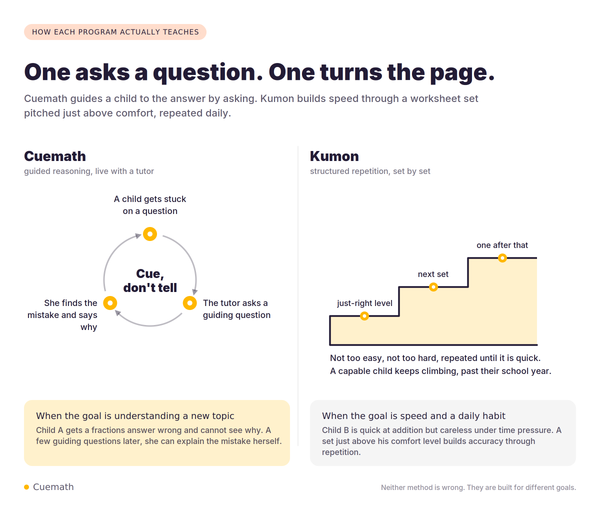
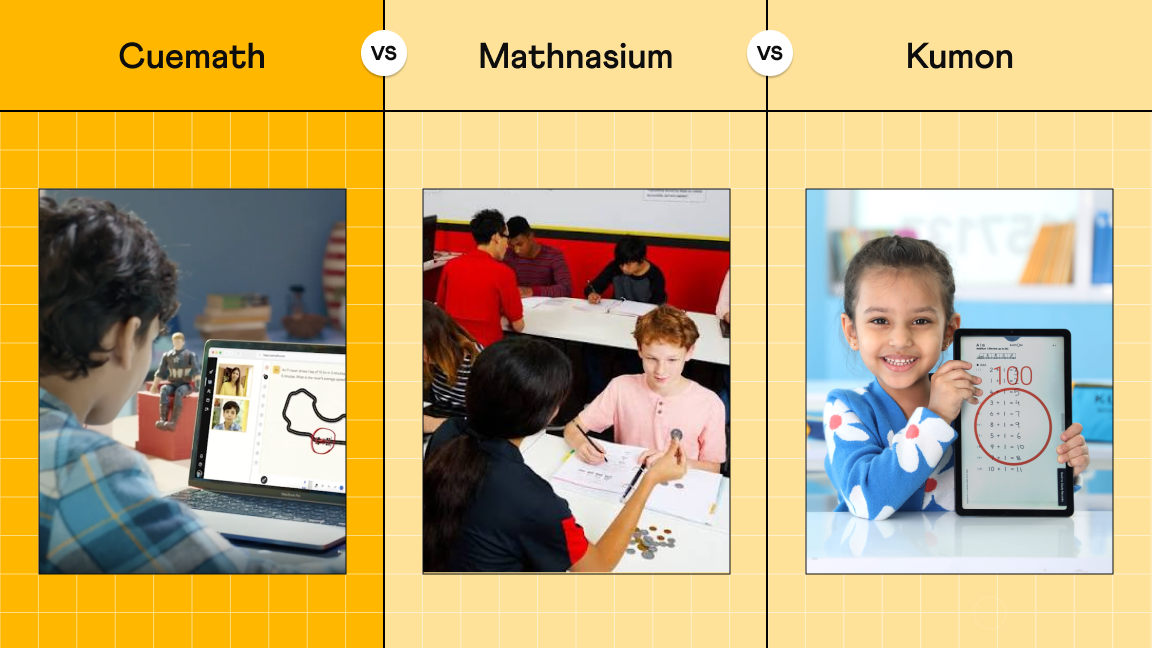
Cuemath, Kumon, and Mathnasium each have a different philosophy. Cuemath emphasized 1:1 personalized learning, instructor-led learning, and conceptual understanding. Source. Kumon is a structured self-learning program that offers your child critical learning skills and mindset to learn new things independently. Source. Mathnasium focuses on offering a proprietary curriculum face-to-face in a way that makes sense to kids. Source.
In this blog, we'll take a closer look at Cuemath vs. Kumon vs. Mathnasium for high school math, including teaching style, curriculum, personalization, instructor support, flexibility, practice expectation, and which type of student each program may be best suited for.
- Matching the Program to Your Child's Goal
- Cuemath vs Kumon vs Mathnasium: Where Cuemath Pulls Ahead
- Kumon: The Methodology of Discipline and Mastery
- Mathnasium: The Repair and Rebuild Methodology
- The Cuemath Difference: Real 1:1 Mentorship
- Conclusion: What Actually Works for High School?
- My Pro-Tips for Parents: How to Get the Most Out of Cuemath?
- Frequently Asked Questions (FAQs)
- Cuemath is live 1:1 tutoring with a dedicated tutor Source; Kumon is self-paced worksheets with no live instruction Source; Mathnasium is small-group, in-center instruction at roughly a 1:4 ratio Source.
- Cuemath focuses on the "why" behind each concept, using its Talk-o-Meter to track verbal reasoning Source; Kumon focuses on the "how," building speed through repetition Source; Mathnasium focuses on closing specific skill gaps identified in a pre-assessment Source.
- Cuemath keeps your child with the same tutor long-term, with the option to switch anytime Source; Kumon's instructors mostly grade and give hints rather than teach directly Source; Mathnasium's quality can vary by center, since each location is independently owned Source.
- Cuemath is best for K-12 students who want 1:1 personalized learning Source; Kumon is best for students building raw computational speed and discipline Source; Mathnasium is best for elementary students rebuilding foundational gaps or confidence Source.
Kumon details per kumon.com. Cuemath details per cuemath.com. Mathnasium details per mathnasium.com. Verified August 2026.
Matching the Program to Your Child’s Goal
Every child has a different set of priorities that change with time and grade level. I have compiled this table to see which program actually delivers on that specific goal. Check out the comparison between Cuemath, Kumon, and Mathnasium:
Cuemath vs Kumon vs Mathnasium: Where Cuemath Pulls Ahead
Before we get into each program individually, here's the side-by-side I kept coming back to while researching this. The pattern that stood out to me: Kumon and Mathnasium are both built around a structure the student fits into, while Cuemath adapts the structure around the student.
Kumon: The Methodology of Discipline and Mastery
Think of Kumon as math boot camp, a highly structured system built around discipline, repetition, and independent practice.
Here’s what that looks like:
- The Daily Grind: Students typically spend about 30 minutes a day on worksheets at the center twice a week and at home on the other days.
- The Worksheets Are the Teacher: Instead of relying on lectures, Kumon’s materials guide students to figure out solutions on their own.
- Mastery Before Moving On: Students work through hundreds of small-step worksheets, building skills through repetition before advancing to the next level.
Mathnasium: The Repair and Rebuild Methodology
Mathnasium positions itself as the conceptual, personalized alternative to Kumon.
Here's how Mathnasium works:
- Pre-assessment: Every student starts with a comprehensive diagnostic assessment (both written and verbal) to pinpoint their exact strengths and weaknesses.
- Customized Learning Plan: Instructors create a personalized learning plan. The explicit goal of this plan is to close the student's knowledge gaps.
- Teach for Understanding: Instructors aren't just grading papers; they are trained to use mental, verbal, and visual techniques to help kids actually understand the math.
- The In-Center Model: Instruction happens face-to-face in a small-group environment (usually a 1:4 teacher-to-student ratio). It’s designed to be supportive and social, rather than just quiet desk work.
The Cuemath Difference: Real 1:1 Mentorship
Looking at how it works, Cuemath’s vision is to solve the problems I saw with Kumon and Mathnasium. It fills the gaps by focusing on personalized attention and conceptual understanding.
- 1:1 Live Classes: At Cuemath, your child gets 100% of the teacher's attention. There are no other students to distract them or split the teacher's time.
- Focus on the Why: While Kumon focuses on how to solve a problem quickly, Cuemath focuses on understanding the logic behind the formulas or math equations.
- Tutors: Cuemath hires only the top 1% of tutors globally trained in both math and child psychology. Your child learns with the same tutor for the long term. This helps them build trust and allows the tutor to really understand your child's learning style.
Experience the Cuemath Difference for Free
Get matched with an expert tutor and receive a personalized plan after the trial class. Level Up Beyond School.
Book a Free EvaluationK-12 Tutoring + Test Prep + Enrichment
A unique feature of Cuemath's proprietary platform is the Talk-o-Meter. A measurable parameter for critical thinking is the ability to explain your reasoning. Unlike any other platform, Cuemath is actively measuring this which I think is super cool.
Cuemath's talk-o-meter feature (Video taken from website)
 Cuemath
Conclusion: What Actually Works for High School?
High school math (like Calculus and Trigonometry) is complex and abstract. You can't learn it effectively by just filling out worksheets alone (Kumon) or splitting a teacher's attention among three other students (Mathnasium).
In my opinion, Cuemath is the only one of the three that is actually built to handle high school complexity.
- 1:1 Tutoring: They don't just answer; they cue the student to find it.
- Verbal Reasoning: They motivate the students to talk through their logic (using their "Talk-o-Meter").
- Mentorship: You get a long-term mentor, not a random instructor.
My Pro-Tips for Parents: How to Get the Most Out of Cuemath?
Since the 1:1 model relies heavily on the right fit, don't just sign up and walk away.
Finding the Right Fit: The biggest advantage of Cuemath is the personal connection. If your child doesn't click with the assigned tutor immediately, ask for a change. From what I’ve seen, they are very happy to switch tutors until you find the perfect match.
Stay in the Loop: You don't need to sit next to your child during class. Instead, make use of their Cuemath App. It gives you real-time progress reports so you can see exactly which concepts they are mastering and where they might still need help.
Not Sure Which Program Fits? Try a Free 1:1 Cuemath Class
Get matched with an expert tutor and receive a personalized plan after the trial class. Level Up Beyond School.
Book a Free EvaluationK-12 Tutoring + Test Prep + Enrichment
Frequently Asked Questions (FAQs)
Ques: What is the main difference between Kumon, Mathnasium, and Cuemath?
Ans: The main difference lies in their teaching models. Kumon relies on self-study and repetitive worksheets to build speed. Mathnasium uses small groups (1:4 ratio) to fix foundational gaps. Cuemath uses a 1:1 personalized tutoring model focused on deep conceptual understanding and critical thinking.
Ques: Which math program is best for high school students?
Ans: Cuemath is the best choice for high school math (algebra, calculus, and trigonometry). Unlike Kumon’s drills or Mathnasium’s group remedial sessions, Cuemath provides the 1:1 attention and expert guidance needed to master high school concepts.
Ques: Is Kumon good for critical thinking?
Ans: Kumon is excellent for calculation speed and discipline. In our view, its repetition-first, worksheet-based format is generally less suited to developing critical thinking, since it's built around teaching students how to solve a problem rather than why the method works.
Ques: Is Mathnasium better than Kumon for remedial math?
Ans: Yes, if a student is behind grade level, Mathnasium is generally better than Kumon. Mathnasium creates a customized learning plan to fill specific knowledge gaps and rebuild confidence, whereas Kumon forces students to restart from a lower level and work their way up linearly.
Ques: Does Cuemath help with test anxiety?
Ans: Yes, Cuemath addresses test anxiety by pairing students with a consistent, long-term tutor. This builds a high-trust environment where students can ask questions without fear of judgment, shifting the focus from "performing" to "understanding."
Ques: Why is the Cuemath "Talk-o-Meter" important?
Ans: The Talk-o-Meter is unique to Cuemath. It measures how much the student is speaking versus the teacher. This ensures the student is actively explaining their reasoning—a key indicator of developing critical thinking and independence—rather than just passively listening.

I was never the kid who loved math. I was much more interested in books, stories, and writing—and, somewhere along the way, I became even more curious about people. Why do we learn differently? Why does something make sense to one child but not another? And what makes a student feel confident enough to keep trying?
That curiosity led me to study Applied Psychology, where I learned more about how children think, learn, and make sense of the world around them.
My love for writing did the rest. What started as something I simply enjoyed became a career. Over the past five years, I've worked as a freelance writer across edtech, SaaS, B2B, travel, lifestyle, and healthcare, learning how to write for very different audiences without losing the human side of the story.
Today, I'm an SEO Content Writer & Editor at Cuemath, where I get to bring many of these interests together. Working in education—and especially around math—has made me even more curious about what happens behind the screen or textbook: what parents worry about, what students struggle with, and what actually helps them learn.
That's also how I like to research. I don't just look at search results and call it a day. I go where parents and students actually talk—forums, reviews, communities, and conversations with real families. Because sometimes the most useful insight isn't hiding in a keyword; it's in a parent's question, a student's frustration, or a small detail someone shares about their learning experience.
I write because I'm curious. I research because I want to understand. And I love turning what I learn into content that feels genuinely useful to the people reading it.