AI Tutoring Study: 2,379 Students Got an AI Tutor, and Their Grades Went Down
A randomized trial at the University of Maryland gave 2,379 college students access to an AI tutor for a semester. In the clearest comparison, their final grades came out about 4 points lower. Here is what the study found and what it means for younger students.

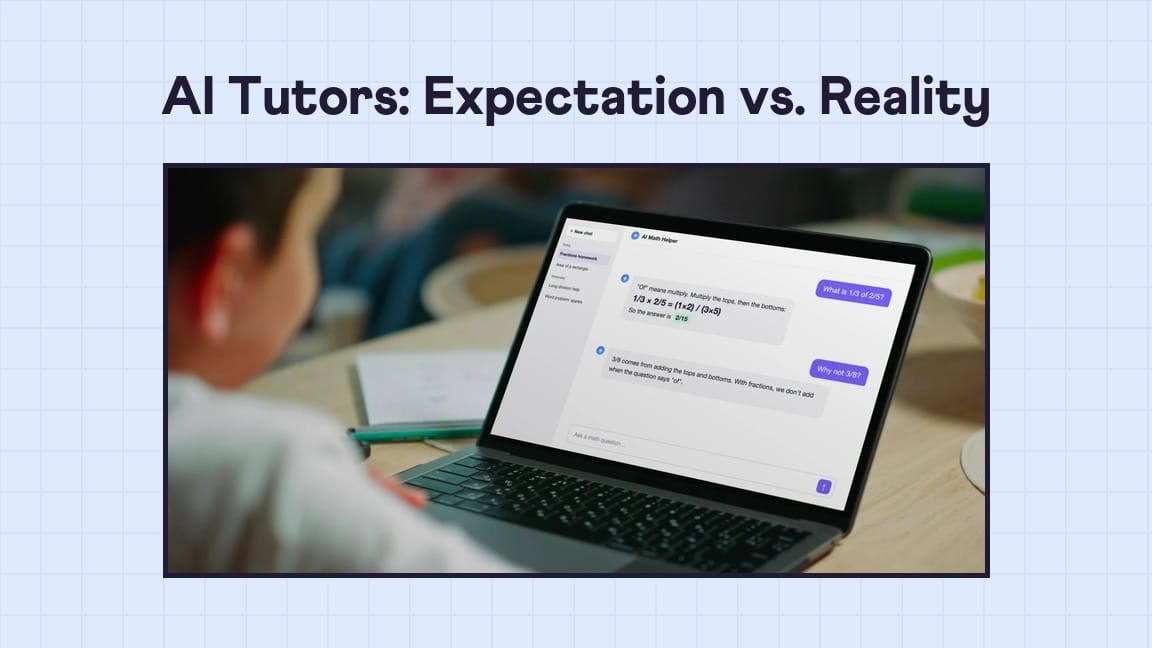
AI tutors promise better learning, but a new University of Maryland study raises concerns. Among 2,379 college students, those given access to an AI tutor earned final grades about four points lower than their peers. The study was published in October 2026.
While the research focused on college students, K–12 math studies suggest a similar lesson: AI tutoring works best when it encourages students to think, not just gives them answers.
Here’s what the study found, why grades may have dropped, and five things parents should check when their child uses an AI tutor.
What Did the AI Tutoring Study Find?
Students who had the AI tutor got lower grades and did less coursework. UMD split 30 instructors into two groups at random. One group's students got a GPT-4o study assistant inside their course website; the other group's students didn't.
| What was measured | Result |
|---|---|
| Final grades | About 4 points lower (out of 100) in the same courses |
| Course work | Far fewer quizzes, discussion posts and online activities |
| Homework scores | No clear change |
Across all 34 sections, which mixed different courses, the grade drop was too small to be certain. The drop in coursework showed up everywhere.
Why Did Grades Drop When So Few Students Used the AI Tutor?
The researchers point to three likely reasons:
| Reason | What the study found |
|---|---|
| Students asked for answers | 73.8% of requests asked for facts or solutions. Only 0.7% asked the AI to check their work. |
| It replaced real course work | Fewer quizzes and discussion posts, and fewer questions to instructors |
| Access changed habits | Only about 15% used it, but the whole group's results dropped |
UMD's provost said having the tool on offer may have made all AI use, like ChatGPT, feel acceptable, even for students who never opened it.
First-generation college students lost the most: about 5 points, compared with about 2 points for everyone else.
What Does AI Tutoring Research Show for K-12 Students?
AI tutoring helped younger students only when it made them think. Four recent K–12 math studies show this:
- High school math (about 1,000 students): AI that gave answers left students 17% worse once it was taken away. A version that gave hints mostly avoided that.
- Khanmigo (18 Tennessee middle schools): a small gain, about the same as Khan Academy without AI. Students rarely asked it for help.
- NUMI (6,000+ middle schoolers): AI helped students fix mistakes. A small lasting gain showed up only when students had to get 3 right in a row.
- Goblins (6,065 Arizona middle schoolers): students who solved more problems, with teachers assigning the work, scored higher on the MAP math test. The study wasn't randomized, so it shows a link, not proof.
In short: AI helped when a teacher guided it, it gave hints instead of answers, or students had to fix mistakes. It didn't help when students just had open access.
More reading: AI tools in high school math · Cuemath's free MAP practice curriculum
Want a Teacher Who Checks Your Child's Thinking, Not Just the Answer?
Book a free 1:1 math evaluation. A Cuemath specialist works through problems with your child and shows you where they get stuck.
Book a Free Evaluation100% free · No credit card · About 30 minutes
What Should Parents Check Before a Child Uses an AI Tutor?
Check how the tool is used, not just which tool it is:
- Does it give answers or hints? Ask it a homework question and see.
- Does it make your child fix mistakes? The studies found AI helps most right after a wrong answer.
- Is a teacher or parent guiding it? AI worked better when an adult assigned the work.
- What does your child ask it? Look at the chat history. "What's the answer?" is a warning sign.
- Is it replacing a real teacher? If your child stops asking their teacher for help, notice that.
Cuemath tutors work this way in every live 1:1 class: they ask questions instead of giving answers, and the child explains each step. More reading: how to tell if tutoring is working · Why thinking skills matter more with AI
What Happens Next?
UMD chose to study the tool before giving it to every instructor and has shared the findings with the 40 courses that already use it. Goblins is planning an outside randomized trial to test its results.
Until then, the evidence points one way: AI works as a practice tool when it makes your child think, not when it hands over answers. More reading: AI in US schools in 2026
Daily Math Practice in the Cuemath App
Five short math exercises a day, plus logic puzzles and math games. Your child works through each one and builds the skills step by step.
100% Free • No Card Needed • A Few Minutes a Day
Frequently Asked Questions
Does AI tutoring work?
AI tutoring can work when it makes students think, but not when it hands out answers. In a University of Maryland trial of 2,379 college students, open access to an AI tutor led to lower grades.
What did the University of Maryland AI tutoring study find?
The University of Maryland AI tutoring study found that students with a GPT-4o study assistant finished about 4 points lower than students in the same courses without it. They also did far less course work.
Why did students with an AI tutor get lower grades?
Students mostly used the AI tutor to get answers, and it replaced coursework like quizzes and questions for instructors. Only about 15% used it, but having it on offer seems to have changed how the whole class studied.
Does this AI tutoring study apply to my middle schooler?
Not directly, because the students were in college. But K–12 studies found the same pattern: AI that gave answers didn't help, and AI that made students fix mistakes did.
Is AI tutoring better than human tutoring?
Not yet, based on the evidence so far for K–12 students. Stanford researchers say AI-led tutoring doesn't yet meet the evidence bar that human tutoring does. Cuemath's live 1:1 classes use a human tutor for this reason.
What did the Goblins AI math study find?
Arizona middle schoolers who used the Goblins math platform more, with teachers assigning the work, scored higher on the MAP math test. The study wasn't randomized, so it shows a link, not proof.
Did Khanmigo improve math scores?
Khanmigo gave a small gain in a two-year Tennessee study, about the same as Khan Academy without AI. Students rarely asked the AI for help.
How can I tell if my child is using AI to learn or just to get answers?
Look at the chat history. "What's the answer to number 5?" means they're getting answers. "Is my second step right?" means they're checking their own thinking.
Should my child stop using AI for homework?
No, but they should try each problem first and use AI only to check their steps or get a hint. Then ask them to explain the answer to you without the AI. Our guide on how to help with math homework has more ideas.
Sources
- EdWorkingPaper 26-1598: UMD AI tutor trial (October 2026): trial design, grade and participation results, request types, 15% usage, first-generation results
- Maryland Today: Study Suggests More Guidance Needed in Use of AI Course Assistants (October 16, 2026): UMD's summary, Provost Rice's comments, guidance for the 40 courses
- PNAS: Generative AI without guardrails can harm learning (June 25, 2025): answers vs. teacher-written hints in high school math
- NBER Working Paper 35620: Khanmigo in Tennessee (August 2026): two-year Khanmigo trial in 18 Tennessee middle schools
- NBER Working Paper 35621: NUMI mastery practice (August 2026): AI help and the 3-in-a-row mastery rule, Hamilton County Schools
- EdWorkingPaper 26-1611: Goblins in Deer Valley Unified (October 2026): Goblins results, study design, Accelerate funding
- Stanford SCALE: AI Tutoring Is Not a Monolith (August 20, 2026): evidence standard for AI-led tutoring
- Overdeck Family Foundation: What Early Evidence Tells Us About AI Tutoring (October 19, 2026): planned outside trial of Goblins

I was never the kid who loved math. I was much more interested in books, stories, and writing, and, somewhere along the way, I became even more curious about people. Why do we learn differently? Why does something make sense to one child but not another? And what makes a student feel confident enough to keep trying?
That curiosity led me to study Applied Psychology, where I learned more about how children think, learn, and make sense of the world around them.
My love for writing did the rest. What started as something I simply enjoyed became a career. Over the past five years, I've worked as a freelance writer across edtech, SaaS, B2B, travel, lifestyle, and healthcare, learning how to write for very different audiences without losing the human side of the story.
Today, I'm an SEO Content Writer & Editor at Cuemath, where I get to bring many of these interests together. Working in education, and especially around math, has made me even more curious about what happens behind the screen or textbook: what parents worry about, what students struggle with, and what actually helps them learn.
That's also how I like to research. I don't just look at search results and call it a day. I go where parents and students actually talk: forums, reviews, communities, and conversations with real families. Because sometimes the most useful insight isn't hiding in a keyword; it's in a parent's question, a student's frustration, or a small detail someone shares about their learning experience.
I write because I'm curious. I research because I want to understand. And I love turning what I learn into content that feels genuinely useful to the people reading it.