
Word Problems Made Easy: Step-by-Step Method for Parents
Many children find word problems confusing. Cuemath’s 8-step strategy uses step-by-step lessons, visual models, and guided practice to make solving math easy and boost confidence.


Many children in the early learning years struggle with word problems (or story problems)—not because the math is difficult, but because understanding the story can feel confusing. Here’s a simple, reliable 8-step strategy to help your child in the elementary school break down any word problem with confidence.
Key Takeaways
1. Read the story slowly (understand it first)
2. Make a chart: Given vs Find
3. Underline key words that help identify the operation
4. Draw a quick model (bar model, number line, etc.)
5. Write the equation — the math sentence
6. Solve step-by-step
7. Check the answer
8. Practice builds confidence.
With regular exposure to different types of word problems, elementary school students build stronger foundational skills and greater confidence. Platforms like Cuemath support this growth with structured practice and step-by-step guidance.
1️⃣ Read the Story of the Word Problem Slowly (Understand First)
Before doing any math, encourage your child to read the problem once without trying to solve it.
Ask: “What is happening in the story?”
This builds comprehension before calculation.
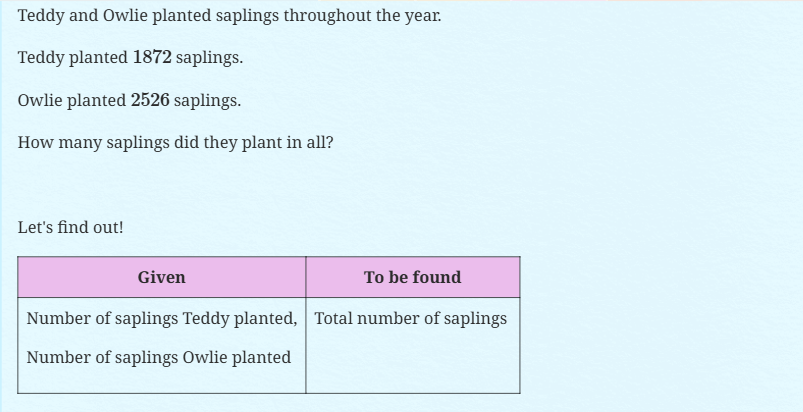
2️⃣ Make a T-Chart: Given vs Find
This is one of the most powerful habits.
It helps children separate important information from the question.
3️⃣ Underline Key Words
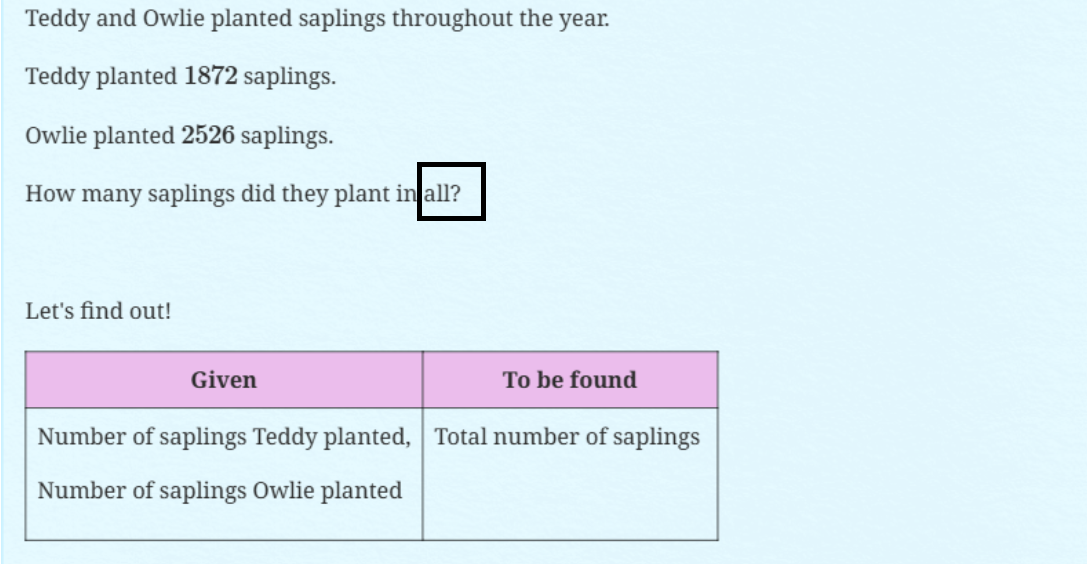
Guide your child to underline clue words in the problem.
Common helpful words include:
- total, left, each
- altogether, shared, difference
These often hint at the necessary operation.
4️⃣ Choose the Operation
Look for Keywords:
Add: total, in all, altogether
Subtract: left, fewer, difference
Multiply: groups of, each, times
Divide: shared equally, per, ratio
- Think about the question: Ask yourself, “Am I combining, taking away, repeating, or splitting?”
- Pick the operation that makes sense: Keywords help, but understanding the story is more important.
This turns a confusing story into a clear math action.
For example: “Sarah has 12 candies. She gives 4 to her friend. How many does she have now?” → subtract, which matches the keyword “gives,” but if the problem said “Sarah shared candies equally among 3 friends,” you’d need to divide.
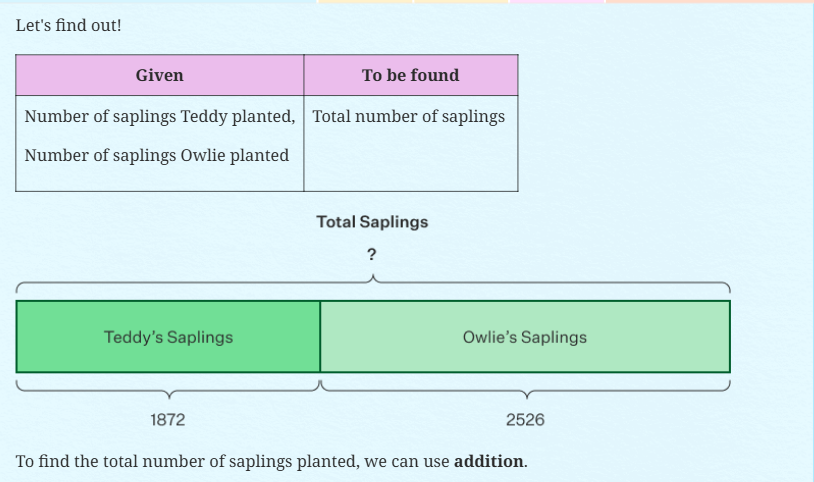
5️⃣ Draw a Quick Model
Visuals make word problems so much easier.
Your child can draw:
- bar models
- small sketches
- number lines
A picture often reveals the solution.
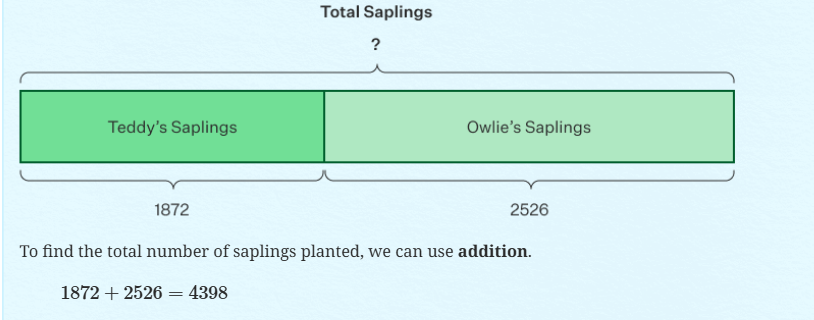
6️⃣ Write the Equation-Math sentence
Now translate the story into a math sentence.
This step connects real-life language with mathematical thinking.
7️⃣ Solve Step-by-Step
Encourage neat, careful calculations.
Rushing leads to mistakes—slow and steady wins this race.
8️⃣ Check the Answer
Teach your child to verify:
- Does my answer make sense?
- Is it too big or too small?
- Did I answer exactly what the question asked?
This final step builds accuracy and confidence.
Practice makes Perfect:
Finally, during the early learning years, make sure your child practices plenty of questions at different levels of complexity—starting with simple word problems and gradually progressing to multi-step word problems—to build strong confidence.
Cuemath’s Step-by-Step Word Problem Lessons That Help Children Overcome Fear
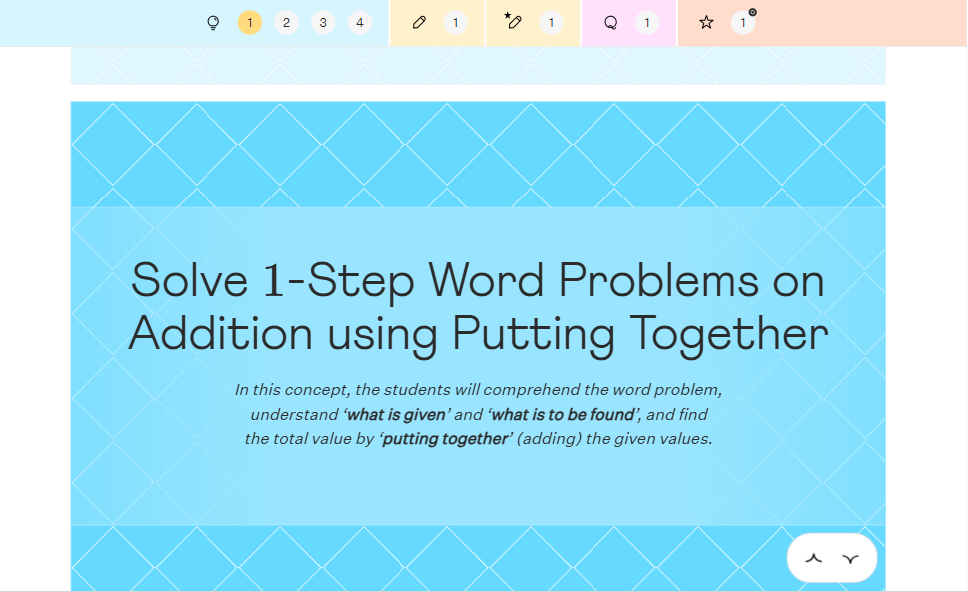
Cuemath goes far beyond simply teaching formulas. There is an entire set of structured lessons dedicated to mastering word problems (or story problems), designed with varying difficulty levels—from simple one-step stories to complex multi-step situations.
Each lesson uses a clear, child-friendly strategy that removes fear and builds confidence:
- They learn to identify 'Given' vs. 'To be found'
- They choose the right operation through guided clues
- They practice visual models before calculating
With this gradual, supportive approach in the early learning years, word problems and real-world applications stop feeling intimidating. Children begin to approach each problem with clarity, logical thinking, and steady confidence—one step at a time.
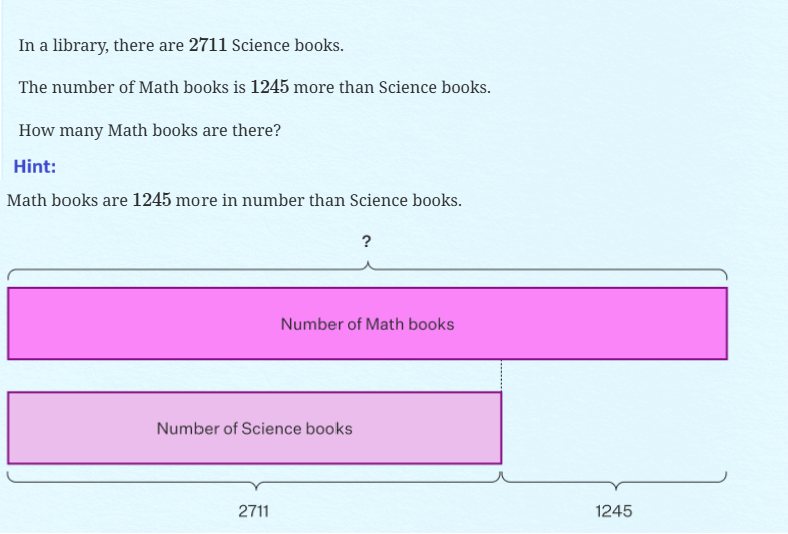
Try This Word Problem with Your Child Using the Same 8-Step Approach!
Give Your Child Confidence in Math – Start Cuemath 1:1 Online Tutoring Today!
Ready to make your kid MathFit?
FAQ
1. Why does my child struggle with word problems even though they know the math?
Many children understand the operations but struggle with the language of word problems. They may miss key details, misunderstand the question, or pick the wrong operation.
Structured approaches—like the step-by-step method taught at Cuemath—help kids read carefully, visualize the scenario, and choose the correct strategy.
2. How can I help my child understand word problems at home?
Use a simple routine:
- Read the problem slowly
- Underline key information
- Ask what the question is actually asking
- Draw a picture
- Choose the operation
- Solve and check
This is the same step-by-step logic-building approach used by Cuemath tutors to help children become strong problem solvers.
3. Why does my child rush and make silly mistakes in word problems?
Kids rush when they feel anxious or want to finish fast.
Teach them a quick habit: “Slow down → Think → Check.”
Programs such as Cuemath train children to pause and evaluate whether their answer makes sense, reducing careless errors over time.
4. How do I get my child to slow down and read word problems properly?
Try the “Read twice, solve once” rule.
The first read builds understanding; the second read focuses on important details.
This technique is widely used in Cuemath’s structured worksheets to build accuracy and attention to detail.
5. What are some easy strategies to solve word problems?
The most effective strategies include:
- CUBES method
- R-D-W (Read–Draw–Write)
- Bar models
- Guess & Check
- Rewriting the problem in simple language
These are the same visual and logical strategies practised in Cuemath sessions to make problem-solving easier and more intuitive.
6. How do I improve my child’s reading comprehension for math problems?
Use short, simple problems and ask your child:
- “What is the story about?”
- “What do we need to find?”
This builds comprehension gradually.
At Cuemath, students practice identifying the “core question” first, which helps them break even tough problems into clear steps.
7. Why does my child freeze or panic when they see long word problems?
Longer questions feel overwhelming because they look more complicated than they actually are.
Teach your child to read one sentence at a time and ignore extra details.
This is similar to how Cuemath teachers guide students—chunking long questions into smaller, manageable statements.
8. How can I teach my child keywords for addition, subtraction, multiplication, and division?
Create a simple keyword chart:
- Addition: total, in all, altogether
- Subtraction: difference, left, fewer
- Multiplication: groups of, times, each
- Division: equal share, per, split
This keyword approach is also reinforced in Cuemath’s curriculum, making it easier for kids to identify operations quickly.
9. How do I help my child check their work independently?
Teach them this self-check routine:
- Reread the question
- Check if they used the right operation
- Think: “Does this answer make real-life sense?”
Cuemath emphasizes this reflective checking habit, which builds independence and reduces repeated mistakes.
10. How do I build my child’s confidence in solving word problems?
Start with simple stories, use visuals, and celebrate small wins.
Confidence builds when kids see progress.
The supportive, one-to-one approach used at Cuemath helps children overcome math anxiety and replace fear with logical thinking and clarity.

About the Author
Neelima Kotamaju
Educator
With 10+ years in EdTech, I design learning experiences rooted in pedagogy, classroom insights, and child psychology, ensuring my work is meaningful and engaging.
View My LinkedIn