10 SAT Prep Tips to Boost Your Score in 2026 (Digital SAT Strategies That Work)
Learn how to ace the SAT with expert SAT prep tips. This SAT study guide explains how to study for the test, improve your SAT math and reading scores, and aim for a 1600 SAT score.

🗓 Last updated: April 2026
The best SAT prep tips aren't about studying more — they're about studying smarter. Most students who jump 150+ points on the Digital SAT don't do it by grinding through endless practice tests. They do it by managing their time better, mastering the 15 math topics that actually show up most, learning to use Desmos properly, and fixing the small, careless mistakes that quietly cost 30–50 points every time.
This 2026 guide walks you through 10 SAT prep tips that have helped Cuemath students score 1500+ on the Digital SAT, how to build a realistic study plan, how to pace yourself on the adaptive modules, and what to do in the final weeks before test day. Whether you're starting 6 months out or 6 weeks out, these are the strategies that actually move scores. Every tip is actionable, every strategy is tested, and every point of improvement is within your reach.
Key Takeaways: TL; DR
- Success on the SAT depends heavily on strategy, practice, and familiarity with the test format, in addition to strong math and reading skills. Here are some expert SAT prep Tips for high SAT scores:
- 1: Small score gains matter. Even a 20–30 point increase—especially in SAT Math—can significantly improve admission chances at selective and Ivy League schools.
- 2: Know the Digital SAT format. It’s fully digital, adaptive, allows calculators for all Math questions, and has no negative marking.
- 3: Follow a structured study plan:
- Months 1–2: Build concepts and accuracy
- Months 3–4: Timed practice + error analysis
- Final weeks: Full-length mocks + fine-tuning
- 4: Quality practice beats quantity. Use official tests, maintain an error log, and review mistakes deeply.
- 5:Time management and smart guessing are critical. Don’t get stuck—collect easy points first and eliminate wrong options.
- 6:SAT Math drives scores. Master algebra, functions, data analysis, geometry, and key formulas to unlock 100+ point gains.
- 7:Mindset, sleep, and nutrition matter. Rest well, eat smart, and stay hydrated for peak performance.
- How to study for the SAT with Cuemath :
- 1:1 personalized SAT Math tutoring
- Targeted Digital SAT-style practice with built-in calculator and tools
- Visual, interactive, concept-first lessons
- SAT Math prep included with core math courses (no extra cost)
- Proven results with 750+ SAT Math scores
- 👉 Bottom line: With the right strategy, structured practice, and personalized support, a 1500+ SAT score—or even a perfect 1600—is achievable.

Why SAT Strategy Matters to Learn How to Ace the SAT
⬆ Back to TOCGetting a high SAT score is all about strategy and preparation.
Even a 20–30 point increase in SAT Math can move a student from average to competitive, or from competitive to elite, particularly at highly selective schools.
By focusing on SAT Math practice, mastering formulas, and smart test strategies, you can turn small score improvements into big advantages. Every point counts, and the right strategy can make the difference between being average, competitive, or elite.
At Ivy League schools:
- At least 25% of the students reported in 2022–2023 earned a perfect SAT Math score.
- The majority of enrolled students who scored 150 reported in 2022–2023.
For many Ivy League colleges, an SAT score around 1500–1580 places applicants in the upper half of admitted students and signals strong academic readiness.
10 Strategies & Expert SAT Prep Tips to Boost Your SAT Score
Tip 1: Master the Digital SAT Format Before You Study (The 98-Question Rule)
⬆ Back to TOCQuick Answer
The Digital SAT is a 2-hour-14-minute, fully adaptive test with 98 questions across Reading & Writing and Math, scored 400–1600, with a built-in Desmos calculator and no penalty for wrong answers.
Before mastering strategies to solve the questions, you need to know the digital SAT format.
| Aspect | SAT Overview |
|---|---|
| Purpose | A standardized test used by colleges to assess college readiness. |
| Test Format | Fully digital and adaptive (difficulty adjusts by section). |
| Sections | Reading & Writing and Math |
| Total Questions | ~98 questions |
| Test Duration | ~2 hours 14 minutes |
| Scoring Range | 400–1600(200–800 per section) |
| Calculator Use | Built-in graphing calculator available for all Math questions |
| Negative Marking | None — no penalty for wrong answers |
| Test Frequency | Offered multiple times a year |
| Who Should Take It | Students applying to U.S. colleges or scholarships |
Understanding the format, timing, and common question types gives you a huge advantage.
Tip 2: The 3-Phase SAT Study Plan (Months 1–2, 3–4, Final Weeks)
⬆ Back to TOCQuick Answer
The most effective SAT study plan runs 6–8 months in three phases: months 1–2 for building concepts, months 3–4 for timed practice and error review, and the final weeks for full-length mock tests and strategic refinement.
⏱ Set Up a Realistic Timeline for the SAT Prep
Start studying early, even months (at least 6-8 months) before your SAT date. A structured plan helps you cover concepts thoroughly and avoid last-minute stress.
Here’s a simple progression:
Months 1–2: Learn Concepts & Build Fundamentals
- SAT Math: Strengthen core topics like algebra, linear equations, functions, ratios, and geometry. Learn and memorize high-impact SAT Math formulas and practice applying them across question types.
- Reading & Writing: Build skills in understanding short digital passages, identifying main ideas, grammar rules, and sentence structure.
- Goal: Accuracy first — focus on understanding why answers are correct or incorrect.
Months 3–4: Timed Practice & Mistake Review
- SAT Math: Practice under timed conditions, using the built-in calculator strategically. Analyze errors to identify weak concepts, careless mistakes, or time issues.
- Reading & Writing: Practice adaptive-style questions and improve pacing while maintaining accuracy.
- Goal: Improve speed, consistency, and decision-making under time pressure.
Final Weeks: Full-Length Tests & Strategic Adjustments
- SAT Math: Take full-length digital mock tests, refine calculator use, and focus on high-value questions that offer the biggest score gains.
- Reading & Writing: Fine-tune passage strategies, grammar shortcuts, and guessing techniques.
- Goal: Build test-day confidence, reduce mistakes, and lock in your target score.
Tip 3: Keep an Error Log — The Cuemath Review Method
⬆ Back to TOCQuick Answer
Quality beats quantity in SAT practice — use official College Board practice tests, keep a weekly error log that categorizes every mistake by type (careless, content gap, timing, misreading), and review patterns before starting your next practice set. This method is followed by the top scorers of SAT.
Effective SAT practice tests are about quality, not quantity.
- Simulate real test conditions using official SAT practice tests
- Review every question deeply
- Maintain an error log (careless mistakes, content gaps, timing issues)
- Prioritize official SAT materials over third-party questions
Why practice hours matter
A 2017 study by the College Board and Khan Academy analyzed nearly 250,000 students and found that 20 hours of practice on Official SAT Practice was associated with an average score gain of 115 points, while even 6–8 hours of practice correlated with an average gain of 90 points. While the study was conducted on the redesigned paper SAT, the underlying principle holds true for the Digital SAT: consistent, targeted practice produces measurable score gains.
Source: College Board Newsroom, May 2017.
Here’s a Sample Error Log for the SAT Prep (With Examples)
| Section | Question # | Question Type | My Answer | Correct Answer | Error Type | What Went Wrong | Fix / Action |
|---|---|---|---|---|---|---|---|
| Math | 7 | Linear equation | B | D | Careless mistake | Solved correctly but copied sign wrong | Slow down on final step; double-check signs |
| Math | 18 | Word problem (percent) | C | A | Content gap | Forgot percent increase formula | Review percent formulas; do 10 similar problems |
| Reading | 24 | Inference | A | C | Misreading | Chose an answer that sounded right but lacked evidence | Always locate exact lines before answering |
| Writing | 33 | Verb tense | D | B | Grammar rule gap | Didn’t recognize tense shift | Review verb tense consistency rules |
| Math | 30 | Quadratic equation | Skipped | B | Timing issue | Spent too long on earlier questions | Use two-pass strategy; mark & return |
Do a weekly error log review (Important)
At the end of each week, ask:
- Which error type appears most often?
- Is SAT Math or SAT Reading causing more issues?
- Are mistakes concept-based or strategy-based?
👉 Your study plan for the next week should be based only on these patterns, not random practice.
Tip 4: The Two-Pass Timing Strategy (Bank Easy Points First)
⬆ Back to TOCQuick Answer
Use the two-pass method: answer every easy and medium question first, flag anything that takes more than 60 seconds, and return to the harder questions only after you've secured every point you can earn quickly.
Time pressure is one of the biggest score killers on the SAT test day. Many students know the material but lose points by mismanaging time.
Hence, it is crucial to simulate real test conditions by taking SAT practice tests during SAT prep.
Smart Timing Tips for the SAT
- Don’t spend too long on one hard question
- Answer easy ones first
- Return to tougher items only if you have time
This ensures you collect all the “easy” points you can’t afford to lose.
Tip 5: Strategic Elimination — Never Leave a Bubble Blank
⬆ Back to TOCQuick Answer
The SAT has no penalty for wrong answers, so never leave a question blank — use process of elimination to rule out clearly wrong choices first, then guess from what's left to maximize your scoring odds.
The SAT doesn’t penalize incorrect answers. That means you should never leave a question blank. Multiple-choice tests reward students who effectively eliminate wrong answers as much as those who identify correct ones.
For each question:
- Read the question carefully, identifying exactly what it asks
- Before looking at answers, formulate your own answer
- Evaluate each answer choice, actively looking for why it's wrong
- Eliminate answers with clear flaws first
- Compare remaining answers, identifying which has the strongest textual support
- Select the answer you can definitively defend using passage evidence
Tip 6: The Evidence-First Reading Strategy for the Digital SAT
⬆ Back to TOCQuick Answer
On the Digital SAT Reading & Writing section, the correct answer is always directly supported by the passage — stop looking for the "best" interpretation and start looking for the answer that is literally restated in the text using synonyms.
Reading passages can be intimidating, but strategic thinking makes them manageable. Develop an Effective Reading Approach. Test different reading strategies during practice to identify your optimal method:
Strategy A: Skim–Question–Read
- Quickly skim the passage for main ideas and structure
- Read all questions carefully
- Thoroughly read the passage with questions in mind
- Answer questions referencing specific passage sections
Strategy B: Question-First Reading
- Read all questions before touching the passage
- Read the passage actively, marking sections relevant to questions
- Answer questions as you encounter relevant information
Strategy C: Active Annotation
- Read the passage once, annotating main ideas, tone shifts, and key evidence
- Summarize each paragraph’s purpose in the margin
- Approach questions with a clear understanding of passage structure
Master Active Reading Techniques. Engage with passages intellectually rather than passively absorbing words:
- Identify the author's main argument and purpose
- Note shifts in tone, perspective, or argument
- Recognize supporting evidence versus opinions
- Anticipate counterarguments or complications
- Connect ideas across different paragraphs
Each question type demands specific skills. Practice recognizing and approaching each type systematically.
Tip 7: Memorize the 15 High-Frequency SAT Math Concepts (They Cover 70% of the Section)
⬆ Back to TOCQuick Answer
SAT Math rewards mastery of a narrow set of high-frequency topics — focus on linear equations, systems of equations, ratios, percentages, functions, and quadratics, memorize the core formulas not included on the reference sheet, and learn to use Desmos for algebra and graphing shortcuts.
The SAT Math section tests logical reasoning, problem-solving, and conceptual understanding — not speed alone. Students aiming for a 1600 SAT score or wondering how to raise SAT score quickly must know that success comes from combining strong fundamentals with smart SAT strategies.
The best way to study for SAT Math is through focused SAT study, clear problem-solving frameworks, and targeted SAT prep tips that convert practice into points.
Here's how to ace the SAT Math section, trusted by top scorers and the best SAT prep classes.
SAT Study Guide to Master Core SAT Math Concepts (High-Frequency Topics)
Focus on the content areas that appear most often on SAT Math practice tests. If you’re wondering how to increase SAT score efficiently, mastering these domains delivers the biggest payoff.
| SAT Math Domain | Key Concepts Tested |
|---|---|
| Algebra | Linear equations, systems of equations |
| Advanced Math | Quadratic equations, expressions |
| Problem Solving & Data Analysis | Ratios, percentages, statistics |
| Functions | Function notation, transformations |
| Geometry | Area, volume, angles, triangles |
| Trigonometry | Sine, cosine, tangent |
| Exponents | Exponential growth and decay |
Use a Systematic SAT Math Problem-Solving Method
One of the most overlooked SAT tips is consistency. Every top scorer follows a repeatable process — this is core SAT prep advice.
- Read the full question carefully (avoid jumping to calculations)
- Identify what the question is actually asking
- Choose the fastest solution method
- Estimate a reasonable answer range
- Solve step-by-step
- Check whether the final answer makes logical sense
This method dramatically reduces careless mistakes and is a proven way to raise SAT scores under time pressure.
How to Avoid Common SAT Math Mistakes
Avoiding mistakes is just as important as learning content when figuring out how to score a 1600 on the SAT.
| Mistake Type | Why It Happens | How to Fix It |
|---|---|---|
| Careless errors | Rushing through easy questions | Pause before final answer |
| Wrong variable | Misreading question demand | Underline what’s asked |
| Sign/exponent errors | Skipped steps | Write intermediate steps |
| Calculator overuse | Dependency | Strengthen mental math |
| Unrealistic answers | No estimation | Estimate before solving |
Memorize Essential SAT Math Formulas
Although the SAT provides a formula sheet, memorizing key formulas saves time—a key insight from the best books to study for the SAT.
| Formula Type | Should You Memorize? |
|---|---|
| Area & volume | Yes |
| Slope & midpoint | Yes |
| Quadratic basics | Yes |
| Trigonometric ratios | Yes |
Scoring 750+ on SAT Math comes down to three habits:
mastering the high-frequency topics above, following a consistent problem-solving method, and building muscle memory for the formulas you can't look up on the reference sheet. Students who do all three consistently tend to see their Math section scores move from the 600s into the 700s within 3–4 months of focused practice.
Solved SAT Math Geometry Problem
Tip 8: The Test-Day Mindset Reset (30-Second Breathing Protocol)
⬆ Back to TOCQuick Answer
Test anxiety is the silent score-killer — practice mindfulness and deep-breathing techniques during your mock tests so they become automatic on test day, and treat each hard question as a single data point rather than a verdict on your performance.
A calm mind equals a higher score.
Key Mindset Tips for the SAT test day
- Visualize success before entering the test room
- Don’t panic when you see a tough question
- Take deep breaths and reset focus
Studies show that mental preparation and stress control significantly improve performance during high-stakes exams.
Tip 9: The 48-Hour Test-Day Readiness Protocol (Sleep, Food, Hydration)
⬆ Back to TOCQuick Answer
Aim for 7–8 hours of sleep in the two nights before the test, eat a balanced breakfast with slow-release carbs and protein on test morning, and stay hydrated throughout prep — physical readiness directly affects focus, memory, and decision-making under pressure.
Your brain needs fuel—and rest.
⭐ Target 7–8 hours of sleep before test day
⭐ Eat slow-release carbs + protein on exam morning
⭐ Stay hydrated throughout preparation and test day
Physical readiness affects cognitive function more than most students realize.
Tip 10: The Complete SAT Test-Day Checklist (What to Bring, What to Do, What to Avoid)
⬆ Back to TOCQuick Answer
On test day, bring a valid photo ID, admission ticket, fully charged device with Bluebook installed, an approved backup calculator, pencils, a snack, and water — arrive at least 30 minutes early, and avoid any last-minute cramming that could raise anxiety.
✔ Sleep well the night before
✔ Eat a balanced breakfast
✔ Arrive early with all supplies
✔ Hydrate, breathe, and start strong
A confident start often leads to a confident finish.
How Cuemath Helps Boost Your SAT Scores
⬆ Back to TOCNow that you know the 10 strategies, here's how Cuemath can help you execute them.
Because SAT Math accounts for 50% of the total SAT score, even a small drop in accuracy can be the difference between a 1450 and a 1500+ SAT score. That’s why personalized SAT Math prep is critical for students aiming for top percentiles.
Cuemath’s 1:1 SAT Math tutoring is designed to pinpoint each student’s exact gaps—whether in algebra, functions, problem-solving speed, or careless errors—and fix them through targeted practice and proven SAT strategies.
This concept-first SAT study approach helps students consistently maintain 740–780, a key benchmark for breaking into the 1.
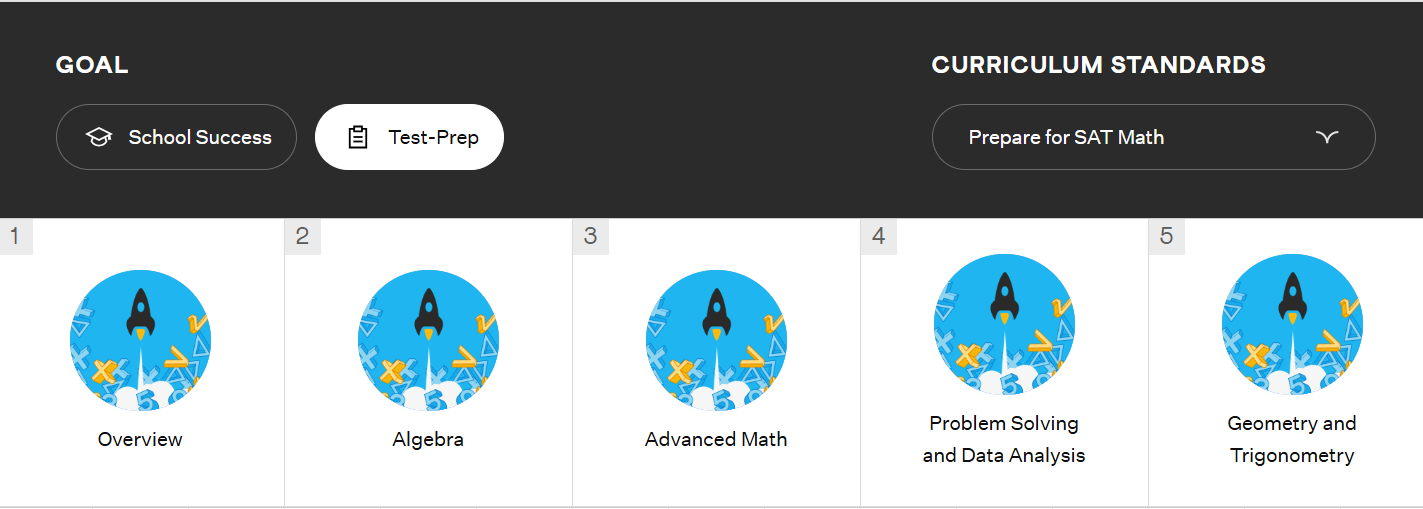
Here’s why Cuemath is recommended for the SAT Math Prep:
Don’t judge by one review. Cuemath’s top Trustpilot rating reflects trusted teachers and real student success

Students enrolled in Algebra, Geometry, Precalculus, or Calculus programs get SAT Math prep included at no extra cost.
Learn how Cuemath students achieved higher SAT scores using Cuemath’s personalized SAT Math prep. Read a few Cuemath's SAT success stories:
 Cuemath
 Cuemath
Conclusion: Turn SAT Strategy Into High SAT Scores
⬆ Back to TOCA high SAT score isn't about natural talent or endless practice — it's about strategy, structure, and smart study. Students who ace the SAT don't practice endlessly; they practice intentionally.
By mastering high-impact SAT Math concepts, understanding the Digital SAT format, and using targeted SAT prep tips, even small improvements can unlock big admissions advantages — including at Ivy League and highly selective universities.
With a structured plan, consistent practice, and honest error review, a 1500+ SAT score — or even a perfect 1600 — is genuinely achievable.
The choices made early often shape both outcomes and experience—choose thoughtfully.
Math Made Simple, SAT Scores Made High!
Master high school math with a proven SAT study guide where every course includes targeted SAT prep tips and strategies—so you know exactly how to ace the SAT, raise your SAT score, and aim for a perfect 1600 SAT score with confidence.
Frequently Asked Questions (FAQ)
⬆ Back to TOCWhen should I start preparing for the SAT?
For effective SAT prep, start at least 6–8 months before your test date. This allows enough time to strengthen fundamentals, identify weaknesses, and take multiple SAT practice tests. Students who prepare for 6–8 months often see larger score improvements.
Can practice tests really improve my SAT score?
Absolutely. SAT practice tests replicate real test-day conditions, improve your pacing, and highlight areas that need attention. The students who improve most are those who take practice tests under real timed conditions and spend as much time reviewing mistakes as taking new tests.
How can I improve at SAT Math specifically?
To excel in SAT Math:
- Memorize essential formulas and problem-solving techniques
- Solve timed practice questions to balance speed and accuracy
- Review mistakes to eliminate recurring errors
- Focus on process over guessing, while practicing strategic time management
The fastest gains usually come from fixing recurring error types rather than learning new content — most students already know more than they think.
What is the best way to read passages in SAT Reading?
There's no one-size-fits-all approach, but common SAT Reading strategies include:
- Skimming for main ideas before details
- Reading questions first, then scanning for answers
- Annotating key sentences
Experiment with different techniques during practice to find what works best.
Is guessing on the SAT okay?
Yes. The SAT does not penalize wrong answers, so always guess rather than leave blanks. Use process of elimination to improve your odds on harder questions.
How important is time management on the SAT?
Timing is crucial. Many students lose points due to poor pacing. Prioritize easy questions first, set target time per section, and revisit tougher problems only if time allows.
The two-pass method — banking easy points first, then returning to harder questions — is the single most effective pacing strategy for the adaptive Digital SAT.
Can I take the SAT more than once?
Yes. Many students retake the SAT to raise their scores. Colleges often accept Score Choice, so you can submit only your highest results.
What should I bring on SAT test day?
Essential items for SAT test day:
- Printed admission ticket
- Valid photo ID
- Fully charged device with Bluebook app installed
- Approved backup calculator (the Digital SAT has a built-in calculator)
- #2 pencils, snacks, and water
Arrive at least 30 minutes before the start time to allow for check-in and setup of the Bluebook app.
What are the best resources for SAT strategy and practice?
Recommended SAT prep resources include:
- Official College Board SAT practice tests (satsuite.collegeboard.org)
- SAT strategy guides that teach time management, process of elimination, and calculator skills
- Quality third-party resources like Princeton Review, Barron's, or dedicated SAT apps for additional practice beyond the official materials
Will scoring a 1500+ on the SAT guarantee admission to an Ivy League school?
Not necessarily. A 1500+ SAT score is excellent and places you well above the national average, but Ivy League admission is holistic. These schools consider:
- Grades and GPA: Consistently strong academic performance matters as much as test scores.
- Extracurriculars: Leadership, achievements, and impact in clubs, sports, arts, or research are evaluated.
- Essays and Recommendations: Personal essays and teacher recommendations provide insight into character, drive, and fit.
- Class Rank & Course Rigor: Taking advanced or AP courses shows readiness for challenging academics.
Think of a 1500+ SAT as a strong ticket to be considered, but not a guarantee. Many applicants with perfect scores still get waitlisted or rejected because Ivy League admissions weigh multiple factors.
How high should my SAT Math score be to get into top colleges?
Competitive colleges typically look for 600–700+ in Math, while Ivy League and top STEM schools often expect 740–800. A strong Math score can significantly boost your total SAT score, especially if you're aiming for selective programs.
For students aiming at STEM-heavy programs, scoring in the 750+ range on Math often matters more than the combined total.
Does Cuemath offer SAT Test Prep?
Yes — Cuemath offers specialized SAT Test Prep, with a focus on SAT Math. Cuemath's program includes:
- 1:1 personalized tutoring tailored to your strengths and weaknesses
- Targeted Digital SAT-style practice questions with an emphasis on logic, algebra, geometry, data analysis, and problem-solving
- Timed practice and strategy training to build pacing and confidence
- Error analysis and feedback to help you improve efficiently
- Interactive, concept-first lessons that build strong mathematical foundations
While Cuemath's core strength is SAT Math preparation, the analytical and reasoning skills developed also support overall SAT success. Many students use Cuemath alongside official practice tests and broader prep resources for full SAT readiness.
What are the best books to study for the SAT?
The best books to study for the SAT include the Official SAT Study Guide from the College Board for authentic practice, along with strategy-focused books for SAT Math and Reading from publishers like Princeton Review, Barron's, and Kaplan.
What are the best SAT prep classes?
The best SAT prep classes share three features: personalized instruction based on a diagnostic test, a clear content and strategy curriculum, and structured practice with error review. Options range from group classes (Princeton Review, Kaplan) to 1:1 tutoring (Cuemath, Varsity Tutors) — the right fit depends on a student's learning style, starting score, and budget.
What are the best SAT prep tips for 2026?
The best SAT prep tips for 2026 focus on the Digital SAT's adaptive format: master the high-frequency math topics (linear equations, functions, ratios, quadratics), use Desmos for algebra shortcuts, follow the two-pass timing method, keep a weekly error log, and take full-length practice tests under realistic conditions. Most students who gain 150+ points do so in 3–6 months of structured prep.
How can I improve my SAT score by 200 points?
A 200-point SAT score increase is realistic in 3–6 months with three changes: identify your top 5 recurring mistakes through practice test review, master the 15 highest-frequency SAT Math topics (which cover roughly 70% of the Math section), and practice strict timing on adaptive modules. Students who gain 200+ points almost always do it by fixing weaknesses systematically, not by studying more hours.
What is the best way to prepare for the Digital SAT?
The best way to prepare for the Digital SAT is to start 6–8 months before your test date, use official College Board practice tests on the Bluebook app (not third-party materials), focus on the adaptive format's timing demands, and review mistakes weekly. Khan Academy's free Official SAT Practice remains the strongest free resource, paired with timed full-length mocks in the final 4–6 weeks.
How long does it take to prepare for the SAT?
Most students need 3–6 months of consistent SAT prep to reach their target score. An aggressive 3-month plan works for students starting with strong fundamentals, while 6–8 months is ideal for students aiming for 150+ point gains or targeting highly selective colleges. Last-minute prep of 4–6 weeks can still yield modest improvements if focused on strategy and weak-area review.
What is Desmos and how do I use it on the SAT?
Desmos is the graphing calculator built directly into the Digital SAT's Bluebook app, available for all Math questions. Top scorers use Desmos to solve algebra problems visually — graphing equations to find intersections, zeros, and maximums instead of solving algebraically. Practicing with Desmos before test day is essential; many Math questions can be solved in under 30 seconds with the right Desmos technique.
This blog has been reviewed by Cuemath’s team of expert tutors & curriculum specialists, trained in US Common Core State Standards.

About the Author
Neelima Kotamraju
Educator
With 10+ years of experience in EdTech, Neelima Kotamraju designs learning experiences rooted in pedagogy, classroom insights, and child psychology. She works closely with Cuemath's team of expert tutors and curriculum specialists to create structured, outcomes-driven education for students across grade levels — from elementary math to Digital SAT and AP Calculus prep.
View My LinkedIn