How a Grade 4 Student Went From Developing to Excelling in School Math
A Grade 4 student who didn't enjoy math went from Developing to Excelling across two school report cards and was selected for her school's Star Exam. Her mother describes the turnaround; her tutor explains the steady habits that drove it.
Parents of a Grade 4 student are usually the first to notice it. The sigh when the math worksheet comes out. The book closed a little too quickly. "I'm done" when nothing has been done. You tell yourself she is young and math will click. But when every week brings the same reluctance, the worry builds.
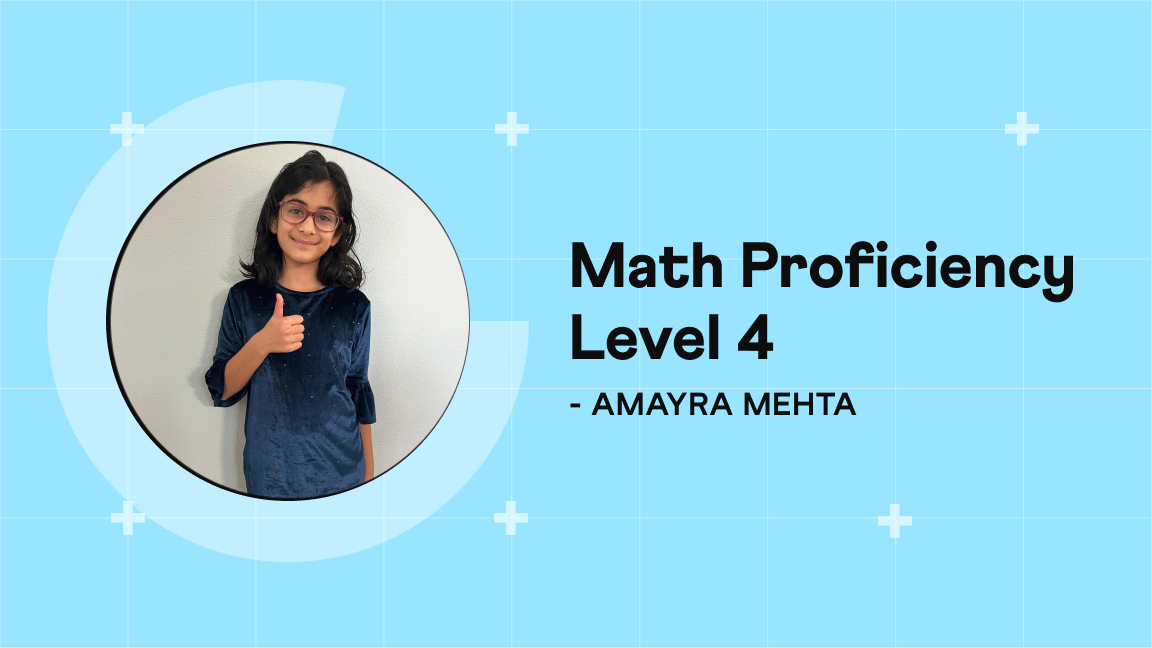
This year, Amayra Mehta's math report card has shown a rare kind of momentum. Across two reporting periods, her Grade 4 math standards now span the top half of her school's 1-to-4 proficiency scale. She held Excelling, the top rating, on most math topics; moved her weakest standard up from Developing; and hit Excelling on new fraction topics introduced in Q2. Her teacher has since selected her for the school's Star Exam.
This is the story of Amayra Mehta, a Grade 4 student in the US whose early reluctance with math turned into the kind of confidence that changes how a child sees the subject.
Meet Amayra Mehta
- Grade: 4
- Country: USA
- Tutor: Zeba
- With Cuemath Since: 2024
- Achievement: From Developing to Excelling across two math report cards, selected for the school's Star Exam
What the 1-to-4 Proficiency Scale on a US Elementary Math Report Card Means
Many US elementary schools use a four-point standards-based grading scale on math report cards. A 4 means Excelling, indicating the student is consistently exceeding grade-level standards independently. A 3 means Proficient, meeting grade-level standards. A 2 means Developing, progressing toward meeting them. A 1 means Beginning, needing significant support. A student moving from a 2 to a 3 or a 4 across reporting periods shows a real change in both skill and confidence, not just the result of a single good test.
What Does It Look Like When a Grade 4 Student Is Not Connecting With Math?
Amayra came into her Cuemath sessions with a familiar kind of reluctance. Her parent said it plainly. She never really enjoyed math. That did not show up as a failing grade. It showed up in her posture during a worksheet. In how quickly she wanted the homework folder closed. In the way she would answer "I know" to a concept she had not actually understood yet.
That combination, small gaps no single test catches plus the emotional drift that makes a child avoid math, is how bright young learners slide through elementary school without the foundation their later years demand. Grade 4 is when math stretches beyond counting and basic operations into multi-step reasoning, fractions, and word problems. A student already pulling away finds these harder to engage with later.
"Amayra is showing wonderful improvement in her learning journey. She is becoming more confident with each lesson and is developing a better understanding of mathematical concepts day by day. Her willingness to try, learn from mistakes, and stay consistent is truly commendable."
~ Zeba, CUEMATH TUTOR
How Does One-on-One Math Tutoring Help a Young Student Build Confidence?
When Amayra started working with Zeba, her Cuemath tutor, the first change was not accuracy but participation. Zeba described a student becoming more confident each session, willing to try, be wrong, and come back. That kind of learning rhythm is quiet. It does not show up on a single test. It shows up over a quarter.
The one-on-one attention was what her parent later pointed to as the turning point. Ritu, Amayra's mother, put it simply. Before Cuemath, Amayra was not very interested in math. In a classroom of twenty, a hesitant math learner can stay hesitant for a long time. In a weekly session with an online math tutor, that hesitation gets caught early. For her family, the change at home has been a very happy surprise.
"Before joining Cuemath, she wasn't very interested in math and her grades were quite low. But now, she has shown amazing improvement—she's doing excellent in math! Her teacher has even selected her for the school Star Exam, which is a wonderful achievement."
~ Ritu Mehta, Amayra's Mother
How Does a Grade 4 Student Go From Developing to Excelling in Math?
Across two reporting periods, Amayra's math report card told a clear story. In Q1, she scored Excelling on most Grade 4 math topics she had been taught, except one standard, Generate and Analyze Patterns, which came in at Developing. In Q2, that same standard moved up to Proficient, showing her weakest area was closing. She scored top marks on new topics now covered, including fraction equivalence and comparing fractions.
Then came something her parents had not expected. Her teacher selected Amayra for the school's Star Exam, a recognition given to the top performers in her grade. For a young student who had started the year with the worksheet pushed away, that selection was a powerful outside signal that the change was real.
Does This Sound Like Your Child?
Your child might be on a similar path if they:
- Are in early elementary grades and quietly avoid math homework without ever complaining about it
- Get decent grades at school but do not seem to enjoy or engage with math the way you hoped
- Would benefit from one-on-one attention that a classroom setting cannot provide
- Are at the Grade 3 to Grade 5 window when the math curriculum starts stretching beyond basic operations
Frequently Asked Questions
What does the 1-to-4 proficiency scale on a US elementary math report card mean?
The 1-to-4 scale appears on many US elementary report cards. A 4 is Excelling, a 3 is Proficient, a 2 is Developing, and a 1 is Beginning. A student who moves from a 2 to a 3 or 4 across reporting periods is showing real growth in skill and confidence.
Does one-on-one math tutoring help a Grade 4 student who does not enjoy math?
One-on-one math tutoring lets a tutor catch hesitation early and rebuild confidence at the student's pace. For a Grade 4 learner who has drifted, the shift begins with participation before it shows up in grades. Weekly sessions with an online math tutor build this rhythm.
Why is Grade 4 an important year for math confidence?
Grade 4 is when math moves beyond counting and basic operations into fractions, multi-step problems, and early reasoning. A student who loses interest here struggles more in Grade 5 and 6. Building confidence at this stage is easier than rebuilding it later.
The Earlier Your Child Starts Enjoying Math, the Further They Go
Weekly one-on-one math sessions are where elementary report cards quietly start changing. Start with a reluctant learner and end with a confident one.
Start with a Free Cuemath Evaluation Today.
Book a Free EvaluationFor students in Grades K to 12 worldwide.
What Two Quarters of Improvement and a Star Exam Selection Say About Amayra's Math Journey
What Amayra's two report cards show is not one top rating. It is a Grade 4 student who started the year pushing the workbook away, moved her weakest standard up from Developing in a single quarter, held top marks on everything her class covered, and was chosen by her teacher for the school's Star Exam. That change rarely comes from extra homework. It comes from a young learner being seen every week, allowed to try and be wrong, shown that math makes sense at the right pace. That is what being MathFit looks like for a nine-year-old. A child who has started to notice math mattering on her own.