Mathnasium Reviews 2026: What Parents Say About Cost, Results & Complaints
Mathnasium has a 3.9/5 rating on Trustpilot, but parent experiences vary a lot depending on the center. It works well for younger kids who need help with math basics. It's a no if your child is in high school or needs one-on-one attention.


🗓️ Last Updated: May 2026
Mathnasium has a 3.9/5 rating on Trustpilot currently. Parent experiences vary a lot depending on the Mathnasium center. It tends to work well for younger kids who need help with math basics. It's a harder sell if your child is in high school, needs one-on-one attention, or is struggling to keep up with what's being taught in class right now.
Here's something most parents don't know before they walk in: Mathnasium is a franchise. There are over 1,000 locations across the US, and each one is independently owned. The Mathnasium brand controls the curriculum and teaching method, but the owner decides who gets hired, how many kids share each instructor, what you're charged, and how refunds work.
Two Mathnasium centers in the same city can feel like completely different programs. That's why online Mathnasium reviews are all over the place. A parent in one zip code has a completely different experience from a parent across town. So instead of giving you a single thumbs up or thumbs down, for this blog, we went through what parents are actually saying on Reddit and Trustpilot (the good and the bad), what it typically costs ($250–$350/month), and the specific questions to ask at your local Mathnasium center before you commit.
What is Mathnasium and How Does it Work?
Mathnasium is an after-school math learning center for kids in grades K–12. Students come in a few times a week, work through a personalized set of math problems, and build up the skills they're missing.
Mathnasium uses games, rewards, and hands-on activities to make math feel less like a chore, which is why a lot of parents say their kids actually start looking forward to going.
What Happens During a Mathnasium Session?
Students attend Mathnasium sessions for 60 minutes for 2–3 times a week. They reach the centre, sit at shared tables, working through their custom worksheet binders while instructors move around the room. When a student gets stuck, they raise their hand and an instructor comes over to help.
There's also a rewards system built in. One Reddit user who attended as a child described it: "I had a lot of fun while I was there because you got hole punches in a card for each worksheet you completed, which you could save to get little prizes." It's a small thing, but it's part of why younger kids often look forward to going.
Before your child starts, there's a placement assessment. A former center director on Reddit described theirs as a 45-minute verbal test before the written portion. The depth of that assessment varies by center, but the goal is the same: build a custom worksheet set.
Curious how Mathnasium compares to other popular programs?
Our tool lets you pick Mathnasium and any program you have in mind and compare them side-by-side: price, teaching format, curriculum focus, and who each is actually built for. One screen, no other website needed.
Compare Mathnasium with Other Programs →Does Mathnasium Have Tutors?
No, Mathnasium is not a math tutoring program. It is neither a personalized math tutoring program. There are instructors at the centre who are not to be confused with the math tutors. The instructor's job is to help students get through the worksheets if they have any doubts.
How Much Does Mathnasium Cost?
Mathnasium prices are not listed publicly since each Mathnasium center sets its own rates.
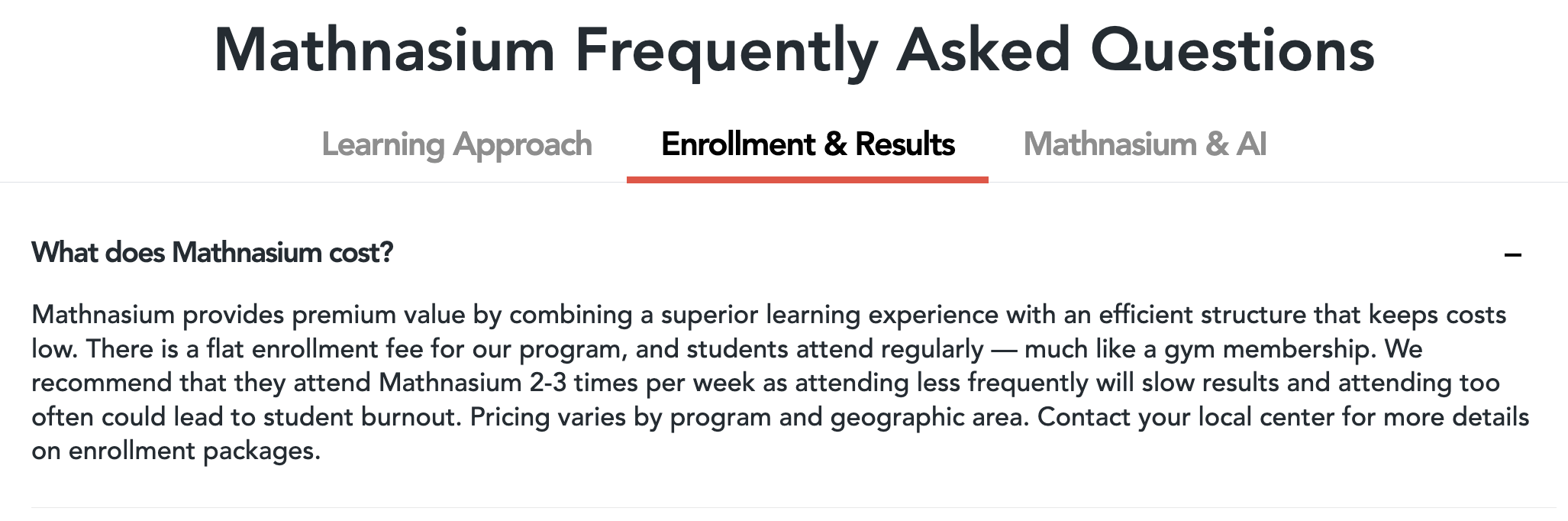
But we did our research earlier by reading parent-reported prices from Reddit and Trustpilot. Mathnasium costs between $250 and $350 per month on average. What's Surprising? Mathnasium charges a one-time enrollment fee of $100–$150.
What is the Common Review About Mathnasium?
Parents who have tried Mathnasium fall under two groups:
a) Mathnasium parents who feel their children have made steady math progress over several months.
b) Mathnasium parents who feel their children got very little attention in sessions.
Here are some Mathnasium reviews from parents, students, and instructors sourced from Reddit as it is:
Mathnasium is good for students who:
- Are behind grade level and need consistent practice (solving worksheets, drill-based practice).
“I had one kid go from a 1st grade special ed level (says his school) to above a 4th grade level in less than 1 year.”
— Former Mathnasium Center Director, r/learnmath (2019)
2. Want a structured learning environment with a consistent routine.
“Attending regularly will gradually make them better math students and patch up gaps in the math they should have learned in previous years.”
— Former Mathnasium Instructor, r/learnmath (2025)
- Are already doing well, motivated, and just need a routine practice solving classes.
“For the kids that are motivated it works wonders, but unfortunately a lot of them are checked out and you can only do so much with someone who doesn’t want to be there at all.”
— Former student and instructor, r/learnmath (2019)
- Are just looking to ace basic math concepts.
“My main focus was number sense, which is why my kids were so successful at learning the building blocks.”
— Former Center Director, r/learnmath (2019)
Mathnasium is not good for students who:
- expect an expert math tutor and 1:1 tutoring.
“Mathnasium has high school children monitoring your children, not helping them nor showing them the steps. They throw a bunch of math sheets and have them sit there and do it for the hour the child is there. They have too many children and not enough qualified tutors. It is absolutely a waste of money.”
— Parent reviewer, r/learnmath (2019)
- need a customized learning plan that adapts according to their learning goals.
“Mathnasium isn’t really the place to dig them out of a hole for the upcoming report card grade, or save them on the next test. It’s sort of like vitamins or exercise — if you make it part of your routine, you will be healthier in the long term. But if you’re sick right now, taking a bunch of vitamin C isn’t going to be much help.”
— Former Mathnasium Instructor, r/learnmath (2025)
- are in high school and need expert tutoring.
“The high school curriculum is bad, but I heard HQ is working on it.”
— Former Mathnasium Instructor of 5 years, r/learnmath (2019)
- are price-sensitive and expect costs to reflect quality.
“Wayyyyy too much money, and they hardly even pay the tutors anything. Such a cash cow, I ended up just hiring a neighbor to help me.”
— Parent, r/learnmath (2019)expect
- Want curriculum-aligned tutoring.
Mathnasium’s curriculum is proprietary and does not follow the US Common Core State Standards. Students work through the Mathnasium binder independent of their school syllabus. If a child is struggling with a specific unit in school, Mathnasium is unlikely to address it directly. (Source: MyEngineeringBuddy, 2025)
Mathnasium is not for a parent who needs week-to-week school curriculum alignment and is looking for help with what their teacher is assigning right now.
Questions to Ask Your Local Mathnasium Instructor
Mathnasium franchise reviews vary so widely because each center is independently owned.
- Two parents in different cities can have opposite experiences.
- A center run by a good director with experienced staff will look very different from one run mainly to cut costs.
- There is no national standard for instructor credentials. Some centers hire retired teachers. Others hire high school students.
What to ask before signing up at any Mathnasium:
- What is the typical student-to-instructor ratio during after-school hours?
- What are the credentials of your instructors?
- Can I observe a session before committing?
- What is your cancellation and refund policy in writing?
- How do you handle it if my child needs help with a specific school topic?
Before you sign up at any Mathnasium:
Mathnasium franchise reviews vary sharply because each center is independently run. Visit during after-school hours and observe the actual instructor-to-student ratio. It can tell you more than any online review.
Mathnasium Reviews on Trustpilot
Mathnasium has a 3.7/5 rating on Trustpilot (as of May 2026).
What parents praise on Trustpilot:
“Mathnasium was quickly helping my son understand the maths and he began to excel. Now he is top scorer in his math class.”
— Trustpilot reviewer (Source: Brighterly Mathnasium Review, 2025)
Parents who leave positive reviews almost always mention a specific tutor who made the difference, or a child who came in well behind grade level and caught up over time.
What parents criticize on Trustpilot:
“Due to my heavy school workload, I requested to change the session to once per week, and I was told to wait. The money was also not returned while I was waiting for their response.”
— Trustpilot reviewer (Source: Brighterly Mathnasium Review, 2025)
The most common complaints on Trustpilot are billing problems, difficulty rescheduling sessions, and poor customer service. These are center management complaints, which again come back to how the individual franchise is run.
How Does Mathnasium Compare to Other Options?
Mathnasium costs more than Kumon, gives students less individual attention than online 1:1 tutoring, and does not align with the school curriculum. The table below gives a quick side-by-side of the three programs parents most often compare. For a full breakdown, see our Cuemath vs Mathnasium comparison.
 Nikita Joshi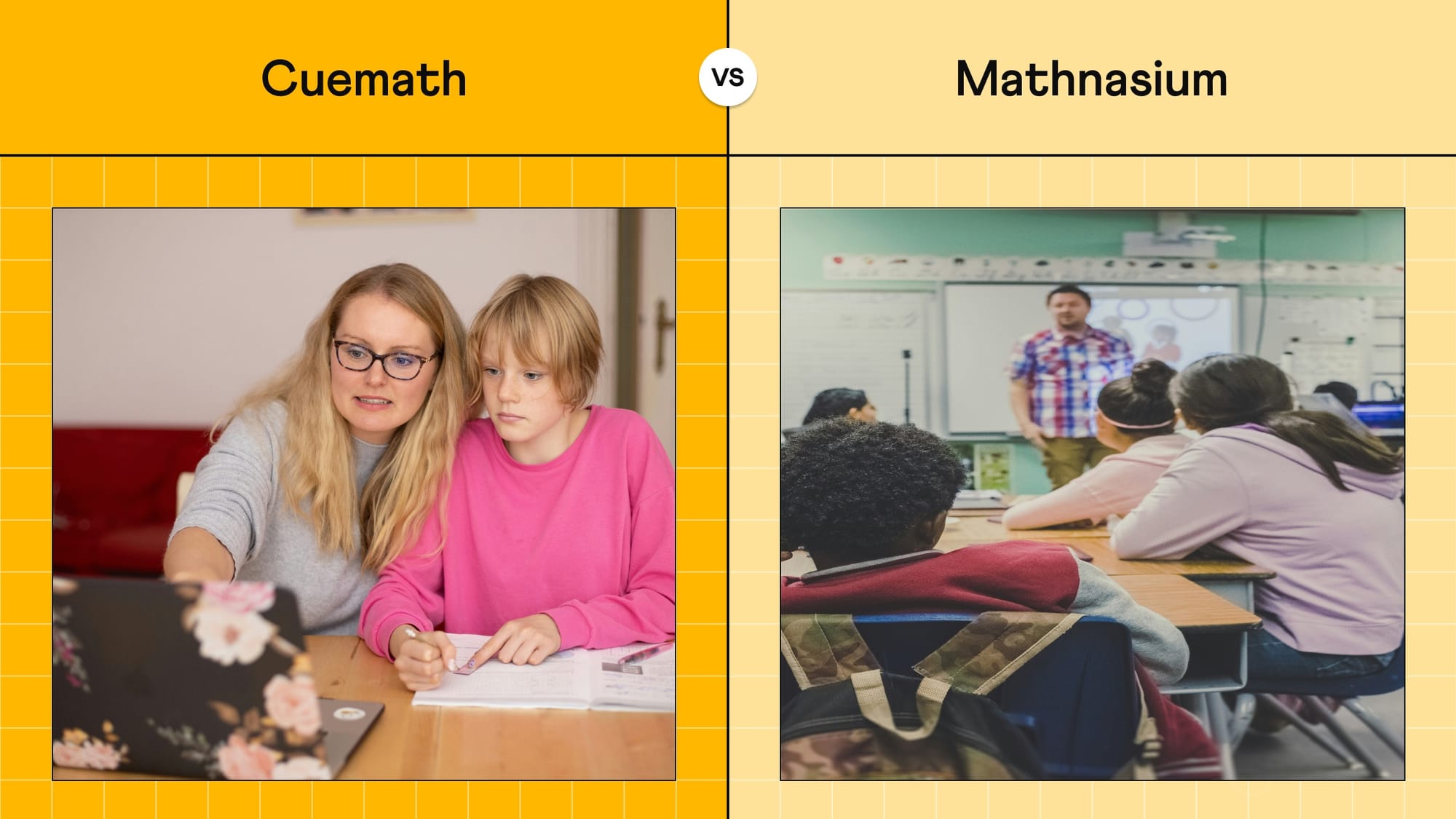
| Mathnasium | Kumon | Cuemath | |
|---|---|---|---|
| Format | In-center, small group | In-center, self-study | Online, 1:1 live |
| Student:Tutor Ratio | ~3–4:1 (up to 15:1 at peak) | Mostly self-directed | 1:1 always |
| Curriculum Alignment | Proprietary (not CCSS) | Proprietary (not CCSS) | US Common Core aligned |
| K–12 Coverage | K–12 (high school weak) | K–12 (advanced weak) | K–12 (full) |
| Cost | $250–$350/month | $100–$200/month | Starting at $25/class |
| Trustpilot | 3.7/5 (63 reviews) | Limited | 4.9/5 (9,667+ reviews) |
| Free Trial | Varies by location | Varies by location | 1 free class + MathFit Evaluation |
| Best For | Foundational gaps, K–6 | Computational fluency drills | 1:1 attention, K–12 |
See What 1:1 Math Tutoring Really Looks Like
Try a FREE live Cuemath class a full 55-minute 1:1 session with a custom learning plan included. No credit card required.
Book a Free Class200,000+ students · 4.9/5 Trustpilot · Grades K–12
What Are the Best Mathnasium Alternatives?
If Mathnasium does not fall under your budget or learning requirements, we have put three simple options for you:
Private Tutors
A private tutor ($30–$80/hour) gives your child 1:1 attention and can adapt to exactly what their school is teaching that week. Quality varies widely depending on who you hire, but a good local tutor is often the most flexible and personal option available. The main downside is the lack of a structured curriculum and the time it takes to find and vet a good fit.
Cuemath
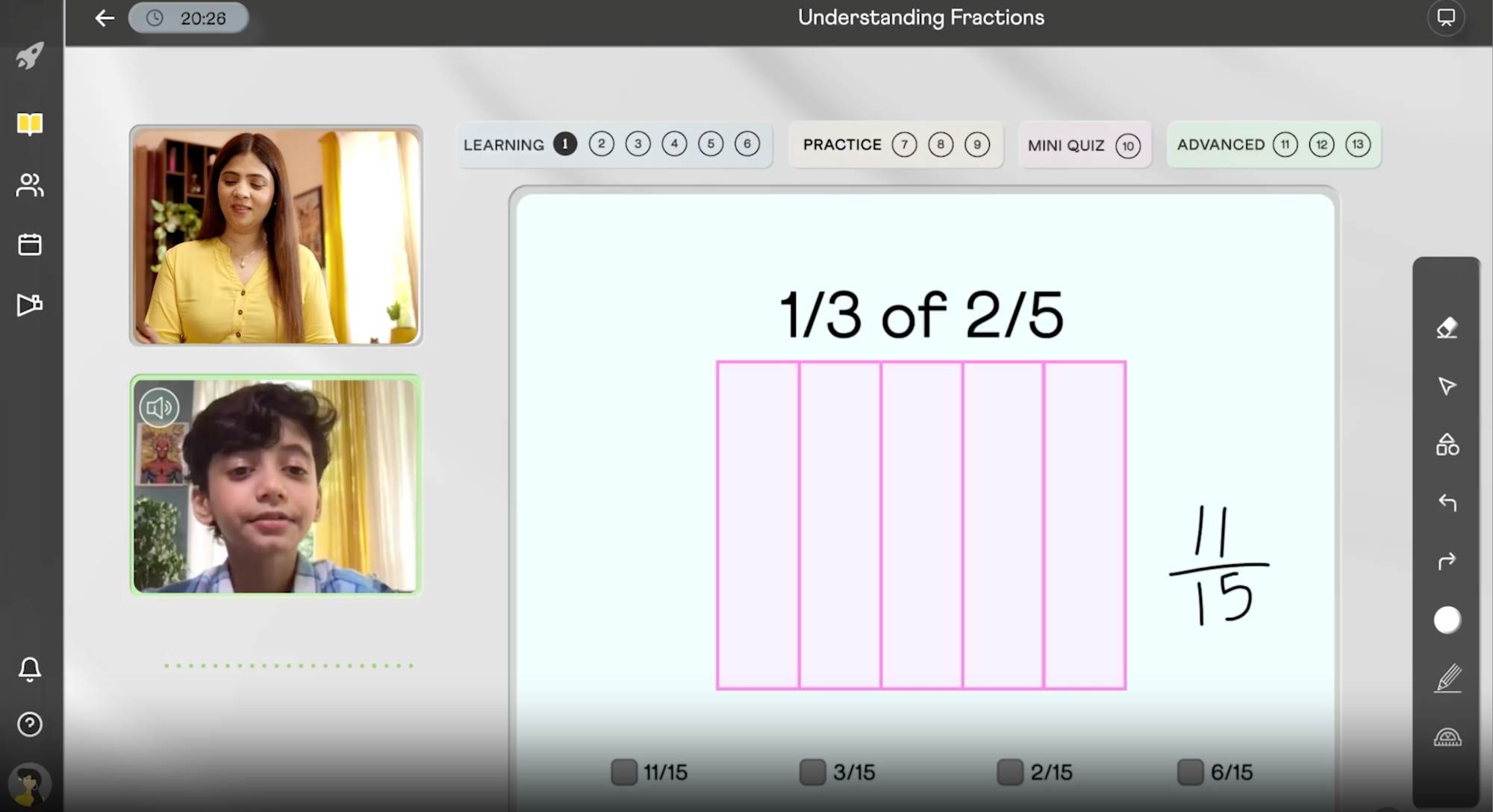
Cuemath is a live, online 1:1 math tutoring program for grades K–12. Every session is one student and one tutor for the full 55–60 minutes, with no shared tables, no circulating instructors, and no competing for attention.
The main things that separate it most clearly from Mathnasium:
1. Your child has their dedicated expert math tutor for every class.
Mathnasium instructors rotate across students within a session and across sessions as staff changes. Cuemath uses a looping model in which your child is matched with one tutor and stays with them for as long as they are enrolled. The tutor knows your child’s specific gaps, their pace, and how they explain their thinking.
2. The curriculum follows US Common Core Standards.
Mathnasium runs its own proprietary curriculum independent of what your child’s school is teaching. Cuemath’s curriculum is aligned to the US Common Core (CCSS), which means sessions directly support what your child is doing in class.
What US parents say:
★★★★★
"Our experience focuses on understanding concepts rather than rote learning. It’s building son’s confidence with patient, clear instruction."
Payal Panda, Parent
View on Trustpilot →★★★★★
"I was initially skeptical about online learning, but my daughter showed noticeable improvement."
Geetu Kotwani, Parent
View on Trustpilot →Who Cuemath is best for: Students in grades K–12 who need consistent 1:1 attention, school-aligned instruction, and a tutor they can build a relationship with over time. Particularly strong for students where Mathnasium falls short: high schoolers, students with math anxiety, and families who need to see week-to-week progress tied to school performance.
Free trial: 1 full live 1:1 class + free math test for students to test their skills and tutors to build a customized learning plan, no credit card required. Starting at $25/class.
See What 1:1 Math Tutoring Really Looks Like
Try a FREE live Cuemath class a full 55-minute 1:1 session with a custom learning plan included. No credit card required.
Book a Free Class200,000+ students · 4.9/5 Trustpilot · Grades K–12
Kumon
Kumon is lower cost ($100–$200/month) and more drill-based than Mathnasium. Students work through a fixed global worksheet curriculum mostly on their own, with instructors available for questions but not providing direct explanation. It works well for students who are self-directed and benefit from high-volume repetition. It is a weak fit for students who need someone to explain concepts or who already dislike worksheets.
Frequently Asked Questions
What are the most common Mathnasium reviews from parents?
Mathnasium reviews from parents are mixed and vary significantly by location. Parents at well-run centers report steady improvement in foundational math, especially for elementary-age students. Parents at poorly staffed centers describe high student-to-tutor ratios, worksheet-heavy sessions with minimal instruction, and difficulty getting refunds. The most consistent theme across reviews is that the quality of the local franchise determines the experience far more than the brand name. (Sources: r/learnmath, 2019 and 2025; Brighterly, 2025)
How much does Mathnasium cost per month?
Mathnasium costs between $250 and $350 per month on average, depending on location and plan. Urban centers can charge $400 to $500 or more. There is also a one-time enrollment and assessment fee of $100 to $150. Mathnasium does not publish prices nationally because each center is independently owned. You will need to contact your local center for a quote. (Source: MyEngineeringBuddy, 2025)
Is Mathnasium worth the money?
Whether Mathnasium is worth the cost depends on what you are paying for at your specific location. At a well-run center with experienced instructors and a reasonable student-to-tutor ratio, parents report measurable improvement over three to six months, especially for elementary students. At centers with poor staffing or high turnover, the cost is hard to justify relative to what the child receives. The best approach is to observe a session before committing and ask the center directly about their instructor-to-student ratio during after-school hours. (Sources: r/learnmath, 2019; MyEngineeringBuddy, 2025)
What is the Mathnasium Method?
The Mathnasium Method is Mathnasium's proprietary teaching approach, which focuses on building number sense and conceptual understanding rather than memorization. Students work through multi-sensory activities covering mental, verbal, visual, tactile, and written math. The method is applied through custom worksheet binders created from each student's initial placement assessment. It is not aligned to the US Common Core State Standards, meaning it runs independently of what a student is currently learning in school. (Source: Mathnasium official website; MyEngineeringBuddy, 2025)
Does Mathnasium offer 1:1 tutoring?
Standard Mathnasium sessions are not 1:1. Students work in a shared-table environment where one or two instructors circulate among several students. Some individual centers offer 1:1 sessions at an additional cost, but this is not a national standard and varies by franchise. If 1:1 attention is important to you, confirm the format before signing up. (Source: r/learnmath, 2025)
What grade levels does Mathnasium cover?
Mathnasium covers grades K–12, but parent and instructor feedback consistently notes that the curriculum is stronger at the elementary and middle school level. The high school curriculum, particularly above Algebra II, has been described as weak by multiple former instructors. If your child is in high school and needs help with Precalculus, AP Calculus, or SAT Math, Mathnasium may not have the depth required. (Source: r/learnmath, 2019)
What happens at the first Mathnasium session?
The first Mathnasium session typically includes a placement assessment. This may include a written test and, at some centers, a verbal component where the instructor or director asks the student questions to understand their reasoning. The results are used to build a custom learning plan, which becomes the binder of worksheets the student works from in every subsequent session. Many centers also offer the first session free as a trial. (Source: r/learnmath, 2019)
Why do Mathnasium franchise reviews vary so much?
Mathnasium franchise reviews vary because each center is independently owned. The national organization provides the curriculum and the Mathnasium Method, but decisions about hiring, staffing ratios, pricing, scheduling, and how to handle billing issues are all made at the individual franchise level. A center run by a director who prioritizes student outcomes will operate very differently from one run primarily for revenue. Before committing, parents should visit the center during busy hours to get a direct sense of how it is run. (Sources: r/learnmath, 2019; MyEngineeringBuddy, 2025)
How does Mathnasium compare to Kumon?
Mathnasium and Kumon are both in-center supplemental math programs, but they work differently. Mathnasium uses a group environment with instructor support, a custom worksheet binder, and an emphasis on number sense and concepts. Kumon is largely self-directed, with students working through a fixed global curriculum with minimal explanation from instructors. Kumon is generally less expensive ($100–$200/month versus $250–$350 for Mathnasium). Mathnasium is typically better for students who need some guided support; Kumon works better for students who can self-teach from examples. Both have documented weaknesses at the high school level. (Sources: MyEngineeringBuddy, 2025; Brighterly, 2025)
How does Mathnasium compare to online 1:1 tutoring?
Mathnasium is in-center, small-group, and curriculum-independent. Online 1:1 tutoring gives a student one dedicated tutor for the full session, can be done from home, and many platforms align to the US school curriculum. For students who need close attention, real-time explanation, and content that tracks their school syllabus, online 1:1 tutoring is typically a closer match. Mathnasium's strength is its structured, sequential curriculum for foundational work, particularly in elementary math. (Sources: MyEngineeringBuddy, 2025; Cuemath website, 2026)
Does Mathnasium help with school homework?
Mathnasium sessions do include time for school homework, but it is secondary to the Mathnasium curriculum. Former instructors note that students are typically expected to spend at least half their session on Mathnasium worksheets before getting homework help. If your primary need is consistent homework support tied to your child's current school syllabus, Mathnasium is not designed to be the primary vehicle for that. (Source: r/learnmath, 2025)
Is Mathnasium good for kids with math anxiety?
It depends on the center. Former directors on Reddit describe centers where anxious students found stability and eventually thrived, largely because of consistent, supportive instructors who built genuine relationships. But the worksheet-heavy, group format can also be stressful for students who need to work at a slower pace without peers around. If your child has significant math anxiety, visit the center and observe the environment before committing. Ask the director how they typically handle students who struggle with confidence. (Source: r/learnmath, 2019)
What should I ask before signing up at Mathnasium?
Before signing up at any Mathnasium center, ask: What is the instructor-to-student ratio during after-school hours? What are your instructors' credentials? Can I observe a session before committing? What is your cancellation policy, and when do I need to notify you by? Do you prorate if I cancel mid-month? What happens if my child needs help with a specific school topic? Is a free trial session available? Getting these answers upfront will tell you more than any national-level review.
Sources
- Mathnasium — Official Program Overview — Mathnasium Method, curriculum, and center format descriptions
- MyEngineeringBuddy: Mathnasium Reviews, Alternatives, Pricing — Pricing ranges, hidden costs, refund policy, Trustpilot data
- Brighterly: Mathnasium Review — Trustpilot quotes, pros/cons, curriculum analysis
- Reddit r/learnmath: Has anyone ever been to a Mathnasium? (2019)
- Reddit r/learnmath: What are your thoughts on Mathnasium? (2025)

I grew up a science kid. Math was not my best subject. Class moved fast, I was too shy to ask for help, and I somehow ended up more curious about how people learn than about the subjects themselves.
That's what pulled me into education — not to teach, but to understand how colleges and tutoring programs actually work and what students genuinely need from them.
My love for writing did the rest. I had too many observations and nowhere to put them, so I started writing, and haven't stopped. Over the last five years I've written about edtech, student life, and college programs. For the past year, my focus has been math tutoring specifically.
I work at Cuemath now, so factor that in. I research by going where parents actually talk: forums, reviews, and direct conversations with students and families. I'm writing for the kid who's too scared to raise their hand in class. I was that kid.