The Math Tutoring That Helps Struggling Students, As Per Research
Students struggle in math because it feels abstract and irrelevant to daily life. The best tutoring for a struggling student helps them see math in the real world and builds a foundation. Cuemath does exactly this: a free evaluation done by expert math tutor that finds conceptual gaps.

- Middle school is where math struggle peaks. In a 2026 survey of 729 educators, 44% said most of their middle schoolers struggle the most in math.
- The 2024 Nation's Report Card was grim: no state showed significant improvement in 8th-grade math, fewer than 27% of 8th graders are proficient, and 55% sit at the two lowest levels.
- Students struggle with Fractions with most. 90% of educators name them as the top skill holding students back.
- Struggling is rarely about ability. It is almost always a gap left from an earlier year, a class that moved too fast, or a fear of math.
- The stakes are long-term. Middle school math is the gate to algebra and advanced courses, and achievement here even tracks with future income.
- Kids think math isn't relevant. Employers disagree. US executives say the skills they most lack in young workers, solving complex problems, adaptability, and making sense of information, are all math.
- What the research says works: one-on-one (or tiny-group) tutoring, the same tutor over time, work aligned to school, and steady feedback. The tutor relationship matters most.
- What doesn't: worksheet drilling, group classes, and gimmicky AI "personalization." Real help is a person finding the exact gap and rebuilding from there.
- Why So Many Kids Struggle With Math in Middle School
- What Do Reports Say?
- Why Middle School Math is Hard?
- Where kids get stuck the most: fractions
- Why Falling Behind Now Can Follow Your Child for Years
- The 3 Real Reasons Your Child Struggles in Math
- A gap from years ago that nobody caught
- The class moves faster than your child can
- It's fear, not ability
- What the Research Says Actually Helps a Struggling Student
- The 4 things that make tutoring actually work
- The real secret is the relationship with the tutor
- Does online math tutoring really work?
- Why tracking progress and flexible scheduling matter
- Why Worksheets and Group Classes Rarely Fix a Struggling Kid
- Why Vibe-Coded Personalized Math Apps Keep Failing Your Child
- How to Choose Math Tutoring for a Struggling Student
- Frequently Asked Questions
Every parent of a math-averse kid knows the sounds. The sigh when the worksheet comes out. The folder that closes a little too fast. The "I'm done" when nothing's actually been done, and the "I know" to a concept they clearly don't. That was Amayra Mehta in Grade 4: low grades, zero interest, and a quiet habit of avoiding the subject altogether. Two report cards later, her teacher hand-picked her for the school's Star Exam, and her mom was saying, "she's doing excellent in math."
What changed wasn't a worksheet pack or a louder push to practice. It was one tutor, once a week, who cared less about getting the right answer and more about getting Amayra to try, be wrong, and come back. That's the part most programs miss, and it's exactly what the right math tutoring for struggling students is built to do: not drill harder, but rebuild the foundation and the confidence underneath it.
Amayra is one of many. Cuemath has the student stories to prove it, and that's the point: what works here isn't luck, and it isn't two or three kids who happened to turn a corner. Everything Cuemath does is backed by research on what actually helps a struggling student, and we'll show you that too. But first, let's look at why so many kids struggle with math in the first place, and what the studies actually say.
Why So Many Kids Struggle With Math in Middle School?
- Middle school is when the largest share of students start to struggle with math.
- The work shifts from basic problems to harder problem-solving that needs real understanding.
- Fractions are the single most common skill that trips kids up.
If your child is in middle school, or heading there next year, this is the section to read. Study after study, and the teachers who see it firsthand, point to the same thing: middle school is when students struggle with math the most. Let's dig into why.
What Do Reports Say?
With so much work being done in education sector in America post-covid and rise of AI-led technologies, you might think "math is a piece of cake."
According to *2024 Nation's Report Card, not a single state or district made gains in 8th grade math. Fewer than 27% of 8th graders nationwide are performing at or above the NAEP Proficient level. More than half of middle school students, 55%, are sitting in the two lowest performance levels in math.
That is not comforting.
Why Middle School Math is Hard?
Middle school math shifts from basic problems, like adding or multiplying two numbers, to harder problem-solving that needs both quick, accurate skills and a real understanding of the concepts underneath.
In a *2026 EdWeek Research Center survey of 729 teachers and administrators, 44% said the majority of their middle schoolers face severe or very severe challenges in math. That was higher than high school at 40% and upper elementary at 34%. This same stretch is exactly when math anxiety tends to take root.
Where Kids Get Stuck The Most: Fractions
*When you ask teachers, 90% of them pointed to fractions. Close behind were pre-algebra skills, fluency in basic operations, and spatial reasoning.
Why Falling Behind Now Can Follow Your Child for Years?
It is tempting to treat a rough math year as something your child will grow out of. Middle school math shapes what your child can do in high school and beyond:
- Algebra is the gatekeeper. According to American Institutes for Research, Algebra is the starting point of high school math and science courses that decide a student's graduation and college readiness. The trajectory for advanced coursework is largely set before 9th grade.
- The problem builds on itself. A student who reaches high school still shaky on core concepts is more likely to fall further behind, lose confidence, give up, and in some cases drop out.
- It reaches past the report card. A student's math achievement correlates more strongly with future income than gains in reading or even health-related factors.
The 3 Real Reasons Your Child Struggles in Math
Most kids who struggle do so for one of three reasons. The hard part for a parent is that all three look the same from the outside: bad grades, avoiding homework, and "I'm just not a math person." But the fix for each is completely different, which is why generic help so often misses.
A gap from years ago that nobody caught
Math compounds. Every new topic is built on the one before it.
This is why a struggling 7th grader is often not struggling with 7th grade math. They are stuck on fractions or place value from years earlier. More worksheets at their current grade will not fix that. Someone has to find the gap that is actually causing it.
This is one thing you may not know Cuemath does. In its free evaluation, a math specialist checks where your child stands across four areas, reasoning, application, fluency, and understanding, for their grade. Your child's tutor then uses that to build a learning plan made for your child, not for the class average. Finding the real gap is the whole starting point.
How Cuemath online classes work?
The class moves faster than your child can
A classroom teacher has 30 kids whose understanding is all over the place, and one period to move everyone forward.
A child who needed 10 more minutes on one idea does not get them, and the gap starts to grow. A kid who is slightly behind is not slow. They usually just needed a little more time than the class could give them.
It's fear, not ability
The third reason is the one parents miss most, because it does not look like a math problem. So many students don't see math as relevant.
Kids love to say math is not relevant to real life. *When Education Week asked senior US executives in December 2025 what their young workers most lack, they pointed to solving complex problems, adapting quickly, and making sense of information. Those are all math. The subject your child thinks they will never use is the exact skill set employers say is hardest to find.
Remember Amayra from the start of this article. Her problem was never ability; it was the sigh, the "I'm done," the "I know" to things she did not know. Her tutor Zeba's first win was not a higher score, it was simply getting Amayra to participate, to be wrong, and to come back.
 Vibhuti Chopra
What the Research Says Actually Helps a Struggling Student?
This is the section I most wanted to get right, because it is where opinion usually takes over. So here it stays close to the research.
The 4 things that make tutoring actually work
Not all tutoring is equal. *Stanford's National Student Support Accelerator has mapped what separates high-impact tutoring from programs that just check a box. The same elements show up every time:
- Small-group or one-on-one settings, ideally 1:1 or groups of three to four students
- A sustained relationship with the same tutor over time, not a rotating cast
- Alignment with the classroom curriculum, so your child can immediately use what they learn
- Ongoing assessment and feedback, to keep the instruction targeted in real time
When these come together, tutoring stops being a separate chore and becomes an extension of what is happening in class.
Those four are, more or less, how Cuemath is built: live one-on-one classes, the same tutor every session, work matched to your child's school curriculum, and notes from the tutor after every class so you can see what happened.
The real secret is the relationship with the tutor
Ask parents, tutors, and educators what makes a math tutoring program work and you hear one word over and over: relationships.
Kids will not take risks or ask questions in front of someone they do not trust, and they have to feel safe to learn.
It is why Cuemath assigns your child one expert math tutor every class instead of rotating them. Cuemath tutors are trained in child psychology, not just math. They are experts in math and also know how to deal with students of all ages.
Cuemath is rated #1 tutoring service on Trustpilot. Almost 90% of reviews praise the tutor-student relationship.
 Nikita Joshi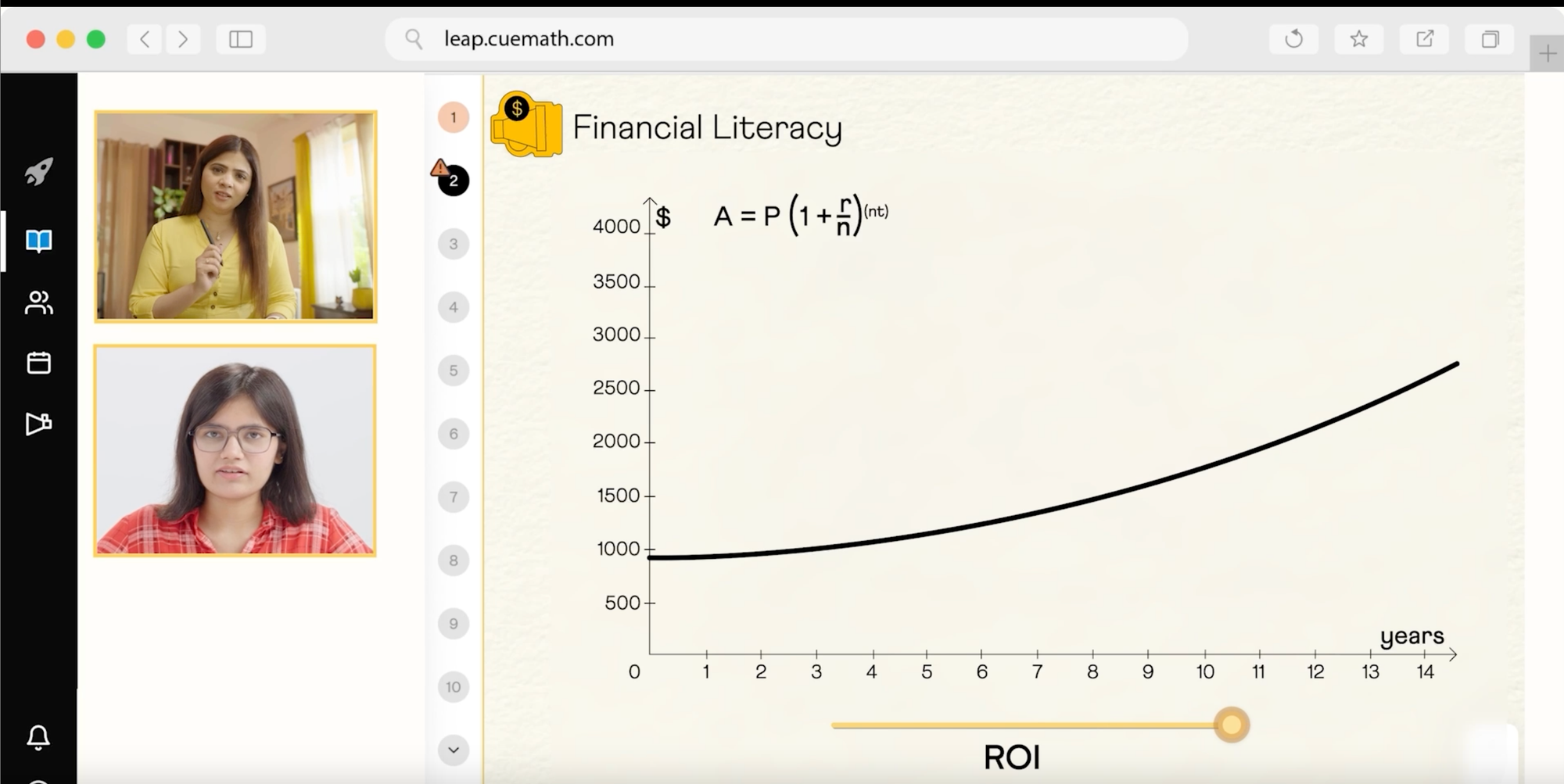
Want to See Exactly Where Your Child Is Stuck?
A free Cuemath evaluation starts by finding your child's exact gap, then a tutor builds a plan around it. No card, no commitment.
Book a Free EvaluationFor Students in Grades K to 12 · No credit card · No commitment
Does Online Math Tutoring Really Work?
Online math tutoring is effective, as long as it is live and thoughtfully designed.
A 2024 peer-reviewed study found that secondary students receiving online math tutoring, largely delivered by qualified math teachers after school, showed gains in both test scores and grades. The ingredients that mattered were the same as in person:
- 1:1 or small groups
- Frequent sessions
- Alignment to classroom work
- Tutors trained for the virtual setting
Take the example of Soham. He started out hesitant on hard math problems and needing reminders to stay consistent. Working online with his Cuemath tutor, Vijay, who asked questions instead of handing over answers, he was eventually explaining his own thinking out loud in class, and scored a 770 on the SAT math section, the 99th percentile. All of it was possible in online mode.
Why Tracking Progress and Flexible Scheduling Matter?
You cannot improve what you do not measure. and flexibility matters for older kids.
In one of the blogs I read, *there was a study on Palm Springs. Its 6–12 graders needed Saturday and on-demand options younger learners did not. A program that bends to a teenager's schedule is one they will actually keep.
 Nikita Joshi
Why Worksheets and Group Classes Rarely Fix a Struggling Kid?
Worksheets and group classes are not bad. They are just built for a different kind of student than a struggling one.
| Format | How it works | Who it actually fits | Why it fails a struggling kid |
|---|---|---|---|
| Worksheet drilling | Repeat one problem type until automatic | A kid who gets the concept and needs speed | Builds speed at a procedure they don't understand; can deepen the fear |
| Group / small-group classes | One instructor, several kids at mixed levels | A kid who is roughly on grade level | The specific early gap rarely gets found; takes 1:1 diagnosis |
| Self-paced app | Videos and practice, no live person | A confident, self-motivated kid | No one to catch the gap or make math feel safe |
| One-on-one tutoring | A dedicated tutor finds and fixes the gap | A struggling, behind, or anxious kid | — |
Why Vibe-Coded Personalized Apps Keep Failing Your Child?
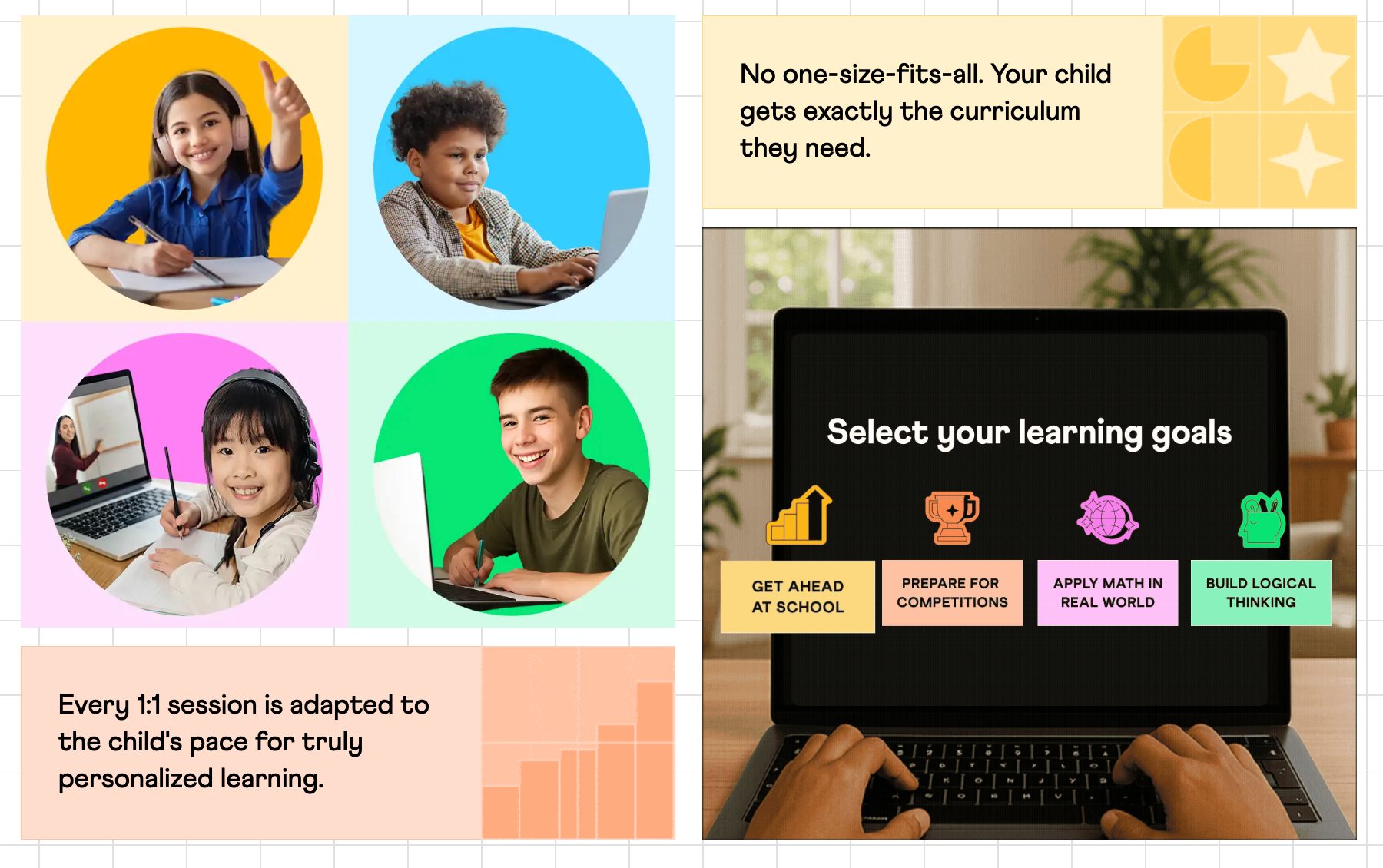
Personalization is good. But personalization done by AI completely misreads what students actually need.
 Nikita Joshi
*Let's take the famous example of Khan Academy. They pulled an AI-led Khanmigo feature that wove students' interests into tutoring. It showed no clear benefit to progress or engagement.
In EdWeek's blog on personalization, I read about a teacher who was testing an AI tool that generates customized math problems. She quotes "Real personalized math has to be connected to what a student actually cares about and true to how math is used in the real world, both at once. An AI inserting a kid's name does not clear that bar."
Take the example of Zorain. He was a capable grade 8 student who simply was not interested in math. No app fixed that. A Cuemath tutor who knew him did, by handing him puzzles and letting him choose the chapters he wanted to explore. Fast forward to present, he scored 100% on his Common Core Algebra unit and made the Principal's List.
How to Choose Math Tutoring for a Struggling Student?
When parents search for a math tutor near them or an online math tutor, they usually compare on price and convenience first. For a struggling student, those are not what decides whether it works.
5 things that actually matter
The research above points to five things that do, in this order:
- A complete diagnosis before any teaching.
- The same tutor every session.
- One-on-one or a tiny group.
- Frequency and consistency.
- Visible feedback and flexibility.
Most platforms do one or two of these. Very few do all five.
Why Cuemath is Best for Struggling Students?
Cuemath is built around all 5 things that matter to a struggling student:
- Evaluation that finds your child's gap
- The same expert math tutor every session
- Live one-on-one classes twice a week
- Curriculum aligned to their school curriculum
- Progress you can actually see
The best way to judge a program is to try a free evaluation.
Cuemath's evaluation is free. It includes skills evaluation and a learning plan built for your child. It is not magic, and it is not instant, but the structure matches what the research says works.
Ready to See If It Clicks for Your Child?
Try a free evaluation with experts and get a learning plan built around your child's gaps.
Book a Free EvaluationFor Students in Grades K to 12 · No credit card · No commitment
Frequently Asked Questions
Does math tutoring actually work for struggling students?
Math tutoring works for struggling students when it is one-on-one or a tiny group, frequent, and delivered by the same tutor over time. Stanford's National Student Support Accelerator identifies those as the elements of high-impact tutoring, along with alignment to classroom work and constant feedback. The format matters far more than the brand: occasional group help moves the needle much less than consistent, individualized work.
Why is my child struggling with math if they are smart?
A child can be smart and still struggle with math because math compounds, and a single early gap quietly blocks everything built on top of it. For middle schoolers, that gap is most often fractions, which 90% of educators name as the top skill holding students back. Intelligence does not fill the gap on its own; someone has to find the specific missed concept and reteach it.
How do I help a child who is behind in math?
To help a child who is behind in math, start by finding the specific concept gap rather than pushing more of the current grade's work. A struggling 7th grader is often stuck on a 4th or 5th grade idea that never landed. From there, the most effective help is frequent one-on-one attention from a consistent, patient tutor, which addresses the gap and the fear at the same time.
Is online math tutoring effective for struggling students?
Online math tutoring is effective for struggling students when it is live and well designed. A 2024 peer-reviewed study found that secondary students receiving online math tutoring from qualified teachers showed gains in both test scores and grades. The ingredients that mattered were small groups, frequent sessions, alignment to classroom work, and tutors trained for the virtual setting, not the location.
Does personalized or AI math tutoring actually help?
Personalized math tutoring helps when a real person diagnoses and targets a student's specific gap, but surface-level AI personalization has mostly underwhelmed. Khan Academy dropped a feature that inserted students' interests into lessons because it showed no clear benefit to progress or engagement. Real personalization means rebuilding the missing concept at the student's pace, which is the strength of one-on-one tutoring.
Will worksheets or a math app fix my struggling child?
Worksheets and math apps usually do not fix a struggling child on their own, because both assume the underlying concept is already in place. For a child who is missing the concept, drilling builds speed at the wrong thing and can deepen the fear. Worksheets and apps are useful for practice once a live tutor has closed the actual gap.
How often should a struggling student have math tutoring?
A struggling student should have math tutoring at least twice a week, not once. Research on high-impact tutoring shows that frequency and consistency are what turn casual support into real intervention. Sessions that recur on a steady schedule, with the same tutor, produce the strongest gains.
How quickly will I see improvement from math tutoring?
You can often see early signs of improvement within a few weeks, but they usually show up as confidence and willingness before grades. A child who stops dreading homework or starts attempting problems alone is improving, even if the report card has not caught up. Gaps that built over years take a few months to fully close.
How much does math tutoring for struggling students cost?
Math tutoring for struggling students ranges from free self-paced apps to $40 to $80 an hour for private tutors and $200 to $400 a month for learning centers. One-on-one live online tutoring with Cuemath starts at $15 per class, twice a week, with a free initial assessment included. The better question is not the price but whether the program finds and fixes the actual cause.
Sources (*)
- The Nation's Report Card (NAGB / NAEP), 2024 — backs "no state or district gained in 8th grade math" and "fewer than 27% of 8th graders proficient."
- American Institutes for Research, "Gateway to Student Success in Mathematics and Science" — backs "algebra is the gatekeeper" and "trajectory set before 9th grade."
- Urban Institute (2024) — backs "math achievement correlates with future income more than reading or health."
- D.C. Policy Center — backs "55% of middle school students perform at the two lowest levels in math."
- Stanford National Student Support Accelerator — backs the elements of high-impact tutoring.
- Peer-reviewed study (ScienceDirect, 2024) — backs "online math tutoring improved secondary students' scores and grades."
- Education Week (Evie Blad), "Elementary Math Has Been in Focus, But Middle and High School Students' Struggles Are Daunting" (May 2026) — backs the 729-educator survey, the 44%/40%/34% figures, 90% fractions, the December 2025 executives survey, and "students don't see math as relevant."
- Education Week, "Personalized Learning in Math Has Proved Elusive and Overhyped" (May 2026) — backs the Khan Academy and Walkington points on AI personalization.

I grew up a science kid. Math was not my best subject. Class moved fast, I was too shy to ask for help, and I somehow ended up more curious about how people learn than about the subjects themselves.
That's what pulled me into education, not to teach, but to understand how colleges and tutoring programs actually work and what students genuinely need from them.
My love for writing did the rest. I had too many observations and nowhere to put them, so I started writing, and haven't stopped. Over the last five years I've written about edtech, student life, and college programs. For the past year, my focus has been math tutoring specifically.
I work at Cuemath now, so factor that in. I research by going where parents actually talk: forums, reviews, and direct conversations with students and families. I'm writing for the kid who's too scared to raise their hand in class. I was that kid. This guide was researched and structured with the help of AI tools, then written, edited, and fact-checked by me.