7th Grade Math Topics: What 7th Graders Learn in 2026
7th graders learn four big areas of math: proportional relationships, negative numbers and fractions, algebra with geometry, and statistics with probability. This blog shows each topic with a short worked example and an everyday use. It also explains how Grade 7 prepares students for Grade 8.

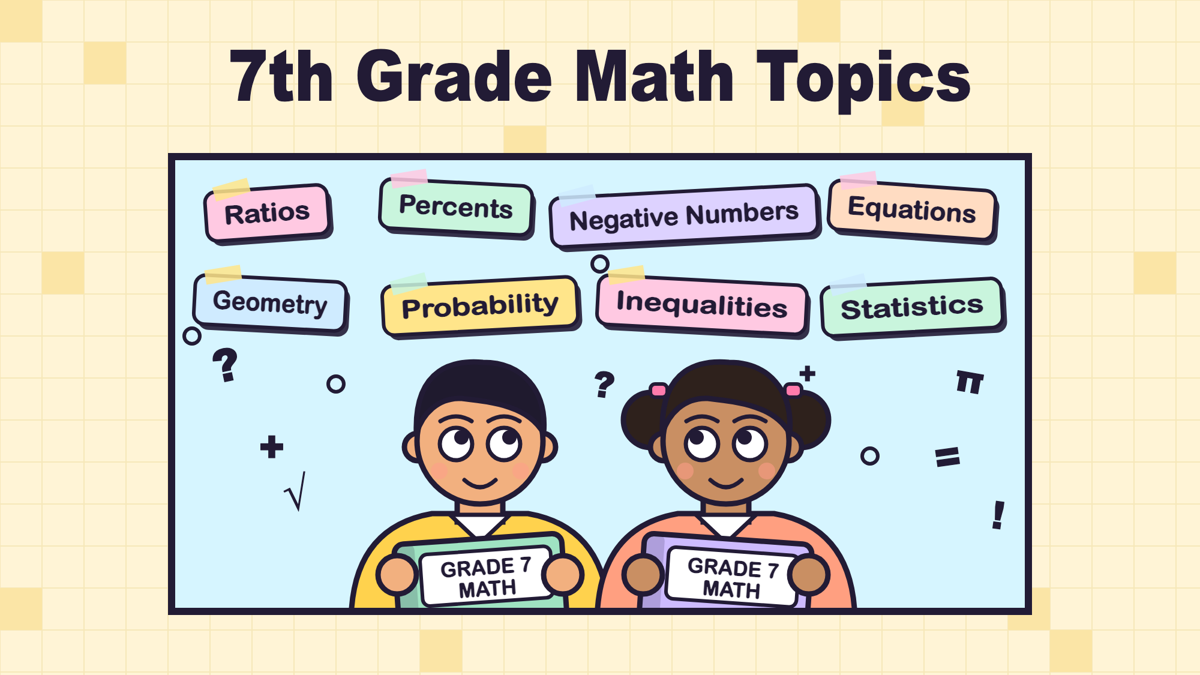
7th graders learn four big areas of math: proportional relationships, operations with negative numbers and fractions, algebra with geometry, and statistics with probability. In ratios and percents, they solve multi-step problems like discounts and unit rates. In algebra, they simplify expressions and solve two-step equations and inequalities. In geometry, they work with circles, angles, scale drawings, surface area and volume. In statistics, they compare data sets and find the probability of two events happening together.
This guide answers "what do 7th graders learn in math" one topic at a time. It walks through each of the 7th grade math topics, and follows the US Common Core standards.
Not sure where your child stands in Grade 7 math? Take Cuemath's free 7th grade math test and get a personalised report on strengths and gaps.
Take the free Grade 7 test7th Grade Math at a Glance
Here are the 7th grade math topics in one table. Each row links to a worked example further down.
| Topic area | What students do | Quick example |
|---|---|---|
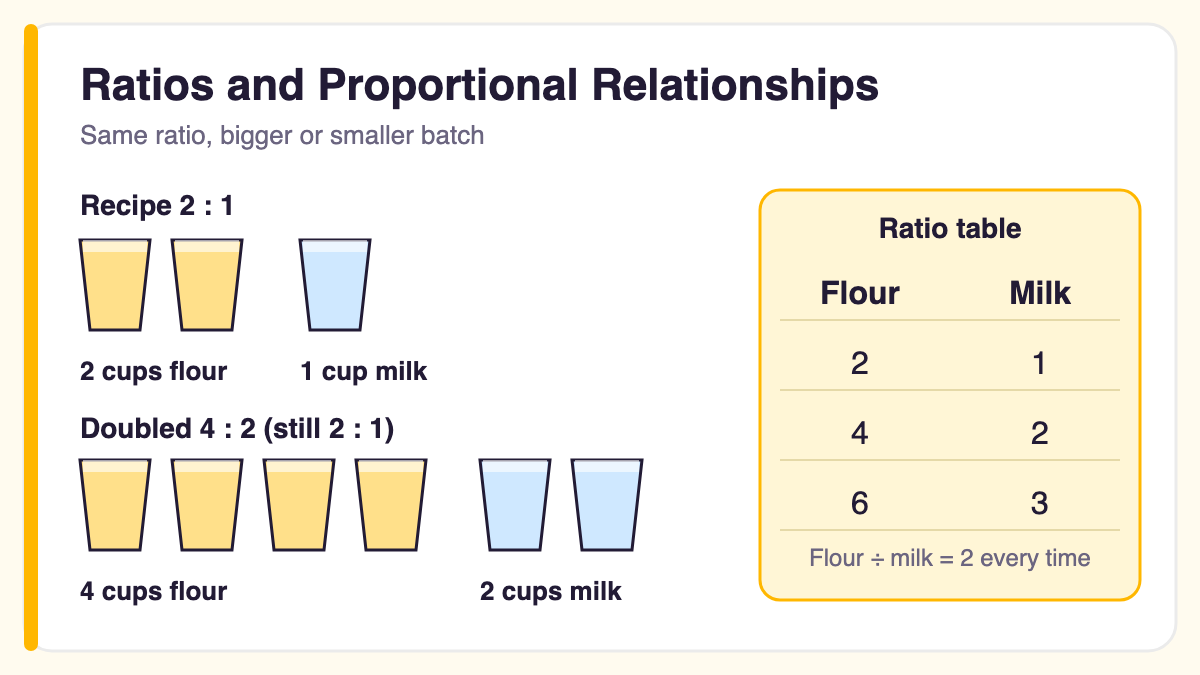
| Ratios and proportions | Compare quantities, find unit rates, spot proportional relationships | 3 lb of apples cost $4.50, so 1 lb costs $1.50 |
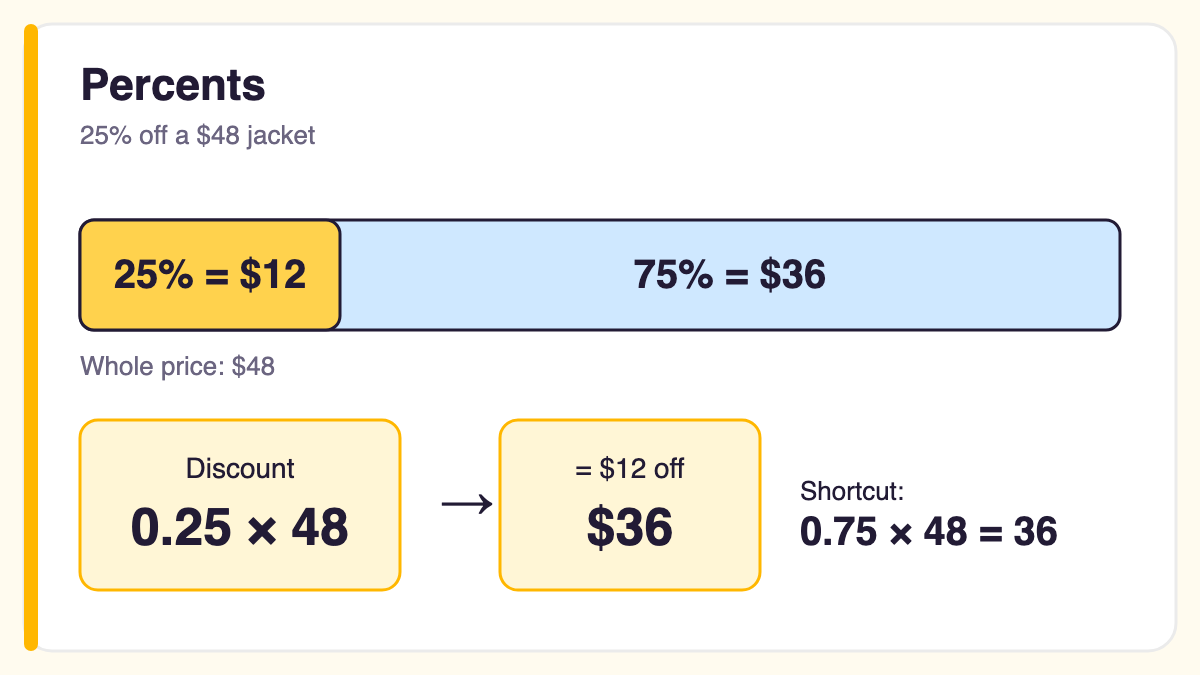
| Percents | Work out discounts, tax, tips and percent change | 25% off $48 is a $12 discount |
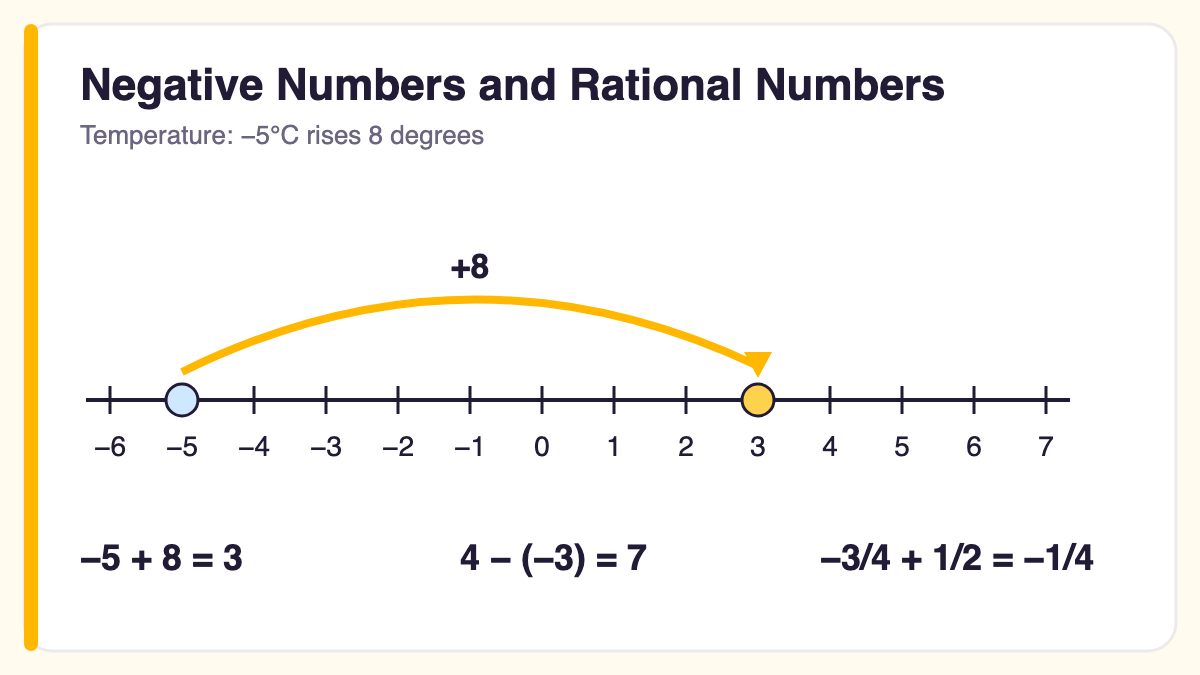
| Negative numbers and rational numbers | Add, subtract, multiply and divide positive and negative numbers, fractions and decimals | 4 − (−3) = 7 |
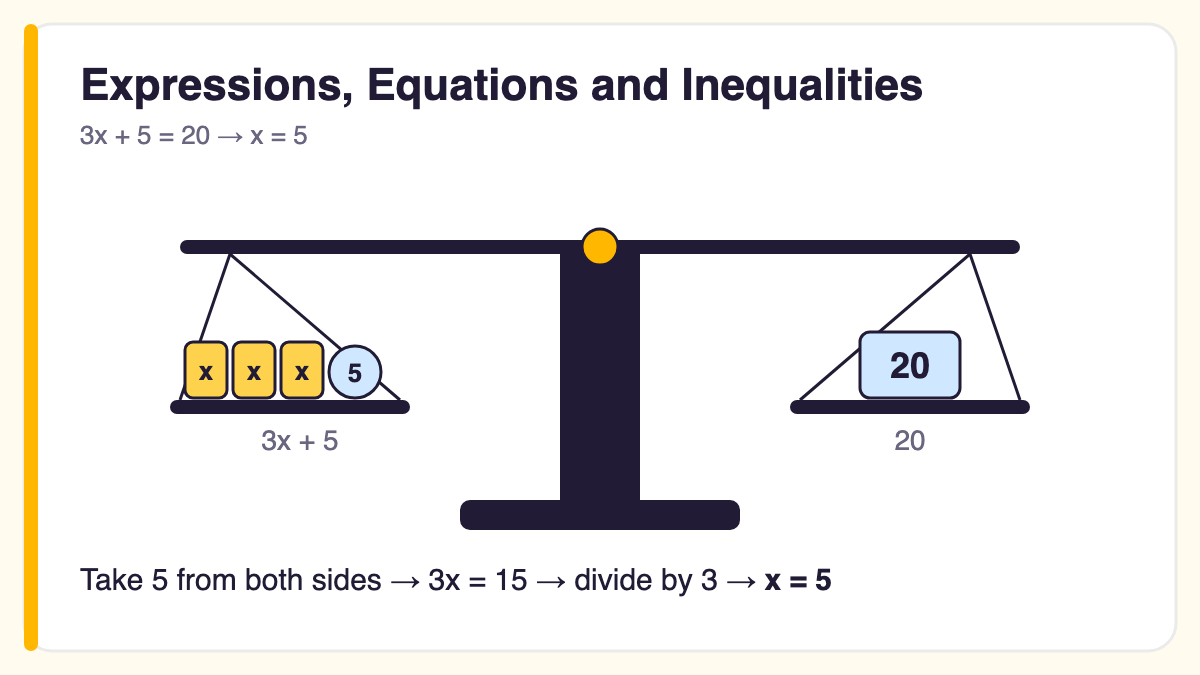
| Expressions, equations, inequalities | Simplify expressions, solve two-step equations and inequalities | 3x + 5 = 20, so x = 5 |
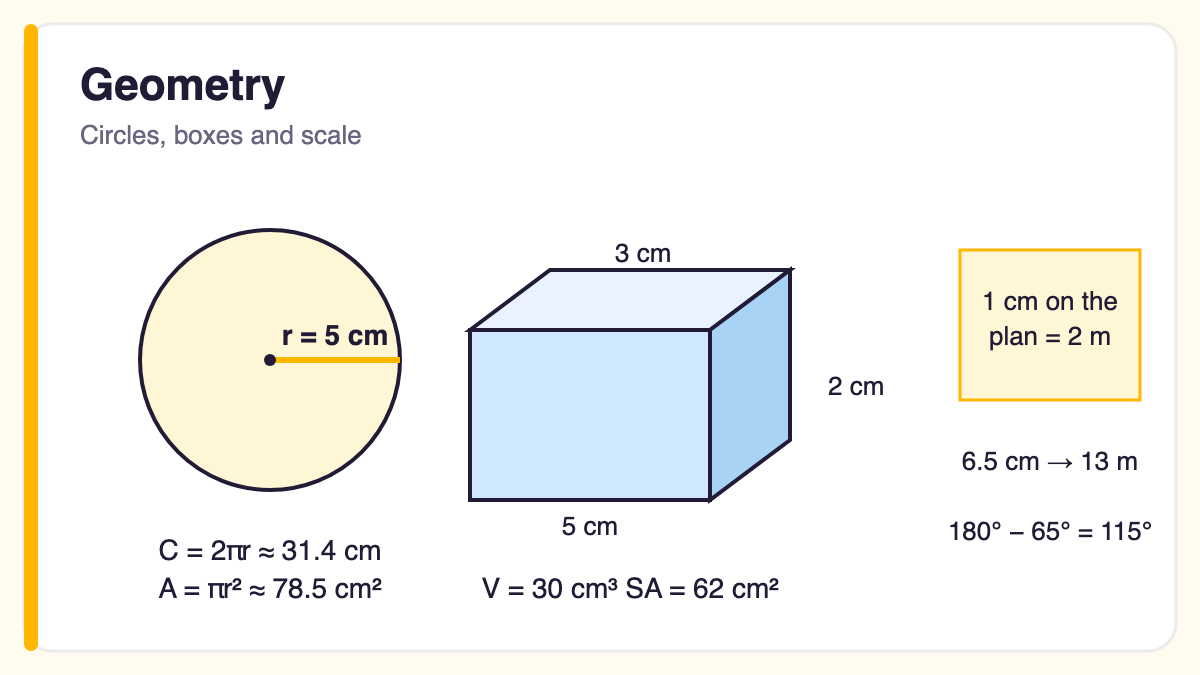
| Geometry | Circles, angles, scale drawings, surface area, volume | A circle with radius 5 cm has area about 78.5 cm² |
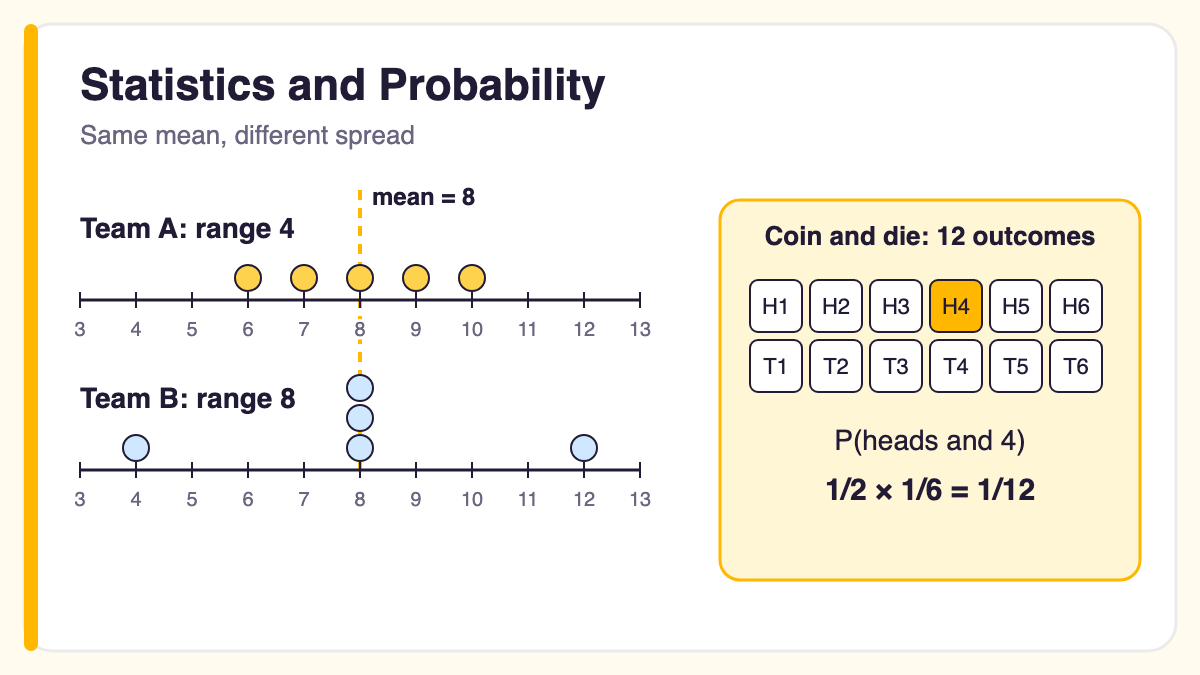
| Statistics and probability | Compare data sets, learn about random samples, find probabilities | P(heads and a 4) = 1/12 |
What Is 7th Grade Math?
7th grade math is the year when students move from finding answers to writing rules. In earlier grades, a child works out one number at a time. In Grade 7, a child starts using letters for unknowns, working with negative numbers in every operation, and checking whether a rule holds every time. It is the bridge between arithmetic and algebra.
The easiest way to see the shift is to follow one situation through three grades. Take a walker who covers 3 miles every hour.
| Grade | The question | How the child solves it | Answer |
|---|---|---|---|
| Grade 6 | How far does she walk in 4 hours? | Use a ratio table: 1 hour is 3 miles, so 4 hours is 4 × 3 | 12 miles |
| Grade 7 | How long does it take her to walk 10.5 miles? | Write the rule y = 3x, then solve the equation 3x = 10.5 | 3.5 hours |
| Grade 8 | A friend starts 4 miles ahead and walks 2 miles an hour. When does she catch up? | Set two linear equations equal: 3x = 2x + 4 | After 4 hours, at 12 miles |
Grade 6 asks the child to find a value. Grade 7 asks the child to write the rule and solve for the unknown. Grade 8 asks the child to compare two rules. A child who is shaky on the Grade 7 step, writing y = 3x and solving an equation, finds the Grade 8 step very hard.
To see the year before, read our guide to what you learn in 6th grade math.
That is why Grade 7 is the year a good mentor matters most. A small gap in negative numbers or proportion setup does not stay small, because every Grade 8 topic builds on it. A patient tutor catches the slip in the third or fourth line of a solution, explains the reason behind the rule, and fixes the gap before Grade 8 begins. Without that, a child can start to feel "I am bad at algebra" at the exact moment algebra begins.
What Do 7th Graders Learn in Math?
The Common Core standards name four focus areas for Grade 7. Almost every US school builds its year around them.
- Proportional relationships. Students use ratios, rates and percents to solve multi-step problems.
- Rational numbers, expressions and linear equations. Students add, subtract, multiply and divide with all rational numbers (fractions, decimals and negatives), then use them in algebra.
- Geometry and measurement. Students work with scale drawings, circles, angle relationships, and the area, surface area and volume of shapes.
- Statistics and probability. Students draw conclusions about a population from a sample, compare two data sets, and find the probability of simple and compound events.
7th Grade Math Topics Explained With Examples
Each topic below has the same layout: what it means, a worked example, and where your child will see it outside school.
Ratios and Proportional Relationships
Percents
Negative Numbers and Rational Numbers
Expressions, Equations and Inequalities
Geometry
Statistics and Probability
See all of these topics in Cuemath's Grade 7 curriculum, taught 1:1 by a tutor who adapts each lesson to your child.
Explore the Grade 7 curriculumWhat a 7th Grader Should Be Able to Do by the End of the Year?
Short on time? This checklist answers "what math do you learn in 7th grade" in ten skills. Use it at the end of the school year or before Grade 8 starts. If your child can do most of these without help, they are on track.
The same mistake keeps coming back? A Cuemath 1:1 tutor spots the pattern in one session and fixes the cause.
Book a free evaluationHow Is Grade 7 Math Different From Grade 8?
Grade 7 builds the tools. Grade 8 uses them for harder ideas. This table compares the two, based on the official Common Core Grade 7 and Grade 8 introductions.
| Math area | Grade 7 | Grade 8 |
|---|---|---|
| Proportions and lines | Proportional relationships, unit rates, graphs through the origin | Proportional relationships become linear equations (y = mx + b) and slope |
| Number system | All four operations with rational numbers | Irrational numbers, square roots, integer exponents |
| Equations | One-variable equations and inequalities | Systems of two linear equations |
| Functions | Not a separate focus | A function is a rule with one output for each input |
| Geometry | Scale drawings, circles, angles, area, surface area, volume of prisms | Congruence, similarity, the Pythagorean Theorem, volume of cones, cylinders and spheres |
| Statistics | Random samples, comparing two data sets, compound probability | Patterns in data with two variables |
Parents who ask what do 7th graders learn in math usually ask the next question too: what changes in Grade 8? The Grade 7 to Grade 8 jump is mostly in algebra. A child who is solid on equations and proportions in Grade 7 finds Grade 8 much smoother. For the full Grade 8 breakdown, read our guide to what you learn in 8th grade math.
Need practice problems for these topics? Download free Cuemath 7th grade math worksheets, organised by topic.
Get free Grade 7 worksheetsHow Does Cuemath Teach 7th Grade Math?
The Cuemath 7th grade math tutoring program covers every topic in this guide in live 1:1 online classes. Your child learns integer operations, rational numbers, algebraic expressions, equations, inequalities, ratios and proportional relationships, percents, probability, statistics, circles, angles, and surface area and volume. Each lesson builds the "why" behind the steps, so these topics hold up when Grade 8 algebra arrives.
It also builds a strong base for the tests that are important in Grades 7 and 8. The Grade 7 course is aligned to school and state standards, including STAAR, and Cuemath's enrichment track prepares students for AMC 8 and Math Kangaroo. Students who stay on into Grade 8 move on to Cuemath's Grade 8 program, with the SAT Prep Suite (worth $499) included free on 6-month and 12-month plans.
Why parents choose Cuemath for Grade 7:
- 1:1 personalized classes. Every class is built around your child's pace and goals, with the tutor's full attention.
- Top 1% tutors. Handpicked, trained in math teaching and child psychology, and matched to your child for the long term.
- Concept-first teaching. Tutors ask guiding questions, so your child learns to explain their thinking and not just copy steps.
- A starting point that fits. A short assessment finds the exact concept your child needs help with, such as negative-number signs or setting up a proportion.
- Practice between classes. Daily practice in the Cuemath app and a parent dashboard keep progress visible.
- Starting at $15/class , with two live classes a week.
Want extra 7 grade math practice on one topic? Cuemath's concept pages cover ratio and proportion, percentages, rational numbers, algebraic expressions, two-step equations, linear inequalities, area of a circle, surface area of a prism and compound probability.
Give your 7th grader a head start on Grade 8. Check Grade 7 readiness with a free test and get a personalised report.
Take the free Grade 7 testFrequently Asked Questions
What is 7th grade math?
7th grade math is the year students move from arithmetic to pre-algebra. They learn proportional relationships, negative numbers and fractions, algebra, geometry, and statistics with probability. Students in Grade 7 are around 12 to 13 years old.
What do 7th graders learn in math that is new this year?
The new parts compared with Grade 6 are negative numbers in every operation, two-step equations and inequalities, circle area and circumference, random sampling, and compound probability. Proportional reasoning, percents and area also go deeper.
What are the main topics in Grade 7 math?
The main 7th grade math topics are ratios and proportions, percents, operations with rational numbers, expressions and equations, geometry, and statistics and probability. Common Core groups these into four focus areas.
What math do you learn in 7th grade?
You learn to work with negative numbers and fractions, solve two-step equations, use percents, find the area and volume of shapes, and compare data sets. Details can vary by state and school.
Is 7th grade math hard?
7th grade math is harder than Grade 6 because it adds negative numbers and algebra. Most students find signs with negative numbers and setting up proportions the hardest parts. Short daily practice and explaining each step out loud help.
Is Grade 7 math pre-algebra?
Yes, in many US schools Grade 7 math is pre-algebra. It covers expressions, equations, inequalities and proportional reasoning. Some schools offer an accelerated pre-algebra track in Grade 7.
What should a student know before starting Grade 7 math?
Before Grade 7, a student should be comfortable with fractions, decimals, basic ratios, and simple one-step equations. Grade 6 also introduces a first look at negative numbers on a number line. If those feel shaky, a short review in the summer helps.
What is the most important topic in Grade 7 math?
The Common Core lists proportional relationships first among the four Grade 7 focus areas, and they lead straight to linear equations in Grade 8. Operations with negative numbers matter just as much, because they appear in almost every other unit.
How can I help my child improve in 7th grade math?
Practise percents and proportions with real prices and recipes, and ask your child to explain each step of a solution. If they stay stuck on one topic, a tutor can find the exact gap. The Cuemath Grade 7 program starts with a short assessment that finds the gap by concept, then a 1:1 tutor works on it.
What is the difference between Grade 7 and Grade 8 math?
Grade 7 builds proportional reasoning, rational-number operations and basic equations. Grade 8 moves on to linear equations and systems, functions, irrational numbers and the Pythagorean Theorem. Our 8th grade math guide covers the full list.
Can my child skip 7th grade math?
Some schools let students skip 7 grade math and start Algebra 1 in Grade 7, or take a combined Math 7/8 course. Placement depends on the school's test and policies, so ask the school directly. A child who skips still needs solid proportional reasoning and equation skills.
Sources
- Common Core State Standards Initiative: Grade 7 Introduction
- Common Core State Standards Initiative: Grade 8 Introduction
- Cuemath: Online Math Classes for Grade 7

I write because I like understanding things properly, and I've never been able to do that quietly.
Six years in, what still interests me most isn't the writing itself. It's the person on the other side. Who are they, what were they actually worried about when they opened this page, and did they leave with what they came for? Most content fails that last test. It answers the easy question instead of the one that was asked.
At Cuemath, I write for parents and students in India and around the world. That range is the part I enjoy. A parent in Bangalore and a parent in Canada are asking about the same child, but not always in the same words, and that difference matters.
So I research before I write. Not just search results. Forums, reviews, the long comment threads where somebody finally admits what they're really confused about. That's usually where the useful thing is hiding.
I also spend time on how people find this writing at all, since a growing number of them now ask an AI instead of typing into Google. But that only works if the writing is clear to begin with. There's no shortcut around that part.