Free AASA Practice Test, Live 1:1 with a Tutor
The AASA is Arizona's state math test for grades 3 to 8. This is a free, grade-by-grade practice test, with worked answers and a tutor hint on every question. You'll also see how live, one-on-one practice closes the gaps a worksheet can't.

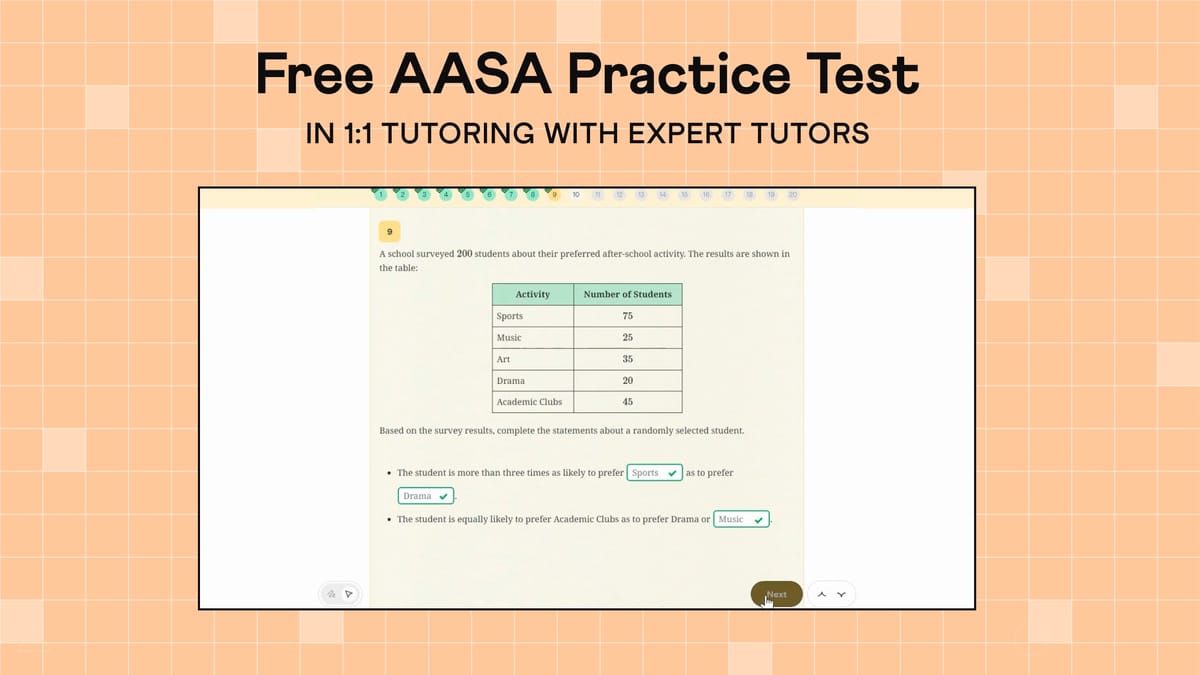
The AASA is Arizona’s state math test for grades 3 to 8. This page has a free AASA practice test, grouped by grade, with a worked answer and a tutor hint on every question. I went through the official AASA question types to build it, so your child practices the formats they will actually see.
A downloaded AASA worksheet shows your child a question and an answer. It cannot see where their thinking goes wrong or explain the concept they never quite got. That is what most AASA practice misses, and it is why a score often does not improve.
Cuemath does AASA practice differently, and it is free to start. Your child practices the questions live and 1:1 with a tutor, not alone. The tutor assigns practice sheets based on your child’s progress and teaches the concepts that need explaining. I will show you the free practice questions first, then how the 1:1 version works.
- Is the AASA Test Important?
- What Math Concepts Are Asked in AASA Test?
- How to Practice for AASA Test?
- Free AASA Practice Test for Grades 3 and 4
- Free AASA Practice Test for Grades 5 and 6
- Free AASA Practice Test for Grades 7 and 8
- Are Free AASA Practice Tests Enough?
- Why Cuemath is the Best Choice for AASA Practice?
- Frequently Asked Questions
Is the AASA Test Important?
The AASA is a standardized test that checks whether a child’s math skills are aligned to Arizona’s expectations. It does not affect your child’s report card grade.
There is one real exception, and it is about reading, not math. Under Arizona’s Move On When Reading law, a 3rd grader who scores far below the cut on the reading part of the AASA may not move up to 4th grade. Good-cause exemptions exist, and it affects fewer than 3% of students. Worth knowing for 3rd grade families.
The AASA test is worth taking seriously. A child who is shaky on fractions or multi-step word problems will struggle on the AASA and in next year’s classroom. That is the real reason to prepare for the AASA test.
📅 Good to know: The spring 2027 AASA window for grades 3 to 8 runs from March 29, 2027 to April 23, 2027. These dates are tentative until Arizona’s State Board of Education approves them, and each school picks its own test days inside the window.
📊 Also know: AASA scores come in four levels: Minimally Proficient, Partially Proficient, Proficient, and Highly Proficient. Proficient and Highly Proficient are the passing levels. A child at the first two levels likely needs support to be ready for the next grade.
What Math Concepts Are Asked in the AASA Test?
The AASA math test covers different topics at each grade, all aligned to Arizona’s standards (based on Common Core). The test usually wraps the math inside a real-world situation, instead of asking for a plain calculation.
| Grade | Main math topics on the AASA |
|---|---|
| Grade 3 | Multiplication and division, fractions as numbers, area, measurement and data, basic shapes |
| Grade 4 | Multi-digit multiplication and division, equivalent fractions, decimals, factors, angles and area |
| Grade 5 | Operations with fractions and decimals, the place value system, volume, the coordinate plane |
| Grade 6 | Ratios and rates, dividing fractions, negative numbers, expressions and equations, basic statistics |
| Grade 7 | Proportional relationships, percent, operations with integers, area and volume, probability |
| Grade 8 | Linear equations, functions, the Pythagorean theorem, scientific notation, transformations |
Related test prep: explore our full math test prep hub, or practice for other state assessments like the STAAR (Texas) and IAR (Illinois).
The AASA asks math questions in several formats, not just multiple choice. A child who knows the math can still lose points if the format is new to them.
Cuemath's AASA practice tests and sheets mimic the exact format the AASA test has. Although some features, like drawing and solving on a live whiteboard and using a 3D protractor, are things Cuemath uses to explain concepts. The official AASA test does not have these.
Multiple choice and multiple select [AASA test format]: Pick one correct answer, or pick all that apply. Multiple select is easy to miss, since more than one answer can be right.
Drop-down menus [AASA test format]: Choose the answer from a list built into the sentence. Arizona calls these inline choice questions.
Sample AASA practice test question by Cuemath.
Plotting on a graph [AASA test format]: Drag points or draw a line on a coordinate grid on screen.
Sample AASA practice test question by Cuemath.
Equation and answer builder [Cuemath feature]: Type a number, a fraction, or build an expression using an on-screen tool.
Sample AASA practice test question by Cuemath.
Multi-step word problems [AASA test format]: Solve more than one step to reach the answer. In our tutors’ experience, this is where students lose the most points.
Sample AASA practice test question by Cuemath.
Geometry tools [Cuemath feature]: Some questions use built-in tools, including 3D tools, to work with shapes, area, and volume.
Sample AASA practice test question by Cuemath.
⏱️ Also know: The AASA math units are untimed. Grades 3 to 6 take the whole math test without a calculator. Grades 7 and 8 get a built-in Desmos scientific calculator on Unit 1 only, and Unit 2 is no-calculator. Practice written steps and mental math, not only calculator work.
How to Practice for the AASA Test?
The best way to practice for the AASA is to fix gaps, not to grind through every topic. A child who already knows a skill gains little from repeating it. Here is a simple plan.
- Find the gaps first. Have your child try a few questions per topic. Note which ones they miss. Those are your targets.
- Practice the real question types. Use multi-step word problems, drop-downs, and graph questions, not just plain sums. The format matters as much as the math.
- Do a little at a time, with explanations. A few questions with a clear “why” beats a 50-question worksheet. Cramming does not move an AASA score.
- Practice on a screen. The AASA is online. Practicing on paper only leaves the on-screen tools unfamiliar.
- Review every wrong answer. The gap is not the wrong answer. It is the reason behind it. Find the reason, and the score follows.
The free practice below is built this way. It is grouped by grade band, with a worked solution and a common-mistake note for every question.
🖥️ Know more: Arizona posts free official AASA sample tests for grades 3 to 8 on Pearson TestNav, the same platform the real test runs on. Have your child try one before test day so the screen and on-screen tools feel familiar.
Pick your child’s grade and answer one question. The Cuemath app gives your child a short workout like this every day, across the same skills the AASA checks.
Try the Cuemath App →100% Free • No Credit Card
Free AASA Practice Test for Grades 3 and 4
Grades 3 and 4 focus on multiplication, division, fractions, and early area and measurement. AASA questions at this level often hide the math inside a short story. Read the question twice before solving.
▸ Show answer & solution
▸ Show answer & solution
▸ Show answer & solution
Free AASA Practice Test for Grades 5 and 6
Grades 5 and 6 move into decimals, fraction operations, ratios, and simple expressions. AASA questions here often use money, recipes, or rates. The numbers get bigger, so the steps must stay neat.
▸ Show answer & solution
▸ Show answer & solution
▸ Show answer & solution
Free AASA Practice Test for Grades 7 and 8
Grades 7 and 8 cover percent, proportional relationships, integers, and early algebra and geometry. AASA questions here often need two or three steps. A graph or an equation may be part of the answer.
▸ Show answer & solution
▸ Show answer & solution
▸ Show answer & solution
Are Free AASA Practice Tests Enough?
A worksheet shows your child the answer; it cannot watch how your child thinks or fix the exact step where they go wrong. That is the real limit of any free AASA practice, including this one. Free practice questions are a great start, and you just used some, but a worksheet can only show the gap, not close it. Here is how the common options compare.
| Option | Finds the exact gap | Explains the why | Real AASA format | Adjusts to your child | Cost |
|---|---|---|---|---|---|
| Free worksheets | No | No | Rarely | No | Free |
| Practice apps | Sometimes | Limited | Sometimes | Some | Free to paid |
| Group test-prep class | No | Some | Sometimes | No | Paid |
| Cuemath 1:1 program | Yes | Yes, live | Yes, on screen | Yes, every class | Free evaluation, then paid |
A worksheet is fine for review. A 1:1 program is what closes a gap. The difference is a person who sees the mistake as it happens and explains the right way in the moment.
Why Cuemath Is the Best Choice for AASA Practice
Cuemath gives your child free AASA practice that is live and 1:1 with a tutor, not a worksheet to solve alone. It is built for grades 3 to 8, the exact AASA range. Here is how the free practice actually works.
It starts with a free skills-and-gaps check. In the free evaluation, a math specialist checks your child’s math across reasoning, application, fluency, and understanding. You learn exactly where your child is strong and where the gaps are before paying anything.
Your child practices the questions live with a tutor. This is the difference from a download. The tutor watches your child solve AASA-style questions in real time, catches the exact step that goes wrong, and corrects the thinking on the spot.
The tutor assigns practice sheets based on progress. The practice is not one-size-fits-all. As your child improves, the tutor hands them the next set of sheets, matched to what they have mastered and what still needs work.
Concepts that need explaining get their own class. When a question reveals a gap, like fractions or ratios, the tutor teaches that concept properly, then goes back to the practice. A worksheet cannot do this.
The tutors know the AASA, and your child keeps the same one. Cuemath tutors come from the top 1% of applicants and have prepared students for state tests like the AASA for years. The same tutor every class means your child stops feeling judged and starts asking questions.
See Exactly Where Your Child Stands, for Free
Start with a free evaluation and a skills-and-gaps check built for grades 3 to 8. Your child’s tutor turns it into a clear AASA practice plan.
Book a Free Evaluation100% refund on unused classes · No questions asked
Frequently Asked Questions
Is the AASA test mandatory in Arizona?
Yes, the AASA test is mandatory in Arizona. Federal law (ESSA) requires public schools to test at least 95% of their students, and Arizona does not allow parents to opt their child out of state testing. Any student present during the spring testing window is expected to take the AASA.
Who takes the AASA test?
Students in grades 3 through 8 at Arizona public and charter schools take the AASA test. High school students take different state tests, not the AASA. The test is given in both math and reading.
What subjects does the AASA test?
The AASA test covers two subjects: English Language Arts (reading and writing) and math. Science is tested separately through AzSCI in grades 5, 8, and 11. This guide focuses on the AASA math test.
What is the format of the AASA test?
The AASA test is taken online and uses several question formats. These include multiple choice, multiple select, drop-down (inline choice), graph-plotting, equation-builder, and multi-step word problems. A paper version is available for students who need one.
If AASA does not affect school grades, why is it important?
The AASA does not change your child's report card grade, but it is the clearest yearly check on whether their math is on grade level. Arizona also uses school-wide AASA scores to set each school's A to F rating. So the skills it measures matter for your child, even when the score is low-stakes for their own grade.
Does Cuemath offer AASA test prep for free?
Cuemath includes AASA test prep inside its 1:1 tutoring program, and the evaluation is free to try. There is no standalone free AASA course; the prep happens within the regular 1:1 program, which is paid after the free evaluation. AASA prep is included at no extra fee once you are in the program, and you simply tell your tutor that your current goal is the AASA.
Do I need to enroll for 1:1 tutoring to avail free AASA prep?
Yes, AASA prep is part of Cuemath's regular 1:1 tutoring program, so you join that program to get it. The evaluation is free with no credit card; after that, the 1:1 program is paid, and AASA prep is included at no extra cost. Once enrolled, tell your tutor your current goal is to prepare for the AASA test, and they tailor the classes and practice sheets to it.
Are Cuemath tutors certified to teach for the AASA?
Yes, Cuemath tutors are certified by Cuemath and chosen from the top 1% of applicants. They are trained in math and child psychology and have prepared students for state tests like the AASA for years. Your child also keeps the same tutor across classes.
Does Cuemath offer real AASA test practice from official mock tests?
Cuemath's AASA practice is modeled on the official AASA format and Arizona's standards, not copied from the state's secured tests. Official AASA questions are not released for reuse, so no program can hand out the actual test. Cuemath tutors practice the exact question types and concepts your child will face, then assign practice sheets based on progress.
When is the AASA test in 2027?
The spring 2027 AASA testing window for grades 3 to 8 runs from March 29, 2027 to April 23, 2027. These dates are tentative until Arizona's State Board of Education approves them. Each school sets its own test days inside the window, so check your child's school calendar for the exact dates.
Is the AASA test timed?
No, the AASA math test is not timed. Students work through the math units at their own pace. The only timed part of the AASA is the Grade 3 oral reading fluency items in the reading test.
Can students use a calculator on the AASA math test?
Students in grades 3 to 6 cannot use a calculator on any part of the AASA math test. Students in grades 7 and 8 get a built-in Desmos scientific calculator on Unit 1 only. Unit 2 is no-calculator for every grade.
What are the AASA score levels?
The AASA reports scores in four levels: Minimally Proficient, Partially Proficient, Proficient, and Highly Proficient. Proficient and Highly Proficient are the passing levels. A child at the first two levels likely needs extra support to be ready for the next grade.
Where can I find official AASA practice tests?
Arizona offers free official AASA sample tests for grades 3 to 8 on Pearson TestNav, the same platform the real test uses. They cover math, reading, and writing. Try one with your child before test day so the screen and on-screen tools feel familiar.
Sources
- Arizona Department of Education — AASA overview (grades, subjects, format)
- Arizona Department of Education — Move On When Reading (3rd grade reading retention)
- Arizona Department of Education — State Accountability / A–F Letter Grades
- Arizona State Board of Education — A–F School Letter Grades
- Arizona Department of Education — 2026–2027 Tentative Test Windows (updated July 10, 2026)
- Tempe Elementary School District — Spring 2027 state testing dates
- Arizona Department of Education — AASA and AzSCI Calculator Guidance
- Pearson — Arizona Online Sample Tests (AASA grades 3–8)

I was never the kid who loved math. I was much more interested in books, stories, and writing, and, somewhere along the way, I became even more curious about people. Why do we learn differently? Why does something make sense to one child but not another? And what makes a student feel confident enough to keep trying?
That curiosity led me to study Applied Psychology, where I learned more about how children think, learn, and make sense of the world around them.
My love for writing did the rest. What started as something I simply enjoyed became a career. Over the past five years, I've worked as a freelance writer across edtech, SaaS, B2B, travel, lifestyle, and healthcare, learning how to write for very different audiences without losing the human side of the story.
Today, I'm an SEO Content Writer & Editor at Cuemath, where I get to bring many of these interests together. Working in education, and especially around math, has made me even more curious about what happens behind the screen or textbook: what parents worry about, what students struggle with, and what actually helps them learn.
That's also how I like to research. I don't just look at search results and call it a day. I go where parents and students actually talk: forums, reviews, communities, and conversations with real families. Because sometimes the most useful insight isn't hiding in a keyword; it's in a parent's question, a student's frustration, or a small detail someone shares about their learning experience.
I write because I'm curious. I research because I want to understand. And I love turning what I learn into content that feels genuinely useful to the people reading it.