Free MAP Test Practice with Expert Tutor Guiding in Real Time
Real MAP-style math questions for grades 3 through 8, each with a worked, concept-first solution you can expand. Plus an honest look at every way to prepare for the MAP test, and which one actually moves a RIT score.

Here is something that surprises a lot of parents. A child has A+ grades in school math and still come home with a low MAP score.
Why?
School tests usually have the exact same problems your child solves in school. Aptitude and reasoning based tests like MAP take those math concepts and reshapes them into unfamiliar ones, so a child who knows the material can still freeze.
That gap is what good free MAP math practice should target, and it is exactly what most free practice misses.
Below are real MAP practice test questions for grades 3 through 8. Let your kid try each one first, then check the solution to figure the reasoning and analyze what the question is really testing.
One bonus, since most parents miss it: Cuemath includes MAP test prep inside its regular 1:1 tutoring at no extra cost, not as a separate paid add-on. I cover exactly how that works near the end.
- Can you actually practice for the MAP test?
- What math is on the MAP test, by grade
- Free MAP Practice Test for Grades 3-4
- Free MAP Practice Test for Grades 5-6
- Free MAP Practice for Grades 7-8
- Free MAP Practice vs a Program
- Why cramming doesn't move a MAP score
- Why Choose Cuemath for MAP Practice Test?
- Frequently Asked Questions
Can you actually practice for the MAP test?
Yes, with one important catch.
- The MAP Growth test from NWEA is computer-adaptive. When your child answers a question correctly, the next one gets harder. When they miss one, the next gets easier.
- MAP test is finding the exact edge of what your child knows, measured on a scale called RIT.
- Two things genuinely help with MAP test practice. The first is format familiarity, so the interface and question styles are not a surprise on test day.
- The second, and the one that actually moves a RIT score, is closing the real math gaps the questions expose. The practice below is built to do both.
What math is on the MAP test, by grade
MAP Growth math is aligned to the same standards your child's school already teaches, which in most US states means Common Core.
| Grade band | Math areas you will see most |
|---|---|
| Grades 3-4 | Place value, multi-digit operations, fractions, basic measurement and data |
| Grades 5-6 | Fractions and decimals, ratios and rates, expressions, the coordinate plane, statistics |
| Grades 7-8 | Proportional reasoning, equations and expressions, linear functions and slope, geometry, probability |
Related test prep: see our guide to math placement test prep, or practice for other state assessments like the IAR (Illinois) and AASA (Arizona).
MAP rarely asks for a plain calculation. It wraps the math problem in a situation and checks whether your child knows which concept to use. You will see that in every MAP practice question below.
Free MAP Practice Test for Grades 3-4
For grades 3-4, MAP test is checking whether the foundations are solid. Speed matters less than whether the idea is actually understood.
Show answer & solution
Show answer & solution
Show answer & solution
Free MAP Practice Test for Grades 5-6
This is where math stops being mostly arithmetic and starts being about relationships. A child can be quick with times tables and still find this band hard, because it asks them to apply an idea, not just compute.
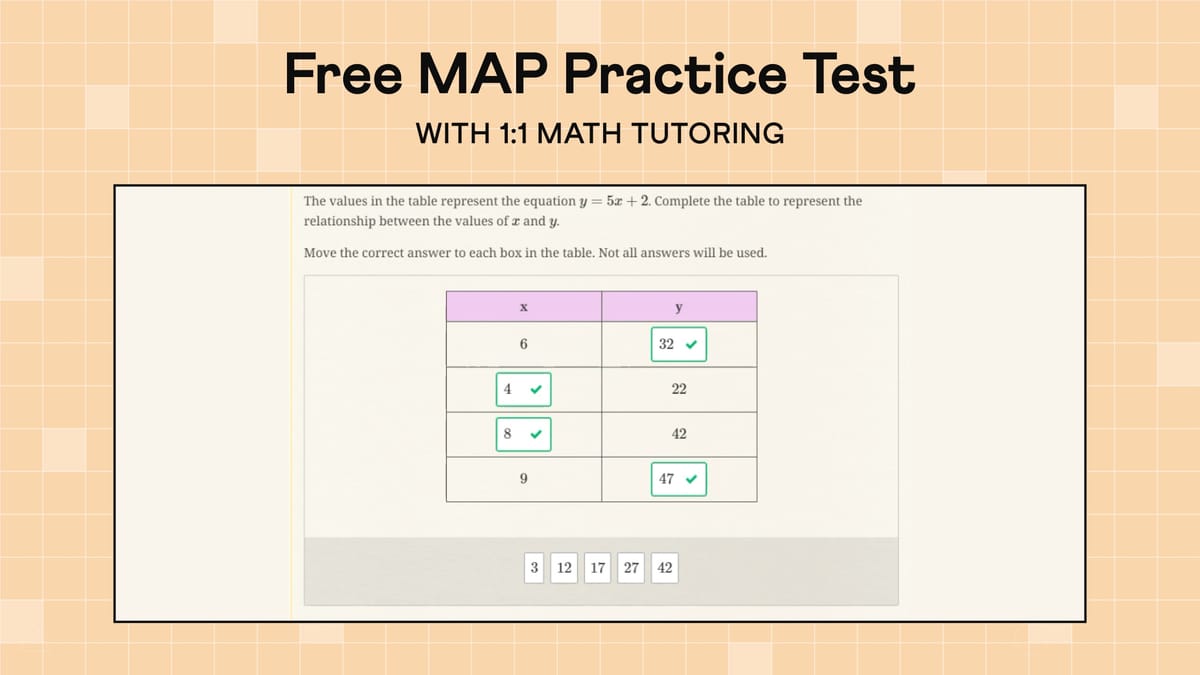
| x | y |
|---|---|
| 6 | 32 |
| ? | 22 |
| 8 | 42 |
| 9 | ? |
Show answer & solution
- 2 students read 3 books
- 4 students read 4 books
- 5 students read 5 books
- 3 students read 6 books
- 1 student read 9 books
Show answer & solution
Show answer & solution
Free MAP Practice for Grades 7-8
By now MAP is testing pre-algebra and algebra: equivalent expressions, equations, and linear functions. The questions look short but reward students who see the structure of a problem instead of grinding through it.
Show answer & solution
Show answer & solution
Show answer & solution
Stuck on the Same Type of Question Twice?
That pattern is the gap a MAP score is measuring. A free Cuemath evaluation finds exactly which concept is tripping your child up and shows you, before you pay anything.
Book a Free EvaluationFor students in grades 3 to 8 · No credit card · No commitment
Free MAP Practice vs a Program
The questions above are enough for a confident kid who just needs to see the format. For most parents, though, the real question is bigger: what is the best way to actually get my child ready?
| Option | Best for | The honest limitation | Cost |
|---|---|---|---|
| Official NWEA warm-up and practice test | Seeing the real interface and question styles | Very short, no teaching, and it never tells you why an answer was wrong | Free |
| Printable practice PDFs and worksheets | Extra repetition on a known weak topic | Static and not adaptive; a child can practice the wrong method and reinforce it | Free |
| Self-paced math apps | Independent kids who already know their gap | No one explains the reasoning; the child has to self-diagnose what to fix | Free or freemium |
| 1:1 tutoring program (Cuemath) | Kids who need someone to find the gap and teach the why | Paid, and it asks for a weekly time commitment | From $25/class, grades 3-7 |
A free warm-up tells you your child got a question wrong. It does not tell you the place-value idea underneath it never clicked. That gap is the difference between practice that feels productive and practice that moves a score.
Because the test is adaptive and built to find a student's ceiling, you cannot really study for it the way you study for a unit quiz. The only durable lever is the underlying skill, applied confidently in an unfamiliar problem.
So the honest answer: if your child is steady in math and just needs format comfort, the free questions on this page plus the official warm-up will do. If they keep hitting the same wall, no amount of free worksheets fixes a gap nobody has explained. That is when a program earns its cost.
 Nikita Joshi
Why cramming doesn't move a MAP score
Because the test is adaptive, there is nothing to cram. Your child cannot memorize the questions, because the questions are chosen live based on their answers.
What moves a RIT score is closing the specific skill gaps the test keeps finding. A child who guesses on ratios in fifth grade will see ratio questions again, scored lower, until the underlying idea is fixed. A correct guess teaches nothing. A wrong answer that gets explained, retried, and understood is what actually changes the next score.
This is the part free practice cannot do on its own. A worksheet marks an answer right or wrong. It does not catch that your child added the numerators when comparing fractions, explain why that breaks, and have them try again until it holds. That feedback loop is the whole game, and it is the reason a score keeps climbing instead of plateauing.
 Neelima Kotamraju
Why Choose Cuemath for MAP Practice Test?
MAP measures whether your child can apply a concept in an unfamiliar problem, not just recall it. A 1:1 tutor is the only kind of practice that finds that exact gap and fixes it. Here is what Cuemath gives a grade 3 to 8 student preparing for MAP:
What you get
- Free evaluation that pinpoints where understanding breaks down by concept, not grade level.
- A dedicated tutor from the top 1% of applicants, kept the same every session.
- Diagnoses the cause of a wrong answer: concept missing, or solid but not automatic under pressure. Each gets a different fix.
- Practice on the unfamiliar, MAP-style versions of the exact concepts your child is weak on.
- 2 sessions a week, 55 to 60 minutes each, fully online and flexible.
- Tutor notes after every session plus a monthly progress score, so you track growth monthly instead of twice a year like MAP.
- MAP prep included in the regular 1:1 plan at no extra cost. Plans for grades 3 to 7 start at $25 per class; the evaluation is free.
 Nikita Joshi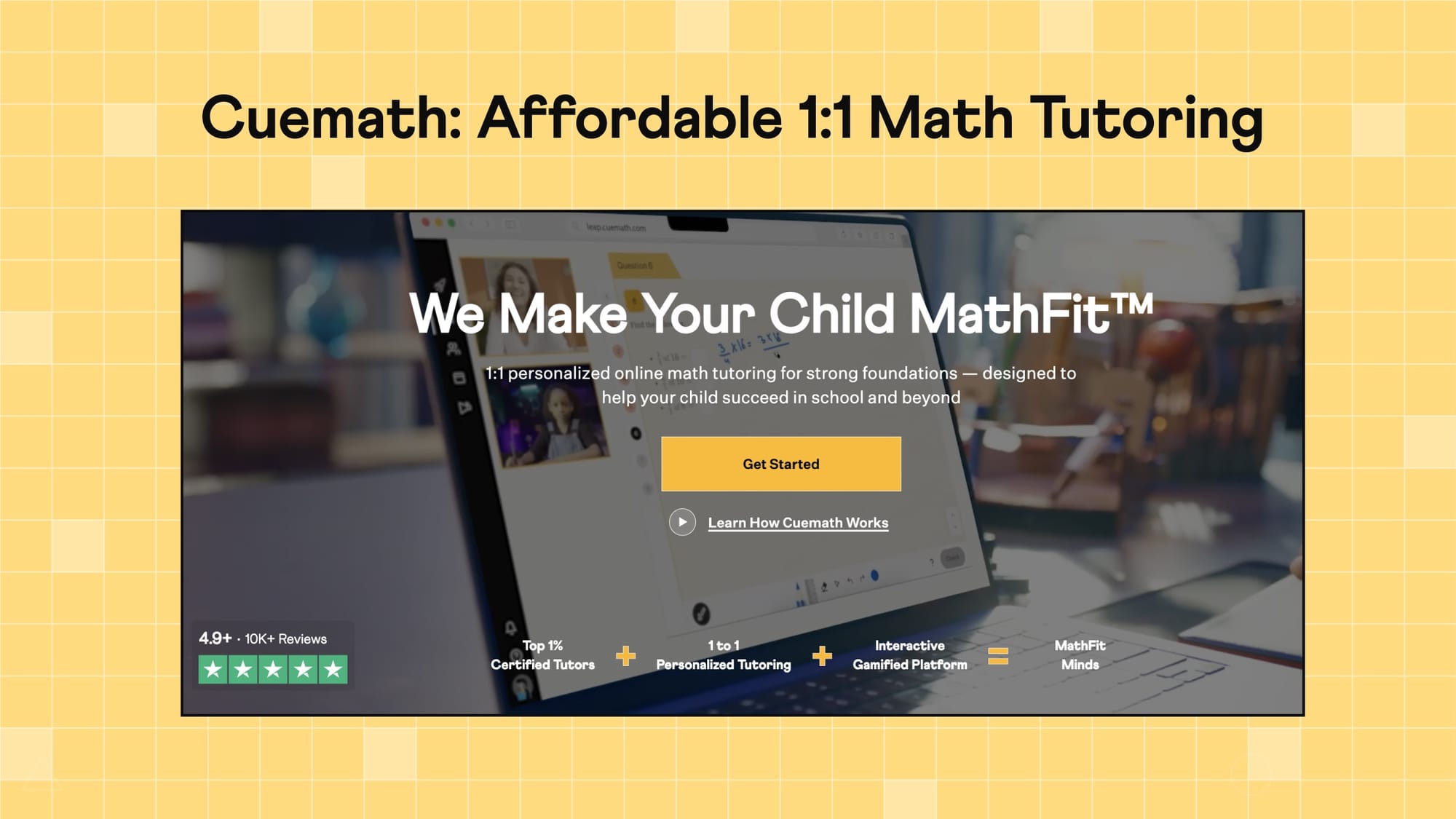
The results
- #1 tutoring service on Trustpilot: 4.9 stars across 10,000+ reviews.
- 2,500+ student wins across national tests, state tests, and the SAT.
- 97.2% of parents say their child improved with Cuemath.
- Sai Geethika, Grade 4: started February with gaps in her math foundation, became the highest scorer in her cohort on the spring MAP math test two months later.
- Nithya, Grade 4: earned her cohort's "Most Growth" award on the spring MAP math test, with the same tutor since Grade 1.
See Exactly Where Your Child Stands, For Free
One free evaluation includes a short assessment that pinpoints the concept gaps behind a MAP score, and a tutor who shows you the plan to close them. From there, MAP prep is part of regular tutoring, so your child keeps growing long after the test.
Book a Free EvaluationFor students in grades 3 to 8 · 100% refund on unused classes · No questions asked
Frequently Asked Questions
Can you practice for the MAP test?
You can practice for the MAP test, but not by memorizing questions. The MAP Growth test is computer-adaptive, so every child sees a different set of questions chosen live based on their answers. What helps is getting familiar with the format and, more importantly, strengthening the underlying math skills the test measures.
Is the MAP math test the same every time my child takes it?
No, the MAP math test is different each time because it is adaptive. The questions get harder after a correct answer and easier after a wrong one, so the test settles on your child's actual skill level. This is why no two students see the same test and why there is no fixed answer key to study.
How can my child practice for the MAP math test at home for free?
Your child can practice for the MAP math test at home using free MAP-style questions like the grade-3-to-8 sets on this page, plus NWEA's official practice warm-up to get used to the interface. Focus on the topics your child finds hard rather than doing random questions. The goal is to fix weak concepts, since that is what actually raises a RIT score.
What is a good MAP math score for my child's grade?
A good MAP math score is one at or above the 50th percentile for your child's grade and the time of year they tested. Because MAP reports a RIT score and a percentile rather than a pass or fail, what counts as good depends on the grade-level norm, not a fixed number. NWEA publishes norms tables that show the typical RIT range for each grade and season.
How many questions are on the MAP math test?
The MAP Growth math test usually has around 40 to 53 questions, depending on the grade and version. It is not timed for most students, so your child can work at their own pace. The number can vary because the adaptive test adjusts as it goes.
Does MAP test prep cost extra at Cuemath?
No, MAP test prep is not a separate paid add-on at Cuemath. Test prep is built into the regular 1-on-1 tutoring plan, alongside school math and homework help, so the same sessions that strengthen everyday math also prepare a child for MAP. Plans for grades 3 to 7 start at $25 per class, and the first evaluation is free.
How long does it take to improve a MAP math score?
Most children show measurable improvement within a few months of consistent, targeted practice, because MAP measures growth over time rather than a single cram. The key is closing specific skill gaps rather than reviewing everything at once. Since MAP is taken two to three times a year, steady weekly work between testing windows is what shows up as a higher score.
Sources
- NWEA — MAP Growth overview (how the adaptive test and RIT scale work)
- NWEA — 2025 MAP Growth norms quick reference (typical RIT ranges by grade and season)
- NWEA Connection — Practice tests for MAP Growth (official warm-up and family guidance)
- Common Core State Standards — Mathematics (the standards MAP math is aligned to, by grade)
- Trustpilot — Cuemath reviews (backs the 4.9 rating, 10,000+ reviews, and 97.2% improvement figure)

I grew up a science kid. Math was not my best subject. Class moved fast, I was too shy to ask for help, and I somehow ended up more curious about how people learn than about the subjects themselves.
That's what pulled me into education, not to teach, but to understand how colleges and tutoring programs actually work and what students genuinely need from them.
My love for writing did the rest. I had too many observations and nowhere to put them, so I started writing, and haven't stopped. Over the last five years I've written about edtech, student life, and college programs. For the past year, my focus has been math tutoring specifically.
I work at Cuemath now, so factor that in. I research by going where parents actually talk: forums, reviews, and direct conversations with students and families. I'm writing for the kid who's too scared to raise their hand in class. I was that kid.