Free AMC 8 Practice Test Sheets + a 12-Week Prep Plan for 2027
Thirty original AMC 8-style problems your child can solve right on the page, with instant answers and a one-line explanation for each. Then a 12-week plan with real dates, from October 26, 2026 to the weekend before the January 21–27, 2027 test window.

Getting ready for the 2027 AMC 8? First time taking the contest or trying to improve on your score? Whatever your goal, the right practice materials and a consistent study plan can make your preparation focused and effective. This guide provides a 12-week AMC 8 study schedule and free AMC 8 practice tests for 2027 to help you develop problem-solving skills, review important math topics, and increase your confidence before the exam. This step-by-step guide will help you get the most out of your preparation, from reviewing past contest problems to learning from mistakes and practicing under timed conditions. All problems are original AMC 8 style questions written specifically for this page, and each answer has a one-line explanation.
- AMC 8 at a Glance
- Free AMC 8 Practice Test Sheets
- Sheet 1: Number Sense
- Sheet 2: Algebra, Ratios and Percents
- Sheet 3: Geometry
- Sheet 4: Counting and Probability
- Mixed Mini Mock (10 Questions)
- The 12-Week AMC 8 Prep Plan (October 26 to January 17)
- Starting Late? A 6-Week Version
- Meet Cuemath's AMC 8 Tutors
- How to Read Your Child's AMC 8 Practice Test Scores
- Where to Find Full Past AMC 8 Tests
- How AMC 8 Registration Works
- Try It Yourself: 20-Question AMC 8 Practice Worksheet
- Frequently Asked Questions
- Sources
AMC 8 at a Glance
The AMC 8 is a 40-minute, 25-question multiple-choice math contest for students in grade 8 and below. The Mathematical Association of America (MAA) writes and runs it. Your child sits it once, at a host school or center, on one day the host picks within January 21–27, 2027.
| What | Detail |
|---|---|
| Test window | January 21–27, 2027 (the host picks the day) |
| Questions | 25 multiple choice, 5 options each (A to E) |
| Time | 40 minutes |
| Scoring | 1 point per correct answer. No penalty for wrong or blank answers. Maximum 25 |
| Calculator | Not allowed |
| Allowed | Pencils (colored too), erasers, blank scratch paper, rulers |
| Who can take it | Grade 8 or below, and under 15.5 years old on test day |
| Topics | Number sense, algebra and percents, geometry, counting and probability, logic |
Forty minutes for 25 questions works out to about 1.6 minutes per question. The real challenge on the AMC 8 is pace, not hard math. Most problems use math your child already knows from school, but ask it in an unfamiliar way. That's why the sheets below are timed to the same pace.
Free AMC 8 Practice Test Sheets
These four AMC 8 practice problem sheets cover the four topic groups that make up most of the test. Each sheet has 5 problems, ordered from easier to harder, just like the real paper.
- Tap an answer (A to E). The sheet tells you right away if it's right and opens a one-line explanation.
- Watch the score bar fill as you go. Hit Try again to reset the sheet.
- Start the 8-minute timer if you want the real AMC 8 pace for 5 questions.
Sheet 1: Number Sense
See why
Answer: C) 50,000. Pair 1001 with 1, 1002 with 2, and so on. Each pair differs by 1,000, and there are 50 pairs: 50 × 1,000 = 50,000.
See why
Answer: D) 512. 2¹⁰ = 2 × 2⁹, so 2¹⁰ − 2⁹ = 2⁹ = 512.
See why
Answer: D) 12. 72 = 2³ × 3². Add 1 to each exponent and multiply: (3 + 1)(2 + 1) = 12.
See why
Answer: B) 1. The last digits of powers of 7 repeat 7, 9, 3, 1. 100 is a multiple of 4, so 7¹⁰⁰ ends in 1, and the remainder is 1.
See why
Answer: C) 61. The number minus 1 must be a multiple of 2, 3, 4, 5, and 6. The least common multiple is 60, so the number is 61.
Sheet 2: Algebra, Ratios, and Percents
See why
Answer: D) 80. 2 · 5 · 10 = 100. Then 100 × (1/2 + 1/5 + 1/10) = 50 + 20 + 10 = 80.
See why
Answer: D) $40. $40 × 1.25 = $50. Then $50 × 0.80 = $40. A 25% rise and a 20% drop cancel out exactly.
See why
Answer: E) 20. The five numbers add to 5 × 12 = 60. The four left add to 4 × 10 = 40. The removed number is 60 − 40 = 20.
See why
Answer: C) 10. If Ben is b, then 3b + 10 = 2(b + 10). So 3b + 10 = 2b + 20, and b = 10.
See why
Answer: B) 2 hours. Together they fill 1/6 + 1/3 = 1/2 of the pool each hour, so the full pool takes 2 hours.
What US Families Say About Cuemath
★ 4.9/5 from 12,000+ reviews on Trustpilot100% free · No credit card needed · Meet a Cuemath tutor 1:1
Sheet 3: Geometry
See why
Answer: C) 50. Width w, length 2w: 2(w + 2w) = 30, so w = 5 and the length is 10. Area = 5 × 10 = 50.
See why
Answer: C) 24. The hypotenuse is √(36 + 64) = 10. Perimeter = 6 + 8 + 10 = 24.
See why
Answer: B) 120°. The interior angles of a hexagon add to (6 − 2) × 180° = 720°. Each of the 6 equal angles is 720° ÷ 6 = 120°.
See why
Answer: A) 16 − 4π. The square's area is 16. The circle's radius is 2, so its area is 4π. The area left over is 16 − 4π.
See why
Answer: C) 12. The cubes with exactly 2 painted faces sit in the middle of each edge. A cube has 12 edges, each with 1 such cube, so the answer is 12.
Sheet 4: Counting and Probability
See why
Answer: D) 125. Each of the 3 digits can be 1, 3, 5, 7, or 9: 5 × 5 × 5 = 125.
See why
Answer: C) 1/6. 6 of the 36 outcomes add to 7 (1+6, 2+5, 3+4, 4+3, 5+2, 6+1). 6/36 = 1/6.
See why
Answer: B) 10. Each of the 5 people shakes 4 hands: 5 × 4 = 20. That counts each handshake twice, so the answer is 20 ÷ 2 = 10.
See why
Answer: C) 30. 5 letters give 5! = 120 orders. L and E each appear twice, so divide by 2 × 2: 120 ÷ 4 = 30.
See why
Answer: C) 47. There are 33 multiples of 3 and 20 multiples of 5. The 6 multiples of 15 got counted twice, so: 33 + 20 − 6 = 47.
Mixed Mini Mock (10 Questions)
Use this in Weeks 9 to 12 of the plan. It mixes all four topics in AMC 8 order, easier to harder. Timer: 16 minutes, the real pace for 10 questions.
See why
Answer: C) 420. This is 2 × (1 + 2 + ⋯ + 20) = 2 × 210 = 420.
See why
Answer: C) 10. 40 ÷ 8 parts = 5 per part. Boys = 15, girls = 25, and 25 − 15 = 10.
See why
Answer: B) 75°. The minute hand points at 6 (180°). The hour hand has moved halfway from 3 to 4 (105°). 180° − 105° = 75°.
See why
Answer: E) 7/8. The only way to get no heads is TTT, with probability 1/8. So the probability of at least one head is 1 − 1/8 = 7/8.
See why
Answer: A) 30. 5² + 12² = 13², so it's a right triangle with legs 5 and 12. Area = ½ × 5 × 12 = 30.
See why
Answer: B) 299. Start at 2 and add 3 ninety-nine times: 2 + 99 × 3 = 299.
See why
Answer: B) 3²⁰. 4¹⁵ = 2³⁰ = 8¹⁰, and 3²⁰ = 9¹⁰. Since 9¹⁰ > 8¹⁰, 3²⁰ is largest.
See why
Answer: D) 7. Count the factors of 5: 30 ÷ 5 = 6, plus one extra from 25 = 5 × 5. That's 7 fives, so 7 zeros.
See why
Answer: C) 180. 10²⁰ − 1 is twenty 9s in a row. 20 × 9 = 180.
See why
Answer: D) 36. Pick 2 of the 4 vertical lines and 2 of the 4 horizontal lines: 6 × 6 = 36.
Want More Than 30 Problems? Practice AMC 8 in the Cuemath App
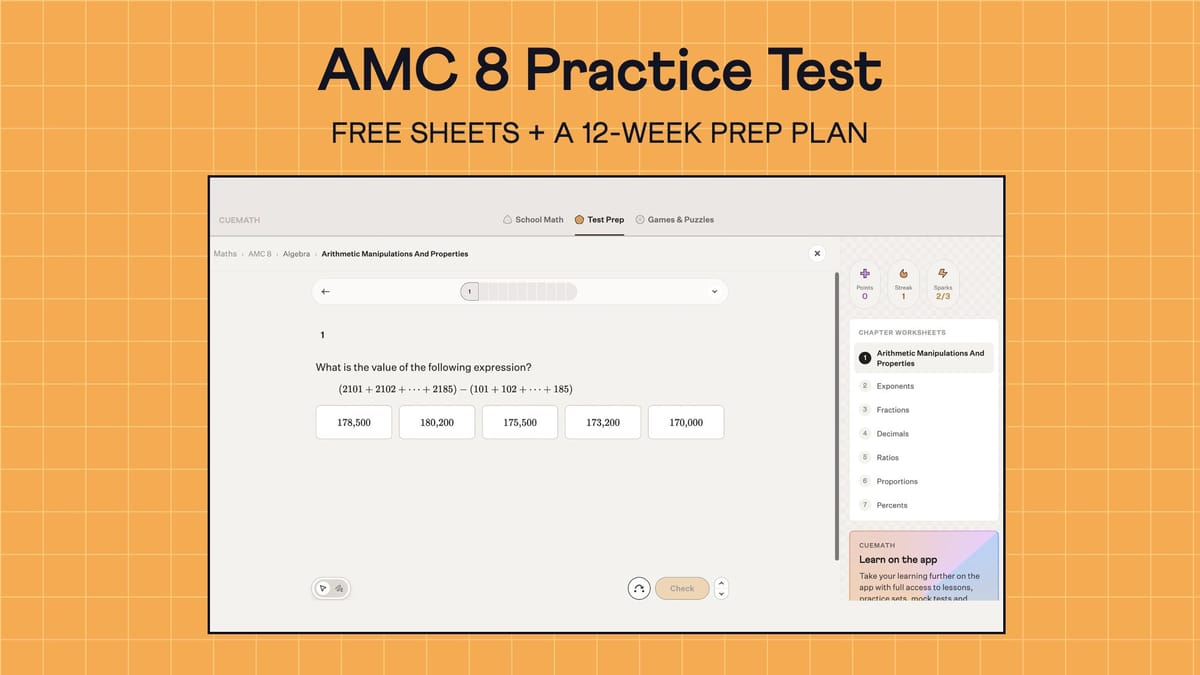
The Test Prep tab has AMC 8 chapter worksheets, from arithmetic and exponents to ratios and percents, in the same answer-and-check format as the sheets above. Points and streaks keep daily practice going between now and January.
100% Free • No Card Needed • A Few Minutes a Day
The 12-Week AMC 8 Prep Plan (October 26 to January 17)
The plan below runs 12 weeks, from Monday, October 26, 2026, to Sunday, January 17, 2027. That's the weekend before the January 21–27 test window. It asks for 4 days a week, 30 to 40 minutes a day. That's enough time to cover every topic once, then spend the last month on full timed tests.
| Week | Dates | Focus | What to do |
|---|---|---|---|
| 1 | October 26 – November 1, 2026 | Baseline | One full past AMC 8, timed at 40 minutes. Write down the score and which topics the misses came from |
| 2 | November 2 – 8, 2026 | Number sense | Sheet 1, then 10 past problems on divisors and remainders |
| 3 | November 9 – 15, 2026 | Number sense | Redo missed Sheet 1 problems from memory, then 10 more past problems |
| 4 | November 16 – 22, 2026 | Algebra and percents | Sheet 2, then 10 past problems on percents and averages |
| 5 | November 23 – 29, 2026 | Algebra and percents (light week: Thanksgiving) | 2 days only: redo Sheet 2, then 5 past rate problems |
| 6 | November 30 – December 6, 2026 | Geometry | Sheet 3, then 10 past problems on area and angles |
| 7 | December 7 – 13, 2026 | Geometry | 10 past problems on circles and 3D shapes |
| 8 | December 14 – 20, 2026 | Counting and probability | Sheet 4, then 10 past counting problems |
| 9 | December 21 – 27, 2026 | Mixed (light week: holidays) | Mixed Mini Mock, timed at 16 minutes |
| 10 | December 28, 2026 – January 3, 2027 | Full test | 1 full past AMC 8, timed. Review every miss |
| 11 | January 4 – 10, 2027 | Full test + weakest topic | 1 full past AMC 8, timed. Then redo the sheet for your weakest topic |
| 12 | January 11 – 17, 2027 | Last full test, then rest | 1 full past test on Monday or Tuesday. Light review only after that |
| Test | January 21 – 27, 2027 | AMC 8 | The host picks the day. Bring pencils, an eraser, and a ruler |
Four rules that make the plan work:
- Keep a mistake list. For every miss, write the problem number, the topic, and one line on what went wrong. In Weeks 10 to 12, your child reviews this list instead of learning new topics.
- Time everything from Week 9. The goal is 1.6 minutes per question, so the real 40 minutes feels normal.
- Practice the blank rule. On every timed test, your child fills in an answer for every question. A blank always scores 0. A guess among 5 choices gets it right 1 time in 5.
- Read the question twice. AMC 8 problems often ask for something a step past the obvious, like the area when the student just found a side length.
Starting Late? A 6-Week Version
If your child starts on Monday, December 7, 2026, there's still time for one pass through every topic. Cut the topic weeks to one each and keep the timed-test weeks.
| Week | Dates | What to do |
|---|---|---|
| 1 | December 7 – 13, 2026 | Baseline past test (40 minutes) + Sheet 1 |
| 2 | December 14 – 20, 2026 | Sheets 2 and 3 |
| 3 | December 21 – 27, 2026 | Sheet 4 + Mixed Mini Mock (16 minutes) |
| 4 | December 28, 2026 – January 3, 2027 | 1 full past test, timed. Review misses |
| 5 | January 4 – 10, 2027 | 1 full past test, timed. Redo weakest sheet |
| 6 | January 11 – 17, 2027 | 1 full past test early in the week, then light review |
Starting even later than December? Skip straight to Weeks 4 to 6. Two timed past tests with careful review will help more than rushing through topics.
Meet Cuemath's AMC 8 Tutors
These Cuemath tutors teach AMC 8 test prep one-on-one to students in grades 3 to 8 in the United States and Canada.
How to Read Your Child's AMC 8 Practice Test Scores
Compare each practice score to your child's own Week 1 baseline, not to a target number. AMC 8 scores range from 0 to 25. The test is written to stretch even strong eighth graders, so a first score in the single digits is normal for a sixth or seventh grader.
On the 5-question topic sheets:
- 5 of 5: Move on to the next topic.
- 3 or 4 of 5: Read every “See why,” then redo the misses the next day without looking.
- 0 to 2 of 5: Spend one more session on this topic with past problems before moving on.
On full past tests (Weeks 1, 10, 11, 12):
- Look at which topic the misses came from, not just the total.
- Count how many questions were left blank or rushed in the last 5 minutes. If it's more than 3, practice pace before more content.
The MAA sets AMC 8 award cutoffs each year based on how all students score that year. The Honor Roll goes to roughly the top 5% of students, and the Distinguished Honor Roll to roughly the top 1%. Because the cutoffs move each year, a practice score can't tell you in advance whether your child will earn an award.
Where to Find Full Past AMC 8 Tests
Past AMC 8 tests are the best full-length practice because the MAA wrote them. Two free places host them:
- LIVE by Po-Shen Loh hosts every AMC 8 from 1985 to 2026 as clean, printable PDFs, with the MAA's permission.
- The AoPS Wiki has every past AMC 8 problem with community-written solutions, often several per problem.
Which years to use when:
- Week 1 baseline: a recent test (2024 or 2025) shows the current style.
- Weeks 2 to 8 topic practice: problems 1 to 15 from older tests (2015 to 2020) match each topic sheet's level.
- Weeks 10 to 12 full tests: 2022, 2023, and 2026, in that order. Save the newest for last.
The AMC 8 wasn't held in 2021. So if a list jumps from 2020 to 2022, nothing is missing.
How AMC 8 Registration Works
Parents can't register a child for the AMC 8 directly. The school, or another host such as a math circle, learning center, or university, registers with the MAA, and your child signs up through that host.
| Host deadline (with the MAA) | Date | Host's fee |
|---|---|---|
| Early bird | October 28, 2026 | $55 |
| Regular (last date for first-time hosts) | January 5, 2027 | $75 |
| Late (returning hosts only) | January 14, 2027 | $115 |
The one step to take this week is to ask your child's school whether it hosts the AMC 8 and when its own student signup closes. The school's internal date is often weeks earlier than the MAA's. Our full guide, AMC 8 2027 deadlines and readiness by grade, walks through what to do if the school says yes, maybe, or no.
Preparing for more than one contest this year? Cuemath's math test prep programs also cover Math Kangaroo and other tests.
Find Out Which AMC 8 Topic Is Costing Your Child the Most Points
In a free 1:1 session, a Cuemath tutor works through AMC 8-style problems with your child and shows you exactly where the points are going.
Try It Yourself: 20-Question AMC 8 Practice Worksheet
Ready for a longer run? This worksheet mixes all four AMC 8 topic groups in 20 original questions, ordered easier to harder like the real test. Set the 32-minute timer for the real AMC 8 pace, answer every question, then check your score.
See why
Answer: B) −50. Group the terms in pairs: (1 − 2) + (3 − 4) + ⋯ + (99 − 100). Each pair is −1, and there are 50 pairs, so the total is −50.
See why
Answer: C) 50. 40% of 500 is 200, and 25% of 200 is 50.
See why
Answer: B) 12. Work backward: 30 − 6 = 24, and 24 ÷ 2 = 12.
See why
Answer: C) 540°. A polygon with n sides has interior angles adding to (n − 2) × 180°. For a pentagon, that's 3 × 180° = 540°.
See why
Answer: A) 5. The primes are 31, 37, 41, 43, and 47. That's 5.
See why
Answer: D) 72. 2 hours is 4 blocks of 30 minutes, so she reads 4 × 18 = 72 pages.
See why
Answer: D) 7. The units digits of powers of 3 repeat 3, 9, 7, 1. 2027 leaves a remainder of 3 when divided by 4, so the units digit is the third in the cycle: 7.
See why
Answer: A) 28. The side is √49 = 7, so the perimeter is 4 × 7 = 28.
See why
Answer: D) 22. The middle number equals the average, 20. So the numbers are 18, 20, and 22, and the largest is 22.
See why
Answer: B) 2/15. First draw: 4/10. Second draw: 3/9. Multiply: 4/10 × 3/9 = 12/90 = 2/15.
See why
Answer: B) 30. The LCM of 12 and 18 is 36, and the GCF is 6. 36 − 6 = 30.
See why
Answer: A) 80. Speed = distance ÷ time = 120 ÷ 1.5 = 80 kilometers per hour.
See why
Answer: B) 10. The diagonal is the hypotenuse of a right triangle with legs 6 and 8: √(36 + 64) = √100 = 10.
See why
Answer: D) 20. Each of the 8 corners connects to 5 non-neighboring corners: 8 × 5 = 40. Each diagonal is counted twice, so 40 ÷ 2 = 20.
See why
Answer: C) 10. x/3 + x/6 = 2x/6 + x/6 = x/2. So x/2 = 5, and x = 10.
See why
Answer: E) 24. 4 choices for the first spot, 3 for the second, 2 for the third, 1 for the last: 4 × 3 × 2 × 1 = 24.
See why
Answer: C) 10. 2⁹ = 512 is less than 1,000, and 2¹⁰ = 1,024 is greater. So n = 10.
See why
Answer: D) 25π. Circumference = 2πr = 10π, so r = 5. Area = πr² = 25π.
See why
Answer: D) 56. The divisors are 1, 2, 4, 7, 14, and 28. Their sum is 56.
See why
Answer: A) 9. They are 18, 27, 36, 45, 54, 63, 72, 81, and 90. That's 9 numbers.
Frequently Asked Questions
Where can I find a free AMC 8 practice test?
You can take a free AMC 8 practice test right on this page: four 5-question topic sheets and a 10-question mixed mock, all with instant answers. For full 25-question tests, LIVE by Po-Shen Loh and the AoPS Wiki host every past AMC 8 for free.
How many questions are on the AMC 8, and how long is it?
The AMC 8 has 25 multiple-choice questions, and your child gets 40 minutes. That's about 1.6 minutes per question, so practicing with a timer matters as much as practicing the math.
Is a calculator allowed on the AMC 8?
No, calculators aren't allowed on the AMC 8. Neither are phones, smartwatches, compasses, protractors, or graph paper. Your child can bring pencils, erasers, blank scratch paper, and a ruler.
When is the AMC 8 in 2027?
The 2027 AMC 8 runs January 21–27, 2027. Each host school or center picks one day in that window, so ask your child's school which day it chose.
How do I sign my child up for the AMC 8?
You sign up through your child's school or another host site, because parents can't register with the MAA directly. Hosts register by January 5, 2027 (first-time hosts) or January 14, 2027 (returning hosts), but the school's own student signup often closes earlier.
Is 12 weeks enough to prepare for the AMC 8?
Yes, 12 weeks is enough to prepare for the AMC 8 if your child practices 4 days a week for 30 to 40 minutes. That covers every topic once and leaves four weeks for full timed tests. Starting in December still works with the 6-week version on this page.
What is a good AMC 8 score?
A good AMC 8 score is one that beats your child's own baseline, since award cutoffs change each year with how everyone scores. The Honor Roll goes to roughly the top 5% of students, and the Distinguished Honor Roll to roughly the top 1%.
Can a 5th or 6th grader take the AMC 8?
Yes, a 5th or 6th grader can take the AMC 8. The MAA sets a ceiling (grade 8 or below, under 15.5 years old), not a minimum grade. Some hosts set their own rules for younger students, so check with the school first.
Are these practice problems as hard as the real AMC 8?
The AMC 8 practice problems on this page match roughly the first 18 questions of a real AMC 8. The last 7 questions of a real test are harder, which is why the plan switches to full past tests in Weeks 10 to 12.
Sources
- Mathematical Association of America (MAA), American Mathematics Competitions: AMC 8 format, eligibility, scoring, allowed materials, and awards
- MAA, AMC Registration + Information: 2026–27 host registration deadlines and fees
- LIVE by Po-Shen Loh, Past Contests: free printable past AMC 8 tests
- Art of Problem Solving Wiki, AMC 8 Problems and Solutions: past AMC 8 problems with community solutions
- Trustpilot, Cuemath reviews: parent reviews in the carousel

I was never the kid who loved math. I was much more interested in books, stories, and writing, and, somewhere along the way, I became even more curious about people. Why do we learn differently? Why does something make sense to one child but not another? And what makes a student feel confident enough to keep trying?
That curiosity led me to study Applied Psychology, where I learned more about how children think, learn, and make sense of the world around them.
My love for writing did the rest. What started as something I simply enjoyed became a career. Over the past five years, I've worked as a freelance writer across edtech, SaaS, B2B, travel, lifestyle, and healthcare, learning how to write for very different audiences without losing the human side of the story.
Today, I'm an SEO Content Writer & Editor at Cuemath, where I get to bring many of these interests together. Working in education, and especially around math, has made me even more curious about what happens behind the screen or textbook: what parents worry about, what students struggle with, and what actually helps them learn.
That's also how I like to research. I don't just look at search results and call it a day. I go where parents and students actually talk: forums, reviews, communities, and conversations with real families. Because sometimes the most useful insight isn't hiding in a keyword; it's in a parent's question, a student's frustration, or a small detail someone shares about their learning experience.
I write because I'm curious. I research because I want to understand. And I love turning what I learn into content that feels genuinely useful to the people reading it.