Maths Tutoring Near Me: Why Australian Parent Searches Are Surging in 2026?
Australian searches for tutoring have doubled since 2016 and just hit their highest point in a decade. Here's what's driving it and why almost anyone can still call themselves a tutor.


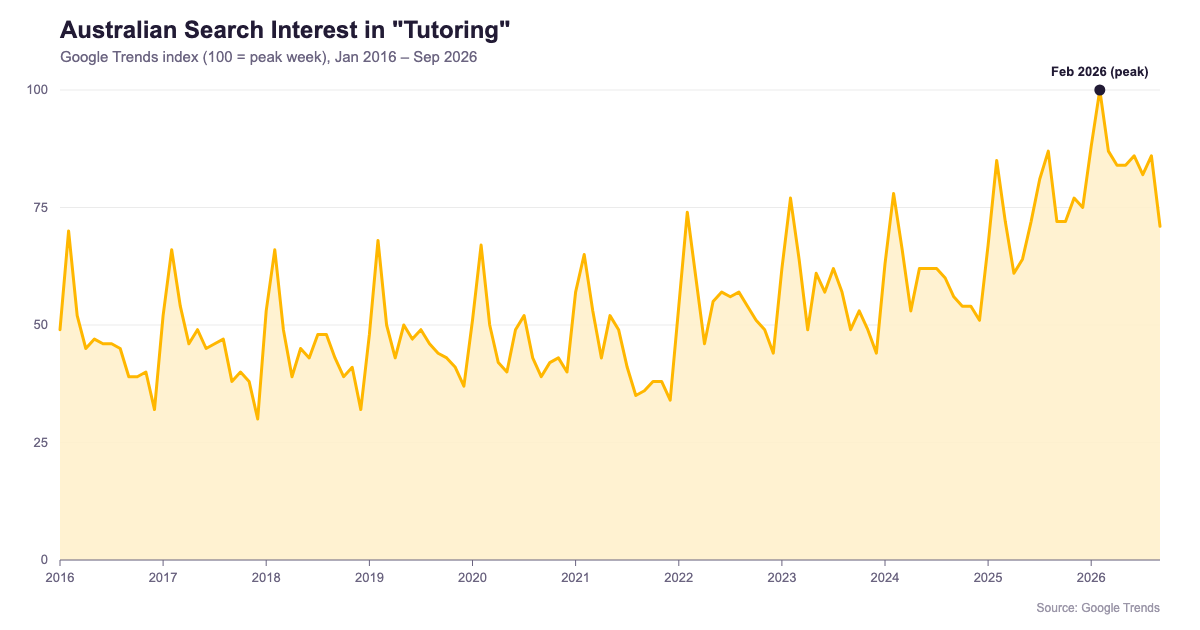
Searches for tutoring in Australia have roughly doubled since 2016 and just hit their highest point in a decade, according to Google Trends data. The surge is heaviest in New South Wales, spikes every February at the start of the school year, and is led by one search above all: online tutoring.
For parents wondering whether outside help has become the norm, the data suggests yes — in an industry that still has no minimum qualifications for who can call themselves a tutor.
Why Are Tutoring Searches at a Decade High?
Australian interest in "tutoring" was flat from 2016 to 2021. Since 2022 — as schools returned to normal operation after two disrupted pandemic years — it has risen every year.
February 2026 was the busiest month in the decade: roughly 20% above February 2025, and about double 2016's level, even as cost-of-living pressure has forced families to cut back elsewhere.
Why Is New South Wales Driving the Boom?
The state gap is large. Here's how every state and territory compares, measured against each one's own total search volume:
| State/Territory | Search Interest (NSW = 100) |
|---|---|
| New South Wales | 100 |
| Australian Capital Territory | 68 |
| Victoria | 64 |
| Western Australia | 56 |
| Northern Territory | 46 |
| Queensland | 43 |
| South Australia | 30 |
| Tasmania | 25 |
Source: Google Trends, Australia, Jan 2016–Sep 2026.
NSW runs the country's largest selective-school system and a high-stakes HSC — "HSC tutoring" is among the most common tutoring-related searches nationally, with "VCE tutoring" close behind.
What Are Families Actually Searching For?
The single most common related search, per EducationHQ's analysis, is "online tutoring."
Maths tops the subject searches, ahead of English. Notably, the second most common related search isn't from a parent at all — it's "tutoring jobs," a sign of the sector's uncredentialed supply side, in a labour market where unemployment just hit 4.6%, its highest since the pandemic, per the Australian Bureau of Statistics.
Is Private Tutoring Regulated in Australia?
No. Australia's tutoring industry has no mandated qualifications for who can teach.
Dr Ben Zunica, a University of Sydney researcher first reported by EducationHQ in 2025, put it plainly: "You don't need any training at all to be a tutor." His team found hourly fees of AU$80 to AU$100, inconsistent background checks, and no national data on who is tutoring whom — in a sector at least one in seven students already use.
That gap is one reason some programs — Cuemath included — built their own tutor-vetting process instead of waiting for one to become mandatory.
How Parents Can Support Learning at Home?
Given the qualification gap above, the practical question isn't just whether to get a tutor, but who parents are getting. A tutor's subject training and whether they track progress against your child's actual school syllabus matter more than convenience or price alone.
Programs like Cuemath, which select tutors from the top 1% of applicants and train them in maths and child psychology before matching them 1:1 to a student aligned with the Australian Curriculum, show what a more structured alternative looks like.
Key Takeaways
- Tutoring search interest in Australia is at a ten-year high, and has risen every year since 2022.
- Demand is concentrated in NSW and peaks every year at the start of the school year.
- "Online tutoring" is the single most-searched related term.
- The industry still has no mandatory qualifications for who can call themselves a tutor.
- What to watch: whether Dr Zunica's findings prompt any regulatory response, and whether next February's data extends the five-year run.
Sources
- Google Trends — Australia, "tutoring" search interest, Jan 2016–Sep 2026 — search-volume, seasonality, and state-comparison data
- Australian Bureau of Statistics — Labour Force, Australia, August 2026 — 4.6% unemployment figure
- University of Sydney — Dr Ben Zunica researcher profile — researcher credentials
- EducationHQ — "Australia's tutoring boom is accelerating, and the search data shows where" (28 Sept 2026) — primary story
- EducationHQ — "Unchecked tutoring industry putting Australian students at 'significant' risk: research" (30 Sept 2025) — original Zunica research report
I write because I like understanding things properly, and I’ve never been able to do that quietly.
Six years in, what still interests me most isn’t the writing itself. It’s the person on the other side. Who are they, what were they actually worried about when they opened this page, and did they leave with what they came for?
At Cuemath, I write for parents and students in India and around the world. So I research before I write: forums, reviews, the long comment threads where somebody finally admits what they’re really confused about. That’s usually where the useful thing is hiding.
For this guide, that meant reading every provider’s own site line by line, so the comparison holds up to scrutiny, including the parts about Cuemath.