What Is the AASA Test? A Simple 2026 Guide for Parents
Wondering what the AASA test is and what it means for your child? This simple 2026 guide for parents explains the AASA, who takes it, what to expect, and how you can support your child’s test preparation.

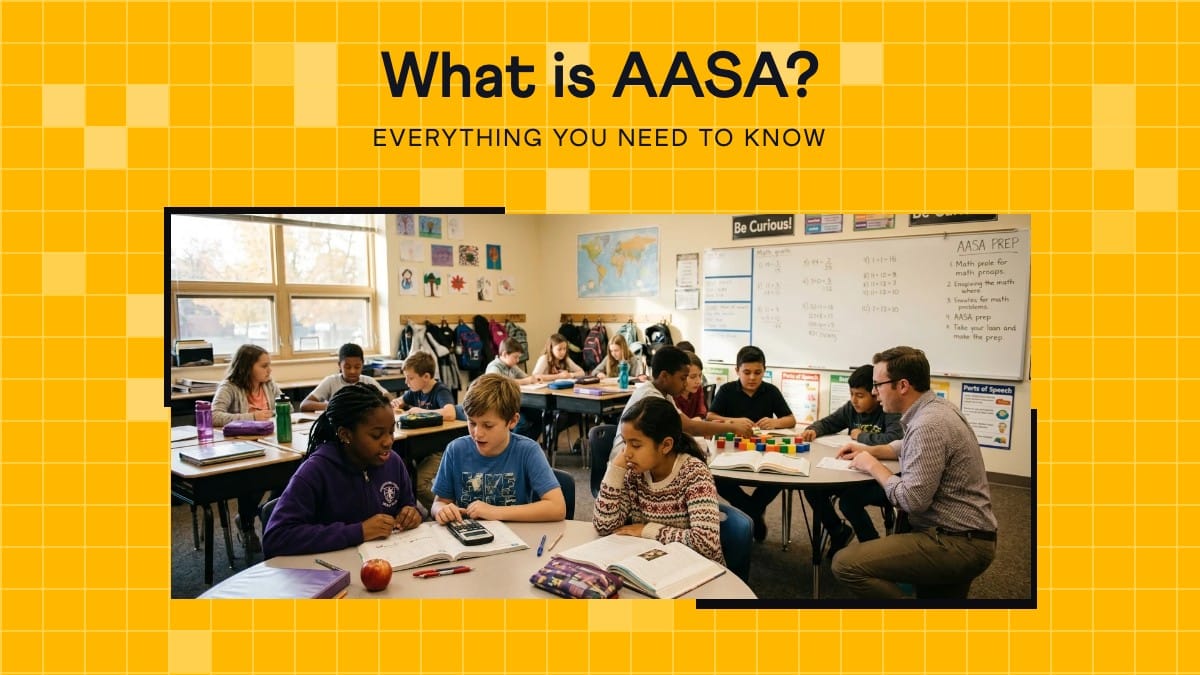
If your child is taking the AASA, you may be wondering what the test is, what it measures, and how you can help them without adding to their stress. The AASA (Arizona’s Academic Standards Assessment) is a state-wide assessment that measures students’ attainment of Arizona’s academic standards in core subject areas.
Standardized testing can be confusing for many parents at first. This guide simplifies the AASA: who takes it, what subjects are tested, when testing typically takes place, and what the results mean. We'll also offer practical tips to help your child feel ready and confident for the 2026 testing season.
- What Is the AASA Test?
- What Does AASA Stand For?
- Who Takes the AASA Test?
- What Subjects Does the AASA Test Cover?
- AASA Test Format and Question Types
- AASA Test Dates for 2027
- How Is the AASA Test Scored?
- Why Is the AASA Test Important?
- How to Prepare for the AASA Test
- AASA Practice Tests and Sample Questions
- AASA vs. Other State Tests
- Frequently Asked Questions
- Sources
What Is the AASA Test?
The AASA test is the statewide achievement test Arizona uses to check how well students in grades 3–8 have learned the state's academic standards in English Language Arts (ELA) and math. The Arizona Department of Education runs it, and every public school and charter school gives it each spring.
- Who runs it: The Arizona Department of Education, with Pearson delivering the online test
- Who takes it: All Arizona public and charter school students in grades 3–8
- What it measures: Whether your child's reading, writing, and math skills meet Arizona's standards for their grade
- Is it mandatory? Yes. Arizona has no opt-out. A 2015 Arizona Attorney General opinion found that parents may not withdraw their children from the required state tests.
| Class test | AASA | |
|---|---|---|
| Who writes it | Your child's teacher | Arizona Department of Education |
| What it covers | One unit or chapter | The full year's standards |
| Same test statewide | No | Yes |
| Counts toward grades | Yes | No |
| Who uses the results | Student, parent, teacher | Families, schools, the state |
What Does AASA Stand For?
AASA stands for Arizona's Academic Standards Assessment. "Academic standards" is the state's list of what students should know and be able to do in each grade, and the AASA is the test that checks those standards.
Parents hear several names because Arizona has renamed its state test three times since 2015. Older school papers, websites, and tutors may still use the old names.
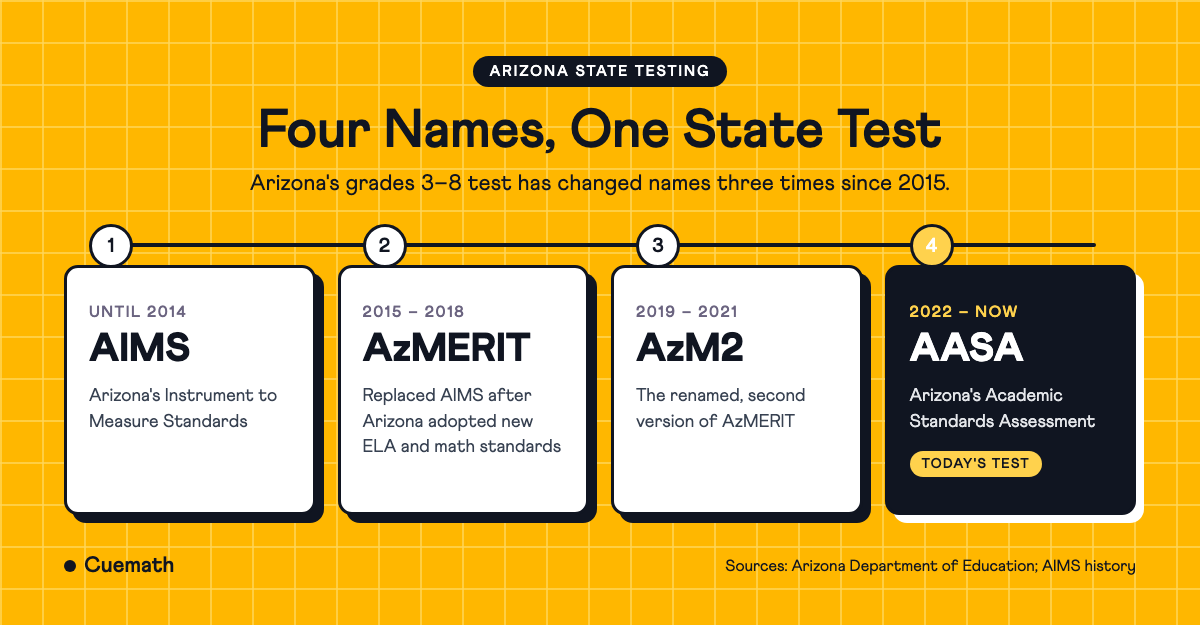
So if you search "Does Arizona still do AIMS testing?" the answer is no. AIMS ended in 2014, and the AASA is today's grades 3–8 test.
Who Takes the AASA Test?
Every Arizona public school and charter school student in grades 3–8 takes the AASA in both ELA and math. Private school and homeschool students do not take it.
- Students with IEPs or 504 plans: take the AASA with the accommodations in their plan, such as a braille, large-print, or regular-print paper test.
- English learners: take the AASA, with the language support the state allows.
- Students with significant cognitive disabilities: take the MSAA, Arizona's alternate test, instead of the AASA.
- High school students: do not take the AASA. They take ACT Aspire in grade 9 and the ACT in grade 11.
| Grade | AASA ELA | AASA Math | AzSCI Science |
|---|---|---|---|
| Grade 3 | ✓ + reading fluency | ✓ | — |
| Grade 4 | ✓ | ✓ | — |
| Grade 5 | ✓ | ✓ | ✓ |
| Grade 6 | ✓ | ✓ | — |
| Grade 7 | ✓ | ✓ | — |
| Grade 8 | ✓ | ✓ | ✓ |
What Subjects Does the AASA Test Cover?
The AASA covers two subjects: English Language Arts and math. Science has its own separate test, AzSCI, in grades 5, 8, and 11.
Mathematics
- Numbers and operations, from multiplication in grade 3 to integers in grade 7
- Fractions, decimals, ratios, and percent
- Expressions, equations, and functions
- Geometry, measurement, and data
- Multi-step, real-world word problems
English Language Arts
- Reading stories and informational texts
- Main idea, details, word meaning, and the author's choices
- Grammar, punctuation, and vocabulary
- Writing a full response that uses evidence from passages
| Grade | Main math topics |
|---|---|
| Grade 3 | Multiplication and division, fractions as numbers, area, measurement and data |
| Grade 4 | Multi-digit multiplication and division, equivalent fractions, decimals, angles |
| Grade 5 | Fraction and decimal operations, place value, volume, the coordinate plane |
| Grade 6 | Ratios and rates, dividing fractions, negative numbers, expressions and equations |
| Grade 7 | Proportional relationships, percent, integers, probability |
| Grade 8 | Linear equations, functions, the Pythagorean theorem, transformations |
On the math test, your child has to find the right answer and, in many questions, build the model, graph, or equation that gets there.
The Grade 3 Oral Reading Fluency part is the only timed part of the whole AASA. Each third grader reads three short passages aloud into a headset microphone, with one minute per passage.
Pick your child’s grade and answer one AASA-style math question. The free Cuemath app gives your child a short daily workout like this across fluency, understanding, application, and reasoning.
Try the Cuemath App →100% Free • No Credit Card
AASA Test Format and Question Types
The AASA is a computer-based test your child takes at school, in short units spread over several days. None of the math, reading, or writing units has a time limit.
| ELA | Math | |
|---|---|---|
| Delivered | Online, on Pearson TestNav | Online, on Pearson TestNav |
| Units | 1 writing + 2 reading | 2 units |
| Grade 3 extra | Oral Reading Fluency | None |
| Timed | No (only Grade 3 fluency) | No |
| Typical time per unit | About 45–90 minutes | About 60–85 minutes |
| Calculator | Not used | Grades 3–6: none. Grades 7–8: Unit 1 only |
| Paper version | Only with state approval | Only with state approval |
A school can give at most two units in one day, plus Grade 3 Oral Reading Fluency. When a student takes two units in a day, they get a break of at least 15 minutes between them, and each unit must be finished on the day it starts.
A child who knows the math can still lose points on a question type they have never seen. One try on the free official sample tests, covered below, takes that surprise away.
AASA Test Dates for 2027
The spring 2027 AASA testing window for grades 3–8 runs from March 29, 2027, to April 23, 2027. The dates are tentative until Arizona's State Board of Education approves them. Each school picks its own test days inside the window, so your child's school calendar has the exact days.
| Test | Grades | Window |
|---|---|---|
| AASA (ELA and math) | 3–8 | March 29, 2027 to April 23, 2027 |
| AzSCI (science) | 5 and 8 | March 23, 2027 to April 9, 2027 |
- Writing and Grade 3 fluency often come first: In 2026, both had to be finished by April 10, 2026, two weeks before the rest of the window closed.
- Make-up days: A child who is sick on a test day takes the missed unit on a later day inside the same window. Tell the school as soon as you know about an absence.
- Paper-test requests: Schools must submit requests for paper versions by February 5, 2027.
How Is the AASA Test Scored?
Each AASA subject gives your child a scale score and one of four performance levels. Proficient and highly proficient are the passing levels, and they mean your child met or went beyond Arizona's expectations for their grade.
| Level | Name | What it means |
|---|---|---|
| Level 4 | Highly Proficient | A thorough command of the grade's skills; well prepared for the next grade |
| Level 3 | Proficient | Meets the grade's expectations; on track for the next grade |
| Level 2 | Partially Proficient | Some of the grade's skills; likely needs support for the next grade |
| Level 1 | Minimally Proficient | Few of the grade's skills yet; likely needs substantial support |
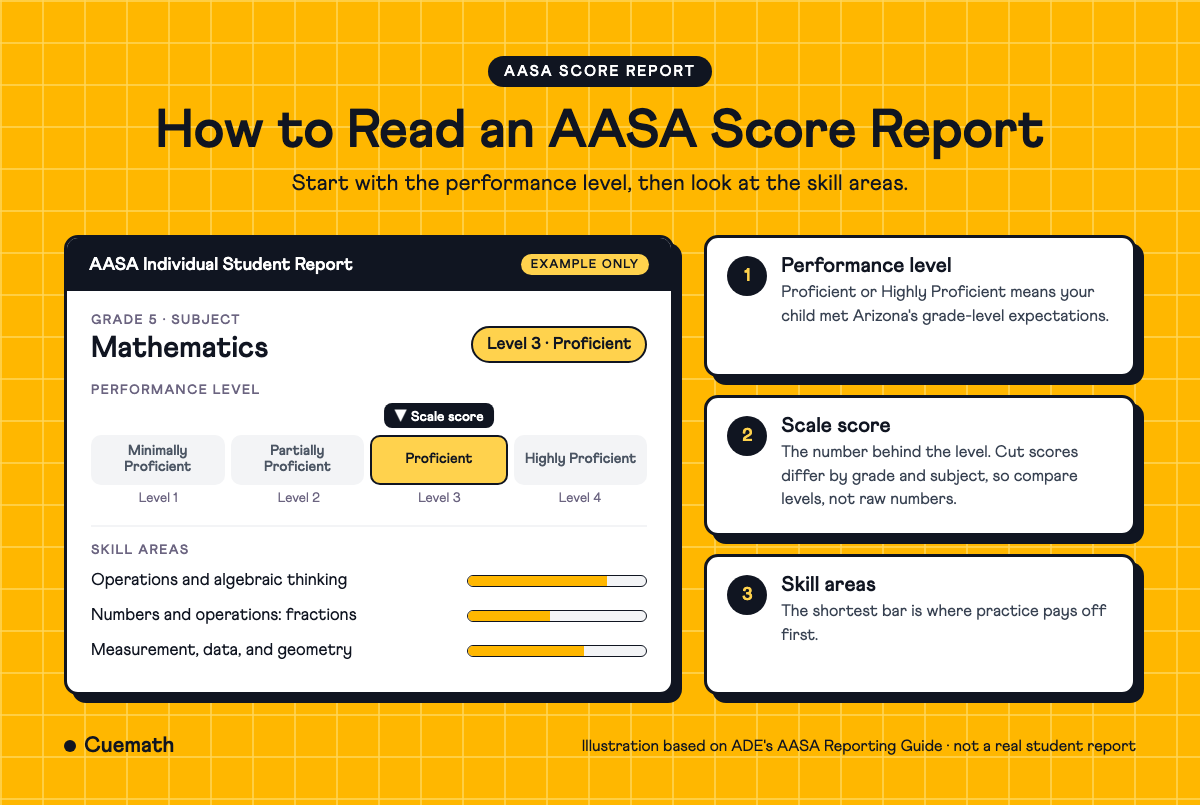
The scale score is the number behind the level. The cut score for each level is different for every grade and subject, so a math score and an ELA score can't be compared directly. Look at the level first.
How to see your child's scores:
- Paper report from school: Schools receive printed Individual Student Reports for families at the end of the school year.
- AASA Parent Portal: If your school takes part, it sends you a claim code. Create an account on the portal, enter your child's name, date of birth, and the claim code, and download the full report as a PDF. Schools choose whether to use the portal, so ask yours if you don't get a code.
Scores arrive at the end of the school year. In 2026, the Parent Portal opened on June 10, 2026, and printed reports reached schools on June 11, 2026.
Why Is the AASA Test Important?
The AASA does not affect your child's report card, but it is the clearest yearly check on whether their reading and math are on grade level. It is a snapshot of skills, not an entrance exam, and there is no pass or fail for the student.
- Families: See where a child is strong and which skill areas need work
- Teachers: Plan extra help or enrichment for the next school year
- Schools and districts: See which subjects and grades need more support
- The state: Uses school-wide AASA results in each school's A–F letter grade, and federal law requires every state to test students each year
The one high-stakes piece is the Grade 3 reading rule under Move On When Reading, covered above.
How to Prepare for the AASA Test
The best AASA preparation is steady practice on grade-level skills plus a little time with the online test format. A few questions a day with a clear explanation beats a 50-question worksheet the week before.
- Review this year's concepts: Use the topic table above to find your child's grade, and start with the topics they feel least sure about.
- Try the official sample test: Arizona's free sample tests run on the same TestNav platform as the real test. One sitting is enough for the tools to feel familiar.
- Read every day: Twenty minutes of reading, plus one question at the end ("What was the main idea?"), builds the skills AASA ELA checks.
- Practice explaining answers: At homework time, ask, "How did you get that?" Explaining steps is what multi-step math and two-part ELA questions reward.
- Practice without a calculator: Grades 3–6 use no calculator at all, and grades 7–8 get one on Unit 1 only.
- Pace, don't rush: The units are untimed, so the real risk is skipping steps, not running out of time. Teach your child to reread the question before choosing an answer.
- Sleep and breakfast: A normal bedtime and breakfast on test days help more than extra practice the night before.
Find Out Which AASA Math Skills Need Work Before March 29, 2027
Book a free 1:1 evaluation with a Cuemath math specialist. They check your child's grade-level math against Arizona's standards, including multi-step word problems and no-calculator work, and show you exactly which skills to practice first.
What US parents say on Trustpilot
“My son feel more confident in math and actually enjoy his tutoring sessions. We’ve also noticed a positive improvement in his grades.”
100% Free • No Credit Card • Grades K–12
AASA Practice Tests and Sample Questions
You can find free AASA practice in two places: Arizona's official sample tests and our free grade-by-grade AASA practice test.
- Official AASA sample tests (grades 3–8): Arizona posts free sample tests in math, reading, and writing on Pearson TestNav. They show the real screen, tools, and question types.
- Scoring guides: ADE publishes scoring guides for the sample tests, including one for Grade 3 Oral Reading Fluency.
- Cuemath's free AAS A practice test: 9 math questions grouped by grade band, each with a hint, a step-by-step solution, and the most common mistake.
AASA vs. Other State Tests
The AASA is Arizona's test for grades 3–8 in ELA and math. Arizona gives three other state tests, and every other state has its own version of the AASA.
| AASA | AzSCI | ACT Aspire | ACT | |
|---|---|---|---|---|
| Purpose | Grades 3–8 ELA and math | Science achievement | High school achievement | High school achievement and college readiness |
| Grades | 3–8 | 5, 8, and 11 | 9 | 11 |
| Subjects | ELA, math | Science | English, math, reading, science, writing | English, math, reading, science, writing |
| Format | Online, untimed units | Online | Online | Online |
| Spring 2027 | March 29 – April 23, 2027 | March 23 – April 9, 2027 (grades 5, 8) | Spring 2027 | Spring 2027 |
Moving from another state? The AASA does the same job as these tests:
- California and several other states use the SBAC: What Is the SBAC Test?
- New Jersey uses the NJSLA: What Is NJSLA?
- Texas uses STAAR, replaced by the Student Success Tool from 2027: Spring 2027 STAAR Test Explained
Frequently Asked Questions
What is the AASA test?
The AASA test is Arizona's yearly state test in English language arts and math for students in grades 3–8. It checks whether each student meets Arizona's academic standards for their grade.
What does AASA stand for?
AASA stands for Arizona's Academic Standards Assessment. It replaced the AzM2 test in 2022.
Is the AASA test mandatory?
Yes, the AASA test is mandatory for Arizona public and charter school students in grades 3–8. Arizona law does not let parents opt their child out, according to a 2015 Arizona Attorney General opinion.
Can I opt my child out of state testing in Arizona?
No, Arizona does not allow parents to opt their child out of the AASA or other state tests. Students present during the testing window take the test.
When is the AASA test in 2027?
The spring 2027 AASA testing window runs from March 29, 2027, to April 23, 2027. The dates are tentative until the State Board of Education approves them, and each school sets its own days inside the window.
How long is the AASA test?
The AASA test has no time limit, and most units take about one to one and a half hours. ELA has three units (four in grade 3), and math has two, spread over several days.
How do I check my child's AASA scores?
You can check your child's AASA scores on the printed report your school sends home or on the AASA Parent Portal with a claim code from your school. Scores arrive at the end of the school year.
What is a good score on the AASA?
A good AASA score is Proficient (Level 3) or Highly Proficient (Level 4). Both mean your child met or went beyond Arizona's expectations for their grade.
Does the AASA test affect my child's grades?
No, the AASA test does not affect your child's report card grades. The one exception is Grade 3 reading, where a very low score can affect promotion to 4th grade under Move On When Reading.
Does Arizona still do AIMS testing?
No, Arizona stopped giving AIMS in 2014. It was replaced by AzMERIT in 2015, which became AzM2 and then the AASA in 2022.
Can students use a calculator on the AASA math test?
Students in grades 3–6 cannot use a calculator on the AASA math test. Students in grades 7 and 8 get a built-in Desmos scientific calculator on Unit 1 only.
Is there a free AASA practice test?
Yes, Arizona offers free official AASA sample tests for grades 3–8 on Pearson TestNav. Cuemath also has a free grade-by-grade AASA math practice test with worked solutions.
Sources
What the AASA is, grades, subjects
- Arizona Department of Education: AASA: official program page
- Chandler Unified School District: Understanding AASA: computer-based format, Grade 3 fluency details, sample test access
- Deer Valley Unified School District: State Achievement Testing: grades, subjects, AzSCI, MSAA
Name history
- ADE: AASA 2022 Technical Report: AzM2 renamed AASA in 2021–22
- Wikipedia: Arizona's Instrument to Measure Standards: AIMS replaced by AzMERIT in 2015
Opt-out
- Arizona Attorney General: Opinion I15-008: parents may not withdraw children from state tests
Format, units, calculators, accommodations
- ADE: 2025–2026 Detailed Testing Calendar: untimed units, daily unit limits, 15-minute break, 2026 writing and fluency deadline
- ADE: AASA and AzSCI Calculator Guidance: calculator rules by grade
- ADE: Special Paper Version Request Process: paper versions and the 2026–27 request window
- ADE: MSAA: alternate assessment
Dates
- ADE: 2026–2027 Tentative Test Windows: spring 2027 windows, updated July 10, 2026
- Tempe Elementary School District: State Testing: spring 2027 AASA and AzSCI windows
Scoring and results
- ADE: AASA Reporting Guide: four performance levels
- ADE: AASA Parent Portal User Guide: claim code and downloading the report
- Arizona State Board of Education: A–F School Letter Grades: school accountability
- ADE: Move On When Reading: Grade 3 reading rule
Other Arizona tests
- ADE: ACT Aspire: grade 9
- ADE: ACT: grade 11
- ADE: AzSCI: science, grades 5, 8, and 11
Practice
- Pearson: Arizona Online Sample Tests: official AASA sample tests, grades 3–8

I was never the kid who loved math. I was much more interested in books, stories, and writing, and, somewhere along the way, I became even more curious about people. Why do we learn differently? Why does something make sense to one child but not another? And what makes a student feel confident enough to keep trying?
That curiosity led me to study Applied Psychology, where I learned more about how children think, learn, and make sense of the world around them.
My love for writing did the rest. What started as something I simply enjoyed became a career. Over the past five years, I've worked as a freelance writer across edtech, SaaS, B2B, travel, lifestyle, and healthcare, learning how to write for very different audiences without losing the human side of the story.
Today, I'm an SEO Content Writer & Editor at Cuemath, where I get to bring many of these interests together. Working in education, and especially around math, has made me even more curious about what happens behind the screen or textbook: what parents worry about, what students struggle with, and what actually helps them learn.
That's also how I like to research. I don't just look at search results and call it a day. I go where parents and students actually talk: forums, reviews, communities, and conversations with real families. Because sometimes the most useful insight isn't hiding in a keyword; it's in a parent's question, a student's frustration, or a small detail someone shares about their learning experience.
I write because I'm curious. I research because I want to understand. And I love turning what I learn into content that feels genuinely useful to the people reading it.