What Is the SBAC Test? A Simple 2026 Guide for Parents
Your child's school calls it SBAC, CAASPP, OSAS, or something else, and the score report arrives full of four-digit numbers. This guide explains what the Smarter Balanced test is, what it asks, how scoring works, and what the result actually means for your child.

If your child attends a public school in California, Oregon, Washington, or another state that uses the Smarter Balanced Assessment System, you may have heard the term “SBAC test.” But what exactly is it, and what should parents know about it?
The SBAC test is a set of statewide assessments designed to measure how well students are meeting grade-level expectations in English language arts/literacy and mathematics. Students typically take the assessments online during the spring, and the results can help families and schools understand a student’s academic progress.
This guide explains the SBAC test in simple terms, including what it measures, which students take it, when testing usually happens, how scores work, and how parents can support their children without adding unnecessary stress.
- What Is the SBAC Test?
- What Does My State Call the SBAC Test?
- Which Grades Take the SBAC?
- What Is on the SBAC Test?
- What Are the Two Parts of the SBAC?
- How Long Is the SBAC Test, and When Is It Given?
- How Is the SBAC Test Scored?
- What Does My Child's SBAC Score Report Show?
- Do SBAC Scores Matter for My Child?
- How Can My Child Prepare for the SBAC Test?
- Frequently Asked Questions
- Sources
What Is the SBAC Test?
The SBAC test is an end-of-year state test that checks whether your child is on track with grade-level ELA and math. The name comes from the group that writes it: the Smarter Balanced Assessment Consortium, a group of states that share one set of test questions instead of each writing their own.
States formed the consortium in 2010, and students first took the full test in spring 2015. As of October 2025, Smarter Balanced has 13 members: 11 states, the U.S. Virgin Islands, and the District of Columbia, which joined most recently.
The test is built on the Common Core standards (or a state's version of them). That means the questions match what your child's teacher covers during the year. A 4th grader sees 4th grade math, not a random mix of topics.
| Class test | SBAC test | |
|---|---|---|
| Who writes it | Your child's teacher | Smarter Balanced, shared by member states |
| What it covers | One unit or chapter | The whole year's grade-level standards |
| Same questions for everyone? | Yes | No Each student gets different questions |
| Goes on the report card? | Yes | No |
| Who uses the results | Student, parent, teacher | Families, teachers, schools, district, state |
What Does My State Call the SBAC Test?
Each member state gives the SBAC test its own local name, which is why so many parents don't realize their child takes it. Use this table to match what your school says to what the test is.
| State | Local name | High school grade |
|---|---|---|
| California | CAASPP | Grade 11 |
| Washington | SBA part of WCAP | Grade 10 |
| Oregon | OSAS | Grade 11 |
| Nevada | SBAC | None (high school takes the ACT) |
| Hawaii | SBA | Check with your school |
| Idaho | ISAT | Check with your school |
| Connecticut | Smarter Balanced | None (high school takes the SAT) |
| Delaware | DeSSA | None (high school takes the SAT) |
| South Dakota | Smarter Balanced | Check with your school |
| Michigan | M-STEP | Check with your school |
| Indiana | Check with your school | Check with your school |
| District of Columbia | DC CAPE 2.0 | Check with your school |
Which Grades Take the SBAC?
- Grades 3–8: Students take the SBAC test in ELA and math every spring, in every member state.
- California and Oregon: High school students take it once more, in grade 11.
- Washington: High school students take it in grade 10.
- Connecticut, Delaware, and Nevada: No SBAC in high school. These states use the SAT or ACT instead.
- Example: A California child takes the SBAC seven times, once a year from grade 3 to grade 8 and once more in grade 11.
What Is on the SBAC Test?
The SBAC test covers two subjects, ELA and math, and each subject checks a small set of skills. The score report for each subject is built around these same skill areas, so knowing them now makes the report easier to read later.
ELA
Math
Question: A recipe uses 3/4 cup of flour for one batch. Maya makes 2½ batches. She says she needs less than 2 cups of flour. Is Maya correct? Explain how you know.
What the test wants: the calculation (3/4 × 5/2 = 15/8 = 1⅞ cups), the answer (yes, Maya is correct), and one or two sentences explaining why. A bare "yes" earns partial credit at best.
Written by Cuemath to show the question style. Not an official Smarter Balanced item.
What Are the Two Parts of the SBAC?
Each SBAC subject has two parts: a computer-adaptive test and a performance task. Smarter Balanced recommends that students take them on separate days.
The computer-adaptive test (CAT)
The questions change based on your child's answers, so the test finds your child's level with fewer questions than a fixed test would need.
The performance task (PT)
One longer, real-world problem that takes several steps. Your child works through it and explains each choice.
Can Your Child Explain the Answer, Not Just Find It?
SBAC math gives points for reasoning and multi-step problem solving. The Cuemath app gives your child a short daily workout across fluency, understanding, application, and reasoning, so explaining an answer becomes a habit before test day.
Try the Cuemath App100% Free • No Credit Card • 5 Minutes a Day
How Long Is the SBAC Test, and When Is It Given?
The SBAC test has no time limit, so no student gets cut off mid-question. Schools plan around estimated times, and most students finish both subjects in about 5–6 hours, spread across several school days in spring.
Each state sets its own spring testing window, and your child's school picks the exact days inside it. Your child's teacher or school newsletter will have the actual dates.
How Is the SBAC Test Scored?
Each SBAC subject gives your child two results: a scale score, which is a four-digit number, and an achievement level from 1 to 4. Level 3 or higher means your child met the grade-level standard.
The scale score runs from roughly 2100 to 2900. The range goes up each grade, so a score of 2450 means something different in grade 3 than in grade 7.
| Level | Standard label | California (from 2026) | What it means |
|---|---|---|---|
| Level 4 | Standard Exceeded | Advanced | Above grade level |
| Level 3 | Standard Met | Proficient | At grade level: the target |
| Level 2 | Standard Nearly Met | Developing | Close, with some gaps |
| Level 1 | Standard Not Met | Minimal | Needs substantial support |
In 2026, California renamed the four levels on its score reports. The scores needed for each level did not change, so you can compare this year's report with last year's. Our CAASPP 2026 results guide covers that change in detail.
What Does My Child's SBAC Score Report Show?
Your child's SBAC score report shows their overall scale score, their achievement level, and how they did in each skill area. The skill areas are the most useful part for a parent.
For each skill area, the report shows one of three marks:
- Above standard: clearly strong
- Near standard: close to grade level, not yet secure
- Below standard: a gap worth working on
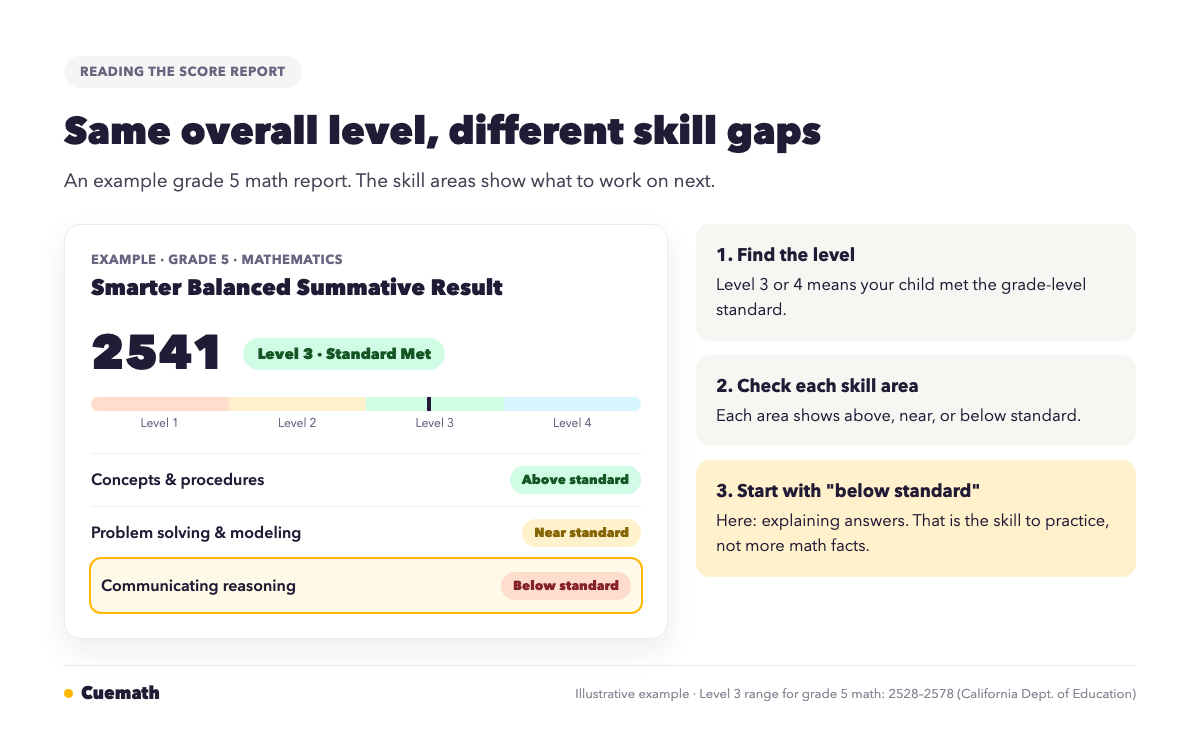
Here is how to read it. A child can land at Level 3 overall and still be below standard in "communicating reasoning." That tells you the exact skill to work on: explaining answers, not learning more math facts. Two children with the same overall score can need very different help.
Do SBAC Scores Matter for My Child?
SBAC scores do not go on your child's report card and do not decide whether they move up a grade. Schools and states use the results to see how well students are learning, and teachers use them to plan support.
Scores can still matter in three specific ways:
- Class placement: Some districts look at SBAC math results when placing students into middle school math tracks. Ask your school if it does.
- College readiness in California: California's grade 11 results feed the Early Assessment Program, which California State University and California community colleges use for English and math course placement.
- Early warning: A Level 1 or 2 in grade 3 or 4 math points to gaps that get harder to close as math builds on itself in later grades.
Colleges don't use SBAC scores in admissions decisions.
How Can My Child Prepare for the SBAC Test?
The best preparation is strong grade-level skills, plus a little practice with the online test format. Cramming right before the test doesn't help much, because the adaptive test measures what your child actually knows. (For general habits, see our guide on how to study for a math test.)
- Try the free official practice test: Smarter Balanced offers practice and training tests for every grade online. You can sign in as a guest without an account, so your child sees the real question types before test day.
- Practice typing short answers: Every section asks for some typed responses. A 3rd grader who types slowly loses focus, not knowledge.
- Ask, "How do you know?" at homework time: This one habit trains the "communicating reasoning" skill. Have your child say or write one sentence explaining their answer. This step-by-step method for word problems works well for it.
- Read nonfiction together: Informational texts make up a large share of the ELA reading questions.
- Use last year's report: Start with any skill marked "below standard." That's where practice pays off most.
- Keep test week calm: Normal sleep, breakfast, and a relaxed attitude help more than extra worksheets the night before.
Find Out Where Your Child Stands Before the Next SBAC
Book a free 1:1 evaluation with a Cuemath math specialist. They check your child's grade-level math skills, including the "explain your reasoning" part SBAC scores, and show you exactly what to work on.
Rated 4.5+ on Trustpilot by parents like you
100% Free • No Credit Card • Grades K–12
Frequently Asked Questions
What is the SBAC test?
The SBAC test is the Smarter Balanced state test in ELA and math for grades 3–8 and one high school grade. Students in California, Washington, Oregon, and other member states take it each spring, and it measures progress toward grade-level standards.
Is the SBAC test the same as CAASPP?
Yes, the ELA and math parts of California's CAASPP are the SBAC test. CAASPP is California's name for its whole testing program, which also includes a separate science test.
Is the SBAC test hard?
The SBAC test feels harder than a class test because it adapts to your child's level and asks them to explain their thinking. Every student meets questions that stretch them, so feeling challenged doesn't mean your child is doing badly.
What is a good SBAC score?
A good SBAC score is Level 3 (Standard Met) or Level 4 (Standard Exceeded). For example, a grade 5 student needs a math scale score of 2528 or higher to reach Level 3.
Does the SBAC test affect my child's grades?
No, the SBAC test does not affect your child's report card grades or decide whether they move up a grade. Some districts use the math results for class placement, so ask your school.
Do colleges look at SBAC scores?
Colleges don't use SBAC scores for admission. In California, grade 11 results help CSU and community colleges place students into English and math courses through the Early Assessment Program.
Can I opt my child out of the SBAC test?
Opt-out rules depend on your state. In California, parents can submit a written request each year to excuse their child from CAASPP testing; other states have their own process, so ask your school.
How many days does SBAC testing take?
SBAC testing usually spreads across several school days in spring, because the two subjects and their two parts take about 5–6 hours total. Your school sets the exact schedule.
Where can my child take an SBAC practice test?
Your child can take free official SBAC practice tests on the Smarter Balanced website. They can use guest sign-in, so no account is needed.
When do SBAC results come out?
SBAC results reach families in summer or fall, depending on the state and district. California posts statewide results in the fall, and families usually get individual reports through their district's parent portal.
Sources
- CAASPP & ELPAC: Smarter Balanced Assessments for ELA and Mathematics—who takes the test, CAT + performance task format, untimed 5–6 hour estimate
- Washington OSPI: State Testing—Washington tests grades 3–8 and 10
- California Department of Education: Smarter Balanced Scale Score Ranges—scale score ranges and Level 3 cut scores by grade
- Smarter Balanced: Reporting Scores—scale scores and the four achievement levels
- Smarter Balanced Welcomes District of Columbia as Newest Member (Oct 2025)—current membership: 11 states, 1 territory, and DC
- Smarter Balanced: Practice Tests and Sample Questions—free official practice and training tests
- Trustpilot reviews of Cuemath—parent review quotes used in this post

I was never the kid who loved math. I was much more interested in books, stories, and writing, and, somewhere along the way, I became even more curious about people. Why do we learn differently? Why does something make sense to one child but not another? And what makes a student feel confident enough to keep trying?
That curiosity led me to study Applied Psychology, where I learned more about how children think, learn, and make sense of the world around them.
My love for writing did the rest. What started as something I simply enjoyed became a career. Over the past five years, I've worked as a freelance writer across edtech, SaaS, B2B, travel, lifestyle, and healthcare, learning how to write for very different audiences without losing the human side of the story.
Today, I'm an SEO Content Writer & Editor at Cuemath, where I get to bring many of these interests together. Working in education, and especially around math, has made me even more curious about what happens behind the screen or textbook: what parents worry about, what students struggle with, and what actually helps them learn.
That's also how I like to research. I don't just look at search results and call it a day. I go where parents and students actually talk: forums, reviews, communities, and conversations with real families. Because sometimes the most useful insight isn't hiding in a keyword; it's in a parent's question, a student's frustration, or a small detail someone shares about their learning experience.
I write because I'm curious. I research because I want to understand. And I love turning what I learn into content that feels genuinely useful to the people reading it.