What Is NJSLA? The Complete 2026 Guide for NJ Parents
NJSLA is New Jersey's yearly assessment in English language arts, math, and science for grades 3 through 11. This guide breaks down what it actually tests, how the 2026 shift to computer-adaptive testing changes scoring, and what a score report does and doesn't tell you about your child.

NJSLA stands for the New Jersey Student Learning Assessments, the state's yearly test measuring how well public school students in grades 3 through 9 (and grades 5, 8, and 11 for science) are meeting New Jersey's academic standards.
Starting in 2026, the English language arts and math portions moved to a new computer-adaptive format called NJSLA-A, which changes how the test behaves even though what it measures hasn't changed.
This guide walks through what's tested, how scoring and cut scores actually work, how NJSLA compares to NJGPA and PARCC, and what to do if a score report points to a gap.
- What Does NJSLA Stand For?
- NJSLA vs. a Regular School Test
- What Subjects Does NJSLA Cover?
- Which Grades Take NJSLA?
- NJSLA-A vs. NJSLA-S: What's the Difference?
- What Does "Computer-Adaptive" Mean?
- What Is Tested in NJSLA?
- How Long Is the NJSLA?
- When Is NJSLA Given?
- How Is NJSLA Scored?
- Scoring & Results: The Questions Every NJSLA Parent Asks
- Does NJSLA Give a Percentage Grade?
- What's a Cut Score?
- Why Did 2026 Results Take So Long?
- When Do Parents Actually Get Results?
- What Does the Score Report Tell You?
- Does NJSLA Decide If a Student Passes?
- Is NJSLA the Same as NJGPA?
- How Can Students Prepare for NJSLA?
- Should Students Study Only for NJSLA?
- What About Students With Disabilities?
- Frequently Asked Questions
What Does NJSLA Stand For?
NJSLA stands for New Jersey Student Learning Assessments, administered by the New Jersey Department of Education (NJDOE) as part of the state's statewide assessment program. The purpose isn't just to give students another school test; state assessments exist for four specific reasons:
- Measuring academic performance: the assessments measure student knowledge and skills in English language arts, mathematics, and science.
- Checking progress against New Jersey standards: NJSLA results are aligned with the New Jersey Student Learning Standards (NJSLS), so a score shows how a student is doing against a fixed academic bar, not against other students.
- Providing information to schools and educators: Schools use assessment information to identify strengths and areas where additional instructional attention may be useful.
- Supporting statewide accountability: New Jersey is required to administer statewide assessments under federal law (the Every Student Succeeds Act), as well as state requirements.
NJSLA vs. a Regular School Test
One of the easiest ways to understand NJSLA is to compare it with a classroom assessment.
NJSLA should not be thought of as simply a larger version of a classroom quiz.
What Subjects Does NJSLA Cover?
The current NJSLA family includes assessments in English Language Arts (ELA), mathematics, and science. There are important differences between these assessments.
Which Grades Take NJSLA?
The exact assessment a student takes depends on the grade and, for mathematics, the student's course or accountability requirements. For the 2026–27 school year, New Jersey's published schedule lists:
This means not every student takes every NJSLA subject every year; a 4th grader takes NJSLA ELA and Math but not NJSLA Science, for example, since science is only tested in grades 5, 8, and 11.
What Is the Difference Between NJSLA-A and NJSLA-S?
The names are similar, but the testing systems are different.
What Does "Computer-Adaptive" Mean?
What Is Tested in NJSLA?
NJSLA assesses different skills depending on subject and grade. The exact content and complexity depend on the student's grade, but each subject follows a consistent focus:
How Long Is the NJSLA?
Testing time depends on the assessment and subject. Here's how the clock breaks down for the current NJSLA-A and NJSLA- Science assessments:
These are published testing times; individual students may have approved testing accommodations or other applicable provisions.
When Is NJSLA Given?
Testing dates vary by school year. New Jersey’s statewide schedule for the 2026–27 school year lists two testing windows:
| Administration | Applies To | Dates |
|---|---|---|
| 🎯 Spring 2026–27 | NJSLA-A ELA & Mathematics, NJSLA-Science | Apr 19 – May 21, 2027 |
| Fall Block 2026 | ELA: Grade 9; Mathematics: Grades 9–12, depending on applicable course/accountability requirements | Nov 30 – Dec 16, 2026 |
Because schools and districts administer assessments within these state testing windows, students should follow their school’s specific testing calendar.
💡 If you're specifically looking for the Spring 2026 results timeline (the test students already took), Cuemath's NJSLA 2026 Results Delay guide covers the exact dates districts and families should expect this cycle.
How Is NJSLA Scored?
NJSLA results are reported using five performance levels for the current NJSLA-A ELA and mathematics assessments, from “Did Not Yet Meet Expectations” to “Exceeded Expectations,” shown below.
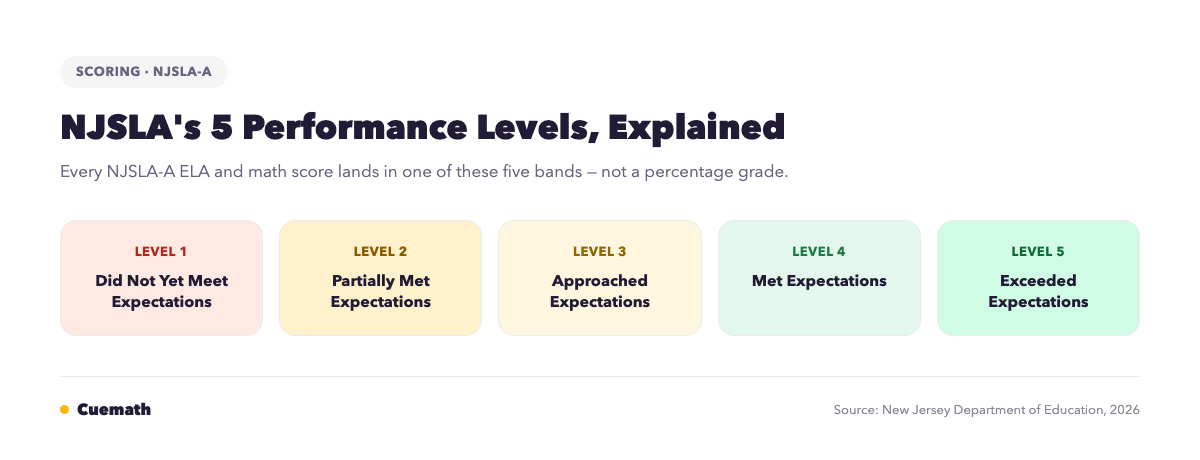
These levels describe how a student's demonstrated performance compares with the knowledge and skills expected at the applicable grade level. For example, "Met Expectations" means the student's performance met the applicable standard for that assessment; it does not mean a student received a classroom percentage such as 80% or 90%. NJSLA-Science uses a separate, unrelated four-level scale (Below Proficient, Near Proficient, Proficient, and Advanced Proficient).
Scoring & Results: The Questions Every NJSLA Parent Asks
Six things parents ask about the moment scores come back; answered straight, no jargon.
Does NJSLA Give a Percentage Grade?
No — NJSLA reports use performance levels, not a percentage. A score only means something next to the grade, standard, and level it was measured against.
What's a Cut Score?
The boundary between performance levels, like the line between Level 2 and Level 3. New Jersey set brand-new cut scores for NJSLA-A in September 2026.
Why Did 2026 Results Take So Long?
NJSLA-A is a new test, so NJDOE had to build new cut scores, hand-score more open-response questions, and run extra checks. A one-time delay — 2027 goes back to normal.
When Do Parents Actually Get Results?
Districts must hand you the Individual Student Report within 30 days of receiving it from the state — through the family portal, on paper, or both.
What Does the Score Report Tell You?
Overall performance, a performance level, strengths, and growth areas — meant to be read alongside classroom grades, not instead of them.
Does NJSLA Decide If a Student Passes?
No. Grade promotion depends on classroom performance and school policy — NJSLA measures academic standards, not report-card grades.
Is NJSLA the Same as NJGPA?
No, NJSLA and NJGPA are two different New Jersey assessment programs.
A student should not assume an NJSLA result is the same as a graduation-proficiency determination; that is specifically NJGPA's role, tested separately in 11th grade.
How Can Students Prepare for NJSLA?
The most useful preparation is usually connected to the skills being assessed rather than attempting a large collection of answers.
- Understand the standards: Students should know what concepts and skills their grade-level curriculum covers.
- Practice reading carefully: For ELA and science, students may need to extract information from passages, diagrams, tables, or other sources.
- Show mathematical reasoning: For mathematics, students should practice solving unfamiliar problems rather than only repeating familiar examples.
- Practice written responses: ELA includes a writing component, so students should be comfortable organizing ideas, using evidence, explaining reasoning, revising writing, and responding directly to a prompt.
- Become familiar with the testing interface: Because NJSLA-A is computer-based and adaptive, familiarity with the digital testing environment can reduce unnecessary technology-related stress. New Jersey provides practice-test resources through its assessment program.
Should Students Study Only for NJSLA?
No — Study Broadly, Not Narrowly
NJSLA preparation works best as a complement to normal classroom learning, not a replacement for it. The stronger approach: learn the concept → practice the skill → solve unfamiliar problems → review mistakes → apply the skill again. That's more useful than memorizing answers to practice questions. If your child needs more structured support, compare the best online math tutoring platforms.
What About Students With Disabilities?
Accommodations Are Handled Individually
New Jersey's statewide assessment system includes procedures for students who require testing accommodations, such as presentation, response, timing, or setting changes, when approved and applicable. Schools and districts manage these through the state's assessment administration systems — families should discuss individual accommodation questions with the student's school.
Not Sure Where Your Child Stands Before the Next NJSLA?
Book a free 1:1 evaluation with a Cuemath math specialist. They'll show you exactly which concepts need work — not just a grade-level label.
Real parents, real Trustpilot reviews
Book a Free Evaluation100% Free • No Credit Card Needed
Frequently Asked Questions
What does NJSLA stand for?
NJSLA stands for New Jersey Student Learning Assessments, New Jersey's statewide testing program in English Language Arts, mathematics, and science. It is administered by the New Jersey Department of Education and assesses students in grades 3 through 9 (ELA/Math) and grades 5, 8, and 11 (Science).
What is NJSLA used for?
NJSLA is used to measure how well students are meeting New Jersey's academic standards, help schools identify where students need instructional support, and meet state and federal accountability requirements. It also informs decisions like course placement in middle and high school, such as honors or accelerated math tracks.
Is NJSLA the Same as PARCC?
Not exactly. New Jersey previously used PARCC assessments as part of its statewide testing system. NJSLA became the name used for New Jersey's statewide assessments aligned with the state's standards, and the testing system has since evolved further, with ELA and mathematics moving to the NJSLA-A computer-adaptive format in 2026. Older resources that refer to PARCC or older versions of NJSLA may describe a testing system that differs from the current one.
Is NJSLA mandatory?
Yes, NJSLA is mandatory for eligible public school students enrolled in tested grades and courses under New Jersey and federal requirements. Homeschooled students in New Jersey are not required to take NJSLA.
Is NJSLA adaptive?
The current NJSLA-A English Language Arts and mathematics assessments are computer-adaptive, meaning question difficulty adjusts based on a student's answers. NJSLA-Science remains a fixed-form assessment and did not move to the adaptive format.
Which grades take NJSLA?
For the 2026–27 schedule, NJSLA ELA is administered in grades 3–9, NJSLA mathematics is administered from grade 3 through high school depending on the course, and NJSLA-Science is administered in grades 5, 8, and 11. Not every student takes every subject in every grade.
Is NJSLA the same as NJGPA?
No, NJSLA measures general academic achievement across grades 3–9 (plus science in grades 5, 8, and 11), while NJGPA is New Jersey's separate 11th-grade graduation-proficiency assessment. Strong NJSLA performance in earlier grades can make the later NJGPA test feel more familiar, but the two are administered separately.
Can parents see NJSLA results?
Yes, districts provide individual student assessment reports to parents or guardians after receiving the reports from NJDOE, generally within 30 days. Results are typically available both through an online family portal and a paper Individual Student Report sent home by the school.
What About English Learners?
New Jersey also administers WIDA ACCESS and WIDA Alternate ACCESS assessments for English learners. These are separate from NJSLA. The statewide assessment schedule lists WIDA ACCESS for grades K–12 and Alternate ACCESS for eligible students in grades 1–12. A student's English-language-proficiency assessment and NJSLA participation are therefore two different parts of New Jersey's assessment system, not one combined test.
Can Students Take a Paper Version?
NJSLA is primarily delivered digitally, but New Jersey has procedures for paper-based testing materials and approved circumstances. The state's administration information includes paper-based materials such as large-print and Braille materials where applicable. Whether a particular student uses a paper-based format depends on the applicable testing requirements and approved testing attributes.
What Happens If a Student Misses NJSLA?
Schools have procedures for make-up testing within the applicable administration window. For example, the 2026–27 spring administration provided districts flexibility within the statewide testing window while requiring students to have a regular testing date and a make-up opportunity. Students and families should follow instructions from their school if a testing session is missed.
Does NJSLA affect a student's classroom grade?
No, NJSLA is a statewide assessment rather than an ordinary classroom examination. Whether or how assessment participation or results are reflected in local school practices can depend on district or school policies, but NJSLA itself does not generate a classroom grade.
What counts as a good NJSLA score?
A score in Level 4 ("Met Expectations") or Level 5 ("Exceeded Expectations") generally indicates a student is performing at or above the applicable grade-level standard on NJSLA-A. An A Level 1, 2, or 3 result doesn't mean a student is failing—it signals specific standards that could use more attention before they affect the next grade level.
Can students opt out of NJSLA testing?
New Jersey requires eligible public school students in tested grades and courses to participate in NJSLA under state and federal law, and the state does not offer a formal opt-out provision the way some other states do. Families with specific concerns about testing participation should contact their child's school or district directly, since local practices and documentation requirements can vary.
Where can students find official NJSLA practice tests?
The New Jersey Department of Education publishes official NJSLA practice tests and released test items directly on its statewide assessment portal, which is the most reliable source for practice material that matches the current computer-adaptive format. Third-party practice tests may not reflect NJSLA-A's current item types or adaptive behavior.
Sources
- New Jersey Department of Education — Adaptive Assessments — primary source for NJSLA-A/NJGPA-A program structure, subjects, and grade coverage
- NJSLA-Adaptive and NJGPA-Adaptive Frequently Asked Questions — official FAQ backing mandatory-participation, scoring, and format claims
- NJDOE Statewide Assessment Testing Schedule 2026-27 — testing window and key-date source
- New Jersey Department of Education — Assessment (main hub) — cut-score adoption and statewide assessment program overview
- Trustpilot reviews of Cuemath — parent review source for testimonial quotes used in this post

I was never the kid who loved math. I was much more interested in books, stories, and writing, and, somewhere along the way, I became even more curious about people. Why do we learn differently? Why does something make sense to one child but not another? And what makes a student feel confident enough to keep trying?
That curiosity led me to study Applied Psychology, where I learned more about how children think, learn, and make sense of the world around them.
My love for writing did the rest. What started as something I simply enjoyed became a career. Over the past five years, I've worked as a freelance writer across edtech, SaaS, B2B, travel, lifestyle, and healthcare, learning how to write for very different audiences without losing the human side of the story.
Today, I'm an SEO Content Writer & Editor at Cuemath, where I get to bring many of these interests together. Working in education, and especially around math, has made me even more curious about what happens behind the screen or textbook: what parents worry about, what students struggle with, and what actually helps them learn.
That's also how I like to research. I don't just look at search results and call it a day. I go where parents and students actually talk: forums, reviews, communities, and conversations with real families. Because sometimes the most useful insight isn't hiding in a keyword; it's in a parent's question, a student's frustration, or a small detail someone shares about their learning experience.
I write because I'm curious. I research because I want to understand. And I love turning what I learn into content that feels genuinely useful to the people reading it.