Year 3 NAPLAN 2027: A Parent's Guide to the Maths Test
Year 3 NAPLAN is the first time your child sits Australia's national literacy and numeracy assessment. Here is what the 2027 numeracy test covers, what the questions look like, and how to prepare without over-preparing.

Year 3 NAPLAN is the first time your child sits Australia's national literacy and numeracy assessment, and it arrives only a few weeks into the school year. This guide covers the 2027 dates, the four tests and how results are reported, then spends most of its time on the numeracy test: what it covers, what the questions look like, and what genuinely helps an eight-year-old get ready.
- What is NAPLAN, and why does my child sit it in Year 3?
- When is NAPLAN 2027?
- What does the Year 3 NAPLAN numeracy test actually look like?
- What types of questions are on the Year 3 numeracy test?
- What maths is on the Year 3 NAPLAN numeracy test?
- How does Cuemath prepare your child for Year 3 NAPLAN?
- What else is on Year 3 NAPLAN besides maths?
- How is Year 3 NAPLAN marked?
- What NAPLAN tells you about your child’s maths, and what it doesn’t
- Frequently asked questions
What Is NAPLAN, and Why Does My Child Sit It in Year 3?
NAPLAN stands for the National Assessment Program – Literacy and Numeracy. It is run by the Australian Curriculum, Assessment and Reporting Authority (ACARA) and sat each year by students in Years 3, 5, 7 and 9. ACARA describes it as the only national assessment that all Australian students have the opportunity to undertake.
Year 3 is the first checkpoint, and that timing is the point. ACARA’s stated purpose is to check how well children are learning essential reading, writing and numeracy skills as they move through school, and to help teachers identify children who need extra challenge or extra support. A gap spotted in Year 3, when the maths is still about place value and equal groups, is far easier to close than the same gap found in Year 5, when fractions and multi-digit multiplication have been built on top of it.
Not Sure How Secure Your Child’s Year 2 Maths Really Is?
A free one-on-one session with a Cuemath tutor shows which foundations are solid and which need another look before March. The trial class costs nothing, and there are no hidden fees if you decide to continue.
Book a Free 1-on-1 Maths AssessmentFor children in Year 2 and Year 3. No commitment, no preparation needed.
When Is NAPLAN 2027?
When is NAPLAN 2027?
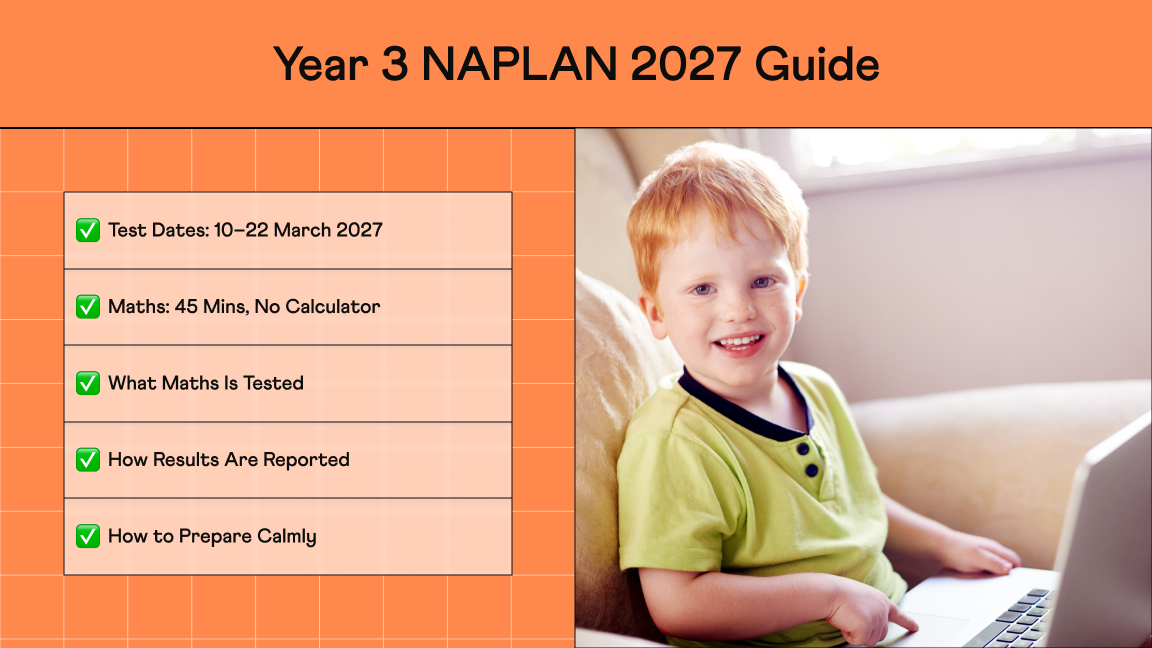
NAPLAN 2027 runs from Wednesday 10 March to Monday 22 March 2027. Year 3 children sit the writing test on paper on day one, 10 March. Reading, conventions of language and numeracy follow in that order, on days your school chooses within the nine-day window. Your school will confirm its own timetable during Term 1.
Source: ACARA, NAPLAN 2027 Information for parents and carers; SCSA WA (calculator rule).
What Does the Year 3 NAPLAN Numeracy Test Actually Look Like?
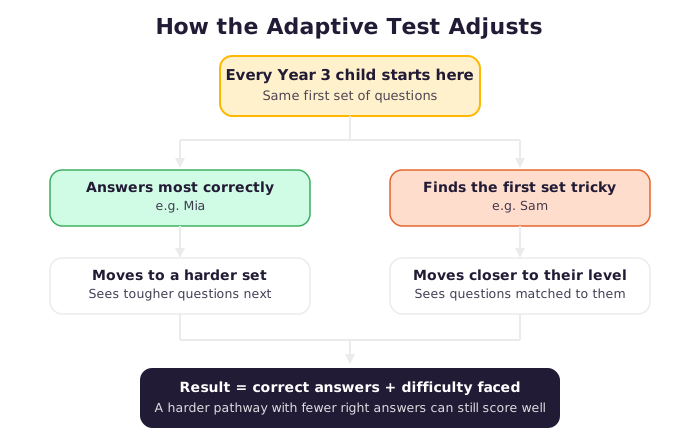
Your child sits the numeracy test on a computer or tablet at school, in 45 minutes, without a calculator. The questions are not a fixed paper that everyone sees in the same order. They adapt as your child works (called Adaptive Design), which is the single most useful thing to explain to them before March.
The easiest way to understand adaptive testing is with an example.
Suppose your child, Mia, starts the numeracy test. Every Year 3 child begins with the same first set of questions. Mia answers most of them correctly, so the test moves her onto a harder set. Her friend Sam finds the first set tricky, so the test moves him onto questions closer to where he is.
By the end, Mia has seen tougher questions than Sam, and that counts in her favour: ACARA says a result reflects both how many answers are correct and how hard the questions were.
What types of questions are on the Year 3 numeracy test?
Expect these main formats.
- Multiple-choice questions ask your child to pick one of four answers.
- Short-answer questions ask them to type a number into a box.
- Some interactive questions ask them to drag, drop or select parts of a picture, such as shading a fraction or placing a number on a line.
- Many questions include a picture, a graph or a map, and almost all of them are wrapped in a short story about someone buying, sorting, measuring or travelling.
Students in all year groups can also switch on audio to hear questions read aloud. For a child who reads more slowly than they calculate, that option is worth knowing about.
What maths is on the Year 3 NAPLAN numeracy test?
ACARA lists the numeracy test as covering number, algebra, measurement, space, statistics and probability, the same six strands your child’s school works through in the Australian Curriculum.
Because the test is sat so early in the year, the NAPLAN assessment framework says most questions are drawn from content taught in previous years, with some items set above and below year level so the adaptive design can measure the full range of children.
| Strand | What your child should be able to do |
|---|---|
| Number |
•Numbers to 1000
•Hundreds, tens and ones
•Add and subtract
•Equal groups and arrays
•Money
|
| Algebra |
•Patterns that go up or down
•Find the missing step
•Addition facts to 20
•Twos facts
|
| Measurement |
•Length, mass and capacity
•Calendars
•Clock to the quarter hour
•Halves, quarters and eighths
|
| Space |
•Sort shapes by sides
•Position on maps and grids
•Follow directions
|
| Statistics |
•Tallies, tables and graphs
•Answer questions from data
|
| Probability |
•Certain, likely, unlikely, impossible
|
Source: ACARA Australian Curriculum v9.0 Mathematics, Year 2 achievement standard (via QCAA alignment document); ACARA NAPLAN 2027 parent information. Probability is formally introduced in Year 3.
How Does Cuemath Prepare Your Child for Year 3 NAPLAN? (NAPLAN Practice Questions)
Cuemath writes its own NAPLAN-style practice papers for Year 3. Its mock tests covers all six maths strands, in the formats your child will meet in March: multiple choice, typed answers, and questions built around a picture, a map or a graph.
The papers are inside Cuemath's NAPLAN test-prep module, which is included in the regular plan at no extra cost, alongside everyday Australian Curriculum lessons with a live one-on-one tutor. See what a Cuemath plan costs.
Here are four questions from one of them, what each is built to reveal, and what happens next in class.
Question 1: Equal Groups
Tyler buys 3 trays with 12 eggs in each, and your child picks the calculation that gives the total. The answer is 12 + 12 + 12. The wrong options are deliberate. Choosing 12 + 12 usually means your child counted two trays and lost track of the third. Choosing 10 + 10 + 10 means they rounded each tray and forgot the extra twos.
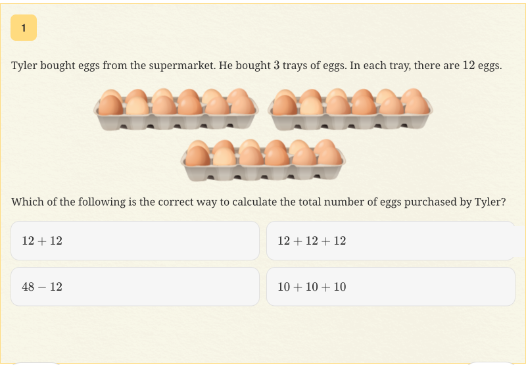
In a Cuemath class, a wrong choice here sends the tutor back to the picture: your child circles each tray, says ‘3 groups of 12’ aloud, and then sees the same total written as 3 × 12. That one step turns a Year 2 idea, equal groups, into the multiplication your child will meet later in Year 3.
Question 2: The Word ‘More’
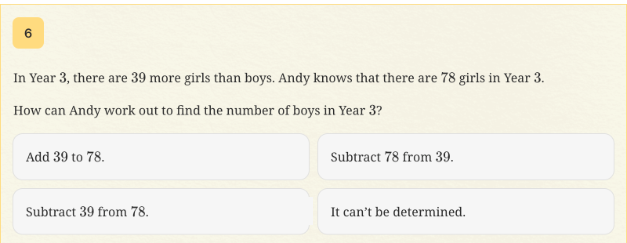
There are 39 more girls than boys in Year 3, and there are 78 girls. How do you find the number of boys? The answer is to subtract 39 from 78, which gives 39 boys. This question is built to catch a habit rather than a gap. Many children have learnt that ‘more’ means add, so ‘Add 39 to 78’ looks right even though the girls are the bigger group.
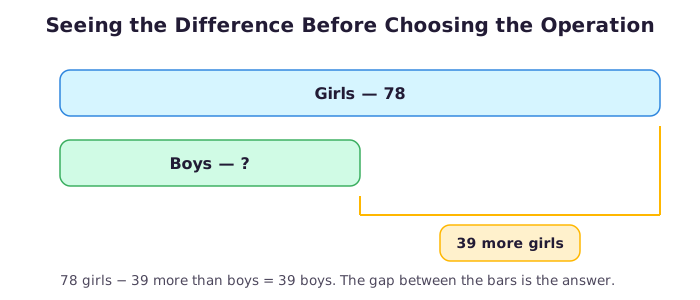
In a Cuemath class, the tutor asks your child to draw the two groups as bars before choosing an operation. The longer bar is the girls, the shorter bar is the boys, and the gap between them is 39. Once a child sees it drawn, the subtraction is obvious, and the same bar picture works for dozens of word problems after this one.
Question 3: A Clock With No Minute Hand
Noah’s clock has lost its minute hand, and your child has to work out the time from the hour hand alone. The hand sits past the 10, most of the way towards the 11, so the answer is 10:40. This is a deliberate stretch question. Year 2 children read time to the quarter hour, and the real NAPLAN test includes some items above year level, so Cuemath’s papers do too.
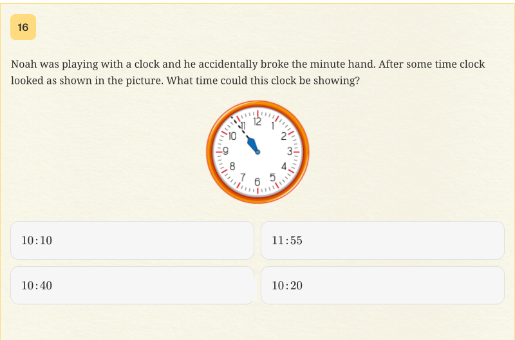
In a Cuemath class, the tutor uses a clock your child can move, turning the minute hand slowly while your child watches the hour hand creep from one number towards the next. A child who has only read digital clocks usually finds this surprising, and it tends to stick once they have seen it happen.
Question 4: Two Skills in One
A spinner shows eight numbers, and your child decides how likely an odd number is. Six of the eight (13, 73, 97, 35, 27 and 59) are odd, so the answer is ‘likely’. The question is built to test two things at once: everyday chance language, and recognising odd numbers by the ones digit when the numbers are two digits long.
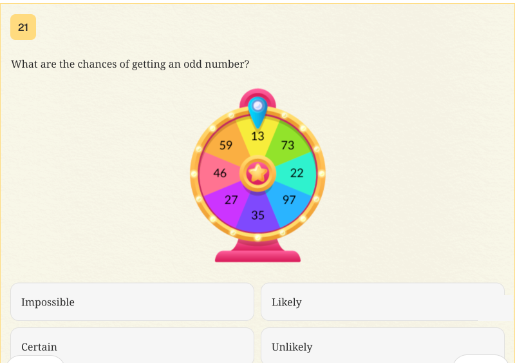
In a Cuemath class, if your child hesitates over whether 97 is odd, the tutor treats it as a place value and odd-and-even question, not a probability one. That distinction matters. Extra practice on chance would not help a child whose real gap is spotting the ones digit.
What Else Is on Year 3 NAPLAN Besides Maths?
Numeracy is one of four tests, and the other three all come before it in the week. They are worth understanding, partly because reading skill feeds straight into how well your child copes with maths word problems. Here is what each involves for Year 3.
- Writing (40 minutes, on paper). Your child responds to a prompt with either a narrative or a persuasive text. Year 3 is the only year level still writing by hand.
- Reading (45 minutes, online). Your child reads a mix of informative, imaginative and persuasive texts and answers questions about them.
- Conventions of language (45 minutes, online). This covers spelling, grammar and punctuation.
How Is Year 3 NAPLAN Marked?
Your child will not receive a mark out of 100 or a band number. Since 2023, NAPLAN has reported results against proficiency standards, with a separate standard for each test at each year level.
ACARA sets each standard at a level that is challenging but reasonable for a child at the time of testing, based mainly on what has been taught in previous years. That wording matters. A Year 3 numeracy result is a judgement about how secure your child’s Foundation to Year 2 maths is in March, not a verdict on how they will do in Year 3.
What are the four NAPLAN proficiency levels?
Since 2023, NAPLAN reports results at four proficiency levels: Exceeding, Strong, Developing and Needs additional support. Strong means your child met challenging but reasonable expectations for the time of testing. Developing means they are working towards those expectations. The levels replaced the old ten-band scale and the national minimum standard.
Because the test is adaptive, the result is not simply a count of correct answers. ACARA says it combines the number of questions answered correctly with the average difficulty of the questions a child was given. Two children could each get 20 questions right and land at different levels, because one was working on a harder pathway.
What Year 3 NAPLAN Tells You About Your Child’s Maths, and What It Doesn’t
A NAPLAN report shows where your child sat against a national standard on one morning in March. It does not show why. An example makes the difference clear.
Suppose your child, Leo, receives Developing in numeracy. You know he is working towards the expected standard. What you don’t know is the reason. He might know his facts well but freeze on word problems. He might read beautifully but still count on his fingers to add. Or he might have rushed and clicked ‘add’ on the girls-and-boys question because he saw the word ‘more’. Each of those needs completely different help, and the report looks the same for all three.
Get a Free Maths Evaluation Before March 2027
In a free one-on-one session, a Cuemath tutor checks how secure your child's Year 2 maths foundations are, the ones Year 3 NAPLAN draws on, and shows you exactly where to focus before test week. There is no registration fee and no commitment.
Book a Free EvaluationOnline, live and one-on-one. Following the Australian Curriculum and your state's syllabus.
Frequently Asked Questions
Is Year 3 NAPLAN compulsory?
NAPLAN is expected of all Year 3 students, but parents can withdraw their child. Withdrawal is made in writing to the school before testing, and it is intended for religious beliefs or philosophical objections to testing. Students with significant disability or who have recently arrived in Australia from a non-English speaking background may be granted an exemption.
When is NAPLAN 2027 for Year 3?
NAPLAN 2027 runs from Wednesday 10 March to Monday 22 March 2027. Year 3 children sit the writing test on paper on the first day, then reading, conventions of language and numeracy on days the school chooses within the window. Your child’s school will share its own timetable during Term 1.
How long is the Year 3 NAPLAN numeracy test?
The Year 3 NAPLAN numeracy test is 45 minutes long. It is sat online and is always the last of the four NAPLAN tests. Writing takes 40 minutes, and reading and conventions of language take 45 minutes each.
Can Year 3 students use a calculator in NAPLAN?
No. Year 3 and Year 5 students do not use a calculator in the NAPLAN numeracy test. Only the Year 7 and Year 9 numeracy tests include a section where a calculator is allowed. Year 3 questions are designed to be solved with mental strategies, drawings and working on scrap paper.
Is Year 3 NAPLAN done on paper or online?
Year 3 NAPLAN is mostly online. The reading, conventions of language and numeracy tests are completed on a computer or tablet and are adaptive, meaning the questions adjust to how a child is answering. The writing test is the one exception: all Year 3 students still complete it on paper.
Do Year 3 NAPLAN results affect selective school or Opportunity Class entry?
NAPLAN is not designed to be a school admission test. ACARA notes that results may help inform a new school about a student, but entry to NSW Opportunity Classes and selective high schools is based on separate tests, including Mathematical Reasoning and Thinking Skills. The NSW Opportunity Class placement test is sat in Year 4.
When do Year 3 NAPLAN results come out?
Each child’s individual NAPLAN report is provided by their school later in the year. Reports show a proficiency level for each of the four tests. If you have not received a report, ACARA advises contacting your child’s school first and then your state or territory test administration authority.
Sources
Government sources
- ACARA – NAPLAN 2027 Information for parents and carers — 2027 test window, Year 3 durations and order, adaptive design, proficiency levels, ACARA’s position on preparation and coaching
- ACARA – NAPLAN test window March 2027 infographic — Day-by-day window and Year 3 writing on paper on day one
- ACARA – Tailored tests — How the adaptive pathway works
- ACARA – NAPLAN assessment framework — Most items drawn from content taught in previous years; items set at, above and below year level
- ACARA – 2026 NAPLAN Individual student report: information for parents and carers — Definitions of the four proficiency levels; NAPLAN not designed as an admission test
- NSW Government – NAPLAN key dates — Confirms the 2027 test window
- SCSA WA – NAPLAN information for home educators — No calculator for Years 3 and 5; audio option; public demonstration site
- QCAA – NAPLAN information for parents and carers — Withdrawal and exemption
- QCAA – Year 2 Mathematics: Australian Curriculum v9.0 achievement standard — Year 2 maths expectations used in the strands table
- SCSA WA – NAPLAN (K–10 Outline) — No calculator for Years 3 and 5; audio read-aloud option in all year groups

I write because I like understanding things properly, and I've never been able to do that quietly.
Six years in, what still interests me most isn't the writing itself. It's the person on the other side. Who are they, what were they actually worried about when they opened this page, and did they leave with what they came for? Most content fails that last test. It answers the easy question instead of the one that was asked.
At Cuemath, I write for parents and students in India and around the world. That range is the part I enjoy. A parent in Bangalore and a parent in Canada are asking about the same child, but not always in the same words, and that difference matters.
So I research before I write. Not just search results. Forums, reviews, the long comment threads where somebody finally admits what they're really confused about. That's usually where the useful thing is hiding.
I also spend time on how people find this writing at all, since a growing number of them now ask an AI instead of typing into Google. But that only works if the writing is clear to begin with. There's no shortcut around that part.