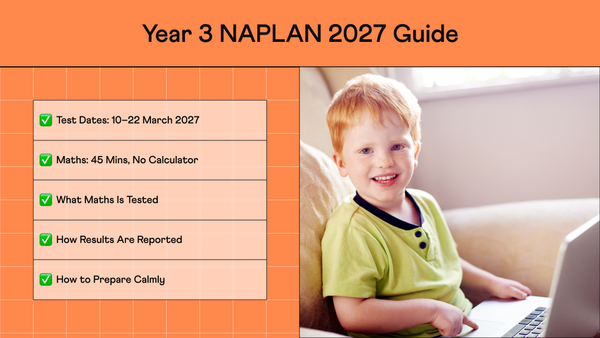
NAPLAN 2027 Dates Confirmed: Testing Set for 10–22 March
NAPLAN 2027 has been confirmed for 10–22 March, with Years 3, 5, 7 and 9 sitting the tests. Here's what's different this year, including a date clash families should know about.

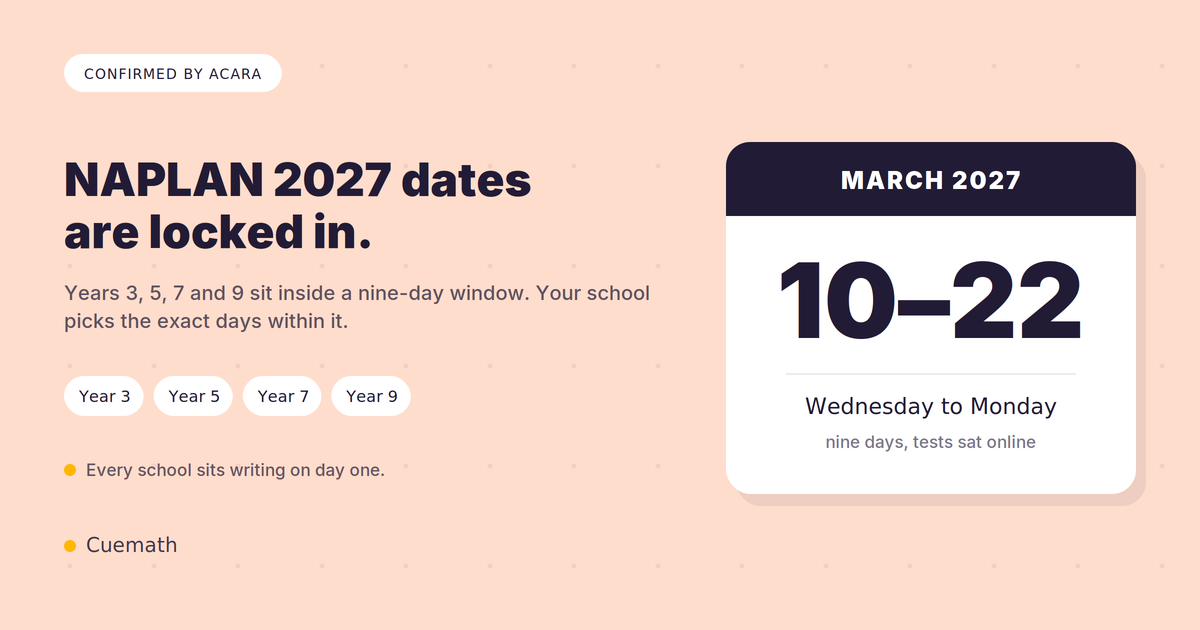
NAPLAN 2027 will run from Wednesday 10 March to Monday 22 March, the National Assessment Program’s official site confirms. Students in Years 3, 5, 7 and 9 sit the tests, which check reading, writing, conventions of language, and numeracy. The dates matter for every family with a child in one of those year levels and this year’s window has one detail worth knowing early: it overlaps with Eid al-Fitr.
What Are the Key NAPLAN 2027 Dates?
The nine-day window has one fixed anchor: the writing test.
- Test window: Wednesday 10 March to Monday 22 March 2027
- All schools complete the writing test on day one, Wednesday 10 March
- Tests are online, except Year 3 writing, which is done on paper
- Catch-up tests are available for students absent on their school’s scheduled day
- Dates are already locked in years ahead: 2028 (15–27 March) and 2029 (14–26 March)
What Does NAPLAN 2027 Actually Test, and How?
NAPLAN checks skills students are already learning in class — it isn’t a separate curriculum.
- Reading, numeracy and conventions of language use “tailored testing,” which adjusts question difficulty based on a student’s answers
- Harder questions aren’t a bad sign — a student who reaches a tougher question set is on track for a higher score
- The digital skills needed are just everyday classroom skills; students don’t need to be able to touch-type
Does NAPLAN 2027 Overlap With Ramadan or Eid al-Fitr?
Yes and the official testing body has already planned for it.
- Eid al-Fitr falls on 10 March 2027, the same day as the NAPLAN writing test
- Ramadan begins 8 February 2027 and runs into the first days of the test window
- ACARA’s official guidance, developed with the Islamic Schools Association of Australia, encourages schools to schedule tests early in the window and in the morning, when fasting students have more energy
- Families with concerns are encouraged to raise them with their child’s school ahead of test week
If Eid al-Fitr Falls During Testing: What You Can Actually Do
Since day one of the NAPLAN window is also expected to fall on Eid al-Fitr, here’s what’s actually worth doing if this affects your family:
- Tell the school now, not in March. Schools plan their internal testing schedule well ahead of the national window, and early notice gives them the most room to place your child’s writing test on a different day within the nine-day window.
- Ask specifically about the writing test. It’s the one test every school runs on day one nationally, so it’s the test most likely to need rescheduling — the other subjects are more flexible across the window.
- Keep the request simple. You don’t need a formal letter — a short note or conversation with your child’s teacher or the school office is enough: “Our family will be observing Eid al-Fitr on [date], could [child] sit the writing test on a different day within the window?”
- Expect a simple yes. ACARA’s own guidance already tells schools to accommodate this, so most schools will have a process ready rather than treating it as an unusual request.
How Should Families Think About Getting Ready?
The official advice is simple: don’t panic-prepare.
- Education authorities are clear that cramming or last-minute coaching isn’t the point of NAPLAN
- What actually helps is steady, everyday practice that builds real understanding over the school year — not a sprint before test week
- Programs like Cuemath’s 1-on-1 online maths tutoring, aligned to the Australian Curriculum, work that way year-round — so test week is just another week, not a scramble
Looking Ahead
The 2027 window is confirmed, but there’s more detail still to come.
- Schools will share exact local timetables and any scheduling adjustments closer to test week
- Families observing Ramadan or Eid al-Fitr should flag any concerns with their child’s school in advance — support is available
- NAPLAN dates for 2028 and 2029 are already set, so families can plan well ahead
NAPLAN 2027 FAQs
What happens if my child misses NAPLAN in 2027?
If your child is absent on a test day within the 10–22 March window, most schools can schedule a catch-up test on another day inside that same window — NAPLAN’s nine-day window exists partly for this reason. If your child misses the entire window, they simply won’t have a NAPLAN result for that year; it isn’t recorded as a fail, and there’s no separate penalty. Check with your school early if you know in advance your child will be away, especially around the Eid al-Fitr period this cycle.
Is NAPLAN 2027 done online or on paper?
Almost all of NAPLAN 2027 is completed online on a school device. The one exception is the Year 3 writing test, which stays on paper because handwriting is still part of what’s being assessed at that age. Reading, language conventions and numeracy are online for every year level, including Year 3.
Is NAPLAN 2027 adaptive — does that mean the test gets harder?
Yes. NAPLAN’s numeracy, reading and language conventions tests are tailored: if a student answers well, the test moves them onto harder questions; if they’re struggling, it adjusts to easier ones. This means two children in the same class can see quite different questions. It isn’t a sign of doing badly if the questions get noticeably harder partway through — it usually means the opposite.
How many times will my child sit NAPLAN, and is Year 9 the last one?
NAPLAN is sat in Years 3, 5, 7 and 9 — four times across a child’s schooling. Year 9 is currently the final year NAPLAN is tested, so the 2027 sitting is the last one for any child in Year 9 that year, unless testing arrangements change again before their turn comes around.
Sources:
Key dates, National Assessment Program (NAP)
Ramadan and NAPLAN, National Assessment Program (NAP)
NAPLAN information for parents and carers, NSW Government (NESA)

I write because I like understanding things properly, and I've never been able to do that quietly.
Six years in, what still interests me most isn't the writing itself. It's the person on the other side. Who are they, what were they actually worried about when they opened this page, and did they leave with what they came for? Most content fails that last test. It answers the easy question instead of the one that was asked.
At Cuemath, I write for parents and students in India and around the world. That range is the part I enjoy. A parent in Bangalore and a parent in Canada are asking about the same child, but not always in the same words, and that difference matters.
So I research before I write. Not just search results. Forums, reviews, the long comment threads where somebody finally admits what they're really confused about. That's usually where the useful thing is hiding.
I also spend time on how people find this writing at all, since a growing number of them now ask an AI instead of typing into Google. But that only works if the writing is clear to begin with. There's no shortcut around that part.