What Is the Identity Property? The Rule Behind + 0 and × 1
Adding 0 and multiplying by 1 look too easy to need a rule, but they have one: the identity property. Here's what it means, why subtraction and division don't get one, how it differs from the zero property, and a free worksheet that checks every answer.

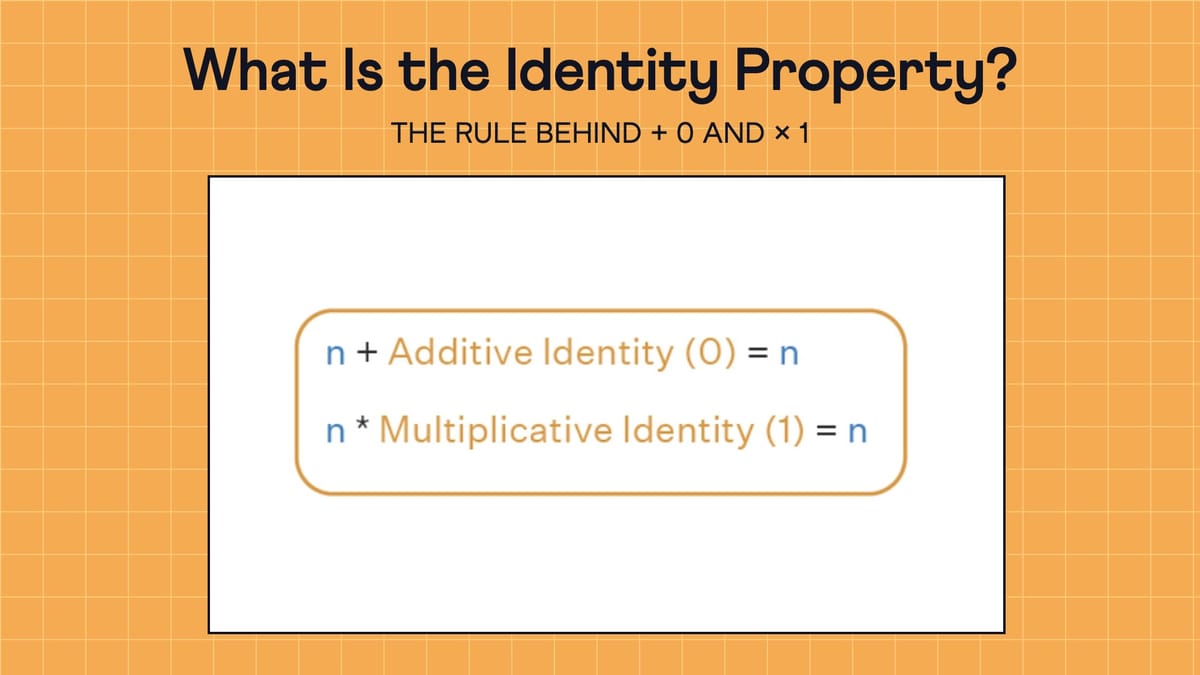
Have you ever heard the word identity? It means something that stays the same and does not change. In math, the Identity Property follows this simple idea. It tells us that adding zero or multiplying by one will never change the original number. For example, when you add 0 to 5, the answer is still 5. Similarly, when you multiply 5 by 1, the answer remains 5. Isn't that interesting? These simple rules make math easier to understand and help us solve problems with confidence.
Let's explore the Identity Property and discover why + 0 and × 1 are so special! In this blog, you'll see what the identity property means, how it differs from the zero property (where most kids slip), why subtraction and division don't count, and a free worksheet and games that check every answer.
Try It Yourself: What Stays the Same? Work out each problem, then press Check My Answer.
Identity Property of Addition and Multiplication
The identity property is a math rule that says adding 0 to a number, or multiplying a number by 1, gives you the same number back. 0 is called the additive identity, and 1 is called the multiplicative identity.
Adding 0 (from Grade 1). Any number plus 0 equals that number: a + 0 = 0 + a = a. If your child has 5 crayons and gets 0 more, they still have 5.
Multiplying by 1 (from Grade 3). Any number times 1 equals that number: a × 1 = 1 × a = a. 1 × 6 means one group of 6, which is just 6. That's why the whole 1s row of the times table needs no memorizing.
In everyday life. A $5 toy with $0 tax still costs $5: 5 + 0 = 5. One bag with 6 apples in it holds 6 apples: 1 × 6 = 6.
Where it comes back later. In Grades 4 and 5, kids turn 3/4 into 6/8 by multiplying by 2/2. That works because 2/2 = 1, so the value doesn't change. Equivalent fractions like this show up on state math tests such as Smarter Balanced and NJSLA.
Common Core lists both rules in its table of “properties of operations,” next to the commutative and associative properties.
Try It Yourself: Find the Identity. Fill in the missing number, then press Check My Answer.
Identity Property vs Zero Property: The 7 Times 0 Mix-Up
The identity property and the zero property both use 0, but they do opposite things. Adding 0 keeps a number the same. Multiplying by 0 turns any number into 0.
| Identity property of addition | Identity property of multiplication | Zero property of multiplication | |
|---|---|---|---|
| Rule | a + 0 = a | a × 1 = a | a × 0 = 0 |
| Example | 7 + 0 = 7 | 7 × 1 = 7 | 7 × 0 = 0 |
| What happens | The number stays the same | The number stays the same | The answer is always 0 |
Kids mix these up because they learn “0 doesn't change anything” when they add, then carry it over to multiplying. Show them what 7 × 0 means: 7 groups of 0. If you have 7 empty bags, you have 0 apples, not 7.
A quick way to tell them apart: look at the sign first, then the number. + 0 or × 1 means the number stays. × 0 means the answer is 0.
Try It Yourself: Identity or Zero?. Look at the sign first, then the number.
Why Subtraction and Division Don't Count
An identity has to work from both sides of the sign. With subtraction and division, it only works from one side: 7 − 0 = 7, but 0 − 7 = −7, and 7 ÷ 1 = 7, but 1 ÷ 7 = 1/7. So math books give the identity property only to addition and multiplication.
| Operation | Number first | Identity first | Same both ways? |
|---|---|---|---|
| Addition | 7 + 0 = 7 | 0 + 7 = 7 | Yes |
| Multiplication | 7 × 1 = 7 | 1 × 7 = 7 | Yes |
| Subtraction | 7 − 0 = 7 | 0 − 7 = −7 | No |
| Division | 7 ÷ 1 = 7 | 1 ÷ 7 = 1/7 | No |
Cuemath has a 4.9 out of 5 rating on Trustpilot from 12,000+ reviews. Here's what US parents say:
Does Your Child Know Why 7 × 0 Isn't 7?
In a free 1:1 evaluation, a Cuemath tutor checks how your child works with 0 and 1, and with the facts that build on them, then shows you exactly what to practice next.
Book a Free Evaluation100% free · No credit card · About 30 minutes
Identity Property Worksheet: Try It Yourself
Pick a tab and have your child answer 10 questions: adding 0 for Grades 1–2, multiplying by 1 for Grades 3–4, or naming the property for Grades 3–6. When they finish, press Check My Answers to see their score and which questions to go over together.
Want more practice? The free Smarter Balanced practice curriculum and NJSLA practice curriculum have more questions by grade.
Pick a tab, answer all 10, then press Check My Answers. The score shows which questions to go over together.
Math Games to Play After the Worksheet
Finished the worksheet? These 6 Cuemath games start with addition and multiplication facts, then move on to equivalent fractions. Pick one and play it right here on the page.
Each game opens right here and takes a few seconds to load. On a phone, turn it sideways for the best view.
Want to practice without a screen? These take about five minutes each:
- Empty bags. Put 4 empty cups on the table and ask how many raisins are in “4 cups of 0.” Then put 1 raisin in each: “4 cups of 1.” Your child sees × 0 and × 1 side by side.
- Plus zero, times one. Call out a number and a rule, like “38, plus zero” or “38, times one.” Your child answers as fast as they can. Mix in “times zero” to catch the mix-up.
- Fraction twins. Fold a paper strip into 4 parts and shade 3. Fold it again to make 8 parts. Your child counts the shaded parts (6) and sees that 3/4 and 6/8 cover the same length.
- Mystery number. Write “__ × 1 = 57” or “0 + __ = 12” on a sticky note. Your child fills in the blank and says which rule they used.
How Cuemath Tutors Teach the Identity Property
Cuemath tutors teach the identity property by having your child explain why 7 + 0 and 7 × 1 stay 7 while 7 × 0 turns into 0. A worksheet only shows whether the answer is right. A tutor can hear whether your child understands “groups of” or is just remembering that “0 and 1 are the easy ones.”
| How Cuemath helps | What it means for your child |
|---|---|
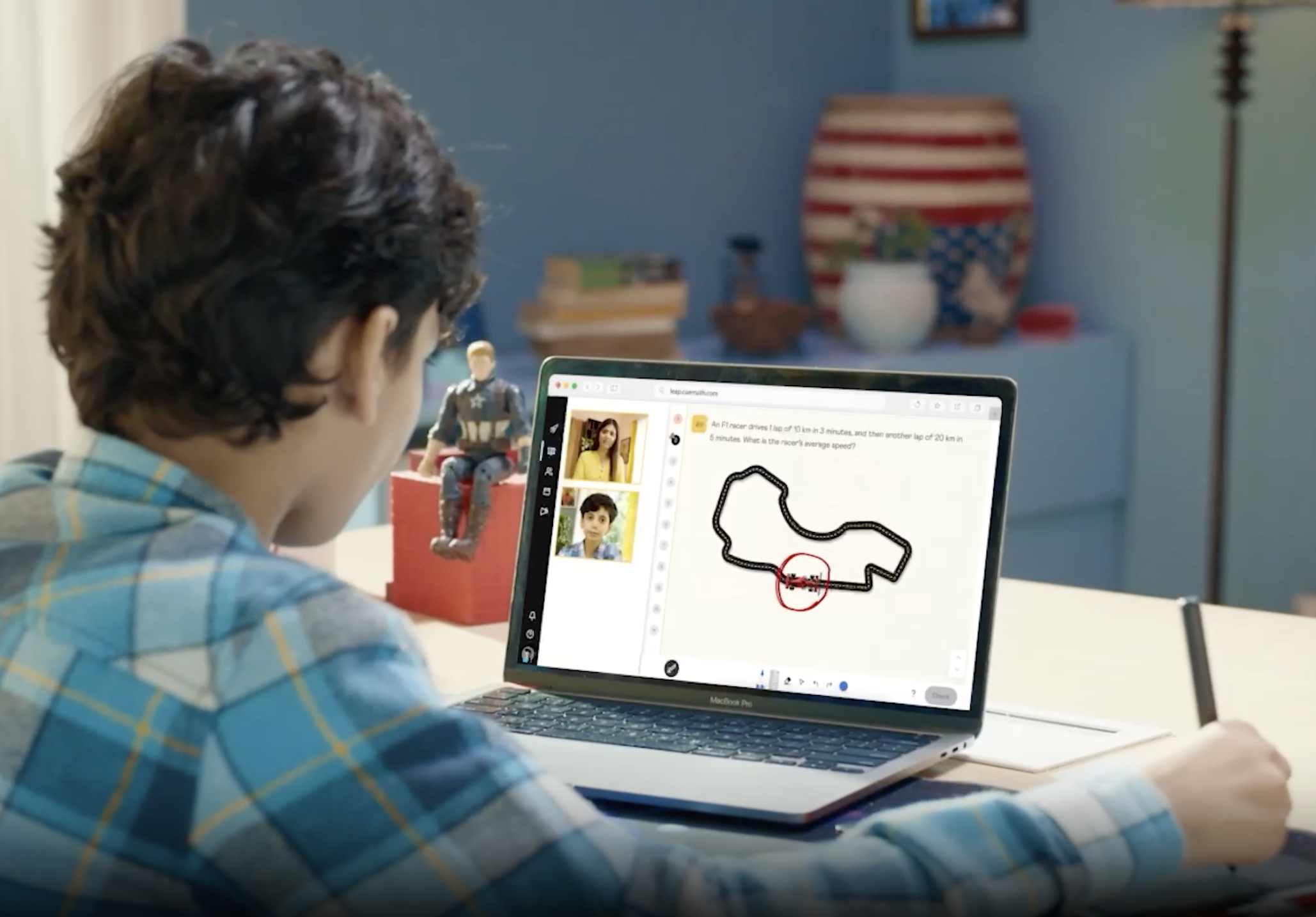
| How it works | In a 1:1 live class, the tutor writes 7 × 0 and 7 × 1 on the Cueboard (Cuemath's shared digital whiteboard). Your child draws the groups and explains why one answer is 0 and the other is 7. Cuemath calls this “cue, don't tell.” The tutor asks questions instead of giving the answer. |
| Who it helps | Grade 1–3 kids who mix up × 0 and + 0, and Grade 4–6 kids who can make equivalent fractions by rule but can't say why 3/4 = 6/8. |
| What it won't fix by itself | If your child only needs the property names for a quiz, the worksheet above is faster than a class. |
| Verdict | For a child who memorizes rules without knowing why they work, one-on-one practice builds the “why” before the next unit depends on it. Cuemath classes start at $15 per class. Meet Cuemath's Grade 3 and Grade 5 math tutors, or see how Grade 3 and Grade 5 online math classes work. |
Real results from US students
More confident in school, with the same tutor since 2023
Her parent says MJ is more confident because her tutor uses the same textbooks and concepts as her school.
Read MJ's story →National Honor Roll, Noetic Learning Math Contest
Shravan used to rush word problems straight to the numbers. After a year of planning before calculating, he made the National Honor Roll.
Read Shravan's story →Results as published in Cuemath's student stories. They are not typical of every child.
Find the Gap Before Fractions Find It
In a free 1:1 evaluation, a Cuemath tutor checks how your child works with 0, 1, and the facts and fractions that build on them, and shows you exactly what to practice next.
Book a Free Evaluation100% free · No credit card · About 30 minutes
Keep Exploring
- The Distributive Property in Multiplication: Why New Math Teaches It Early
- What Is Expanded Form in Math? Why Kids Write 347 as 300 + 40 + 7
- Area Model Multiplication: Steps, Examples, and Worksheet
- Box Method Multiplication
- Math Facts Practice
- How to Teach Addition Using a Ten Frame
- What Are Number Bonds? The New Math Strategy Behind Every Addition Problem
FAQs
What is the identity property?
The identity property is the rule that adding 0 to a number, or multiplying a number by 1, leaves the number unchanged. In symbols, a + 0 = 0 + a = a and a × 1 = 1 × a = a. For example, 25 + 0 = 25 and 25 × 1 = 25.
What is the identity property of addition?
The identity property of addition says that any number plus 0 equals that number: a + 0 = 0 + a = a. For example, 18 + 0 = 18 and 0 + 18 = 18. Because of this rule, 0 is called the additive identity.
What is the identity property of multiplication?
The identity property of multiplication says that any number times 1 equals that number: a × 1 = 1 × a = a. For example, 9 × 1 = 9 and 1 × 9 = 9. Because of this rule, 1 is called the multiplicative identity.
What is the additive identity?
The additive identity is 0, the number you can add to any number without changing it: a + 0 = 0 + a = a. For example, 35 + 0 = 35 and 0 + 35 = 35. It's called the additive identity because it only does this when you add.
What is the multiplicative identity?
The multiplicative identity is 1, the number you can multiply any number by without changing it: a × 1 = 1 × a = a. For example, 35 × 1 = 35 and 1 × 35 = 35. Don't mix it up with 0: multiplying by 0 always gives 0.
What is an example of the identity property?
An example of the identity property is 46 + 0 = 46, and another is 46 × 1 = 46. In both, the number you start with is the number you end with. Fractions work the same way: 3/4 × 1 = 3/4.
What is the difference between the identity property and the zero property?
The identity property keeps a number the same, and the zero property turns it into 0. Adding 0 (7 + 0 = 7) and multiplying by 1 (7 × 1 = 7) are identity properties. Multiplying by 0 (7 × 0 = 0) is the zero property of multiplication.
Is there an identity property of subtraction or division?
No, subtraction and division don't have an identity property, because an identity has to work from both sides. 7 − 0 = 7, but 0 − 7 = −7, and 7 ÷ 1 = 7, but 1 ÷ 7 = 1/7. Common Core lists the identity property only for addition and multiplication.
What grade learns the identity property?
Kids use the identity property of addition from Grade 1 and the identity property of multiplication from Grade 3, when Common Core asks them to “apply properties of operations” (1.OA.B.3, 3.OA.B.5). Common Core says young students “need not use formal terms,” so the name often shows up later. Multiplying by 1 comes back in Grades 4–5 for equivalent fractions and in Grade 6 for algebra.
Sources
- Identity properties and the list of properties of operations: Common Core Table 3: Properties of Operations (a + 0 = 0 + a = a and a × 1 = 1 × a = a)
- Grade levels (“apply properties of operations,” “need not use formal terms”) : Common Core Grade 1 OA (Grade 1, 1. OA.B.3); Common Core Grade 3 OA (Grade 3, 3. OA. B.5)
- Fractions and algebra: Common Core Grade 5 NF (Grade 5, 5. NF.B.5b, “multiplying a/b by 1”); Common Core Grade 6 EE (Grade 6, 6.EE.A.4, y + y + y = 3y)
- Left and right identities: Wikipedia: Identity element (why 7 − 0 = 7 isn't an identity property)
- Reviews: Cuemath on Trustpilot (4.9/5 from 12,000+ reviews)

I was never the kid who loved math. I was much more interested in books, stories, and writing, and, somewhere along the way, I became even more curious about people. Why do we learn differently? Why does something make sense to one child but not another? And what makes a student feel confident enough to keep trying?
That curiosity led me to study Applied Psychology, where I learned more about how children think, learn, and make sense of the world around them.
My love for writing did the rest. What started as something I simply enjoyed became a career. Over the past five years, I've worked as a freelance writer across edtech, SaaS, B2B, travel, lifestyle, and healthcare, learning how to write for very different audiences without losing the human side of the story.
Today, I'm an SEO Content Writer & Editor at Cuemath, where I get to bring many of these interests together. Working in education, and especially around math, has made me even more curious about what happens behind the screen or textbook: what parents worry about, what students struggle with, and what actually helps them learn.
That's also how I like to research. I don't just look at search results and call it a day. I go where parents and students actually talk: forums, reviews, communities, and conversations with real families. Because sometimes the most useful insight isn't hiding in a keyword; it's in a parent's question, a student's frustration, or a small detail someone shares about their learning experience.
I write because I'm curious. I research because I want to understand. And I love turning what I learn into content that feels genuinely useful to the people reading it.