What Is Expanded Form in Math? Why Kids Write 347 as 300 + 40 + 7
Your child's homework turned 347 into 300 + 40 + 7, and you're wondering why. Here's what expanded form means, which grades teach it, the three mistakes kids make most, and interactive worksheets that check every answer instantly.

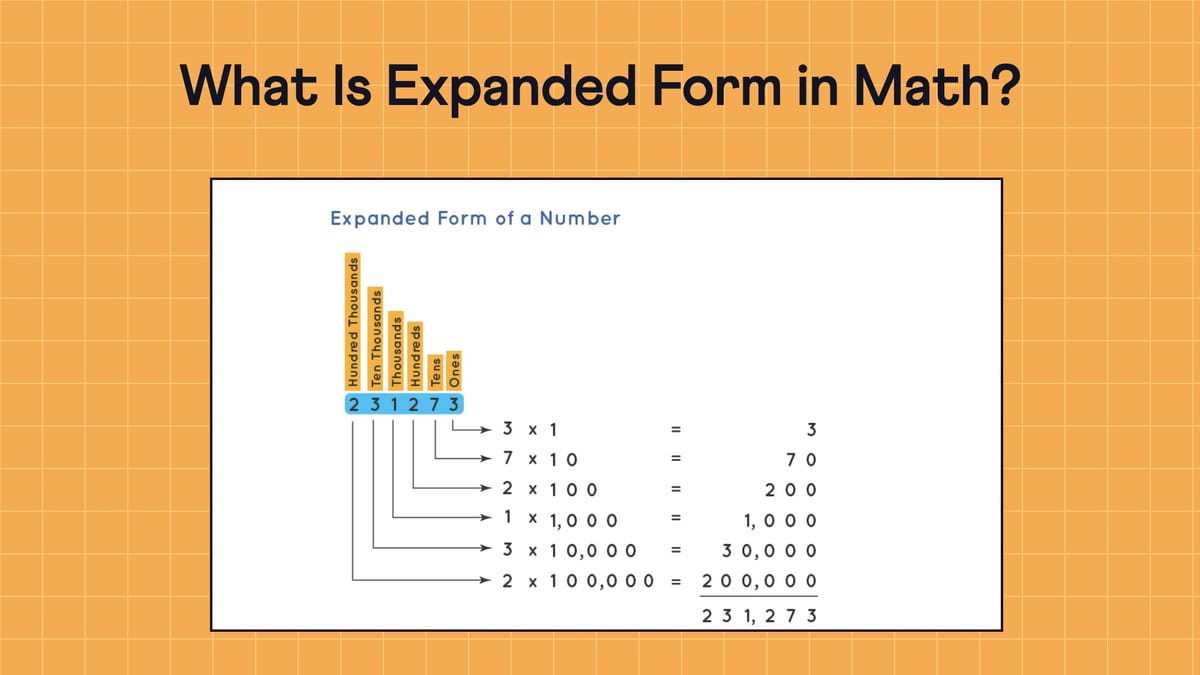
Have you ever wondered why kids are taught to write 347 as 300 + 40 + 7, not simply 347? It may seem like an extra step, but there is a good reason for it! This simple math concept, expanded form, helps children understand what every number in a number really means.
Think of it this way: 347 isn't just three digits rolled into one. It is three hundred, four tens, and seven ones. Instead of just memorizing them, kids start to see how numbers work when they break it down into 300 + 40 + 7. And that knowledge can make a huge difference when they start learning addition, subtraction, and other math skills.
In this guide we will look at what expanded form is, why teachers use it, and how you can help your child to master it with simple everyday examples. You’ll see by the end why breaking a number apart is one of the building blocks of stronger math skills!
- What Is Expanded Form in Math?
- Why Do Schools Teach Expanded Form? (Grade by Grade)
- Standard Form vs. Expanded Form vs. Word Form
- How to Write a Number in Expanded Form
- 2-Digit and 3-Digit Numbers
- Numbers With Zeros
- Decimals
- 3 Expanded Form Mistakes Kids Make (and How to Spot Them)
- Where Expanded Form Shows Up Next: Adding and Multiplying
- Expanded Form Worksheets: 3 Interactive Practice Sets
- Worksheet 1: Grade 2 — 3-Digit Numbers
- Worksheet 2: Grade 4 — Multi-Digit Numbers
- Worksheet 3: Grade 5 — Decimals
- Math Games to Play After the Worksheets
- How Cuemath Tutors Teach Expanded Form
- FAQs
What Is Expanded Form in Math?
Expanded form is a way of writing a number as the sum of the value of each of its digits.
For 285, the 2 is in the hundreds place, so it's worth 200. The 8 is in the tens place, so it's worth 80. The 5 is in the ones place, so it's worth 5. Add those values together and you get the expanded form: 285 = 200 + 80 + 5.
The key idea is the difference between a digit and its value. The digit is the symbol (2). The value is what that symbol is worth in its position (200). Expanded form asks your child to write the value every time.
| Number | Hundreds | Tens | Ones | Expanded form |
|---|---|---|---|---|
| 285 | 2 → 200 | 8 → 80 | 5 → 5 | 200 + 80 + 5 |
| 58 | — | 5 → 50 | 8 → 8 | 50 + 8 |
| 906 | 9 → 900 | 0 → 0 | 6 → 6 | 900 + 6 |
A quick way to check any answer: add the parts back together. If 200 + 80 + 5 gives you 285, the expanded form is right.
Why Do Schools Teach Expanded Form? (Grade by Grade)
Schools teach expanded form because the Common Core State Standards name it in Grades 2, 4, and 5, and the groundwork starts in kindergarten. Each year the numbers get bigger: three digits in Grade 2, multi-digit numbers in Grade 4, and decimals in Grade 5.
| Grade | Common Core standard | What your child does | Example |
|---|---|---|---|
| Kindergarten | K.NBT.A.1 | Breaks numbers 11–19 into ten ones and some more ones | 18 = 10 + 8 |
| Grade 1 | 1.NBT.B.2 | Learns that a two-digit number is tens and ones | 47 = 4 tens and 7 ones |
| Grade 2 | 2.NBT.A.3 | Reads and writes numbers to 1,000 in base-ten numerals, number names and expanded form | 462 = 400 + 60 + 2 |
| Grade 3 | No expanded form standard | Uses place value to round and to add and subtract within 1,000 | 462 rounds to 460 |
| Grade 4 | 4.NBT.A.2 | Reads and writes multi-digit whole numbers in expanded form and compares them | 28,519 = 20,000 + 8,000 + 500 + 10 + 9 |
| Grade 5 | 5.NBT.A.3a | Reads and writes decimals to thousandths in expanded form | 347.392 = 3 × 100 + 4 × 10 + 7 × 1 + 3 × (1/10) + 9 × (1/100) + 2 × (1/1000) |
The Grade 5 standard uses 347.392 as its own example, the same 347 from the title plus three decimal places. Your child learns to expand 347 in Grade 2 and is still expanding it in Grade 5, just with smaller and smaller place values.
State math tests check this skill with questions like “Which shows 4,062 in expanded form?" so it's worth getting right before testing season in spring. Grade 3–5 tests built on these standards, like Smarter Balanced and NJSLA, cover the same place value skills, and Texas's STAAR tests it under TEKS 3.2A, which calls it expanded notation.
If you learned math with “carry the 1,” you already used expanded form without the name. Carrying the 1 in 47 + 25 is moving a group of ten from the ones column to the tens column. Expanded form shows the step on paper instead of hiding it. Our guide to new math vs. old math shows more side-by-side examples.
Standard Form vs. Expanded Form vs. Word Form
The standard form is the number as you normally write it (739). Expanded form is the sum of the digit values (700 + 30 + 9). Word form is the number in words (seven hundred thirty-nine). Worksheets ask kids to switch between all three, and some add a fourth: expanded form with multiplication.
| Form | 739 | 8,015 |
|---|---|---|
| Standard form | 739 | 8,015 |
| Expanded form | 700 + 30 + 9 | 8,000 + 10 + 5 |
| Expanded form with multiplication (expanded notation) | (7 × 100) + (3 × 10) + (9 × 1) | (8 × 1,000) + (0 × 100) + (1 × 10) + (5 × 1) |
| Word form | seven hundred thirty-nine | eight thousand fifteen |
How to Write a Number in Expanded Form
To write any whole number in expanded form, find each digit's place, write its value, and join the values with plus signs.
- Name the place of every digit. In 6,305: 6 is thousands, 3 is hundreds, 0 is tens, and 5 is ones.
- Write each digit's value. 6 thousands = 6,000. 3 hundreds = 300. 0 tens = 0. 5 ones = 5.
- Join the values with plus signs. 6,000 + 300 + 0 + 5.
- Drop the zero if your child's teacher allows it. 6,000 + 300 + 5. Both versions are correct. The zero version shows every place.
- Check by adding back. 6,000 + 300 + 5 = 6,305. ✓
Worked example—6,305:
The 0 tens adds nothing, so most teachers let your child drop it. Add back to check: 6,000 + 300 + 5 = 6,305.
2-Digit and 3-Digit Numbers
- 58 = 50 + 8
- 263 = 200 + 60 + 3
- 615 = 600 + 10 + 5
The 1 sits in the tens place, so it is worth 10, not 1.
Numbers With Zeros
- 470 = 400 + 70
- 906 = 900 + 6
- 4,062 = 4,000 + 60 + 2
- 70,305 = 70,000 + 300 + 5
Two empty places, two zeros to drop. The 7 is still worth 70,000 because the zeros hold its place.
Decimals
Decimal places work the same way, moving right of the decimal point: tenths (0.1), hundredths (0.01), and thousandths (0.001).
- 4.25 = 4 + 0.2 + 0.05
- 36.7 = 30 + 6 + 0.7
- 125.736 = 100 + 20 + 5 + 0.7 + 0.03 + 0.006
In Grade 5, your child may also write decimals with fractions: 4.25 = 4 + 2/10 + 5/100.
Each place right of the point is worth one tenth of the place before it.
Expanding Numbers Every Day Takes 5 Minutes in the Cuemath App
Daily place value practice, from hundreds, tens and ones to decimals, plus puzzles and 1v1 math battles. Points and streaks keep your child coming back between worksheets.
100% Free • No Card Needed • A Few Minutes a Day
3 Expanded Form Mistakes Kids Make (and How to Spot Them)
Nearly all expanded form mistakes come from one thing: your child writes the digit when they should write its value. Here are the three versions you'll see most on homework.
Mistake 1: Writing digits instead of values. Your child writes 562 = 5 + 6 + 2. Add those up and you get 13, not 562. Ask: “What is the 5 worth in this number?” If they say “five,” go back to hundreds, tens, and ones before going further.
Each digit is written as itself, so 562 shrinks to 13.
Each digit is written as its value: 500 + 60 + 2.
Mistake 2: Losing track of a zero. Your child writes 4,062 = 4,000 + 600 + 2. They skipped the 0 in the hundreds place, so the 6 moved up one place. The fix is to write the places above the digits first (Th · H · T · O) and fill one value per place.
The same slip happens in reverse. Asked to write 5,000 + 30 + 7 in standard form, your child writes 537 instead of 5,037. No hundreds were listed, so they forgot the hundreds place needs a 0.
The empty hundreds place got skipped, so the 6 moved up.
Write the places first (Th · H · T · O), then one value per place.
Mistake 3: Putting decimal digits in the wrong place. Your child writes 4.25 = 4 + 0.2 + 0.5. The 5 is in the hundredths place, so its value is 0.05, not 0.5. Their answer adds up to 4.7. Have them say the place names out loud: “two tenths, five hundredths.”
The 5 was treated as tenths.
The 5 is two places right of the point: 5 hundredths.
Is “400 + 70 + 0” wrong? No. Writing 470 as 400 + 70 + 0 is mathematically correct, and so is 400 + 70. Some teachers want the zero shown, and some don't. Follow the model on the worksheet.
Where Expanded Form Shows Up Next: Adding and Multiplying
Expanded form isn't a skill kids practice once and drop. Your child uses it to add bigger numbers, to regroup, and later to multiply with the box method.
Adding with expanded form (grades 2–3). It's the same split-and-combine idea as number bonds, applied to hundreds, tens, and ones. For 236 + 158:
- Hundreds: 200 + 100 = 300
- Tens: 30 + 50 = 80
- Ones: 6 + 8 = 14
- Total: 300 + 80 + 14 = 394
The 14 ones become 1 ten and 4 ones. That's the “carry the 1” step from the standard algorithm, written out.
Every place is added in full, then combined: 300 + 80 + 14.
The carried 1 is the ten inside 14, folded in early instead of written out.
Multiplying with expanded form (Grade 3–4). 23 × 6 = (20 + 3) × 6 = (20 × 6) + (3 × 6) = 120 + 18 = 138.
23 × 6 split into two easy pieces. In the box method, 120 and 18 are the two boxes.
That split is the distributive property, and it's the first step of the box method, the area model, and partial products. A child who can't expand 23 into 20 + 3 will struggle with all three.
Expanded Form Worksheets: 3 Interactive Practice Sets
These three worksheets follow the Common Core grade order: Grade 2 whole numbers, Grade 4 multi-digit numbers, and Grade 5 decimals. Your child types each answer and gets instant feedback. Expanded form answers can go in any order, with or without “+ 0." When every question on a worksheet is answered, you'll see your child's score and two free next steps. For full test-style practice by grade, try Cuemath's free STAAR practice curriculum or Smarter Balanced practice curriculum.
Worksheet 1: Grade 2 — 3-Digit Numbers
Worksheet 2: Grade 4 — Multi-Digit Numbers
Worksheet 3: Grade 5 — Decimals
Math Games to Play After the Worksheets
Finished the worksheets? These four Cuemath games practice other Grade 2–4 skills: fractions, sharing, addition, and equivalent fractions. Pick one and play it right here on the page.
Find the Fraction of a Collection
Fractions of a setPizza Party: share out the toppings and find a fraction of the whole set.
Divide the Candles
Equal sharingSharing Is Caring: split the candles into equal groups so everyone gets the same.
Add to Cross the Pond
AdditionFrog Game: add the numbers to hop the frog from lily pad to lily pad.
Plant the Equivalent Fraction
Equivalent fractionsZen Garden: plant the fraction that matches, like 1/2 and 2/4.
How Cuemath Tutors Teach Expanded Form
Cuemath tutors teach expanded form by making your child say what each digit is worth before writing anything. A worksheet only shows whether the answer is right. A tutor can see whether your child understands why it's right.

| How Cuemath helps | What it means for your child |
|---|---|
| How it works | In a 1:1 live class, the tutor builds the number with place value blocks on the Cueboard (Cuemath's shared digital whiteboard), and your child splits it into hundreds, tens, and ones. Then your child explains it back: "The 4 is 40 because it's in the tens place.” Cuemath calls this “cue, don't tell.” The tutor asks questions instead of giving the answer. |
| Who it helps | Grade 2–5 kids who can fill in a worksheet but get stuck when expanded form is used in addition with regrouping, the box method, or decimals. A worksheet doesn't catch that gap. A tutor watching your child work does. |
| What it won't fix by itself | If your child only needs to match one teacher's format (zero or no zero, plus signs or multiplication), the model on the worksheet will solve that faster than a class. |
| Verdict | For a child who keeps slipping on zeros or decimal places, one-on-one practice with a tutor catches the exact step that goes wrong. Cuemath classes start at $15/class on the 12-month plan. |
Does Your Child Know What Each Digit Is Worth?
In a free 1:1 evaluation, a Cuemath tutor checks your child's place value, from hundreds, tens and ones to decimals, and shows you exactly what to practice next.
Book a Free Evaluation100% free · No credit card · About 30 minutes
Keep Exploring New Math
- What Is Subitizing? The New Math Skill Kids Learn Before They Count
- How to Teach Addition Using a Ten Frame: A Parent’s Guide
- What Are Number Bonds? The New Math Strategy Behind Every Addition Problem
- How to Teach Subtraction Using a Number Line
- What Is the Area Model in Math? The New Way Schools Teach Multiplication
- The Distributive Property in Multiplication: Why New Math Teaches It Early
- The Box Method for Multiplication: A Step-by-Step Guide for Parents
- Partial Products: The Multiplication Method That Comes Before Carrying
- The Lattice Method: A 700-Year-Old Math Trick for Multiplication
FAQs
What is expanded form in math?
Expanded form in math is a way of writing a number as the sum of the value of each digit. For example, 528 in expanded form is 500 + 20 + 8. It shows what each digit is worth based on its place.
What is 123 in expanded form?
123 in expanded form is 100 + 20 + 3. With multiplication, it's (1 × 100) + (2 × 10) + (3 × 1).
What grade learns expanded form?
Expanded form is first named in Grade 2 under Common Core standard 2.NBT.A.3, with numbers up to 1,000. Kids expand multi-digit whole numbers in Grade 4 (4.NBT.A.2) and decimals to thousandths in Grade 5 (5.NBT.A.3a).
What is the difference between expanded form and expanded notation?
Expanded form usually means writing a number as added values (300 + 40 + 7), and expanded notation usually means writing each digit times its place value ((3 × 100) + (4 × 10) + (7 × 1)). Textbooks don't agree on the names, so follow the example on your child's worksheet.
What is the difference between standard form and expanded form?
Standard form is the number written normally, like 4,062, and expanded form splits it into the value of each digit, like 4,000 + 60 + 2. Kids practice switching both ways.
Do you include zeros in expanded form?
You can include zeros in expanded form or leave them out. Both 470 = 400 + 70 and 470 = 400 + 70 + 0 are correct. Many teachers drop the zero, but some worksheets ask kids to show every place, so check the model problem.
How do you write decimals in expanded form?
To write decimals in expanded form, write each digit's value, including tenths, hundredths, and thousandths: 4.25 = 4 + 0.2 + 0.05. In Grade 5, kids may also use fractions: 4 + 2/10 + 5/100.
Why do schools teach expanded form instead of just carrying?
Schools teach expanded form because it shows why carrying works. When 6 + 8 = 14 ones becomes 1 ten and 4 ones, expanded form makes that regrouping visible. Cuemath tutors use the same idea to move kids from adding by place value to the standard algorithm.
How can I help my child practice expanded form at home?
The easiest way to practice expanded form at home is to pick a number you see every day, like a price, a house number, or a page number, and ask your child what each digit is worth. For daily practice, the free Cuemath App has quick place value exercises, and a free Cuemath evaluation shows exactly where your child's place value understanding breaks down.
Sources
- Common Core State Standards Initiative, Kindergarten Number & Operations in Base Ten: K.NBT.A.1, 18 = 10 + 8
- Common Core State Standards Initiative, Grade 1 Number & Operations in Base Ten: 1.NBT.B.2, tens and ones
- Common Core State Standards Initiative, Grade 2 Number & Operations in Base Ten: 2.NBT.A.3, expanded form first named
- Common Core State Standards Initiative, Grade 3 Number & Operations in Base Ten: no Grade 3 expanded form standard
- Common Core State Standards Initiative, Grade 4 Number & Operations in Base Ten: 4.NBT.A.2, multi-digit expanded form
- Common Core State Standards Initiative, Grade 5 Number & Operations in Base Ten: 5.NBT.A.3a, decimals and the 347.392 example
- Trustpilot, Cuemath reviews: parent reviews and 4.9/5 rating
- Texas Administrative Code, 19 TAC §111.5 (Grade 3 math TEKS): 3.2A, expanded notation

I was never the kid who loved math. I was much more interested in books, stories, and writing, and, somewhere along the way, I became even more curious about people. Why do we learn differently? Why does something make sense to one child but not another? And what makes a student feel confident enough to keep trying?
That curiosity led me to study Applied Psychology, where I learned more about how children think, learn, and make sense of the world around them.
My love for writing did the rest. What started as something I simply enjoyed became a career. Over the past five years, I've worked as a freelance writer across edtech, SaaS, B2B, travel, lifestyle, and healthcare, learning how to write for very different audiences without losing the human side of the story.
Today, I'm an SEO Content Writer & Editor at Cuemath, where I get to bring many of these interests together. Working in education, and especially around math, has made me even more curious about what happens behind the screen or textbook: what parents worry about, what students struggle with, and what actually helps them learn.
That's also how I like to research. I don't just look at search results and call it a day. I go where parents and students actually talk: forums, reviews, communities, and conversations with real families. Because sometimes the most useful insight isn't hiding in a keyword; it's in a parent's question, a student's frustration, or a small detail someone shares about their learning experience.
I write because I'm curious. I research because I want to understand. And I love turning what I learn into content that feels genuinely useful to the people reading it.