What Is the Lattice Method? An Old New-Math Trick for Multiplication
That grid of boxes and diagonal lines in your kid's homework isn't some new Common Core gimmick; it's a 700-year-old math trick, and it's basically a puzzle in disguise. Take the quiz, build the grid yourself, and find out why some teachers still swear by it.

Ever watched your child tackle a multiplication problem and thought, “There has to be an easier way!”
Meet the Lattice Method, a visual multiplication trick that turns numbers into a neat little grid of boxes, diagonals, and patterns.
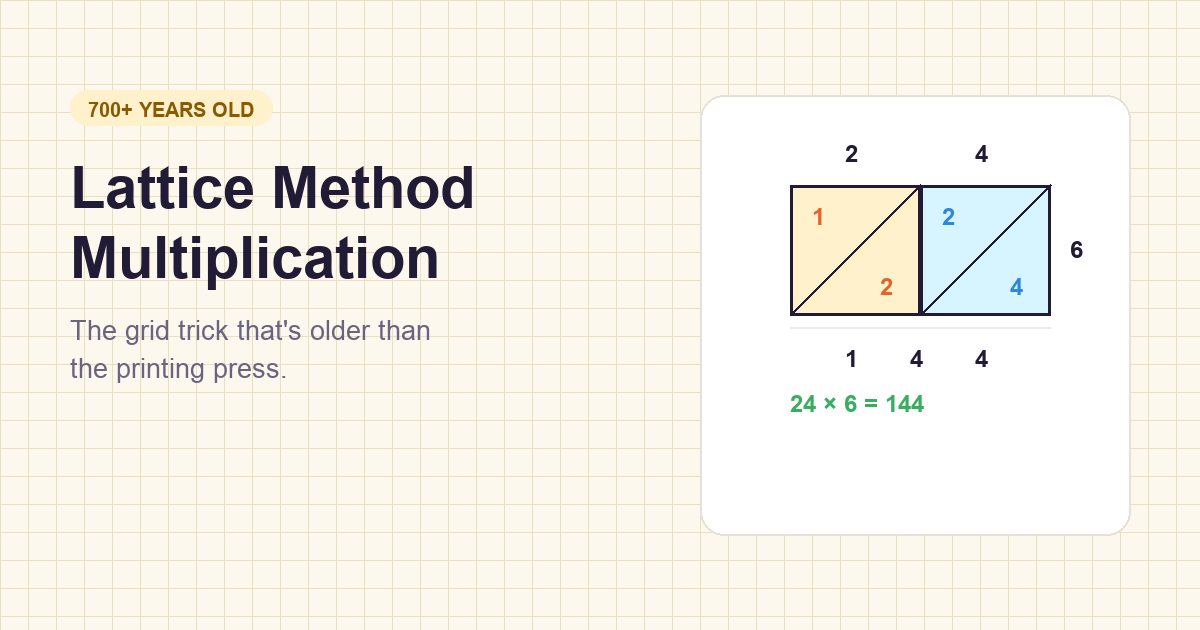
Each digit gets its own box. Multiply, split each answer into tens and ones, then add the numbers along the diagonal lines. Just like that, the answer appears:
1. 16 × 5 = ?
2. 34 × 6 = ?
3. 47 × 8 = ?
Why do kids like it? The work is organized, visual, and easy to follow. No juggling a bunch of numbers in your head or wondering where that carried digit went!
And despite looking like a modern math hack, the lattice method has been used for hundreds of years. It’s an old-school strategy with a surprisingly fresh feel.
So, grab a pencil and let’s turn multiplication into a math puzzle instead of a headache!
School math + test prep + skills AI can't match, at $0 cost.
Everything your child needs from Grade K to 12, curriculum mastery, test prep, and enrichment math, is now in one free app.

Simple log in with email, nothing else
- What Is the Lattice Method of Multiplication?
- Wait — Is This New "Common Core" Math?
- How to Use the Lattice Method: Step-by-Step
- Common Lattice Method Mistakes (Spot the Mistake)
- Lattice Method vs. Standard Algorithm vs. Box Method
- Do Teachers Still Use the Lattice Method?
- What a Cuemath Tutor Checks
- What Parents Say
- Are You a Lattice Method Master? (Quiz)
- FAQs
What Is the Lattice Method of Multiplication?
The lattice method is a visual way to multiply numbers using a grid, diagonal lines, and simple multiplication facts. Instead of carrying digits as you go, each calculation gets its own space, and the final answer is found by adding the numbers along the diagonals.
Why Does It Work?
- Breaks big problems into small steps: Each digit pair gets its own box.
- Keeps numbers organized: Tens and ones have their own spaces.
- Uses diagonal addition: Add along the diagonal lines to build the final answer.
- Less mental juggling: Kids don't have to remember as many numbers while working.
- Same math, different layout: It gives the same answer as traditional multiplication, just in a more visual format.
- Easy to check: The grid makes it easier to spot where a mistake happened.
Quick example:
For 23 × 14, the lattice method breaks the problem into smaller digit-by-digit multiplications and then combines them through diagonal addition.
52 x 8 = 416
Think of it as multiplication with a map; every number has a place, and every step has a path to follow!
A few more examples of the exact same pattern — different numbers, same grid, same diagonals:
Wait — Is This New "Common Core" Math?
No — and here's the receipts.
| Evidence | Who | Where | When |
|---|---|---|---|
| Exhibit A | Ibn al-Banna' al-Marrakushi | Maghreb (Morocco, Algeria, Tunisia) | Late 1200s |
| Exhibit B | Anonymous scribe | England | c. 1300 |
| Exhibit C | Wu Jing | China | 1450 |
| Later | Italian mathematicians | Italy | Names it "gelosia" |
Case closed: whoever built the Common Core standards in 2010 didn't invent this method. They picked an old tool back up and put it on a modern worksheet.
Watch a Free Concept Video on the Lattice Method
Watch Free Concept VideosHow to Use the Lattice Method: Step-by-Step
Draw a grid with one column per digit of the first number and one row per digit of the second number, split every box diagonally, multiply digit by digit, then add along the diagonals from right to left. Here's what that looks like, one level at a time.
Level 1: A 2-Digit by 1-Digit Problem (24 × 6)
- Set up the grid. Draw 2 columns (for 2 and 4) and 1 row (for 6). Write 2 and 4 across the top, 6 down the right side.
- Draw a diagonal through each box, from the top-right corner to the bottom-left corner.
- Fill in the boxes. Left box: 2 × 6 = 12 → 1 above, 2 below. Right box: 4 × 6 = 24 → 2 above, 4 below.
- Add along the diagonals, right to left: 4, then 2+2=4, then 1.
Fill in each box yourself, then reveal your score.
| 2 | 4 | ||
| 6 |
|
|
Final answer:
Round 1 of 2 — Solve: 32 × 7
Final answer:
Level 2: A 2-Digit by 2-Digit Problem (34 × 12)
- Set up the grid. 2 columns (3, 4) and 2 rows (1, 2).
- Fill in the 4 boxes: 3×1=03, 4×1=04, 3×2=06, 4×2=08.
- Add along the diagonals, bottom-right to top-left: 8, then 0+4+6=10 (write 0, carry 1), then 0+3+0+1=4, then 0.
Fill in each box yourself, then reveal your score.
| 3 | 4 | ||
| 1 |
|
|
|
| 2 |
|
|
Final answer:
Boss Level: 3-Digit by 2-Digit (214 × 32)
This one's bigger — 6 boxes, 5 diagonals. Fill in every box yourself before you reveal your score.
| 2 | 1 | 4 | ||
| 3 |
|
|
|
|
| 2 |
|
|
|
Final answer:
More to Try
Fill in every box yourself, then reveal your score. These get bigger as you go.
1. 52 × 3 = ? (2-digit × 1-digit)
2. 61 × 4 = ? (2-digit × 1-digit)
3. 38 × 14 = ? (2-digit × 2-digit)
4. 415 × 3 = ? (3-digit × 1-digit)
Common Lattice Method Mistakes—Spot the Mistake
Instead of just listing what goes wrong, look at these and see if you can catch the error yourself.
Round 1 of 3 — A student is solving 214 × 3:
(that's the whole grid the student drew)
The cheat sheet version, if you'd rather skim it:
- Wrong grid size — count digits before drawing a single line.
- Missing tens digit — every box needs two digits, even if the product is under 10 (write "04," not "4").
- Adding straight across instead of along the diagonal — trace the actual diagonal with a finger first.
- Forgetting to carry between diagonals — circle any diagonal sum over 9 before moving to the next one.
Lattice Method vs. Standard Algorithm vs. Box Method
All three get the same answer. They just organize the work differently.
× 6
144
| 20 | 4 | |
| 6 | 120 | 24 |
| Method | Best For | Not For |
|---|---|---|
| Lattice Method | Kids who lose track of "carrying" in their head; visual learners who like every step in its own box | Fast written practice; kids who find grids cluttered |
| Standard Algorithm | Speed once carrying makes sense; timed tests | A child who doesn't yet understand why carrying works |
| Box (Area) Method | Seeing place value as a grid; a bridge into the distributive property | Very large numbers, where the grid gets unwieldy |
For most 4th and 5th graders, the lattice method works best as a bridge — used while carrying still feels shaky, dropped once the standard algorithm clicks.
Do Teachers Still Use the Lattice Method?
Yes — some teachers still teach it, usually as one option among several strategies in 3rd and 4th grade, not as a full replacement for the standard algorithm.
Why it earns a spot in the lesson plan:
- Separates multiplication from addition completely
- Removes "carrying" as its own confusing rule
- Gives every digit its own clearly marked spot
Why it doesn't stick around forever:
- Slower than the standard algorithm once carrying makes sense
- A messy diagonal or wrong grid size causes errors that have nothing to do with the actual math
- Doesn't scale well to fast mental math
What a Cuemath Tutor Checks
A Cuemath tutor doesn't just check whether the final answer is right. They ask questions like "How many columns does this grid need?" or "Which diagonal does this digit belong to?" — catching setup mistakes before they become wrong answers. That "cue, don't tell" approach runs through every Cuemath 1:1 session, part of the MathFit framework's focus on real understanding over correct-answer guessing.
What Parents Say
Once a child stops fighting the grid and starts using it to double-check their own carrying, parents notice the shift fast — from dreading multiplication homework to walking through it alone.
Are You a Lattice Method Master?
1. Which diagonal do you add first?
2. In a 3-digit by 2-digit lattice grid, how many diagonals are there?
3. A box's product is 7. What do you write in the box?
4. True or False: the lattice method gives a different final answer than the standard algorithm.
5. Solve using any method: 21 × 4 = ?
🚚 Load the truck, solve the cargo math — no download needed.
Lattice Method Practice Worksheet
Ten lattice-method-only problems — no other method, just the grid. Fill in every box, then reveal your score.
1. 17 × 6 = ? (2-digit × 1-digit)
2. 84 × 5 = ? (2-digit × 1-digit)
3. 29 × 31 = ? (2-digit × 2-digit)
4. 56 × 23 = ? (2-digit × 2-digit)
5. 39 × 7 = ? (2-digit × 1-digit)
6. 58 × 4 = ? (2-digit × 1-digit)
7. 63 × 24 = ? (2-digit × 2-digit)
8. 72 × 35 = ? (2-digit × 2-digit)
9. 217 × 4 = ? (3-digit × 1-digit)
10. 46 × 53 = ? (2-digit × 2-digit)
One App for Every Multiplication Method Your Kid Will Ever Meet
Worksheets, concept videos, games, and 1:1 tutor support who can explain lattice, box, or standard — whichever one your child's teacher is using this month.
Explore It Now, It's Free100% Free • No Credit Card Needed • Takes About 15 Minutes to Start
Frequently Asked Questions
Do schools still teach the lattice method of multiplication?
Yes, many schools still teach the lattice method of multiplication, usually in 3rd or 4th grade, as one of several strategies before moving to the standard algorithm. Most classrooms use it as a temporary bridge while students are still shaky on carrying, then move on.
What are the disadvantages of using the lattice method?
The main disadvantages of the lattice method are that it's slower than the standard algorithm once a child understands carrying, and it depends on drawing a neat, correctly sized grid — a messy diagonal or wrong grid size causes errors unrelated to the actual math. It also doesn't scale well to fast mental math.
What are the four methods of multiplication?
The four methods of multiplication most US classrooms teach are the standard algorithm (stack and carry), partial products, the box (area) method, and the lattice method. All four produce the same answer; they differ only in how the steps are organized on paper.
How do you use the lattice method of multiplication in 4th grade math?
In 4th grade, the lattice method of multiplication is used mostly for 2-digit by 1-digit and 2-digit by 2-digit problems: draw a grid matching each number's digit count, split every box diagonally, multiply digit by digit, then add along the diagonals from right to left.
When was the lattice method of multiplication invented?
The lattice method of multiplication dates back to at least the late 1200s, when Arab mathematician Ibn al-Banna' al-Marrakushi described it in the Maghreb. It also appears in an English manuscript from around 1300 and in Chinese mathematician Wu Jing's work from 1450.
What are the advantages of the lattice method?
The main advantages of the lattice method are that it separates multiplication from addition into two completely separate steps, removes "carrying" as its own confusing rule, and gives every digit a clearly marked spot in the grid.
Why is the lattice method also called the gelosia method?
The lattice method is also called the gelosia method because "gelosia" is the Italian word for a window lattice or grating, and the finished grid — with its crossed diagonal lines — looks like one. The Arabic term for the same method, "shabakh," means the same thing.
Is the lattice method the same as the box method?
The lattice method is not the same as the box method, though both use a grid. The box method keeps each digit's product in its own untouched box and adds the boxes at the end; the lattice method splits every box diagonally and adds digit-by-digit along the diagonals, closer to how the standard algorithm actually carries.

I was never the kid who loved math. I was much more interested in books, stories, and writing, and, somewhere along the way, I became even more curious about people. Why do we learn differently? Why does something make sense to one child but not another? And what makes a student feel confident enough to keep trying?
That curiosity led me to study Applied Psychology, where I learned more about how children think, learn, and make sense of the world around them.
My love for writing did the rest. What started as something I simply enjoyed became a career. Over the past five years, I've worked as a freelance writer across edtech, SaaS, B2B, travel, lifestyle, and healthcare, learning how to write for very different audiences without losing the human side of the story.
Today, I'm an SEO Content Writer & Editor at Cuemath, where I get to bring many of these interests together. Working in education, and especially around math, has made me even more curious about what happens behind the screen or textbook: what parents worry about, what students struggle with, and what actually helps them learn.
That's also how I like to research. I don't just look at search results and call it a day. I go where parents and students actually talk: forums, reviews, communities, and conversations with real families. Because sometimes the most useful insight isn't hiding in a keyword; it's in a parent's question, a student's frustration, or a small detail someone shares about their learning experience.
I write because I'm curious. I research because I want to understand. And I love turning what I learn into content that feels genuinely useful to the people reading it.